
ZeroDowntime SQL Database Schema Evolution for Continuous Deployment
Zero-Downtime SQL Database Schema Evolution for Continuous Deployment 2017 IEEE/ACM 39 th International Conference on Software Engineering: Software Engineering 1 Michael de Jong, Arie van Deursen, Anthony Cleve
2 Author Michael de Jong TOPdesk Nederland Software engineer Delft University of Technology Magnet. me
3 INTRODUCTION Continuous deployment is an increasingly popular technique to roll out new features as fast as possible Rapid feedback Rapid bug fixing increased business value thanks to the earlier availability of functionality web services and applications with 24/7 uptime demands using load balancers and rolling upgrades rolling out features over servers without loss of availability
4 INTRODUCTION structural changes to the application’s database Zero-downtime deployments are substantially harder Any applications or web service attempting to query a table under change will either block, appear unresponsive, or even fail To accept downtime, and conduct the deployment in a low traffic time window To adopt the Expand-Contract pattern, and conduct a series of deployments, and later reduce it again With multiple database schemas(Mixed-State)……….
5 INTRODUCTION Neither of these solutions is in the spirit of continuous deployment Extra downtime Significantly more effort An approach to support fully automatic schema evolution with zero-downtime Provide Mixed-State for every schema changeset, by carefully maintaining a set of synchronized “ghost tables” Resilient against crash, safeguards referential integrity Entirely transparent to software engineer
6 INTRODUCTION Quantum. DB a tool-supported approach that abstracts this evolution process away from the web service without locking tables Evaluate by means of 19 synthetic schema changes, as well as to a set of around 95 schema changes Handle real life change scenarios without downtime for medium-sized database
7 BACKGROUND In Continuous Deployment The service must be available at all time Clients using the service must be atomically switched from the old to the new version A Client should not be able anymore to interact with the old version of the web service, unless an explicit rollback has been performed The atomic switch is typically conducted using load balancers, redirecting incoming requests to a specific server Two important approach for redeploying a web service without downtime using a load balancer
8 BACKGROUND The Rolling Upgrade method 1. Instruct the load balancer that the server is unavailable. No new requests will be sent to it. 2. Stop the web service instance running on that server. 3. Upgrade the web service instance to the new version. 4. Start the new version of the web service instance. 5. Instruct the load balancer that the instance is once again available and may receive user requests again. The full system will be in a Mixed-State, in which both the old and the new version of the web service are processing user requests at the same time
9 BACKGROUND The Big-Flip method 1. Update the web service instances in the idle pool. 2. Start the web service instances in idle pool. 3. Instruct the load balancer to switch the roles of the two server pools. The idle pool becomes the active pool and starts handling new client requests, while the active pool becomes the inactive pool and stops handling requests. a short period of time where the system is put in a Mixed-State both versions are running side-by-side From the moment when the initial idle pool starts up new versions of the web service until the moment when the initially active pool shuts down the older web service instances
10 BACKGROUND Blue-Green Deployment the Big-Flip approach applied to the database server and schema where the application switches from using one database server to another Expand-Contract the database schema is modified through incremental steps using non-blocking DDL statements, while maintaining compatibility with both older and newer versions of the web service in order to support a Mixed-State
11 PROBLEM STATEMENT 1. Some schema change operations (DDL statements) are blocking in nature a DDL statement may block other queries from being executed through the use of a table lock a DDL statement may prevent the web service from accessing and manipulating the data stored in the table under change 2. The concept of the Mixed-state When deploying a new version of a web service, two different versions of the same web service may have to be active at the same time imitations on how much you can change and which deployment methods can be used 3. Preserving foreign key constraints during schema evolution Existing approaches and tools either have no support, or insufficient support for these constraints
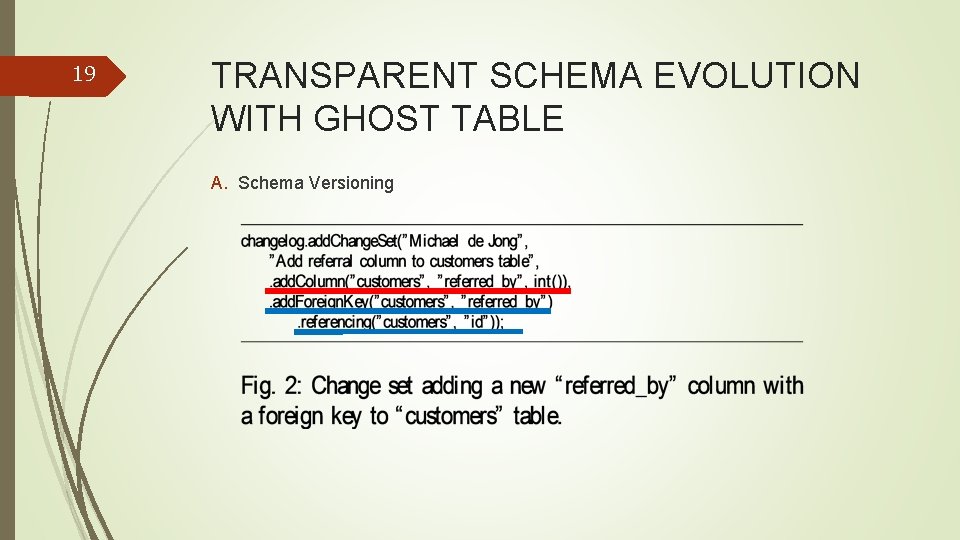
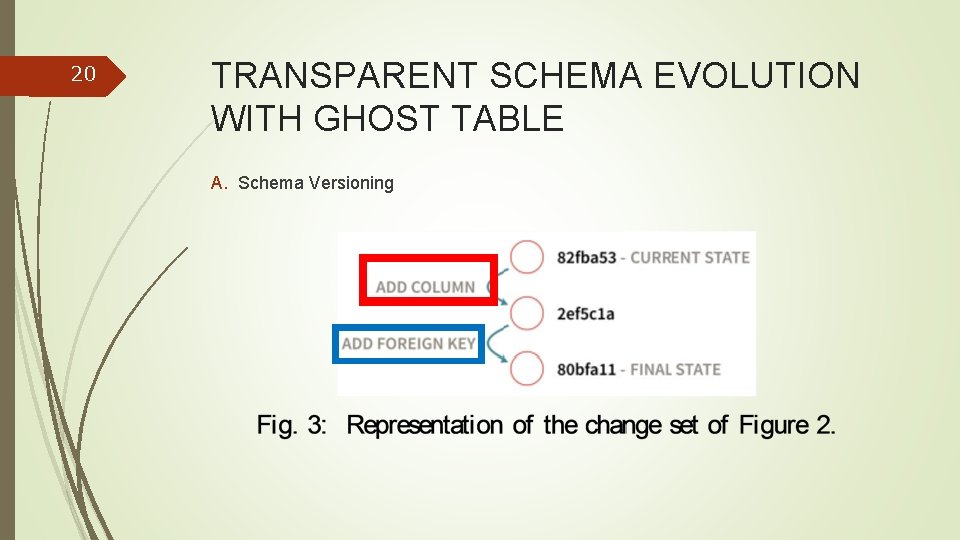
12 PROBLEM STATEMENT R 1: Non-Blocking Schema Changes Changing the schema should not block queries issued by any database client R 2: Scema Changesets to make several non-trivial changes to the database schema in one go R 3: Concurrently Active Schemas Multiple database schemas should be able to be “active” at the same time R 4: Referential Integrity both the migration and evolution of foreign key constraints during both normal use and while evolving the database schema
13 PROBLEM STATEMENT R 5: Schema Isolation Any changes made to the database schema should be isolated from the database client R 6: Non-Invasiveness Any integration with the application should require as little change to the source code as possible R 7: Resilience the data stored in the database always remains in a consistent state
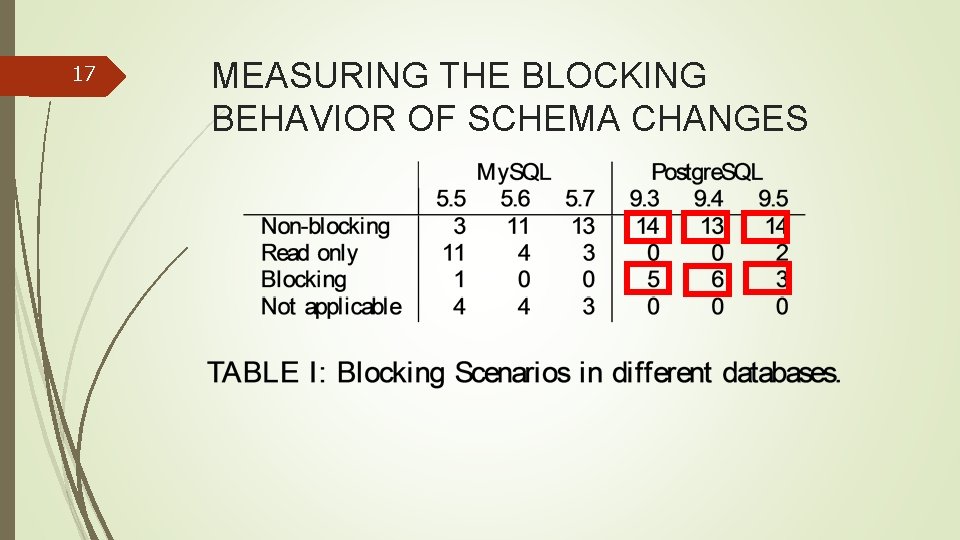
14 MEASURING THE BLOCKING BEHAVIOR OF SCHEMA CHANGES R 1: Non-Blocking Schema Changes The empirical analysis of the blocking behavior of DDL schema evolution operators A. Experimental Setup 1. Prepare a ”users” table with 50 million random records 2. Simulate an application operating on the database by spawning a number of threads each performing INSERT, SELECT, UPDATE, and DELETE 3. Perform one of the DDL statements, and log when it started and finished 4. Restore the database to its original database schema
15 MEASURING THE BLOCKING BEHAVIOR OF SCHEMA CHANGES The schema evolution process is slowed down By having a sizeable dataset in the table under change By stressing the database by continuously querying the table using multiple threads visualize if altering the table blocks the queries issued By recording the start time and end time of each query By graphing this to determine which DDL statements are blocking, and if so for how long, and which type of DML queries they block
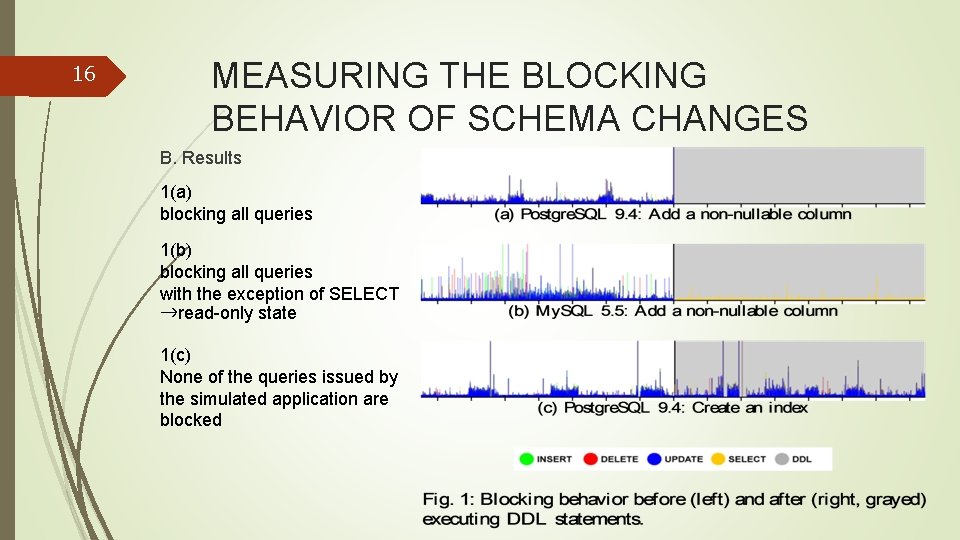
16 MEASURING THE BLOCKING BEHAVIOR OF SCHEMA CHANGES B. Results 1(a) blocking all queries 1(b) blocking all queries with the exception of SELECT →read-only state 1(c) None of the queries issued by the simulated application are blocked
17 MEASURING THE BLOCKING BEHAVIOR OF SCHEMA CHANGES
18 TRANSPARENT SCHEMA EVOLUTION WITH GHOST TABLE Quantum. DB evolve a database schema without downtime meet all requirements R 1 -R 7 provide developers with non-blocking schema changes provide Mixed-State in a way that is transparent to the developer permit the adopting of Rolling Upgrades entail creating ghost tables
19 TRANSPARENT SCHEMA EVOLUTION WITH GHOST TABLE A. Schema Versioning
20 TRANSPARENT SCHEMA EVOLUTION WITH GHOST TABLE A. Schema Versioning
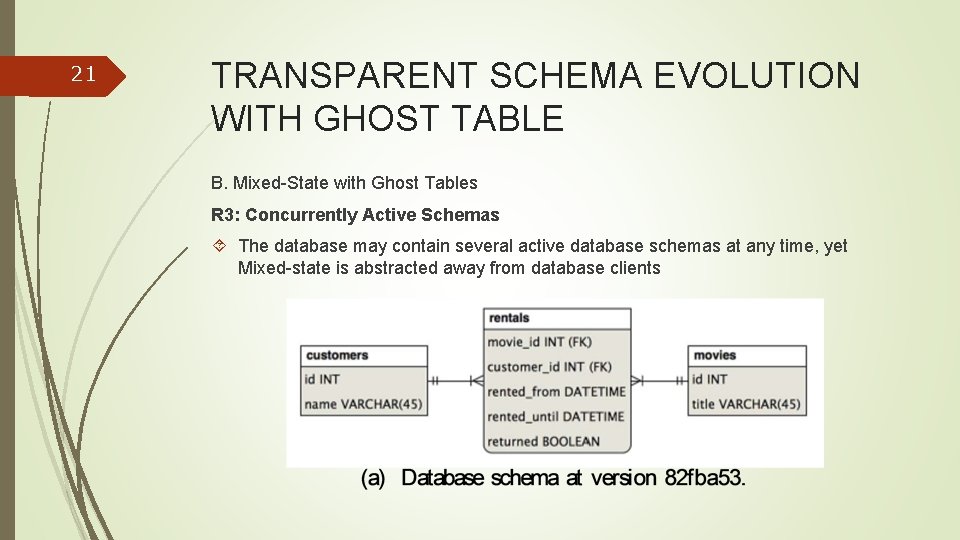
21 TRANSPARENT SCHEMA EVOLUTION WITH GHOST TABLE B. Mixed-State with Ghost Tables R 3: Concurrently Active Schemas The database may contain several active database schemas at any time, yet Mixed-state is abstracted away from database clients
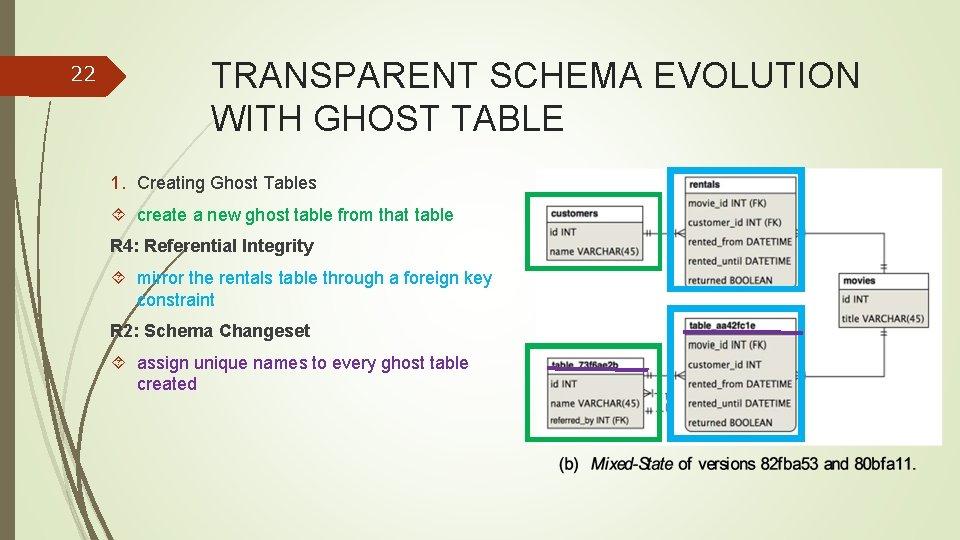
22 TRANSPARENT SCHEMA EVOLUTION WITH GHOST TABLE 1. Creating Ghost Tables create a new ghost table from that table R 4: Referential Integrity mirror the rentals table through a foreign key constraint R 2: Schema Changeset assign unique names to every ghost table created
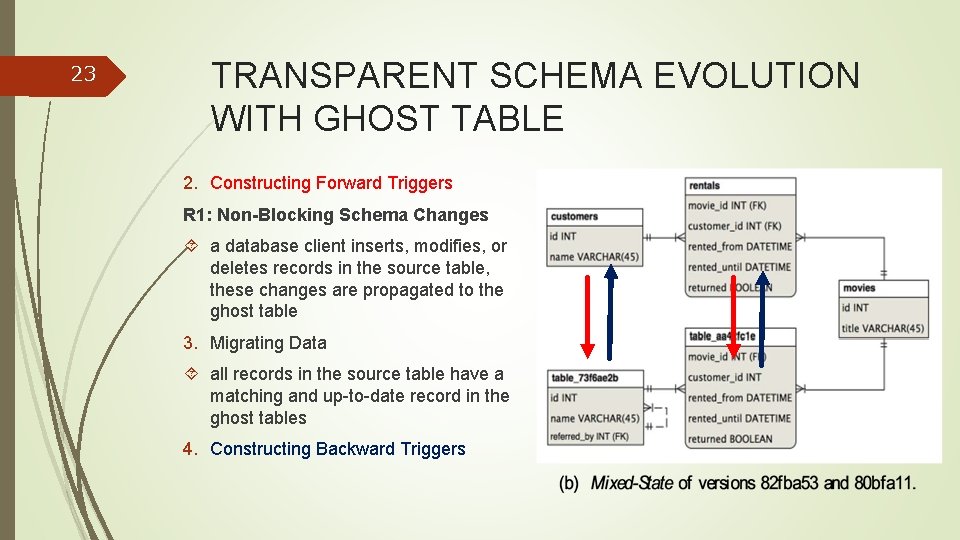
23 TRANSPARENT SCHEMA EVOLUTION WITH GHOST TABLE 2. Constructing Forward Triggers R 1: Non-Blocking Schema Changes a database client inserts, modifies, or deletes records in the source table, these changes are propagated to the ghost table 3. Migrating Data all records in the source table have a matching and up-to-date record in the ghost tables 4. Constructing Backward Triggers
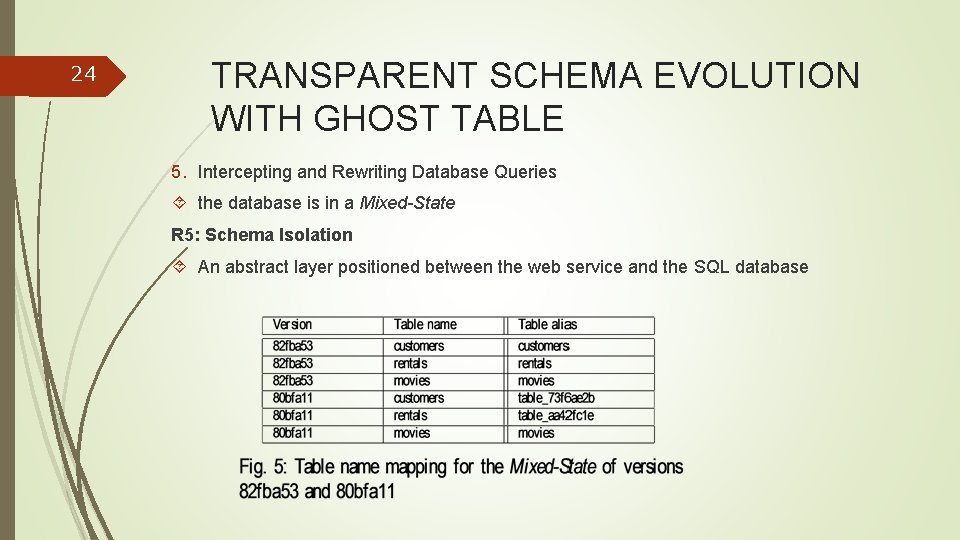
24 TRANSPARENT SCHEMA EVOLUTION WITH GHOST TABLE 5. Intercepting and Rewriting Database Queries the database is in a Mixed-State R 5: Schema Isolation An abstract layer positioned between the web service and the SQL database
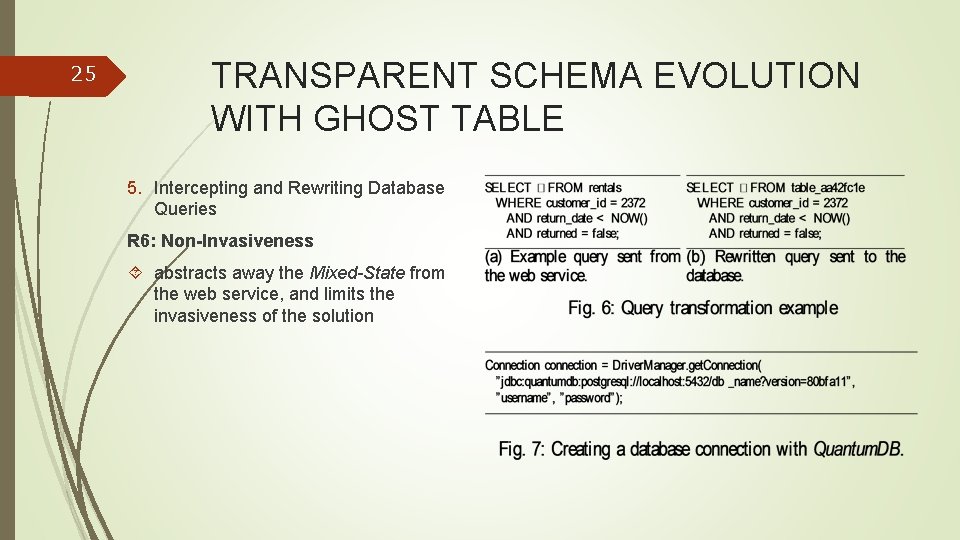
25 TRANSPARENT SCHEMA EVOLUTION WITH GHOST TABLE 5. Intercepting and Rewriting Database Queries R 6: Non-Invasiveness abstracts away the Mixed-State from the web service, and limits the invasiveness of the solution
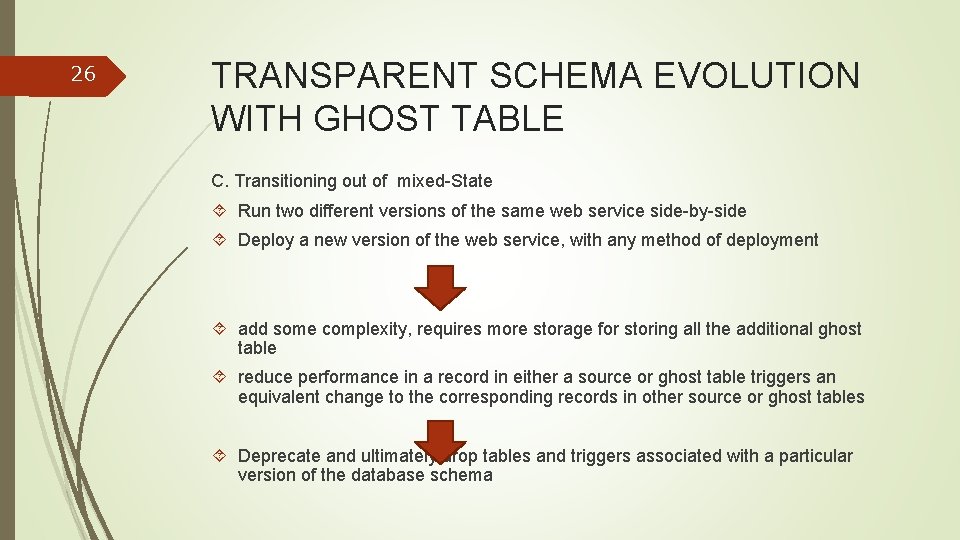
26 TRANSPARENT SCHEMA EVOLUTION WITH GHOST TABLE C. Transitioning out of mixed-State Run two different versions of the same web service side-by-side Deploy a new version of the web service, with any method of deployment add some complexity, requires more storage for storing all the additional ghost table reduce performance in a record in either a source or ghost table triggers an equivalent change to the corresponding records in other source or ghost tables Deprecate and ultimately drop tables and triggers associated with a particular version of the database schema
27 TRANSPARENT SCHEMA EVOLUTION WITH GHOST TABLE C. Transitioning out of mixed-State 1. Tracking Connected Clients need to know which versions of the database schema are still being used determine which connection operates on which specific version of the schema a certain version v of the database schema check whethere active connections to the SQL database still using v or not If this is not the case we can safely assume that it is no longer in use
28 TRANSPARENT SCHEMA EVOLUTION WITH GHOST TABLE C. Transitioning out of mixed-State 2. Dropping a Database Schema first drop all the database triggers which copy records to and from these tables, safely drop the two tables. From that point onwards the database is no longer in a Mixed-State 3. Fault Tolerance R 7: Resilience drop newly created ghost tables, foreign keys, and database triggers when a fault occurs provide the ability to rollback the changes when needed

29 TRANSPARENT SCHEMA EVOLUTION WITH GHOST TABLE D. Implementation: Quantum. DB Adding columns Altering columns Dropping columns Adding foreign keys Dropping foreign keys Adding indices Dropping indices Copying tables Dropping tables Renaming tables Adding tables
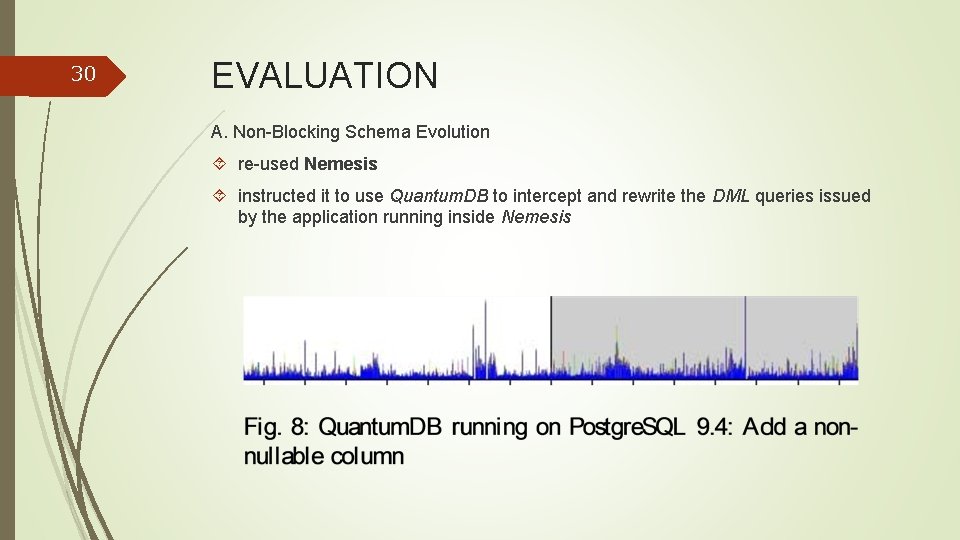
30 EVALUATION A. Non-Blocking Schema Evolution re-used Nemesis instructed it to use Quantum. DB to intercept and rewrite the DML queries issued by the application running inside Nemesis
31 EVALUATION B. Schema History from Industry Quantum. DB can handle real life changesets and databases Magnet. me rapidly growing online platform for connecting students with employers, jobs, and internships with presently over 60, 000 registered students Sept. 2014 –Aug. 2015 11 -month period Already using Liquibase recreating the change sets using the Quantum. DB API was easy to do
32 EVALUATION B. Schema History from Industry changelog for this period consists of 95 changesets, containing 532 schema operations in total The earliest historical backup starts with 77 tables, 499 columns, 111 foreign key constraints, 42 sequences, and 28 indices not related to identity columns contains over 3. 8 million records with the biggest table containing over 1. 4 million records 22 tables are created, 13 tables are dropped, 42 new foreign key constraints are introduced, and 37 foreign key constraints are dropped and recreated using different properties
33 EVALUATION C. Replaying Schema History After achieving Mixed-State with Quantum. DB the older database schema is discarded by dropping tables which only exist in that particular version of the database schema D. Relevance: Avoiding Blocking DDL schema changes are blocking in about one third of the Magnet. me changesets, but Quantum. DB E. Applicability be applied to two thirds of all changesets; Providing support for mixing DML statements in changesets would add 25% to that number F. Quantum. DB Performance on average, each changeset could be executed within 1. 7 minutes
34 DISCUSSION Rolling Upgrades The Magnet. me web service uses Liquibase to manage database schema changes By adopting Quantum. DB Magnet. me would no longer need an engineer to manually deploy database schema changes Continuous Deployment Quantum. DB now supports up to two concurrently active database schemas to use either the Rolling Upgrade or Big-Flip deployment method Scalability Quantum. DB with databases of 50 millions records in a single table, and upwards from 3. 8 million using backups from Magnet. me
35 DISCUSSION Data Loss Quantum. DB is designed in such a way that failures do not cause loss of data Implementation Limitations Quantum. DB does not support DML statements as part of the schema evolution process Foreign Keys Chains The duration of the “forking” process depends on the number of ghost tables External Validity Quantum. DB currently only supports Postgre. SQL Replication
36 CONCLUTION Identify and evaluate an approach which allows us to evolve the schema of a SQL Database in a Continuous Deployment Setting 1. identifying a set of requirements(R 1 -R 7) 2. Verifying blocking behavior through infrastructure(Nemesis) 3. Implementing a prototype(Quantum. DB) Quantum. DB To deploy multiple concurrently active schemas, migrate data and incurs zerodowntime Support changesets as used industry for medium-sized database Support for Mixed-State and foreign key constraints preservation
- Slides: 36