
Zero Waste Transfer Station Whitefield New Hampshire Department
- Slides: 1
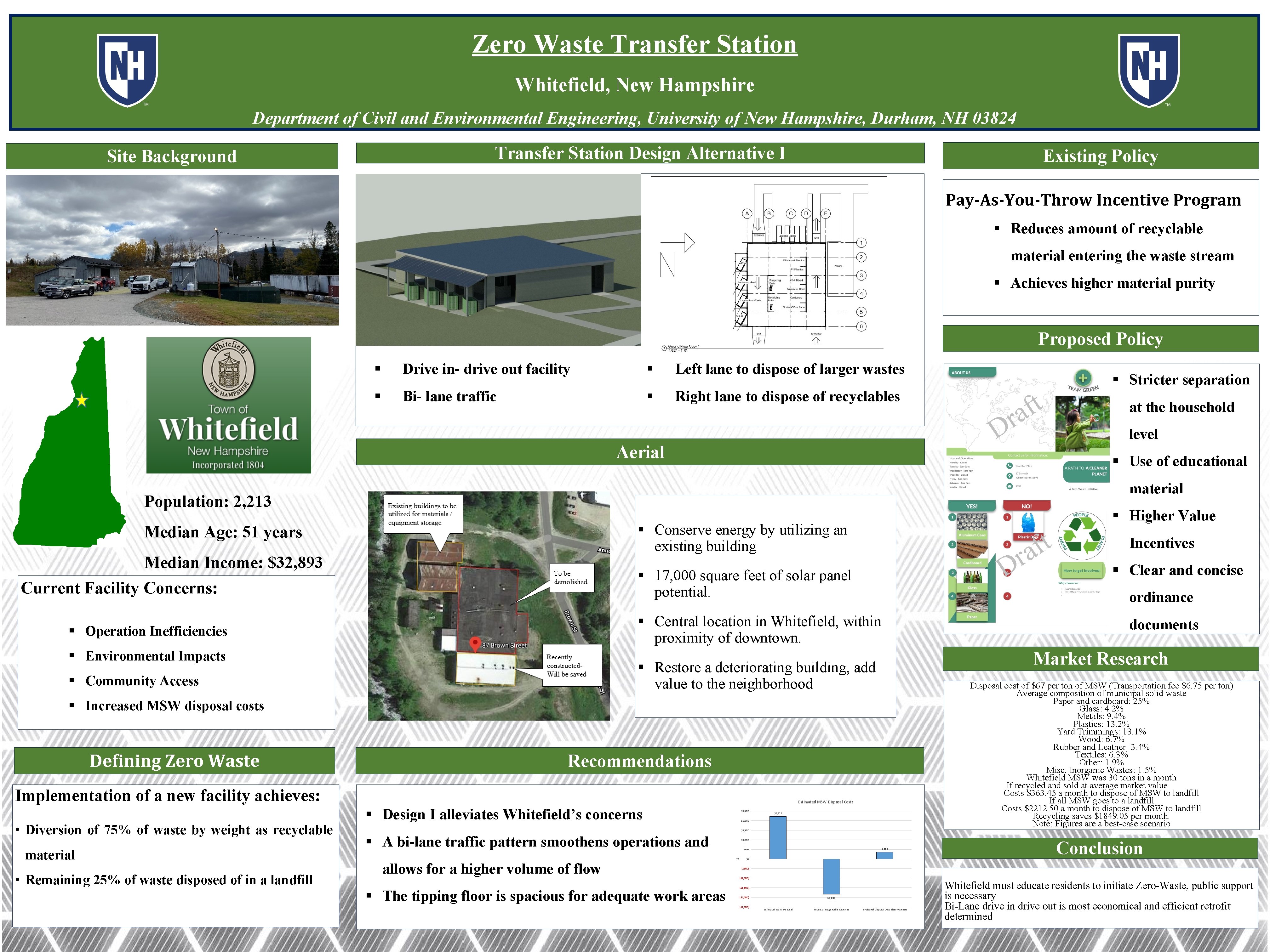
Zero Waste Transfer Station Whitefield, New Hampshire Department of Civil and Environmental Engineering, University of New Hampshire, Durham, NH 03824 Transfer Station Design Alternative I Site Background Existing Policy Pay-As-You-Throw Incentive Program § Reduces amount of recyclable material entering the waste stream § Achieves higher material purity Proposed Policy § Drive in- drive out facility § Left lane to dispose of larger wastes § Bi- lane traffic § Right lane to dispose of recyclables t f a r D Aerial § Higher Value § Conserve energy by utilizing an existing building Median Income: $32, 893 Current Facility Concerns: t f a r D § 17, 000 square feet of solar panel potential. § Environmental Impacts Market Research Disposal cost of $67 per ton of MSW (Transportation fee $6. 75 per ton) Average composition of municipal solid waste Paper and cardboard: 25% Glass: 4. 2% Metals: 9. 4% Plastics: 13. 2% Yard Trimmings: 13. 1% Wood: 6. 7% Rubber and Leather: 3. 4% Textiles: 6. 3% Other: 1. 9% Misc. Inorganic Wastes: 1. 5% Whitefield MSW was 30 tons in a month If recycled and sold at average market value Costs $363. 45 a month to dispose of MSW to landfill If all MSW goes to a landfill Costs $2212. 50 a month to dispose of MSW to landfill Recycling saves $1849. 05 per month. Note: Figures are a best-case scenario § Increased MSW disposal costs Recommendations Implementation of a new facility achieves: • Remaining 25% of waste disposed of in a landfill Estimated MSW Disposal Costs § Design I alleviates Whitefield’s concerns $2, 500 § Clear and concise documents § Restore a deteriorating building, add value to the neighborhood § Community Access Incentives ordinance § Central location in Whitefield, within proximity of downtown. § Operation Inefficiencies $2, 212 $2, 000 $1, 500 § A bi-lane traffic pattern smoothens operations and $1, 000 allows for a higher volume of flow § The tipping floor is spacious for adequate work areas $363 $500 $ material level material Median Age: 51 years • Diversion of 75% of waste by weight as recyclable at the household § Use of educational Population: 2, 213 Defining Zero Waste § Stricter separation $0 Conclusion ($500) ($1, 000) ($1, 500) ($2, 000) ($2, 500) ($1, 849) Estimated MSW Disposal Potential Recycleable Revenue Projected Disposal Cost after Revenue Whitefield must educate residents to initiate Zero-Waste, public support is necessary Bi-Lane drive in drive out is most economical and efficient retrofit determined