
ZERO TRUST AND SOFTWARE DEFINED PERIMETER A NEW
- Slides: 9
ZERO TRUST AND SOFTWARE DEFINED PERIMETER A NEW SECURITY PARADIGM
Overview What is Zero Trust? History CONTENTS Zero Trust Architecture What is Software Defined Perimeter? SDP Architecture ZT/SDP Benefits Summary of Models
From Forrester; WHAT IS ZERO TRUST? All resources are securely accessed no matter who creates the traffic or from where it originates, regardless of location or hosting model, cloud, on-premises or collocated resources. Adopting a least privilege strategy (LPS) that enforces access control to eliminate the human temptation to access restricted resources. Continuously logging and analyzing user traffic inspection for signs of suspicious activity
The concept of zero trust has been present in cybersecurity since before the term “zero trust” was coined. The Defense Information Systems Agency (DISA) and the Department of Defense developed a more secure enterprise strategy dubbed “black core” (BCORE). Moving from a perimeter-based security model to one that focused on the security of individual transactions. HISTORY The work of the Jericho Forum in 2004 publicized the idea of deperimeterization—limiting implicit trust based on network location and the limitations of relying on single, static defenses over a large network segment. The concepts of deperimeterization evolved and improved into the larger concept of ZT, which was later coined by John Kindervag while at Forrester. ZT then became the term used to describe various cybersecurity solutions that moved security away from implied trust based on network location and instead focused on evaluating trust on a per-transaction basis. Both private industry and higher education have also undergone this evolution from perimeter-based security to a security strategy based on ZT principles.
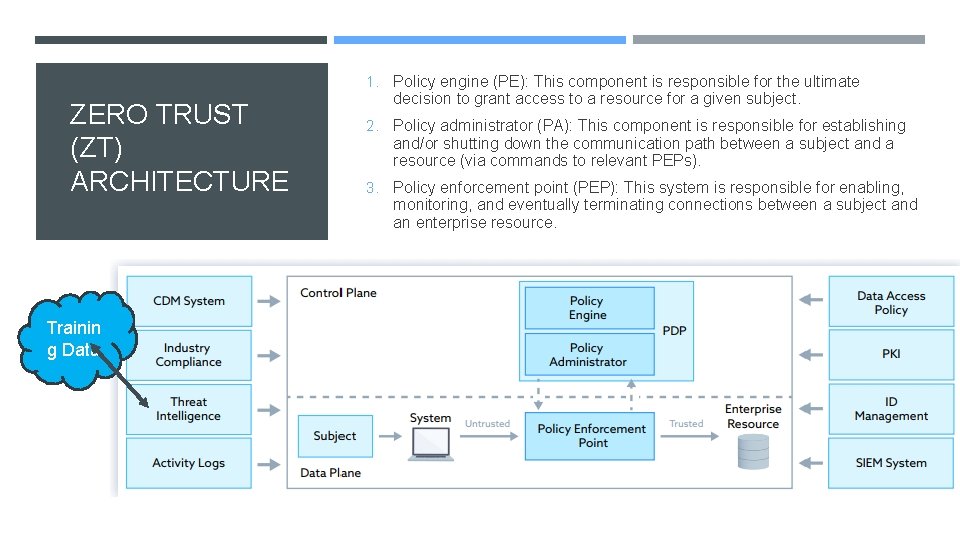
1. Policy engine (PE): This component is responsible for the ultimate ZERO TRUST (ZT) ARCHITECTURE Trainin g Data decision to grant access to a resource for a given subject. 2. Policy administrator (PA): This component is responsible for establishing and/or shutting down the communication path between a subject and a resource (via commands to relevant PEPs). 3. Policy enforcement point (PEP): This system is responsible for enabling, monitoring, and eventually terminating connections between a subject and an enterprise resource.
WHAT IS SDP? A new security paradigm to address new threat vectors Control plane where trust is established separated from the data plane where actual data is transferred. Hiding the infrastructure (e. g. blackening the servers) using a dynamic deny-all firewall (not deny-all, allow exceptions) the point where all unauthorized packets are dropped for logging and analyzing traffic. Usingle packet authorization (SPA) to authenticate and authorize users and validate devices for access to protected services - least privilege is implicit in this protocol.
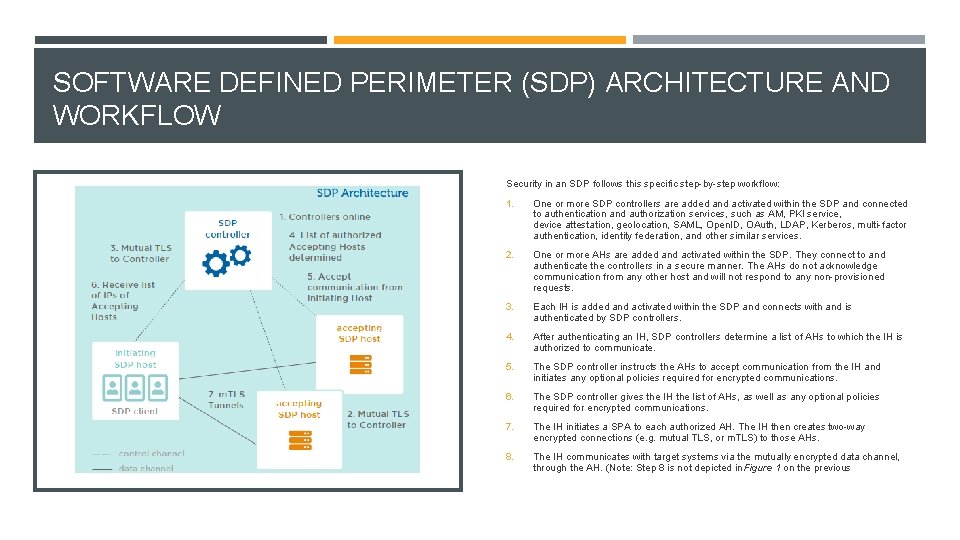
SOFTWARE DEFINED PERIMETER (SDP) ARCHITECTURE AND WORKFLOW Security in an SDP follows this specific step-by-step workflow: 1. One or more SDP controllers are added and activated within the SDP and connected to authentication and authorization services, such as AM, PKI service, device attestation, geolocation, SAML, Open. ID, OAuth, LDAP, Kerberos, multi-factor authentication, identity federation, and other similar services. 2. One or more AHs are added and activated within the SDP. They connect to and authenticate the controllers in a secure manner. The AHs do not acknowledge communication from any other host and will not respond to any non-provisioned requests. 3. Each IH is added and activated within the SDP and connects with and is authenticated by SDP controllers. 4. After authenticating an IH, SDP controllers determine a list of AHs to which the IH is authorized to communicate. 5. The SDP controller instructs the AHs to accept communication from the IH and initiates any optional policies required for encrypted communications. 6. The SDP controller gives the IH the list of AHs, as well as any optional policies required for encrypted communications. 7. The IH initiates a SPA to each authorized AH. The IH then creates two-way encrypted connections (e. g. mutual TLS, or m. TLS) to those AHs. 8. The IH communicates with target systems via the mutually encrypted data channel, through the AH. (Note: Step 8 is not depicted in Figure 1 on the previous
BENEFITS OF SDP/ZT? Reduced attack surface Protects critical assets and infrastructure Hides/darkens assets to unauthorized access Reduced cost – endpoint, incident response Connection-based architecture rather than IP based which are weak Integrated security architecture Using Single Packet Authorization Requires pre-vetting of connections Authenticates BEFORE allowing access to resources Open specification
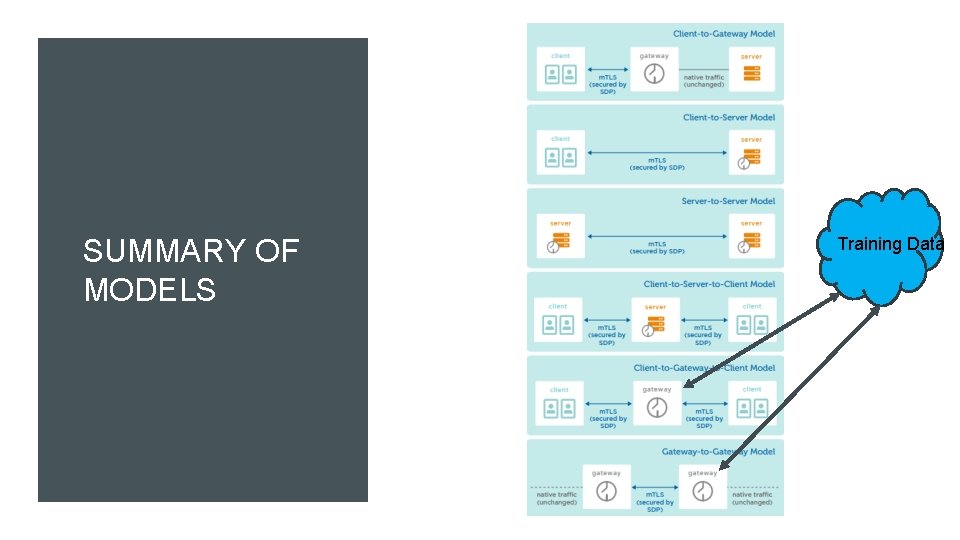
SUMMARY OF MODELS Training Data