
Zero Tilt Preliminary Design Review Frostburg State University

Zero Tilt Preliminary Design Review Frostburg State University Adam Rexroad, Brett Dugan, Mayowa Ogundipe, Kaetie Combs, Michael Stevenson, Daniel Gares, Tyler Lemmert, Subhasis Ghosh, Jared Hughes, Sean Hughes, Andrew Huntley, Derek Val-Addo October 26, 2011 1

Mission Overview 2
Mission Overview � Mission Statement: Zero Tilt’s goal is to provide, for the first time, a stable environment throughout the flight of a Sounding Rocket via two concurrent objectives: ◦ Tilt correction system ◦ Despun platform system 3
Mission Overview � We plan to: ◦ Counteract the platform spin ◦ Orient the platform parallel to the earth’s surface at all times ◦ Confirm the altitude reading using an accelerometer on our platform � We expect to prove that it is possible to correct spin, tilt, and determine the altitude based upon a level reference. � This could benefit any scientific experiment that requires stabilization in order to collect data. 4
Mission Overview: Theory and Concepts � The underlying theory and concepts: �negative feedback control systems �concepts of torque and centripetal force �Micro electromechanical systems (MEMS) �Electromagnetic field theory �Real-Time Systems Theory (for multi -tasking) 5
Past Research Drexel University’s 2011 project incorporating a despun platform. The Results have not been published but the CDR offered evidence of successful trial runs at large stress. We plan to elaborate on Drexel’s design. Modifying and improving the despun platform design in our project. 6
Mission Overview: Mission Requirements � Mission Objectives: �Counter the spin of the rocket during flight. �Keep a level surface to earth using our conceptual design. �Prove successful by comparing the acceleration data from our zero tilt platform with that from the plate. � Minimum success criteria �Our main goals as the Zero Tilt team is to receive results indicating that we achieved zero tilt and confirming the altitude. crestock. com 7
Mission Overview: Expected Results � What we expect: �Determine whether we were successful in keeping our platform level based on data analysis. (within a 10°tolerance) �Find altitude within a reasonable tolerance again based on the data we collect. 8
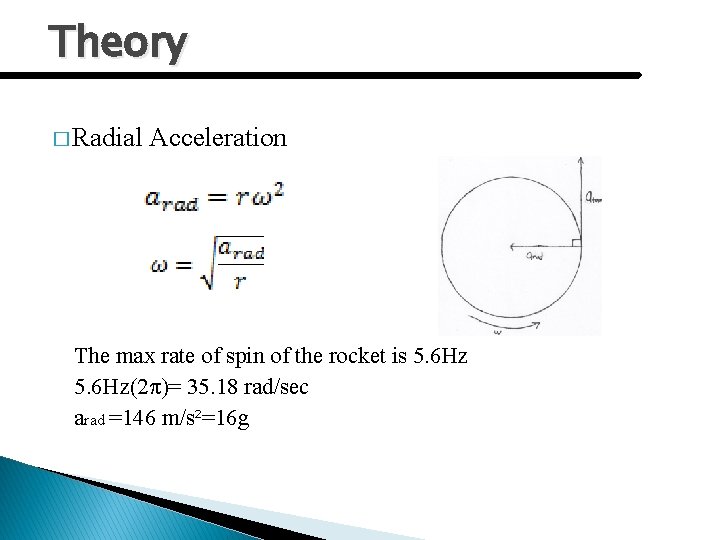
Theory � Radial Acceleration The max rate of spin of the rocket is 5. 6 Hz(2π)= 35. 18 rad/sec arad =146 m/s²=16 g
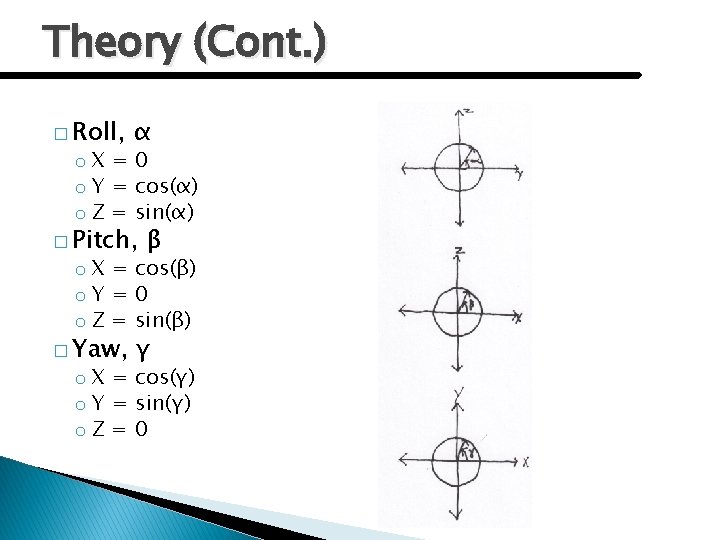
Theory (Cont. ) � Roll, α o. X = 0 o Y = cos(α) o Z = sin(α) � Pitch, β o X = cos(β) o. Y = 0 o Z = sin(β) � Yaw, γ o X = cos(γ) o Y = sin(γ) o. Z = 0
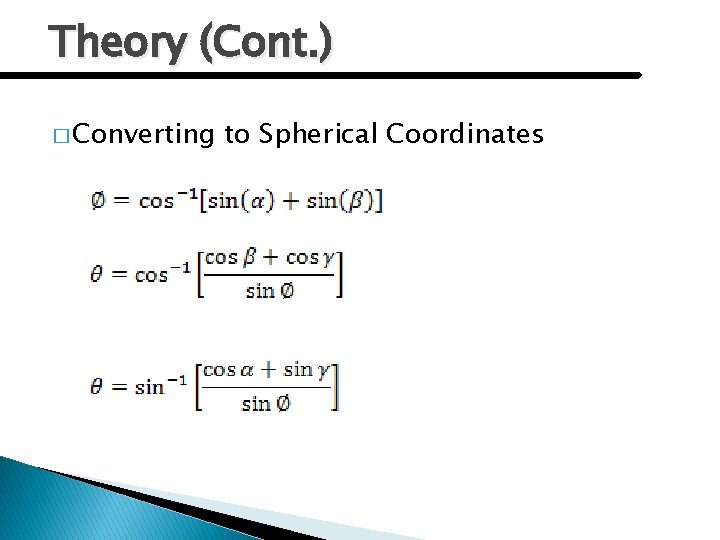
Theory (Cont. ) � Converting to Spherical Coordinates
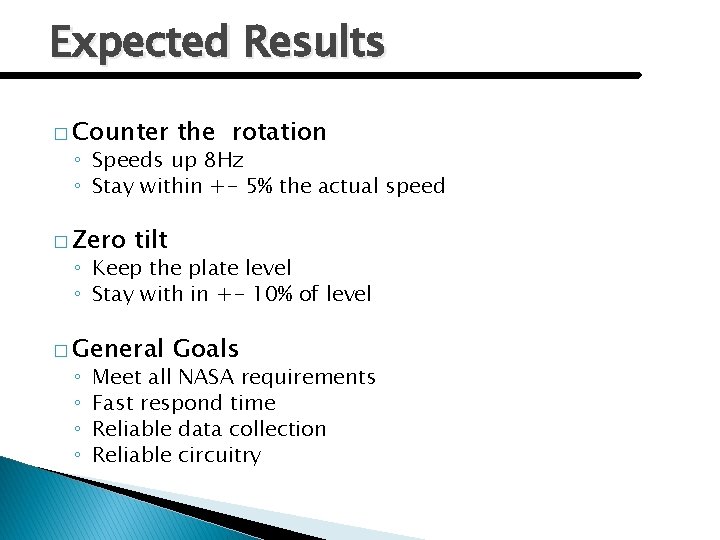
Expected Results � Counter the rotation ◦ Speeds up 8 Hz ◦ Stay within +- 5% the actual speed � Zero tilt ◦ Keep the plate level ◦ Stay with in +- 10% of level � General ◦ ◦ Goals Meet all NASA requirements Fast respond time Reliable data collection Reliable circuitry

Zero Tilt Con. Ops t ≈ 1. 7 min Altitude: 95 km t ≈ 1. 3 min Altitude: 75 km t ≈ 4. 0 min Apogee t ≈ 2. 8 min Altitude: ≈115 km -use the position of the zero tilt plate as initial value for the gyroscope sensor. -switch to gyro input for zero tilt system. Altitude: 95 km t ≈ 4. 5 min Altitude: 75 km t ≈ 5. 5 min Chute Deploys -G switch triggered -All systems on t = 0 min -Initialize despin system -Initialize zero tilt system based on magnetometer. t ≈ 15 min Splash Down
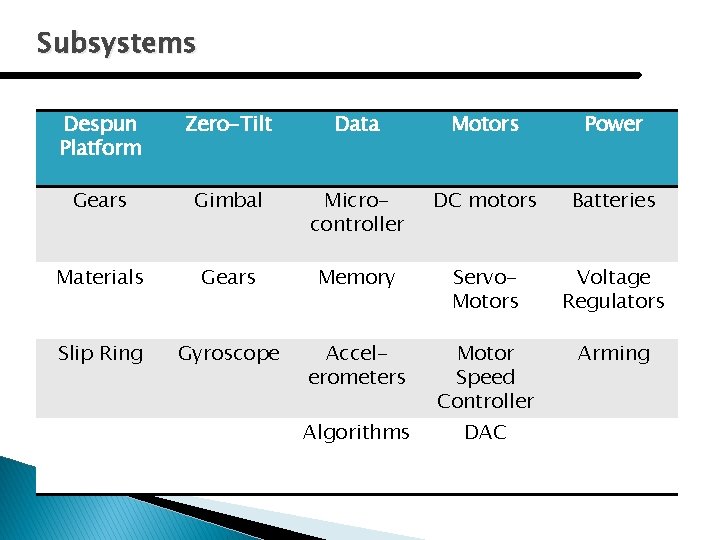
Subsystems Despun Platform Zero-Tilt Data Motors Power Gears Gimbal Microcontroller DC motors Batteries Materials Gears Memory Servo. Motors Voltage Regulators Slip Ring Gyroscope Accelerometers Motor Speed Controller Arming Algorithms DAC
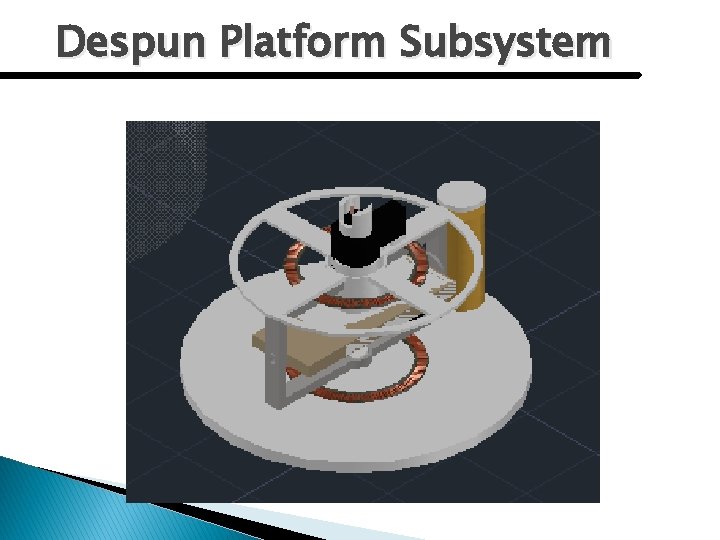
Despun Platform Subsystem
Subsystem Requirements �The platform will be able to keep the platform parallel to the Earth independently of the rockets orientation. �All electrical components must be wired to a battery source without twisting the wires. �The assembly must be contained within the size requirements.
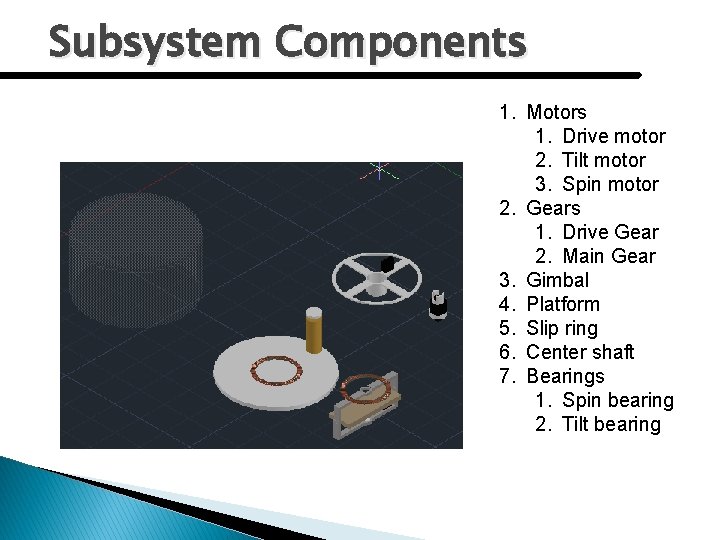
Subsystem Components 1. Motors 1. Drive motor 2. Tilt motor 3. Spin motor 2. Gears 1. Drive Gear 2. Main Gear 3. Gimbal 4. Platform 5. Slip ring 6. Center shaft 7. Bearings 1. Spin bearing 2. Tilt bearing
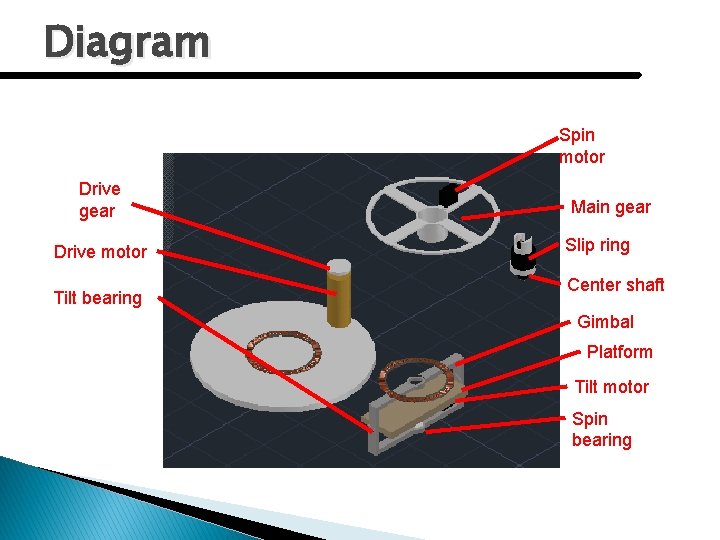
Diagram Spin motor Drive gear Drive motor Tilt bearing Main gear Slip ring Center shaft Gimbal Platform Tilt motor Spin bearing
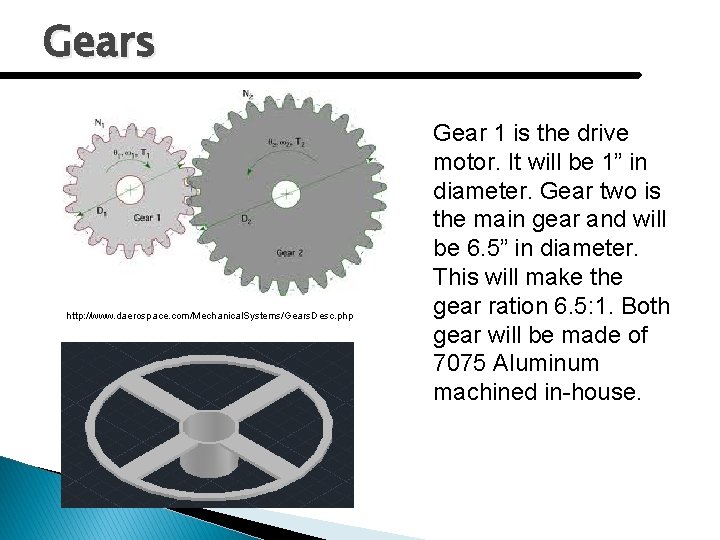
Gears http: //www. daerospace. com/Mechanical. Systems/Gears. Desc. php Gear 1 is the drive motor. It will be 1” in diameter. Gear two is the main gear and will be 6. 5” in diameter. This will make the gear ration 6. 5: 1. Both gear will be made of 7075 Aluminum machined in-house.
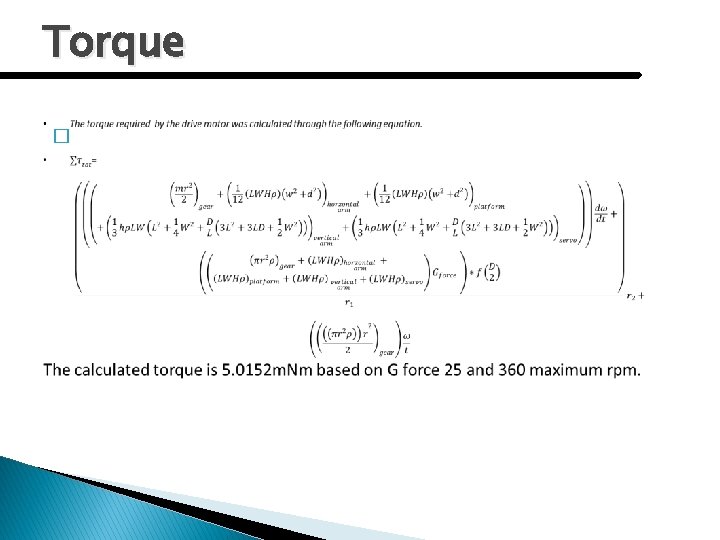
Torque �

Gimbal �The Gimbal will support the platform and spin with the assembly. This component will be made out of 7075 Aluminum.
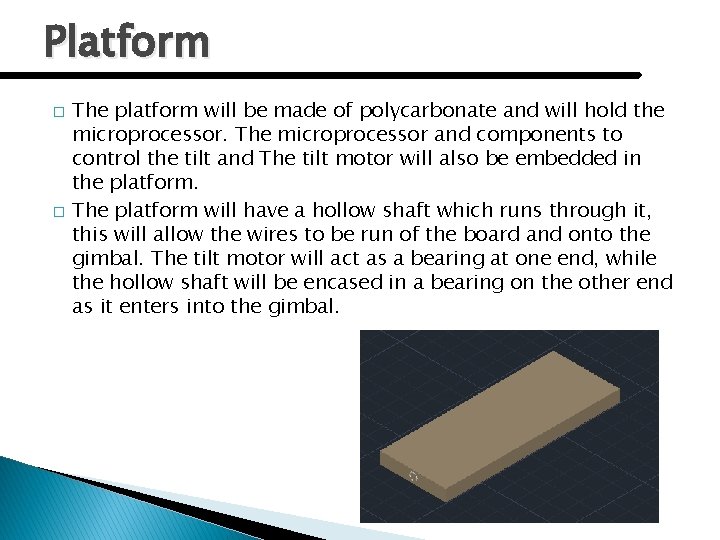
Platform � � The platform will be made of polycarbonate and will hold the microprocessor. The microprocessor and components to control the tilt and The tilt motor will also be embedded in the platform. The platform will have a hollow shaft which runs through it, this will allow the wires to be run of the board and onto the gimbal. The tilt motor will act as a bearing at one end, while the hollow shaft will be encased in a bearing on the other end as it enters into the gimbal.
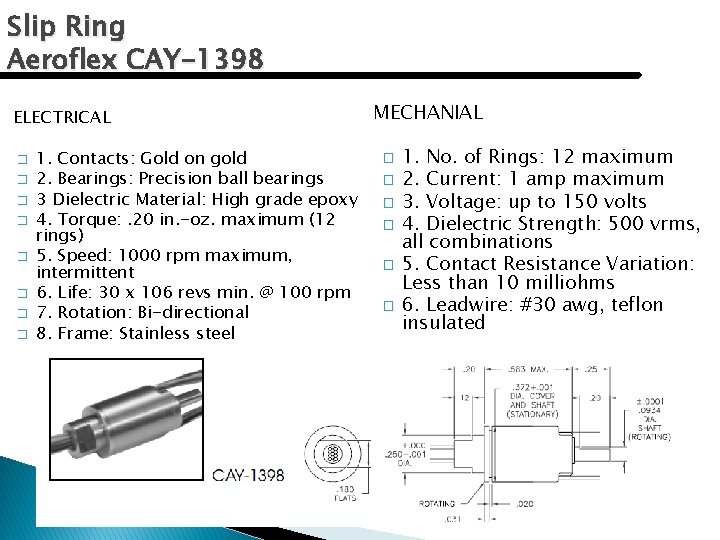
Slip Ring Aeroflex CAY-1398 ELECTRICAL � � � � 1. Contacts: Gold on gold 2. Bearings: Precision ball bearings 3 Dielectric Material: High grade epoxy 4. Torque: . 20 in. -oz. maximum (12 rings) 5. Speed: 1000 rpm maximum, intermittent 6. Life: 30 x 106 revs min. @ 100 rpm 7. Rotation: Bi-directional 8. Frame: Stainless steel MECHANIAL � � � 1. No. of Rings: 12 maximum 2. Current: 1 amp maximum 3. Voltage: up to 150 volts 4. Dielectric Strength: 500 vrms, all combinations 5. Contact Resistance Variation: Less than 10 milliohms 6. Leadwire: #30 awg, teflon insulated
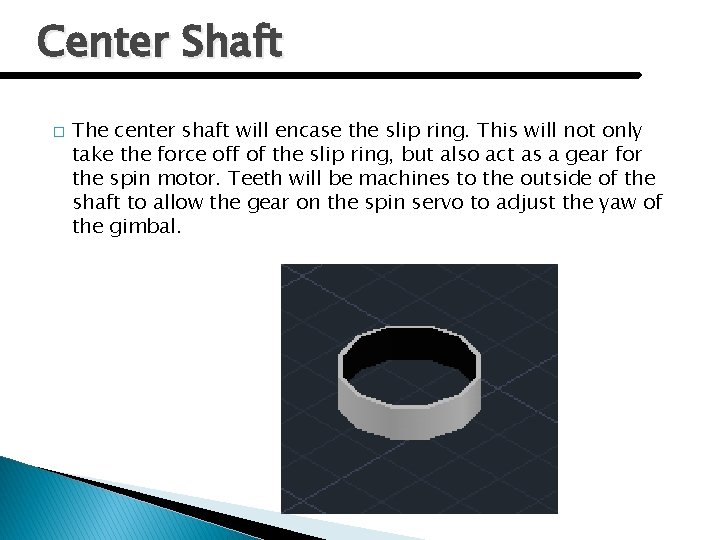
Center Shaft � The center shaft will encase the slip ring. This will not only take the force off of the slip ring, but also act as a gear for the spin motor. Teeth will be machines to the outside of the shaft to allow the gear on the spin servo to adjust the yaw of the gimbal.
Bearings � There are two bearings included in this design. The first is the bearing located in the gimbal which allows the platform to rotate. This will be a very small grade 5 or 7 ball bearing. � The second bearing supports the gimbal. It is a grade 5 ball bearing.
Materials � There were four materials considered for this project. ◦ Aluminum �Pros - light weight �Cons – low shear strength ◦ Steel �Pros – easy to machine �Cons – high density
Materials (cont. ) ◦ Titanium �Pros – very strong �Cons – high density, expensive ◦ Polycarbonate �Pros – Very high tensile strength �Cons – not rigid After considering all of the materials chosen, Aluminum and polycarbonate were chosen as our materials. The poly carbonate was chosen for the platform material because of its light weight and strength. Aircraft grade aluminum was chosen for the gears and gimbal because it has a high strength and light weight. 27
Design Changes � In the conceptual design, thrust bearing were going to be used to keep the rotating parts stable. Due to the compact size of the rotating parts, using a ball bearing should be sufficient in stabilizing these parts. By not using the thrust bearing the friction will be kept to a minimum.
2 D Design
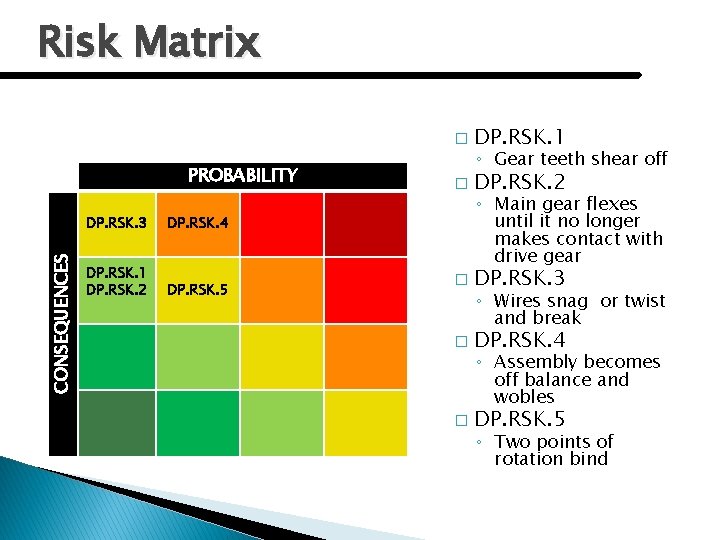
Risk Matrix CONSEQUENCES PROBABILITY DP. RSK. 3 DP. RSK. 4 DP. RSK. 1 DP. RSK. 2 DP. RSK. 5 � DP. RSK. 1 � DP. RSK. 2 � DP. RSK. 3 � DP. RSK. 4 � DP. RSK. 5 ◦ Gear teeth shear off ◦ Main gear flexes until it no longer makes contact with drive gear ◦ Wires snag or twist and break ◦ Assembly becomes off balance and wobles ◦ Two points of rotation bind

Zero Tilt System
Zero Tilt Definition � System Components: �Gimbal, “Goal Post” structure now moved to underneath the despun platform. �Servo Motors �One will make adjustments in spin so that the long side of the plate is parallel with the direction of the rocket. �One will correct the tilt relative to the earth’s surface. �Microprocessor and Gyroscope �Gyro will send data for tilt correction (spin and tilt) to the microprocessor. �Microprocessor will forward the data it receives to the two servo motors.
Zero Tilt Description � Servos �Servo 1 attached directly to shaft to resolve spin. �Servo 2 attached to side of gimbal to resolve tilt. � Zero Tilt Gear �Weight should not be a concern on the tilt platform. Therefore the torque produced in a one to one gear ratio between motor and tilt gear should be sufficient. � Fabrication �Currently have a prototype of the zero tilt platfrom made from polycarbonate. �Hoping to use the same material for tilt gear. (all manufactured in-house)
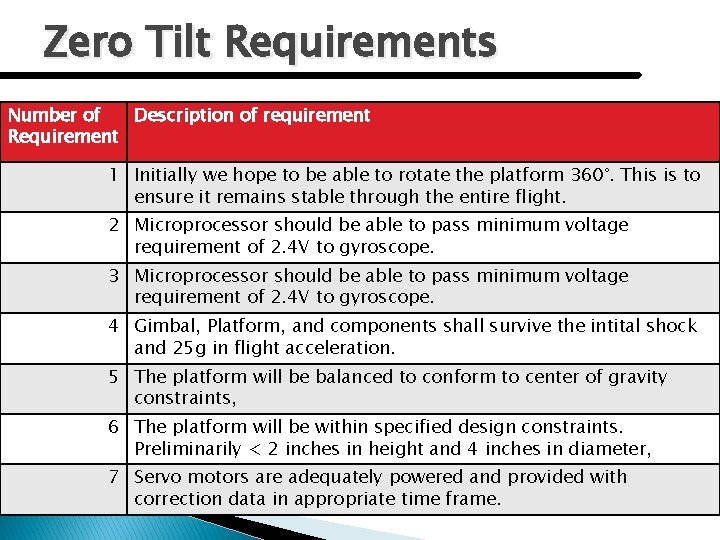
Zero Tilt Requirements Number of Description of requirement Requirement 1 Initially we hope to be able to rotate the platform 360°. This is to ensure it remains stable through the entire flight. 2 Microprocessor should be able to pass minimum voltage requirement of 2. 4 V to gyroscope. 3 Microprocessor should be able to pass minimum voltage requirement of 2. 4 V to gyroscope. 4 Gimbal, Platform, and components shall survive the intital shock and 25 g in flight acceleration. 5 The platform will be balanced to conform to center of gravity constraints, 6 The platform will be within specified design constraints. Preliminarily < 2 inches in height and 4 inches in diameter, 7 Servo motors are adequately powered and provided with correction data in appropriate time frame.
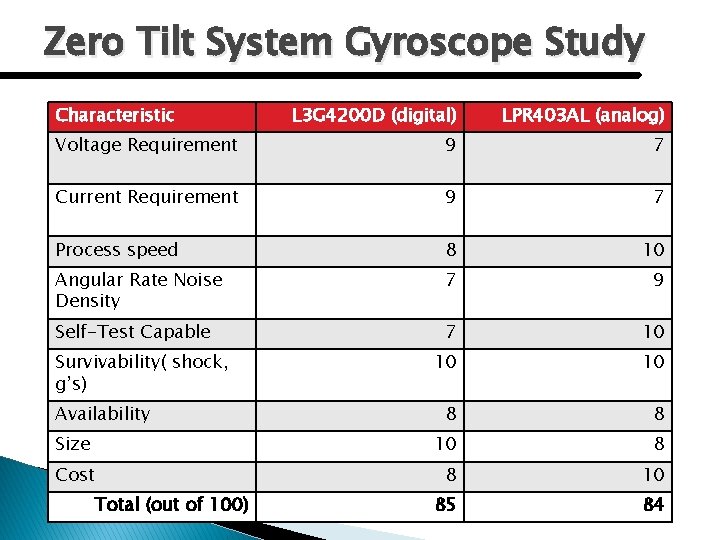
Zero Tilt System Gyroscope Study Characteristic L 3 G 4200 D (digital) LPR 403 AL (analog) Voltage Requirement 9 7 Current Requirement 9 7 Process speed 8 10 Angular Rate Noise Density 7 9 Self-Test Capable 7 10 10 10 8 8 Size 10 8 Cost 8 10 85 84 Survivability( shock, g’s) Availability Total (out of 100)
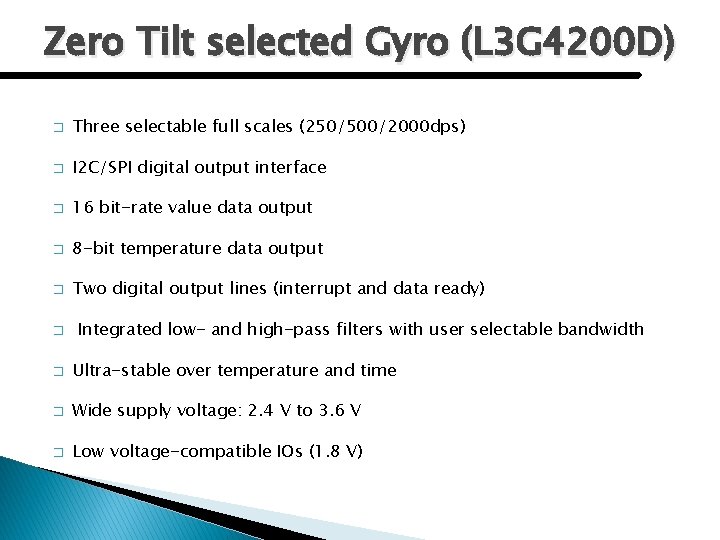
Zero Tilt selected Gyro (L 3 G 4200 D) � Three selectable full scales (250/500/2000 dps) � I 2 C/SPI digital output interface � 16 bit-rate value data output � 8 -bit temperature data output � Two digital output lines (interrupt and data ready) � Integrated low- and high-pass filters with user selectable bandwidth � Ultra-stable over temperature and time � Wide supply voltage: 2. 4 V to 3. 6 V � Low voltage-compatible IOs (1. 8 V)
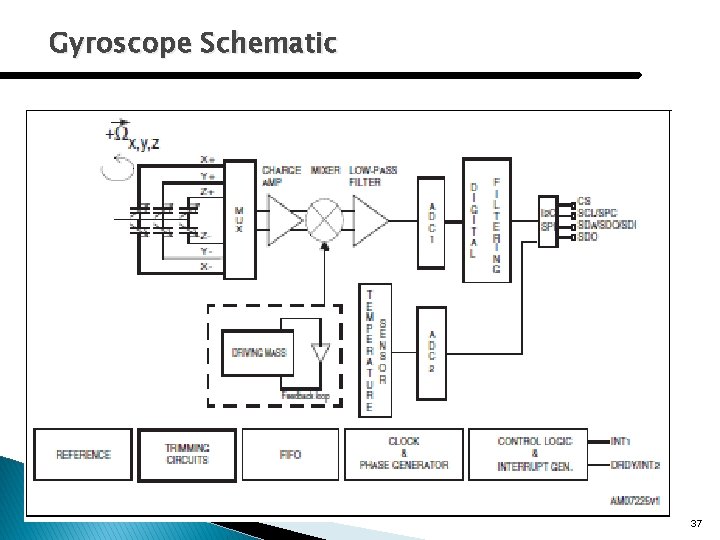
Gyroscope Schematic 37
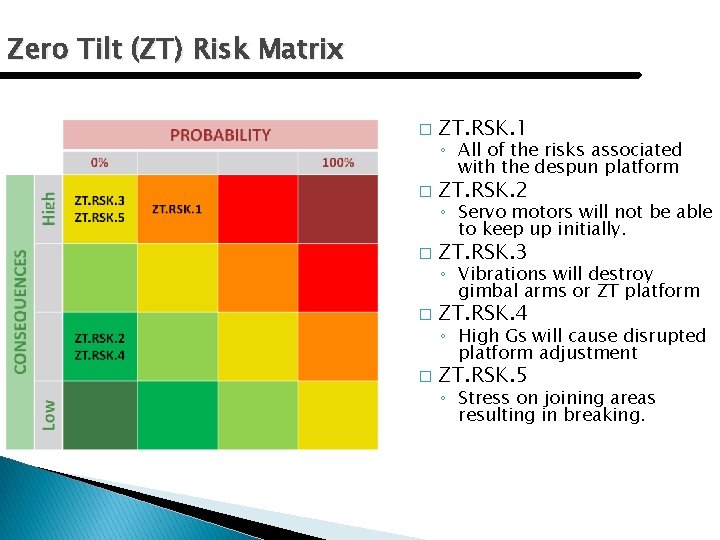
Zero Tilt (ZT) Risk Matrix � ZT. RSK. 1 � ZT. RSK. 2 � ZT. RSK. 3 � ZT. RSK. 4 � ZT. RSK. 5 ◦ All of the risks associated with the despun platform ◦ Servo motors will not be able to keep up initially. ◦ Vibrations will destroy gimbal arms or ZT platform ◦ High Gs will cause disrupted platform adjustment ◦ Stress on joining areas resulting in breaking.

Data Subsystem 39
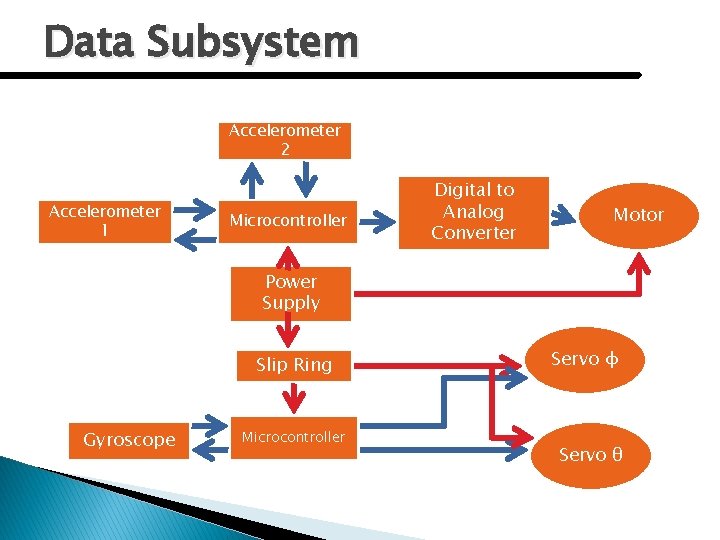
Data Subsystem Accelerometer 2 Accelerometer 1 Microcontroller Digital to Analog Converter Motor Power Supply Slip Ring Gyroscope Microcontroller Servo φ Servo θ
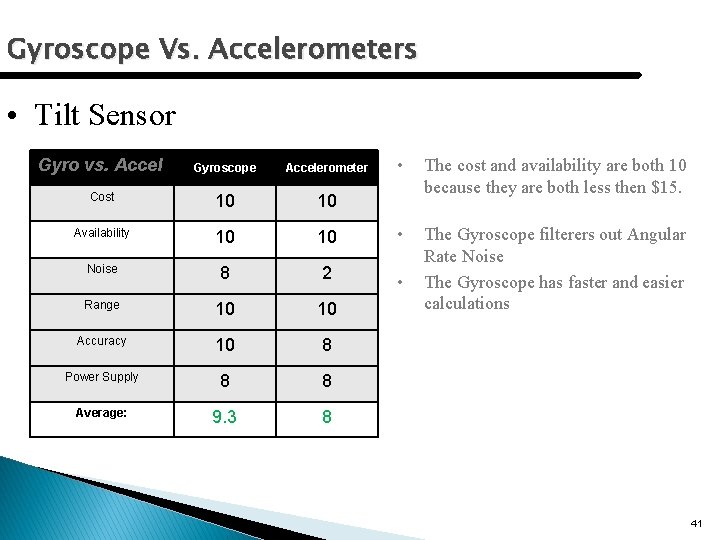
Gyroscope Vs. Accelerometers • Tilt Sensor • The cost and availability are both 10 because they are both less then $15. 10 • 8 2 • Range 10 10 The Gyroscope filterers out Angular Rate Noise The Gyroscope has faster and easier calculations Accuracy 10 8 Power Supply 8 8 Average: 9. 3 8 Gyro vs. Accel Gyroscope Accelerometer Cost 10 10 Availability 10 Noise 41

Gyroscope Vs. Accelerometers • Spin Sensor Gyro vs. Accel Gyroscope Accelerometer Cost 10 10 Availability 10 10 Range 0 10 Accuracy 8 8 Power Supply 10 8 Average: 7. 6 8 • The cost and availability are both 10 because they are both less then $15. • The max rate of spin of the rocket is 5. 6 HZ. This means the accelerometer need to read up 16 G The ADXL 278 has a range of ± 37 g. The gyroscope will need to be able to read up to 2016 dps • • 42
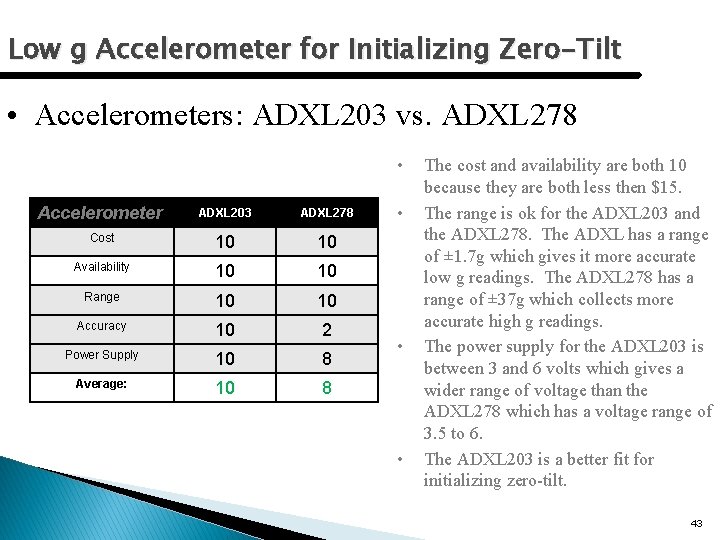
Low g Accelerometer for Initializing Zero-Tilt • Accelerometers: ADXL 203 vs. ADXL 278 • Accelerometer ADXL 203 ADXL 278 Cost 10 10 Availability 10 10 Range 10 10 Accuracy 10 2 Power Supply 10 8 Average: 10 8 • • • The cost and availability are both 10 because they are both less then $15. The range is ok for the ADXL 203 and the ADXL 278. The ADXL has a range of ± 1. 7 g which gives it more accurate low g readings. The ADXL 278 has a range of ± 37 g which collects more accurate high g readings. The power supply for the ADXL 203 is between 3 and 6 volts which gives a wider range of voltage than the ADXL 278 which has a voltage range of 3. 5 to 6. The ADXL 203 is a better fit for initializing zero-tilt. 43
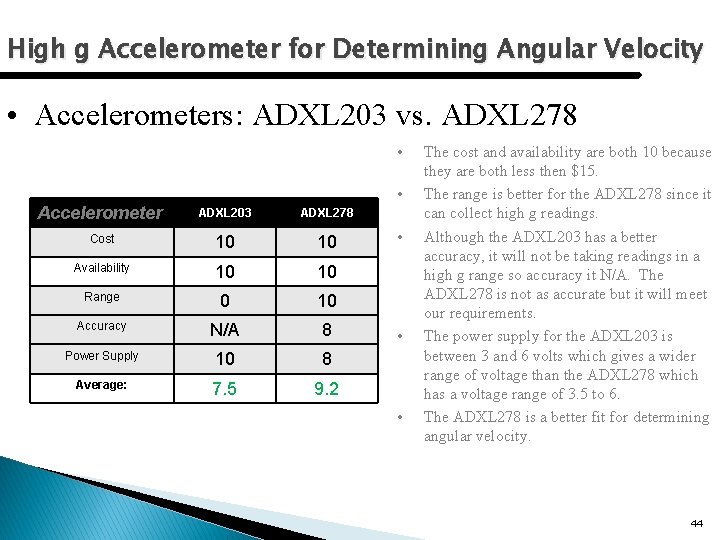
High g Accelerometer for Determining Angular Velocity • Accelerometers: ADXL 203 vs. ADXL 278 • • Accelerometer ADXL 203 ADXL 278 Cost 10 10 Availability 10 10 Range 0 10 Accuracy N/A 8 Power Supply 10 8 Average: 7. 5 9. 2 • • • The cost and availability are both 10 because they are both less then $15. The range is better for the ADXL 278 since it can collect high g readings. Although the ADXL 203 has a better accuracy, it will not be taking readings in a high g range so accuracy it N/A. The ADXL 278 is not as accurate but it will meet our requirements. The power supply for the ADXL 203 is between 3 and 6 volts which gives a wider range of voltage than the ADXL 278 which has a voltage range of 3. 5 to 6. The ADXL 278 is a better fit for determining angular velocity. 44
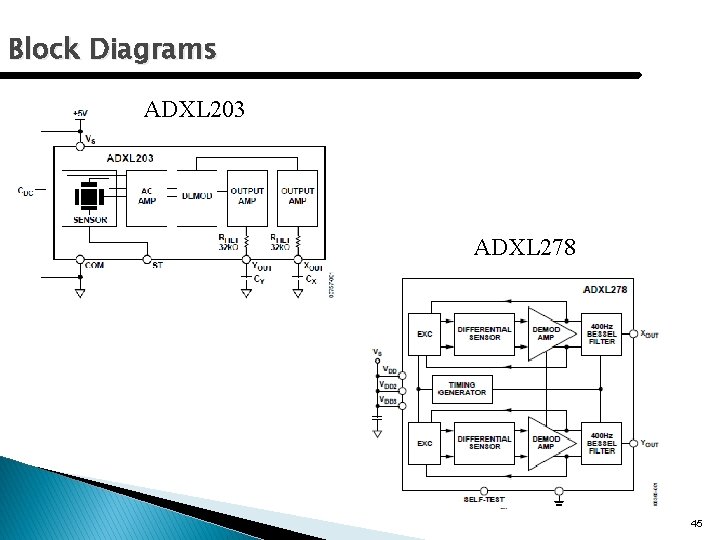
Block Diagrams ADXL 203 ADXL 278 45
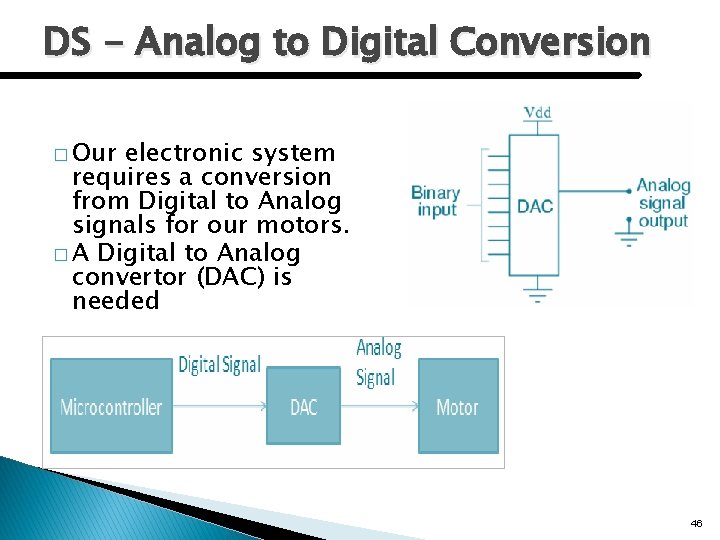
DS - Analog to Digital Conversion � Our electronic system requires a conversion from Digital to Analog signals for our motors. � A Digital to Analog convertor (DAC) is needed 46
Data Processing � ATMEGA 32 -16 PU-ND: we chose this chip due to its operating temperature and its compatibility with our devices and program language. � This chip is also familiar to our team, the previous model was used in our mentors Rockon project and have been extensively researched. � Having been used in the Rockon project we know that the stresses the chip undergoes will not produce an undesirable outcome. 47
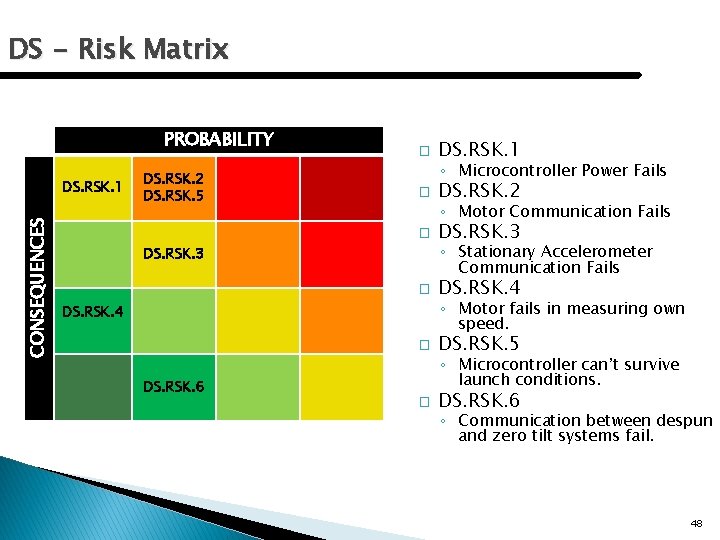
DS - Risk Matrix PROBABILITY CONSEQUENCES DS. RSK. 1 DS. RSK. 2 DS. RSK. 5 � DS. RSK. 1 ◦ Microcontroller Power Fails � DS. RSK. 2 ◦ Motor Communication Fails � DS. RSK. 3 ◦ Stationary Accelerometer Communication Fails DS. RSK. 3 � DS. RSK. 4 ◦ Motor fails in measuring own speed. DS. RSK. 4 � DS. RSK. 6 DS. RSK. 5 ◦ Microcontroller can’t survive launch conditions. � DS. RSK. 6 ◦ Communication between despun and zero tilt systems fail. 48

Motor Subsystem

Motors The motor subsystem is divided in to two sub systems: � � Motor for de-spinning the platform Motors for adjusting the tilt of the platform and turning the gimbal
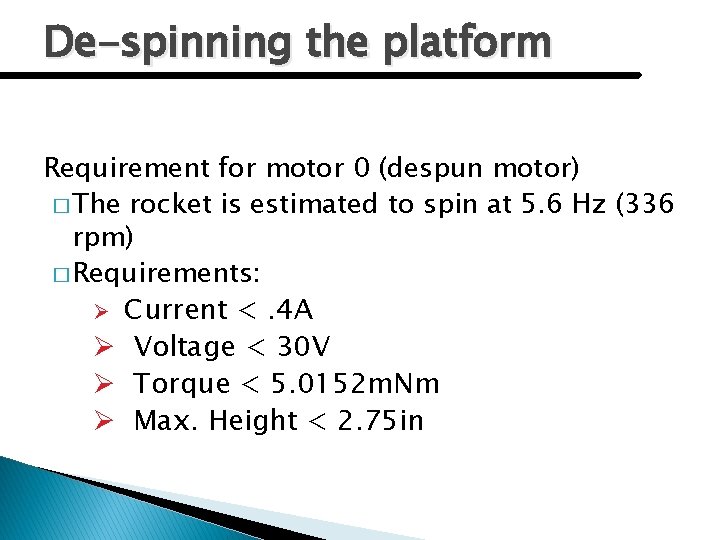
De-spinning the platform Requirement for motor 0 (despun motor) � The rocket is estimated to spin at 5. 6 Hz (336 rpm) � Requirements: Ø Current <. 4 A Ø Voltage < 30 V Ø Torque < 5. 0152 m. Nm Ø Max. Height < 2. 75 in
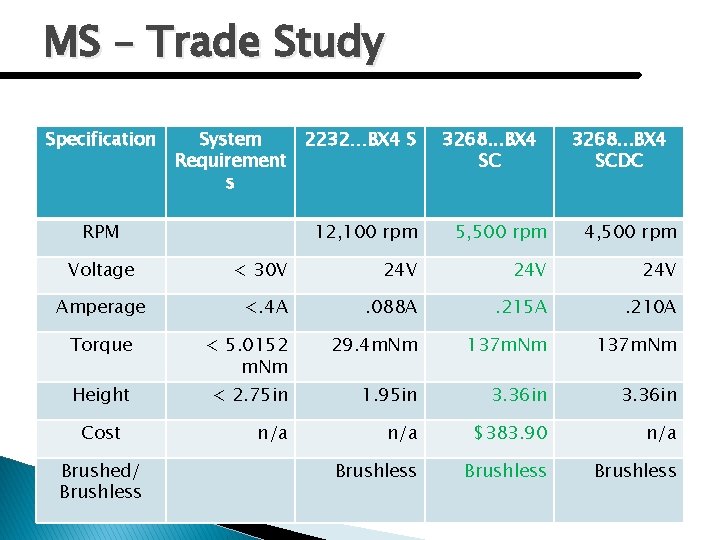
MS – Trade Study Specification System Requirement s RPM 2232…BX 4 S 3268. . . BX 4 SCDC 12, 100 rpm 5, 500 rpm 4, 500 rpm Voltage < 30 V 24 V 24 V Amperage <. 4 A . 088 A . 215 A . 210 A Torque < 5. 0152 m. Nm 29. 4 m. Nm 137 m. Nm Height < 2. 75 in 1. 95 in 3. 36 in n/a $383. 90 n/a Brushless Cost Brushed/ Brushless
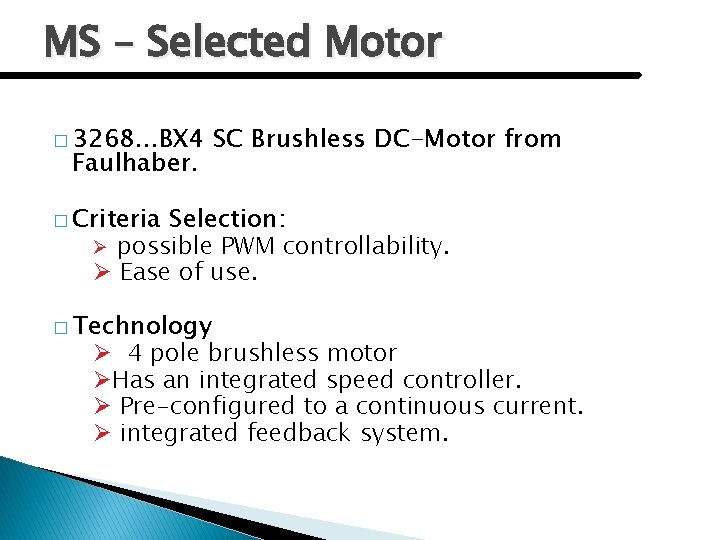
MS – Selected Motor � 3268. . . BX 4 Faulhaber. SC Brushless DC-Motor from � Criteria Selection: Ø possible PWM controllability. Ø Ease of use. � Technology Ø 4 pole brushless motor ØHas an integrated speed controller. Ø Pre-configured to a continuous current. Ø integrated feedback system.
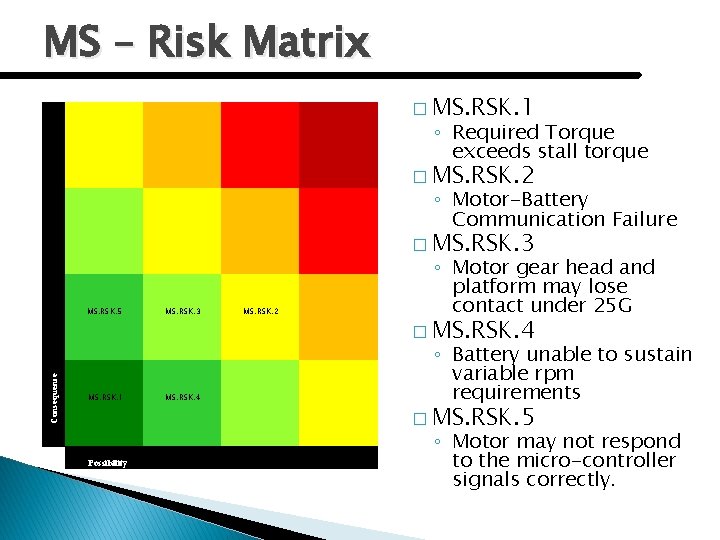
MS – Risk Matrix � MS. RSK. 1 ◦ Required Torque exceeds stall torque � MS. RSK. 2 ◦ Motor-Battery Communication Failure � MS. RSK. 3 Consequence MS. RSK. 5 MS. RSK. 1 Possibility MS. RSK. 3 MS. RSK. 4 MS. RSK. 2 ◦ Motor gear head and platform may lose contact under 25 G � MS. RSK. 4 ◦ Battery unable to sustain variable rpm requirements � MS. RSK. 5 ◦ Motor may not respond to the micro-controller signals correctly.
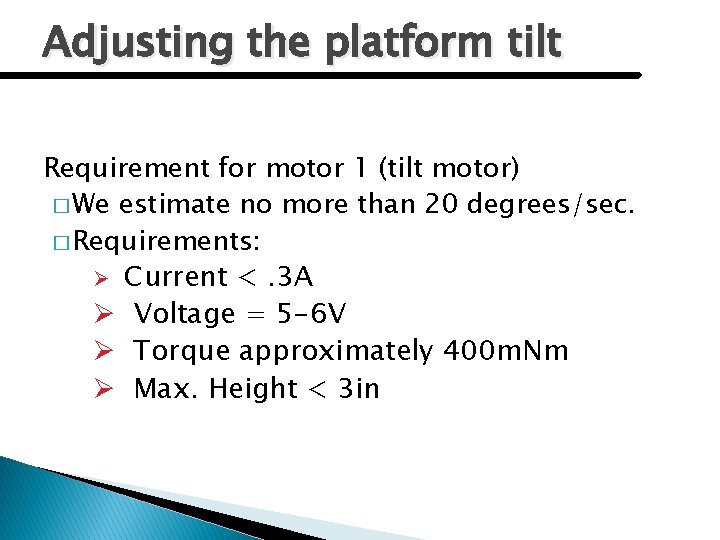
Adjusting the platform tilt Requirement for motor 1 (tilt motor) � We estimate no more than 20 degrees/sec. � Requirements: Ø Current <. 3 A Ø Voltage = 5 -6 V Ø Torque approximately 400 m. Nm Ø Max. Height < 3 in
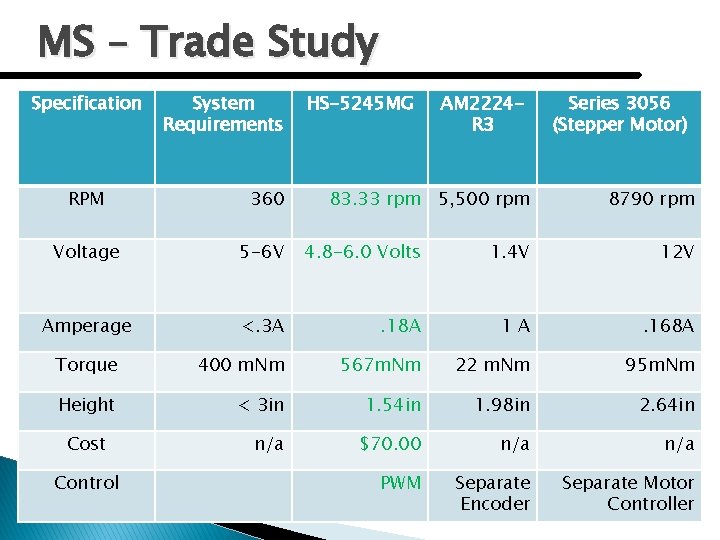
MS – Trade Study Specification RPM System Requirements 360 HS-5245 MG AM 2224 R 3 83. 33 rpm 5, 500 rpm Series 3056 (Stepper Motor) 8790 rpm Voltage 5 -6 V 4. 8 -6. 0 Volts 1. 4 V 12 V Amperage <. 3 A . 18 A 1 A . 168 A Torque 400 m. Nm 567 m. Nm 22 m. Nm 95 m. Nm Height < 3 in 1. 54 in 1. 98 in 2. 64 in n/a $70. 00 n/a PWM Separate Encoder Separate Motor Controller Cost Control
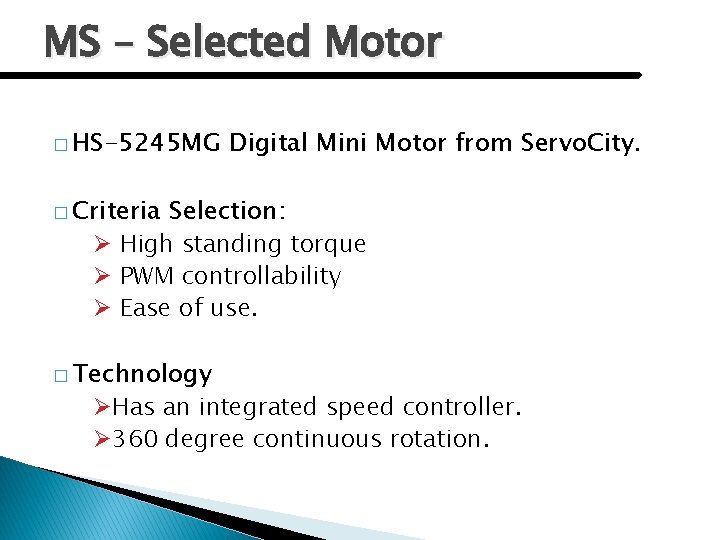
MS – Selected Motor � HS-5245 MG Digital Mini Motor from Servo. City. � Criteria Selection: Ø High standing torque Ø PWM controllability Ø Ease of use. � Technology ØHas an integrated speed controller. Ø 360 degree continuous rotation.
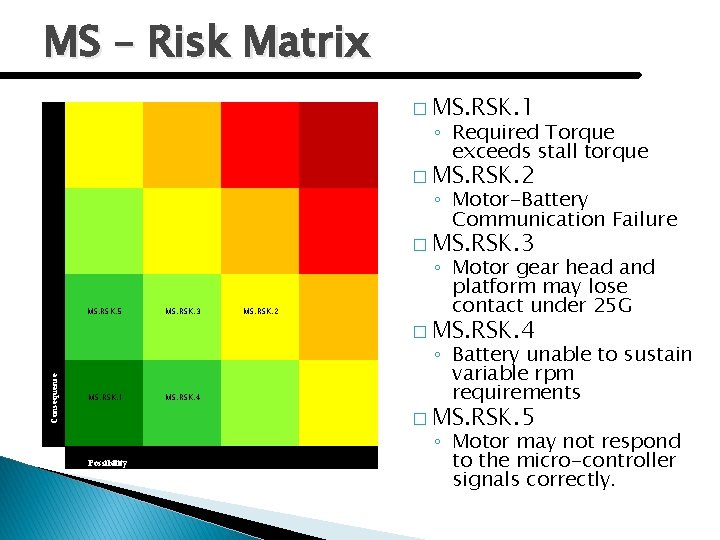
MS – Risk Matrix � MS. RSK. 1 ◦ Required Torque exceeds stall torque � MS. RSK. 2 ◦ Motor-Battery Communication Failure � MS. RSK. 3 Consequence MS. RSK. 5 MS. RSK. 1 Possibility MS. RSK. 3 MS. RSK. 4 MS. RSK. 2 ◦ Motor gear head and platform may lose contact under 25 G � MS. RSK. 4 ◦ Battery unable to sustain variable rpm requirements � MS. RSK. 5 ◦ Motor may not respond to the micro-controller signals correctly.
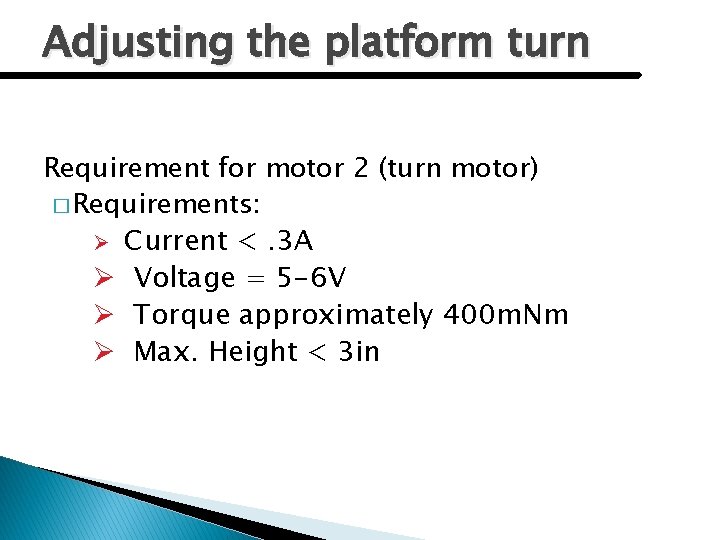
Adjusting the platform turn Requirement for motor 2 (turn motor) � Requirements: Ø Current <. 3 A Ø Voltage = 5 -6 V Ø Torque approximately 400 m. Nm Ø Max. Height < 3 in
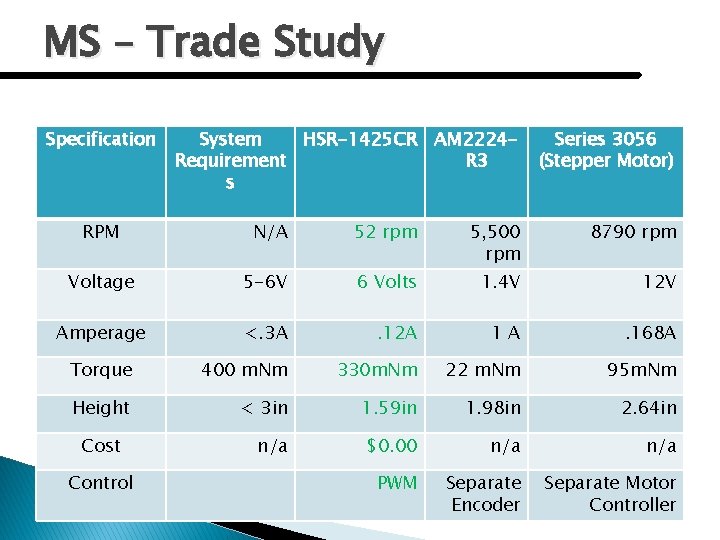
MS – Trade Study Specification System HSR-1425 CR AM 2224 Requirement R 3 s Series 3056 (Stepper Motor) RPM N/A 52 rpm 5, 500 rpm 8790 rpm Voltage 5 -6 V 6 Volts 1. 4 V 12 V Amperage <. 3 A . 12 A 1 A . 168 A Torque 400 m. Nm 330 m. Nm 22 m. Nm 95 m. Nm Height < 3 in 1. 59 in 1. 98 in 2. 64 in n/a $0. 00 n/a PWM Separate Encoder Separate Motor Controller Cost Control
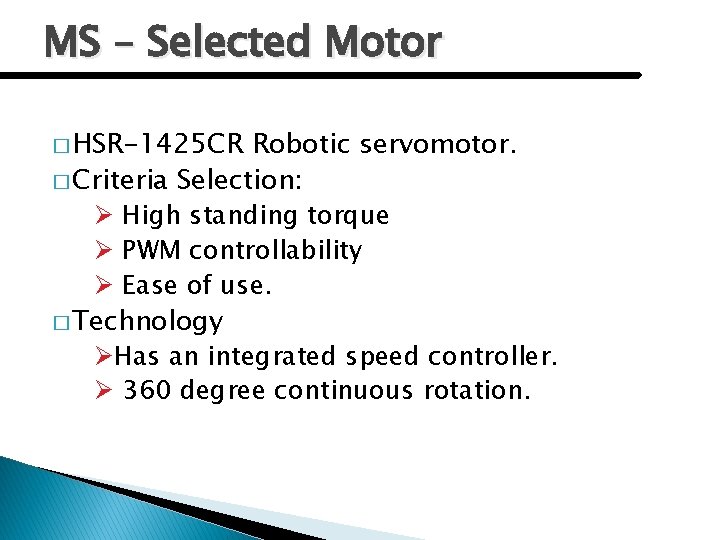
MS – Selected Motor � HSR-1425 CR Robotic servomotor. � Criteria Selection: Ø High standing torque Ø PWM controllability Ø Ease of use. � Technology ØHas an integrated speed controller. Ø 360 degree continuous rotation.
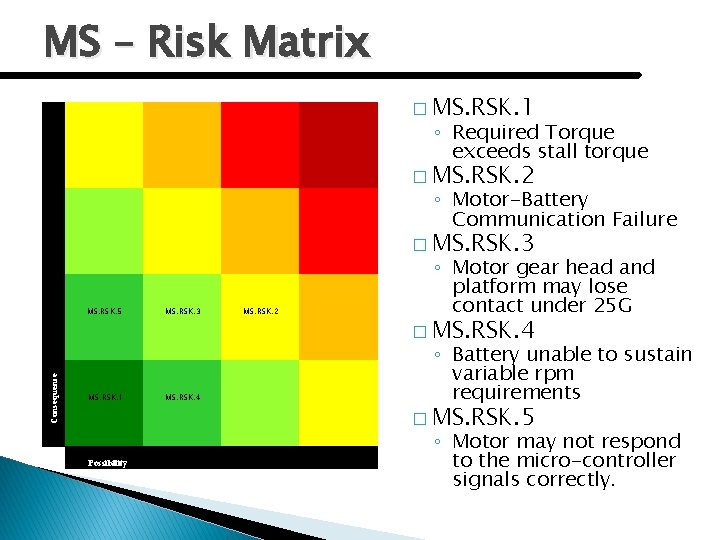
MS – Risk Matrix � MS. RSK. 1 ◦ Required Torque exceeds stall torque � MS. RSK. 2 ◦ Motor-Battery Communication Failure � MS. RSK. 3 Consequence MS. RSK. 5 MS. RSK. 1 Possibility MS. RSK. 3 MS. RSK. 4 MS. RSK. 2 ◦ Motor gear head and platform may lose contact under 25 G � MS. RSK. 4 ◦ Battery unable to sustain variable rpm requirements � MS. RSK. 5 ◦ Motor may not respond to the micro-controller signals correctly.

Power
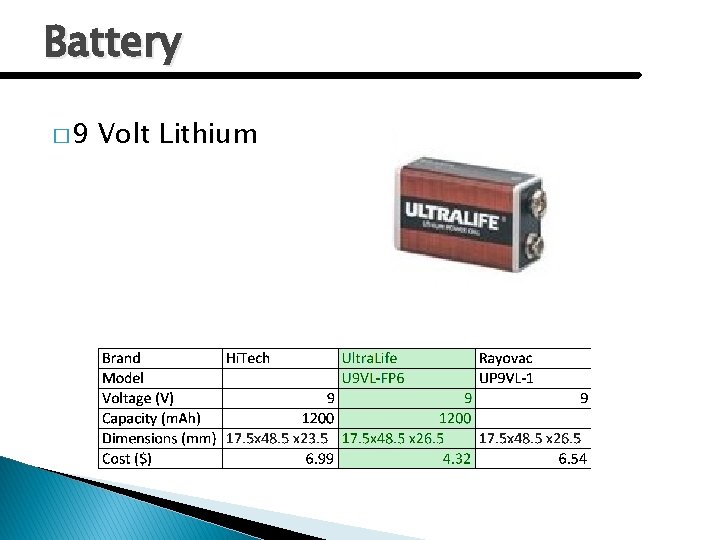
Battery � 9 Volt Lithium
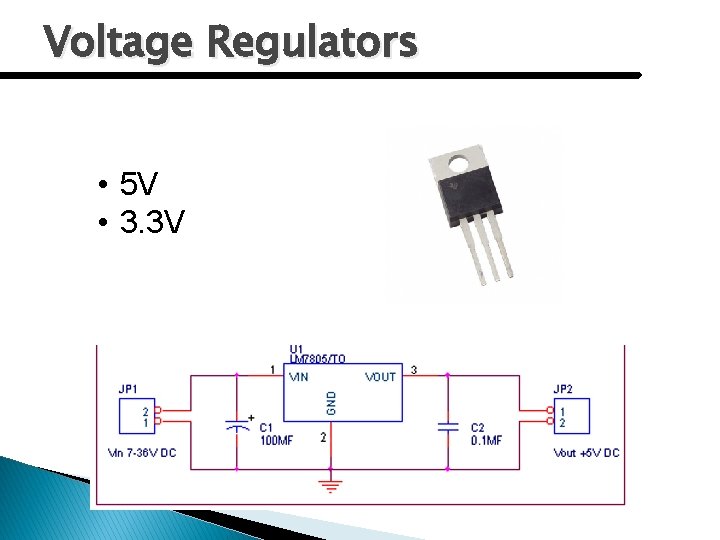
Voltage Regulators • 5 V • 3. 3 V

Sharing Logistics � Who are you sharing with? � Plan for collaboration ◦ Harting ◦ Communicated through email ◦ We shall share designs and ideas through email � We are still working on the structural interface with them but have decided upon position in the cannister. Harting will be above us below. (plate in between) grandpmr. com 66

Project Management Plan 67
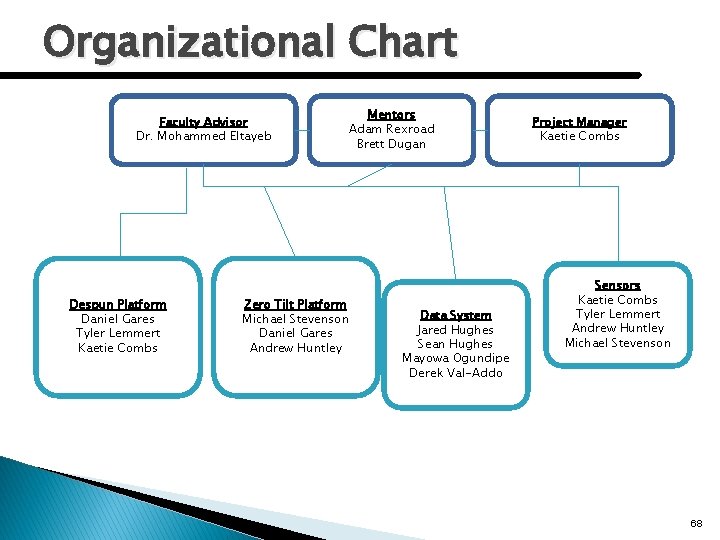
Organizational Chart Faculty Advisor Dr. Mohammed Eltayeb Despun Platform Daniel Gares Tyler Lemmert Kaetie Combs Mentors Adam Rexroad Brett Dugan Zero Tilt Platform Michael Stevenson Daniel Gares Andrew Huntley Data System Jared Hughes Sean Hughes Mayowa Ogundipe Derek Val-Addo Project Manager Kaetie Combs Sensors Kaetie Combs Tyler Lemmert Andrew Huntley Michael Stevenson 68
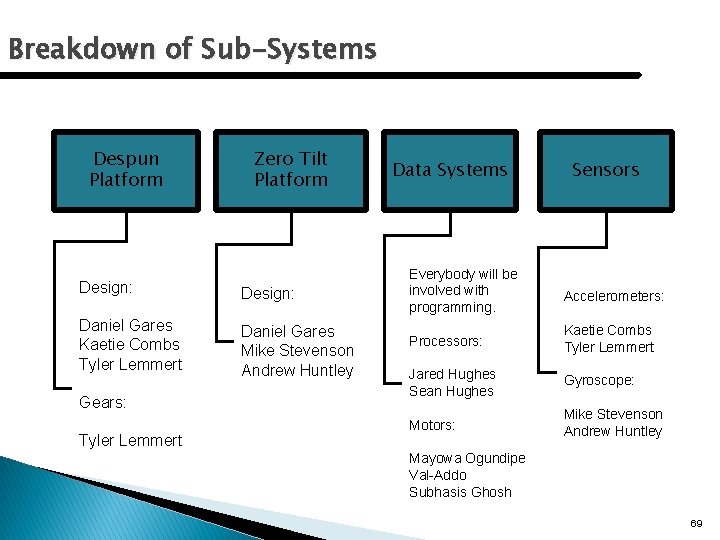
Breakdown of Sub-Systems Despun Platform Zero Tilt Platform Design: Daniel Gares Kaetie Combs Tyler Lemmert Daniel Gares Mike Stevenson Andrew Huntley Gears: Tyler Lemmert Data Systems Sensors Everybody will be involved with programming. Accelerometers: Processors: Kaetie Combs Tyler Lemmert Jared Hughes Sean Hughes Gyroscope: Motors: Mike Stevenson Andrew Huntley Mayowa Ogundipe Val-Addo Subhasis Ghosh 69
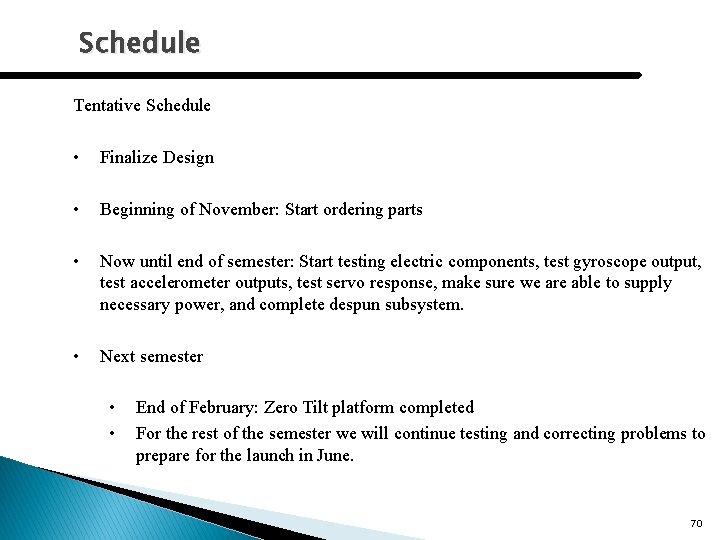
Schedule Tentative Schedule • Finalize Design • Beginning of November: Start ordering parts • Now until end of semester: Start testing electric components, test gyroscope output, test accelerometer outputs, test servo response, make sure we are able to supply necessary power, and complete despun subsystem. • Next semester • • End of February: Zero Tilt platform completed For the rest of the semester we will continue testing and correcting problems to prepare for the launch in June. 70
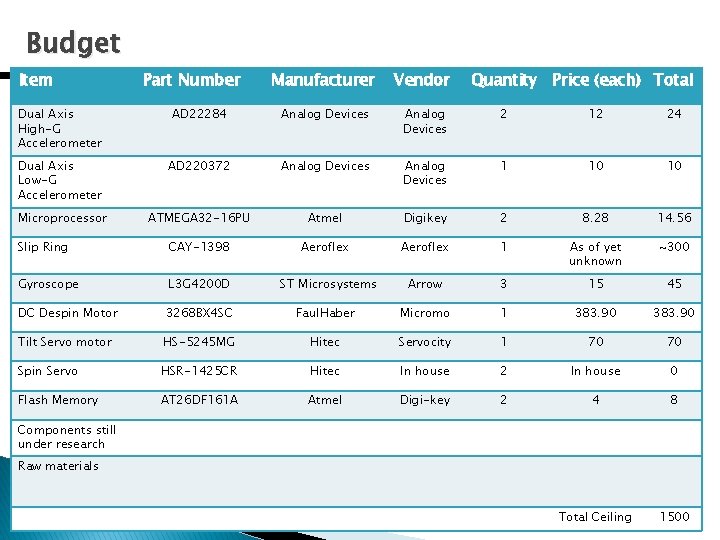
Budget Item Part Number Manufacturer Vendor Quantity Price (each) Total Dual Axis High-G Accelerometer AD 22284 Analog Devices 2 12 24 Dual Axis Low-G Accelerometer AD 220372 Analog Devices 1 10 10 Microprocessor ATMEGA 32 -16 PU Atmel Digikey 2 8. 28 14. 56 Slip Ring CAY-1398 Aeroflex 1 As of yet unknown ~300 Gyroscope L 3 G 4200 D Arrow 3 15 45 DC Despin Motor 3268 BX 4 SC Faul. Haber Micromo 1 383. 90 Tilt Servo motor HS-5245 MG Hitec Servocity 1 70 70 Spin Servo HSR-1425 CR Hitec In house 2 In house 0 Flash Memory AT 26 DF 161 A Atmel Digi-key 2 4 8 Total Ceiling 1500 ST Microsystems Components still under research Raw materials 71
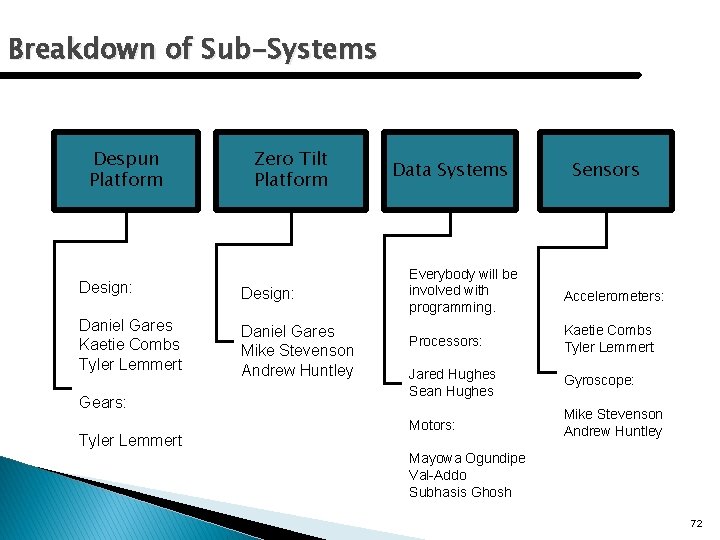
Breakdown of Sub-Systems Despun Platform Zero Tilt Platform Design: Daniel Gares Kaetie Combs Tyler Lemmert Daniel Gares Mike Stevenson Andrew Huntley Gears: Tyler Lemmert Data Systems Sensors Everybody will be involved with programming. Accelerometers: Processors: Kaetie Combs Tyler Lemmert Jared Hughes Sean Hughes Gyroscope: Motors: Mike Stevenson Andrew Huntley Mayowa Ogundipe Val-Addo Subhasis Ghosh 72
Conclusion � We hope to order 90% of the materials required and begin fabrication of the gears. � We need to solidify our power requirements as well as our electric circuitry. � We must test our materials for weight and decide if our current materials will handle the stresses of rocket flight. � We intend to finalize our budget and remain within our $1500 ceiling. � Determine how fast the rocket changes angle with respect to starting position. 73
- Slides: 73