
Zebrafish presented by BonJour Lin CONTENTS 1 2
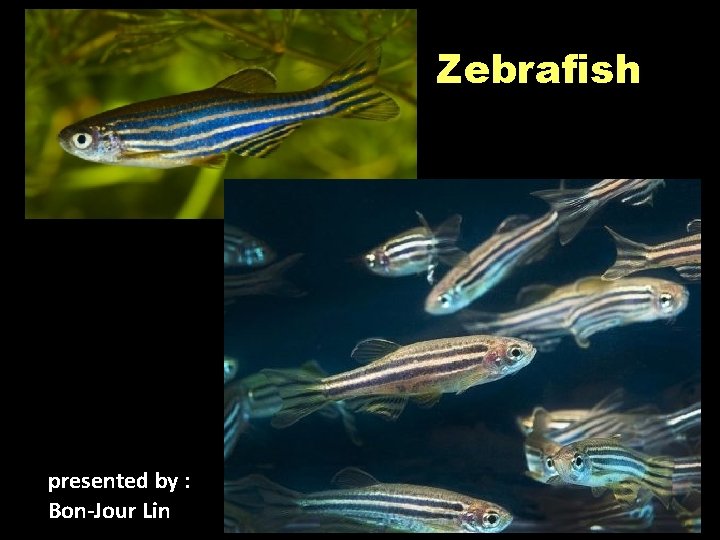
Zebrafish presented by : Bon-Jour Lin
CONTENTS 1. 2. 3. 4. Introduction History Uses as a model organism Genetics of Zebrafish
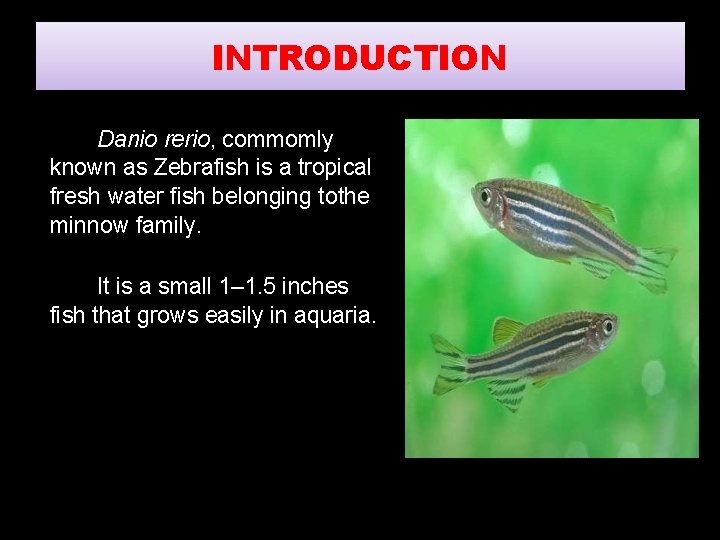
INTRODUCTION Danio rerio, commomly known as Zebrafish is a tropical fresh water fish belonging tothe minnow family. It is a small 1– 1. 5 inches fish that grows easily in aquaria.
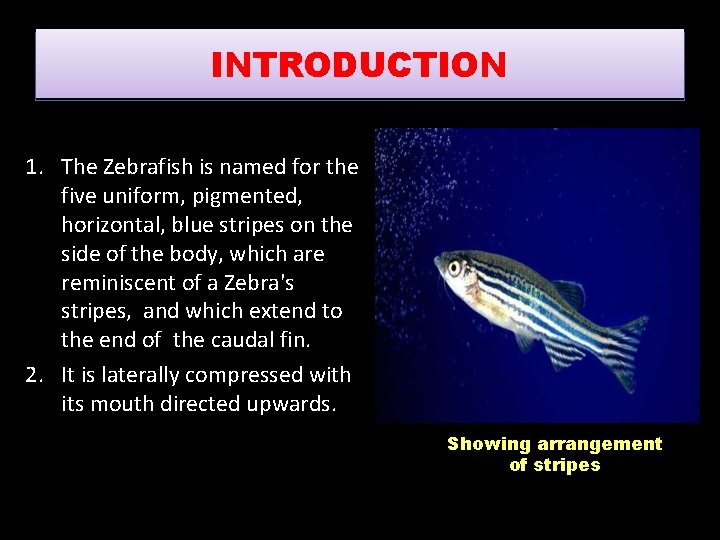
INTRODUCTION 1. The Zebrafish is named for the five uniform, pigmented, horizontal, blue stripes on the side of the body, which are reminiscent of a Zebra's stripes, and which extend to the end of the caudal fin. 2. It is laterally compressed with its mouth directed upwards. Showing arrangement of stripes

HISTORY 1. The use of Zebrafish as a model organism was pioneered at the University of Oregon, U. S. A. by George Streisinger in 1970. 1. He is the “Founder Father” of Zebrafish Developmental and Genetic Research. George Streisinger
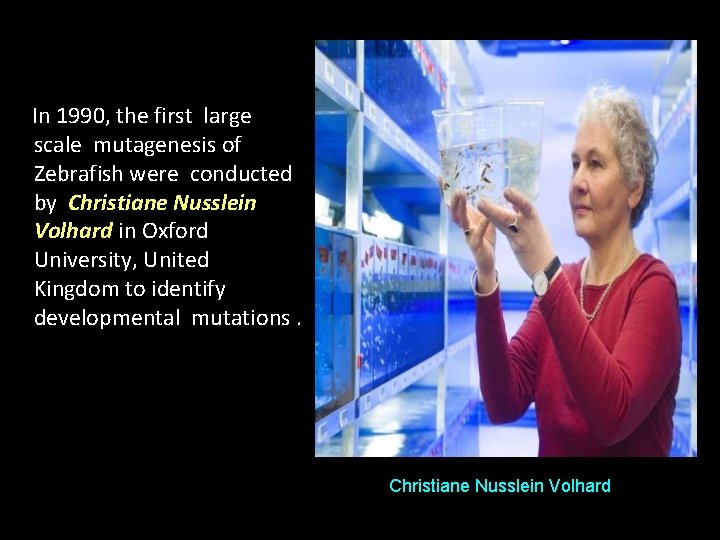
In 1990, the first large scale mutagenesis of Zebrafish were conducted by Christiane Nusslein Volhard in Oxford University, United Kingdom to identify developmental mutations. Christiane Nusslein Volhard

Thomas Look of Dana-Farber Cancer Institute, Boston uses the translucent Zebrafish to study how cancer behaves in 1995. Thomas Look
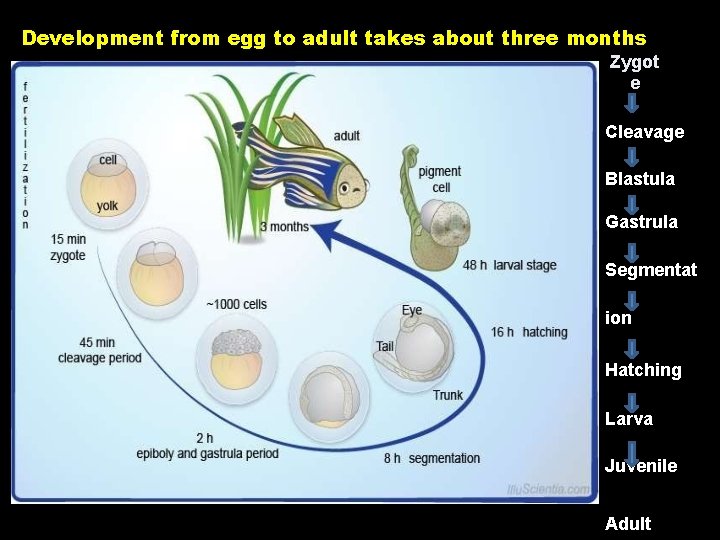
Development from egg to adult takes about three months Zygot e Cleavage Blastula Gastrula Segmentat ion Hatching Larva Juvenile Adult

MODEL ORGANISMS 1. A model organism is a non-human species that has been widely studied, usually because it is easy to maintain and breed in a laboratory setting and has particular experimental advantages. 1. They are used in the laboratory to help scientists understand biological processes.
ADVANTAGES 1. Optically translucent embryos 2. Rapid hatching of eggs 3. Maintenance cost is significantly lower than those for mammals. 4. Amenable for molecular and genetic analysis. 5. As Zebrafish eggs are fertilized and develop outside the mother’s body it is an ideal model organism for studying early development and screening for drug toxicity
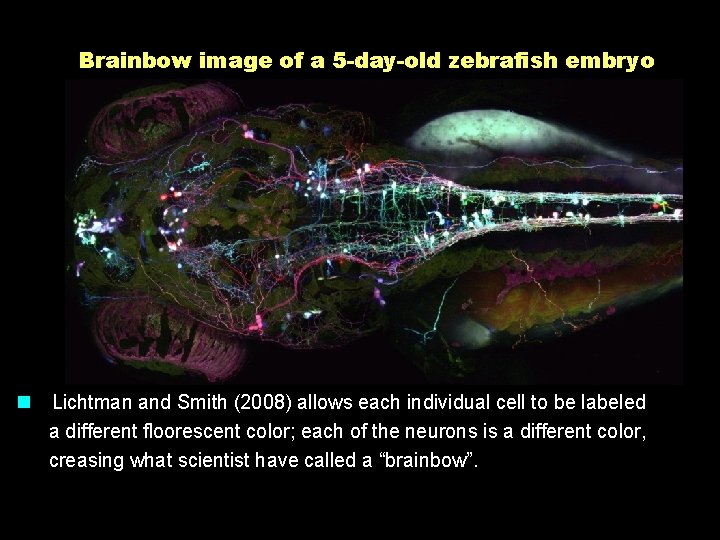
Brainbow image of a 5 -day-old zebrafish embryo n Lichtman and Smith (2008) allows each individual cell to be labeled a different floorescent color; each of the neurons is a different color, creasing what scientist have called a “brainbow”.
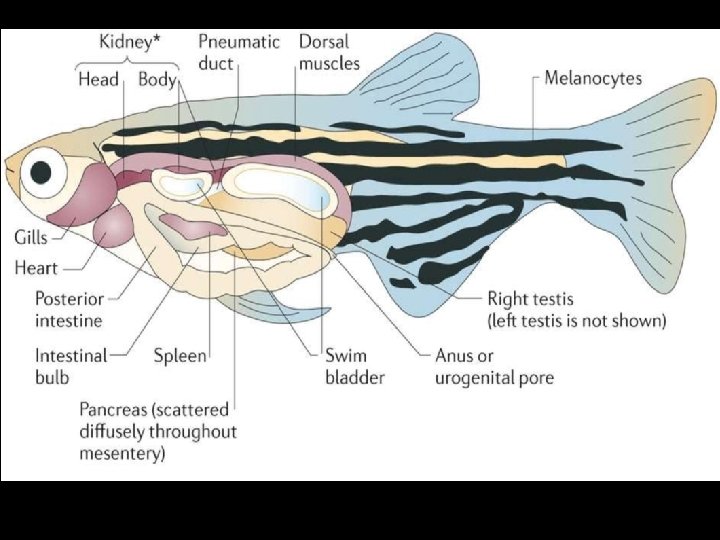
GENETICS 1. 70% of protein-coding human genes are related to genes found in the Zebrafish. 2. 84% of genes known to be associated with human disease have a Zebrafish counterpart. 3. They can be cloned from somatic cells. 4. They can be made transgenic. 5. As a vertebrate, the Zebrafish has the same major organs and tissues as humans. Their muscle, blood, kidney and eyes share many features with human systems.
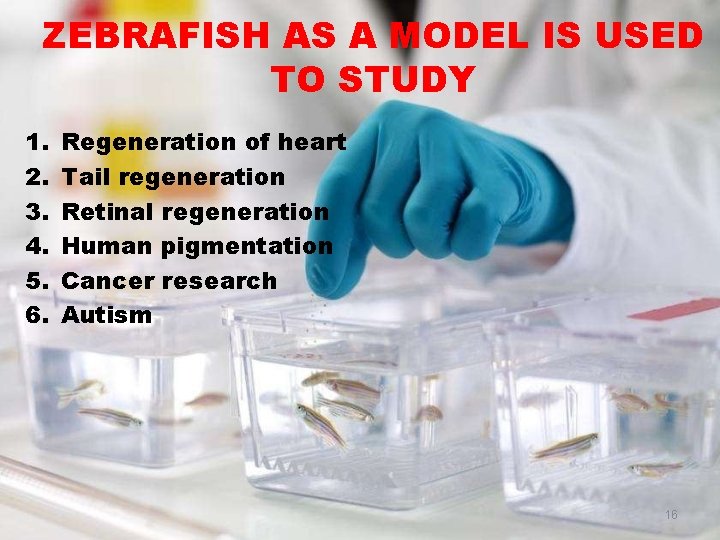
ZEBRAFISH AS A MODEL IS USED TO STUDY 1. 2. 3. 4. 5. 6. Regeneration of heart Tail regeneration Retinal regeneration Human pigmentation Cancer research Autism 16



n Danio rerio, the zebrafish, a model for studying genetic effects in vertebrate development. They are small, hardy fish, about an inch long that have been bread for many years where thy may survive for about five years. They are clear and develop outside the mother’s body, so it is possible to watch a zebrafish egg grow in a newly-formed fish under a microscop Development from egg to adult takes about three months. Are unusual in being nearly transparent so it is possible to observe the development of the internal organs.
n The zebrafish have about 1700 Mb of DNA on 25 chromosomes, and most genes have been found to e similar to human genes. Genetic taggin is relatively easy and microinjecting the egg with DNA is straightforward. Consequently, it has become a favorite model organism for studying the modecular genetics of embryonic development. Zebrafish are able to regenerate their heart, nervous tissues, retina, hearing tissues, and fins.
n Zebrafish for initial screening for new drugs n The fish and embryos absorb small molecules from the water, as to screen a drug for toxicity is fairly easy. Use robotic microscope to visualize embryos as thy are exposed to new drugs Zebrafish are able to grow human tumors, the tumor cells can be trasnplanted into a fish and each step of a tumor formation can be visulized because of transparent nature of zebrafish.
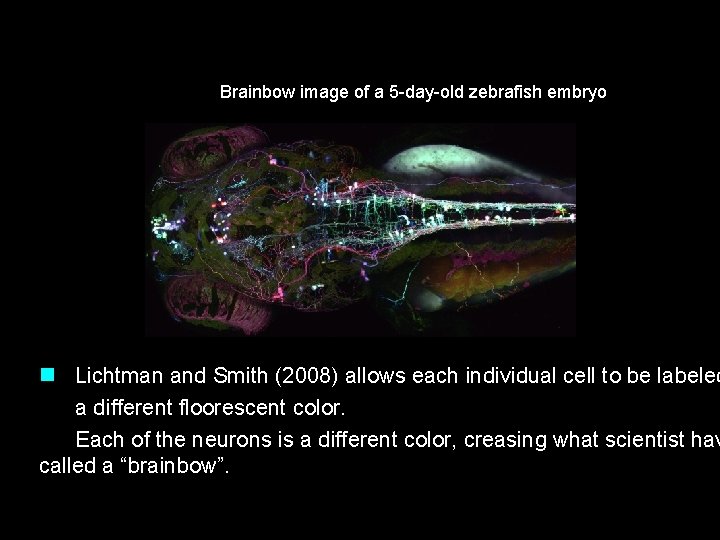
Brainbow image of a 5 -day-old zebrafish embryo n Lichtman and Smith (2008) allows each individual cell to be labeled a different floorescent color. Each of the neurons is a different color, creasing what scientist hav called a “brainbow”.
Reporter Genes for monitoring Gene expression - easily assayable enzymes as reporters - light emission by luciferase as a reporter system - green fluorescent protein as reporters Fusion of the regulatory regions and promoters to the gfp (green fluorescent protein) gene have been used to monitor the expression of many genes, especially in living animals.
- Slides: 22