
ZARA PART 1 THE DEEP DIVE By Julia
ZARA PART 1: THE DEEP DIVE By Julia Piotrowski
CATEGORY • Zara is in the ready-to-wear, fast fashion category. • Fast fashion produces runway-inspired clothing quickly and cheaply for consumers to buy at a fraction of the cost of designer apparel. • The fast fashion market is expected to grow tremendously in the next four (2018 -2022) years due to the growing population of youth, the decreasing cost to produce fast fashion, and growth in media development. • Menswear is the fast fashion category with the biggest focus this year. Brands have been putting more attention on their men’s departments and the ones that only carried women’s wear have been adding men’s departments. • Over the past three years, the fast fashion industry has grown over 21%.
COMPETITION • According to a Global Fast Fashion Retail, Zara’s biggest competitors are: – Uniquilo – Gap Inc. – H&M • In fiscal 2016, Zara had sales of $19. 7 billion. In comparison to their competitors: – H&M- $20. 2 billion – Uniqulo- $16. 6 billion – Gap- $16. 4 billion • Their Target Audiences: – Zara- Women – H&M- Women & Men – Uniqulo- Women & Men – Gap- Women & Men • In 2017, Zara’s biggest competitor, H&M, has seen a decline in sales due to their competitors re-vamping their online stores.
Competitive Marketing Techniques for Zara’s Competitors • Below is a short synopsis of the position Zara’s competitors take in regards to competitive marketing: – H&M: pricing – Uniqulo: basics selection- they carry a variety of colors for each product and focus on basics. – Gap: higher-quality basics – Zara: runway-inspired fast fashion
Indirect Competition • Although Zara’s main source of revenue is through their brick and mortar locations, they still have competition with online retailers like: – ASOS – Missguided – Mango • Right now, ASOS is beating Zara in regards to the size and revenue of their online store. (5. 8 billion) • ASOS also has a greater selection of men’s and plus size categories. • To combat ASOS, Zara has recently re-vamped their online store. It now carries more lines and a greater selection of items.

THE BRAND • Zara has 1, 923 stores in 88 countries. • They have 53 stores in the USA • Their departments include Zara (women’s, also their biggest), Zara Men, and Zara Kids. • Right now, Zara only has locations in the larger markets like Chicago, NYC, LA, Miami, etc. • Although they are fast-fashion, they are more expensive in comparison to their competitors and carry more runway-inspired items. • They have gotten in trouble frequently due to the fact that they seem to copy designers’ exact products seen on the runways. • In comparison to their competitors, they don’t have a consistent sales section, and only have a huge sale every quarter or so.
The Brand, Continued • Zara is a spanish brand that was started in 1974. • Zara caters to the trendy working woman who wants her basics but also likes to take risks. • Their products are priced on the higher end in comparison to their competitors, but still attract a large customer base. • Their products are unique and more runway-inspired. • Products are also higher-quality compared to their competition like H&M.
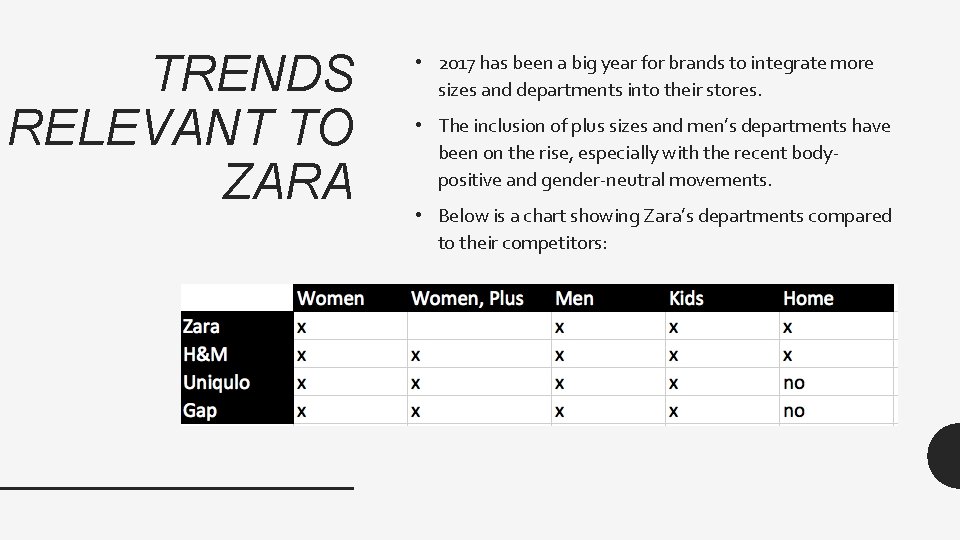
TRENDS RELEVANT TO ZARA • 2017 has been a big year for brands to integrate more sizes and departments into their stores. • The inclusion of plus sizes and men’s departments have been on the rise, especially with the recent bodypositive and gender-neutral movements. • Below is a chart showing Zara’s departments compared to their competitors:
Sources • “Global Fast Fashion Retail Market with Focus on The United States (2017 -2021 Edition). ”Market Reports Online, Daedal Research, 1 June 2017, www. marketreportsonline. com/606037. html. • Loeb, Walter. “Zara Leads In Fast Fashion. ” Forbes, Forbes Magazine, 30 Mar. 2017, www. forbes. com/sites/walterloeb/2015/03/30/zara-leads-infast-fashion/#56 af 21 bf 5944. • Mulier, Thomas. “H&M Plunges Most in 16 Years After Trouncing by Rival Zara. ”Bloomberg. com, Bloomberg, 1 Nov. 2017, www. bloomberg. com/news/articles/2017 -12 -15/h-m-sales-miss-estimates -as-stores-attract-fewer-customers. • Econsultancy, Nikki Gilliland @. “Four Factors Fuelling the Growth of Fast Fashion Retailers. ”Econsultancy, 7 July 2017, econsultancy. com/blog/69216 -four-factors-fuelling-the-growth-of-fastfashion-retailers.
- Slides: 9