
ZangFu Physiology Traditional Chinese Internal Medicine TCM Traditional
- Slides: 49
Zang-Fu Physiology Traditional Chinese Internal Medicine (TCM)
Traditional Chinese Medicine b b b Diet Exercise Rest Acupuncture Chinese herbal formulas
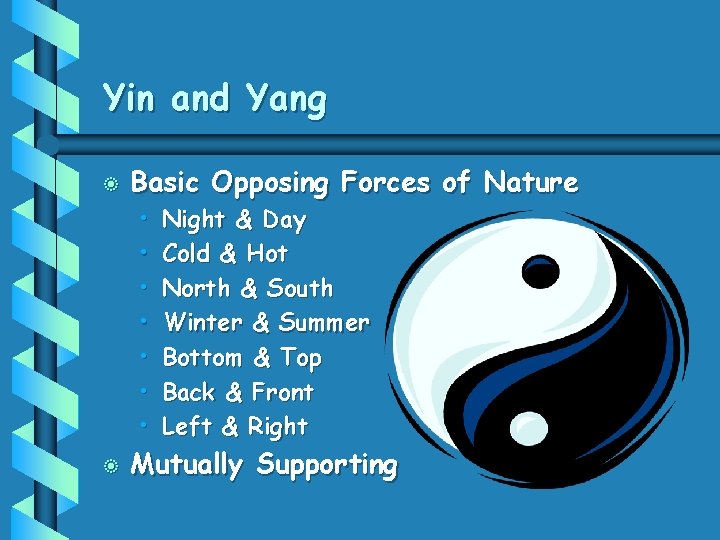
Yin and Yang b Basic Opposing Forces of Nature • • b Night & Day Cold & Hot North & South Winter & Summer Bottom & Top Back & Front Left & Right Mutually Supporting
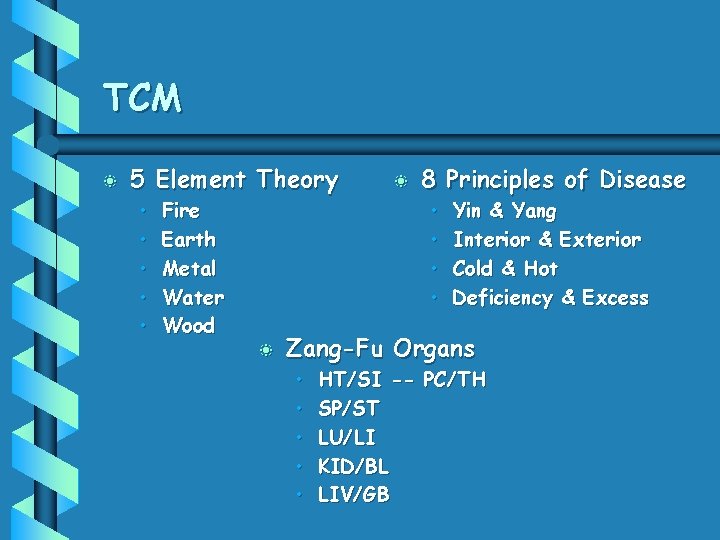
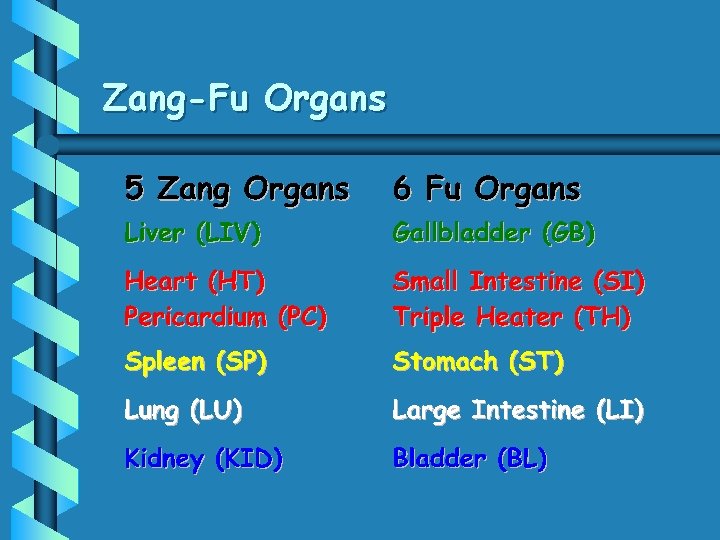
TCM b 5 Element Theory • • • Fire Earth Metal Water Wood b b 8 Principles of Disease • • Yin & Yang Interior & Exterior Cold & Hot Deficiency & Excess Zang-Fu Organs • • • HT/SI -- PC/TH SP/ST LU/LI KID/BL LIV/GB
Zang-Fu Organs
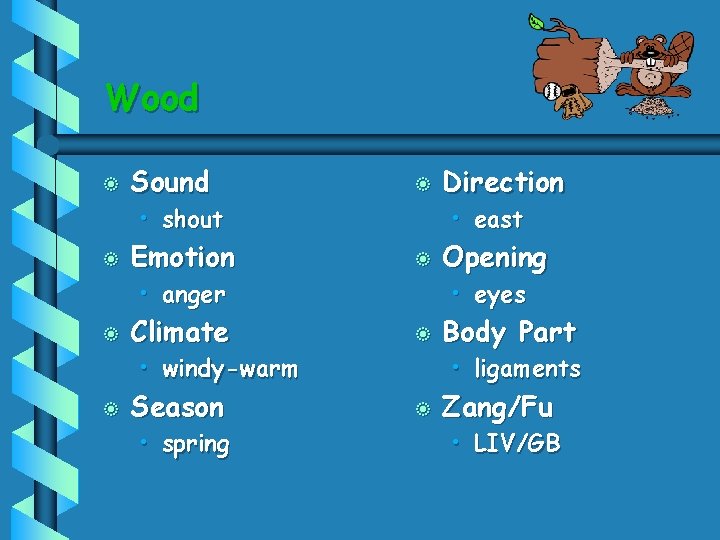
Wood b Sound b Emotion b Climate b Season b • shout b • east • anger b • spring Opening • eyes • windy-warm b Direction Body Part • ligaments Zang/Fu • LIV/GB
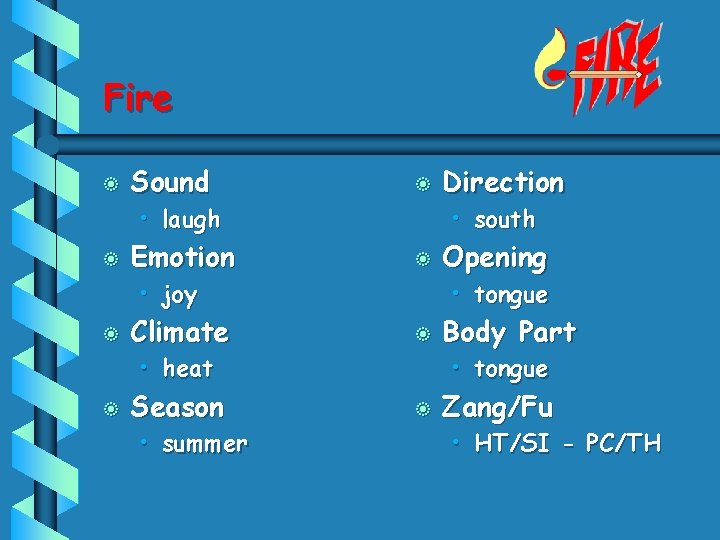
Fire b Sound b Emotion b Climate b Season b • laugh b • south • joy b • summer Opening • tongue • heat b Direction Body Part • tongue Zang/Fu • HT/SI - PC/TH
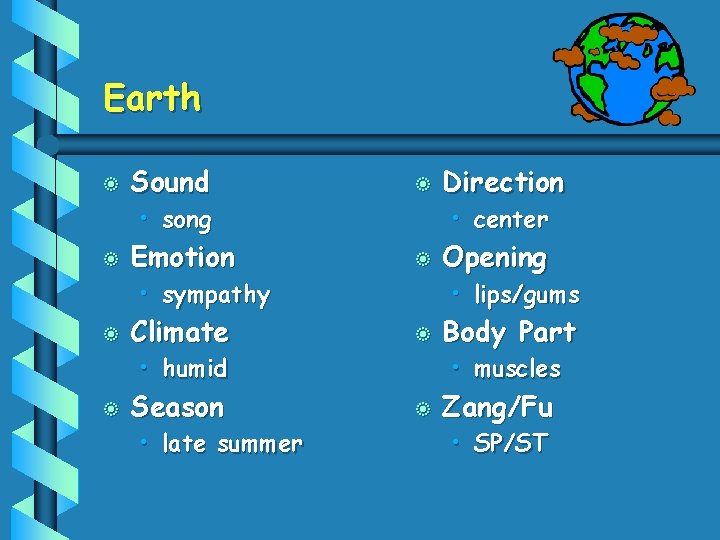
Earth b Sound b Emotion b Climate b Season b • song b • center • sympathy b • late summer Opening • lips/gums • humid b Direction Body Part • muscles Zang/Fu • SP/ST
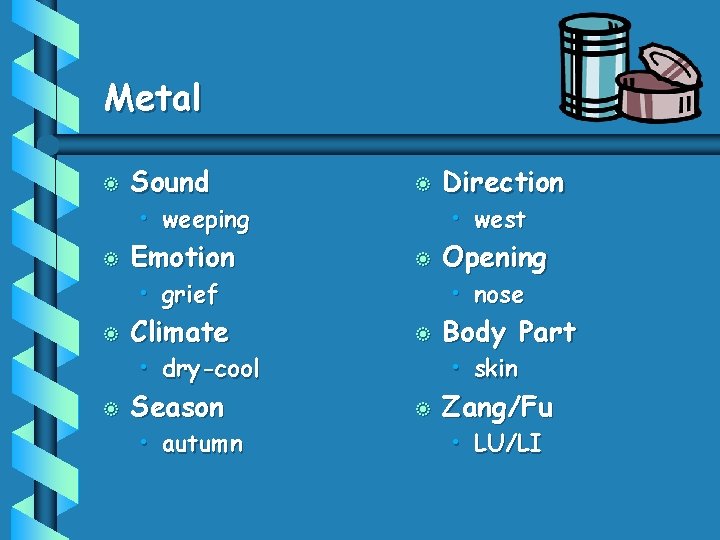
Metal b Sound b Emotion b Climate b Season b • weeping b • west • grief b • autumn Opening • nose • dry-cool b Direction Body Part • skin Zang/Fu • LU/LI
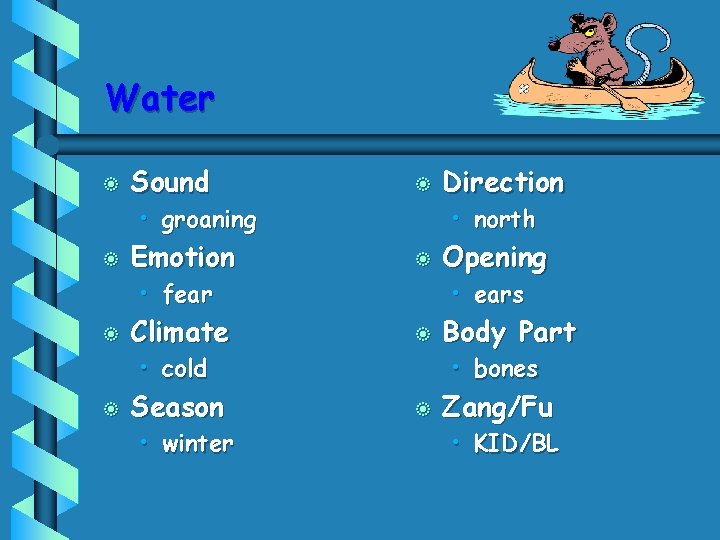
Water b Sound b Emotion b Climate b Season b • groaning b • north • fear b • winter Opening • ears • cold b Direction Body Part • bones Zang/Fu • KID/BL
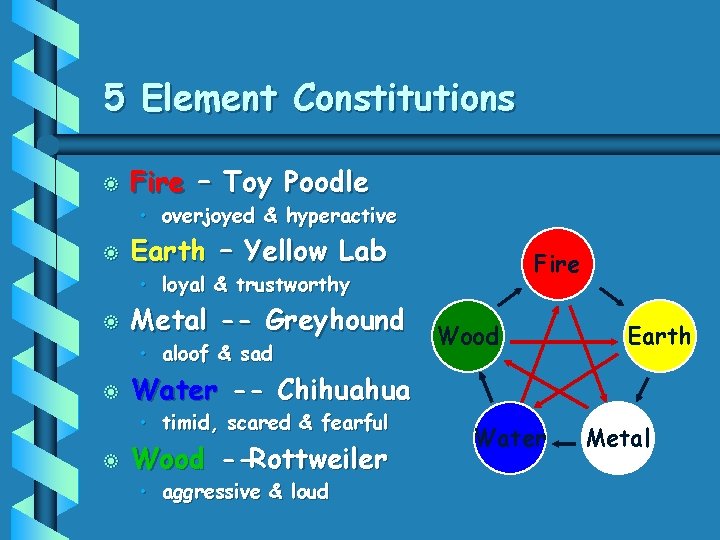
5 Element Constitutions b Fire – Toy Poodle • overjoyed & hyperactive b Earth – Yellow Lab Fire • loyal & trustworthy b Metal -- Greyhound • aloof & sad b Earth Water -- Chihuahua • timid, scared & fearful b Wood --Rottweiler • aggressive & loud Water Metal
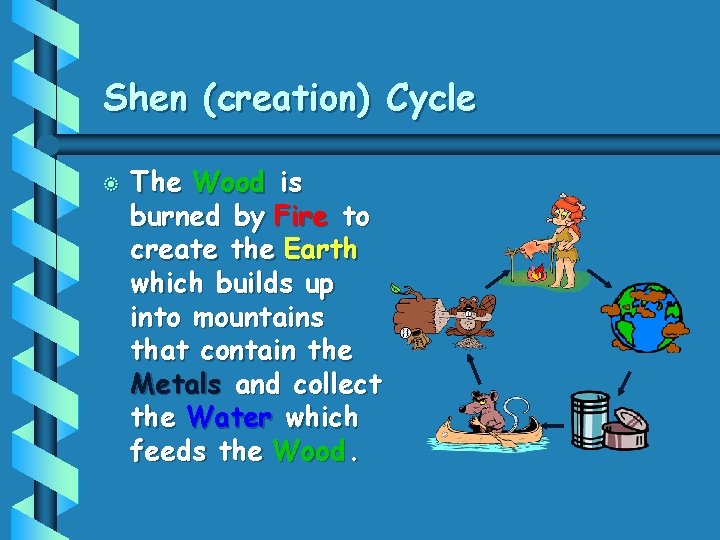
Shen (creation) Cycle b The Wood is burned by Fire to create the Earth which builds up into mountains that contain the Metals and collect the Water which feeds the Wood.
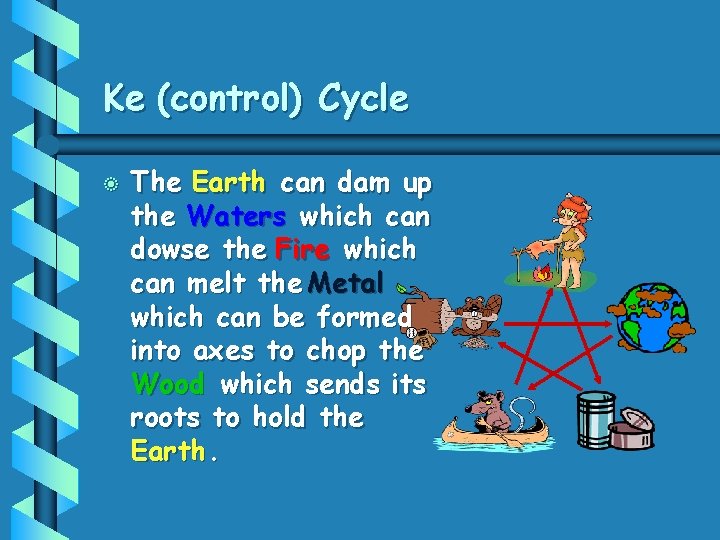
Ke (control) Cycle b The Earth can dam up the Waters which can dowse the Fire which can melt the Metal which can be formed into axes to chop the Wood which sends its roots to hold the Earth.
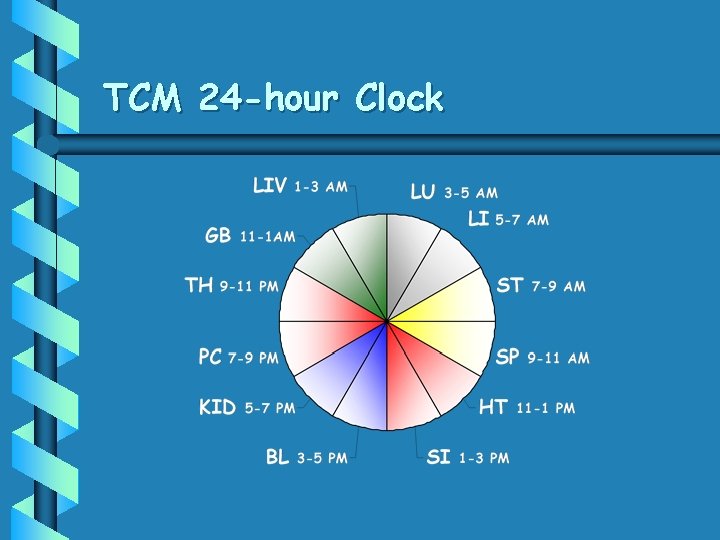
TCM 24 -hour Clock
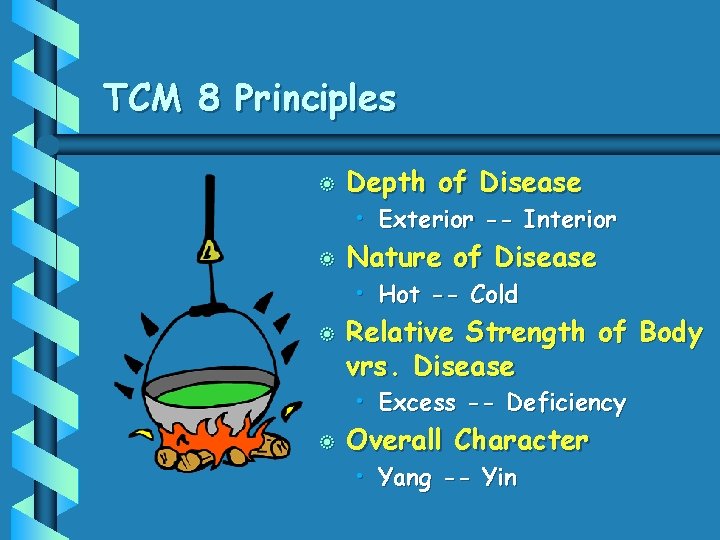
TCM 8 Principles b Depth of Disease • Exterior -- Interior b Nature of Disease • Hot -- Cold b Relative Strength of Body vrs. Disease • Excess -- Deficiency b Overall Character • Yang -- Yin
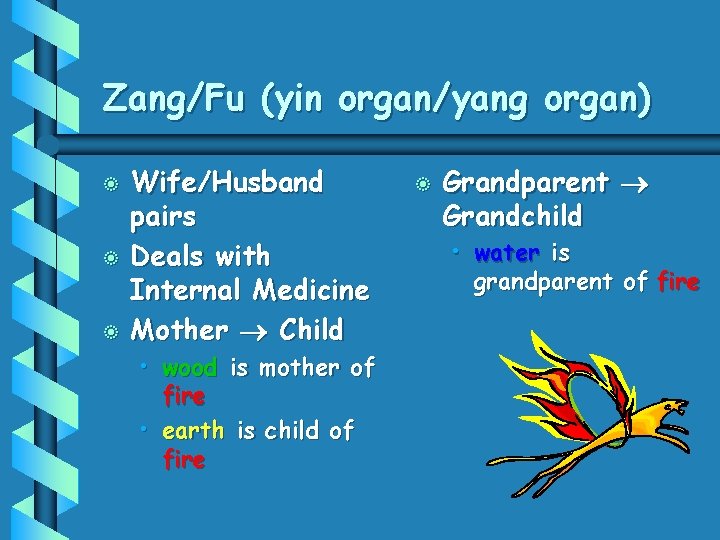
Zang/Fu (yin organ/yang organ) b b b Wife/Husband pairs Deals with Internal Medicine Mother Child • wood is mother of fire • earth is child of fire b Grandparent Grandchild • water is grandparent of fire
Use of TCM Theory b b Balance is the key Support constitutional needs Add treatments for specific problem (local, meridian or zang /fu) Treat master points b b b For Deficiency -Treat parent For Excess --Treat grandparent For Prevention - Treat grandchild
TCM HEART Physiology b Dominates the Blood & Vessels b Houses the Mind b Controls Sweating b Opens in the Tongue
TCM HEART Physiology b Dominates the Blood & Vessels • Motive force behind blood circulation • Requires proper Heart Qi function for normal pulse and mucous membrane color • Deficiency leads to weak, thready pulse and pale tongue
TCM HEART Physiology b Houses the Mind • Mental activity, memory, sleep • Primarily related to Heart Blood • Deficiency of Heart Blood leads to restlessness, anxiety and shen disturbance
TCM HEART Physiology b Controls Sweating • Blood carries body fluid and is interchangeable with it • Body fluid is used to make up sweat • Heart deficiency leads to spontaneous sweating – Night- -Yin – Day- -Yang
TCM HEART Physiology b Opens in the Tongue • Controls color and appearance of the tongue, particularly tip • Deficiency in Heart Blood shows pale (dry) tongue • Excess heat in Heart causes dark red tongue
TCM Pericardium Physiology b b Protects the Heart In Practice, considered the same as the Heart Treat the same May be more related to shen
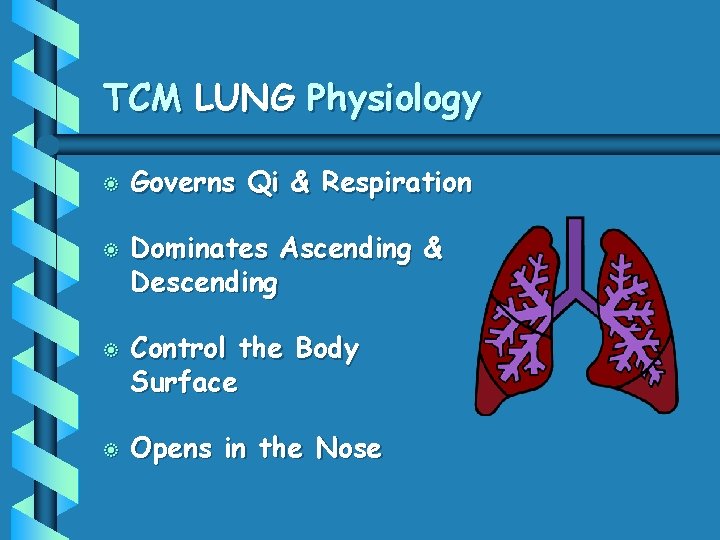
TCM LUNG Physiology b b Governs Qi & Respiration Dominates Ascending & Descending Control the Body Surface Opens in the Nose
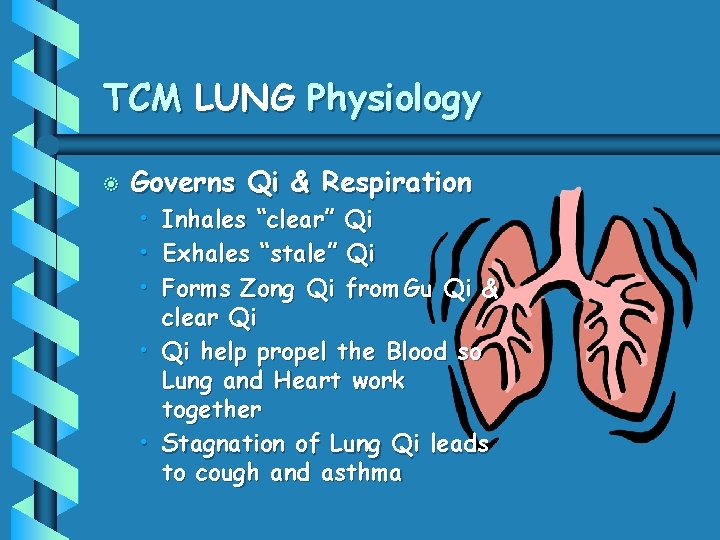
TCM LUNG Physiology b Governs Qi & Respiration • • • Inhales “clear” Qi Exhales “stale” Qi Forms Zong Qi from Gu Qi & clear Qi Qi help propel the Blood so Lung and Heart work together Stagnation of Lung Qi leads to cough and asthma
TCM LUNG Physiology b Dominates Ascending & Descending • Distributes defensive (wie ) Qi and body fluid to entire body • Helps maintain normal descending function, while receiving the ascending water vapor from the kidney
TCM LUNG Physiology b Control the Body Surface • Distributes body fluid to the tissues which in turn helps regulate skin moisture and sweating • Provides Wei Qi
TCM LUNG Physiology b Opens in the Nose • Lung is a canopy over the other organs and very delicate • Easily affected by pathogens (wind, heat, cold or dryness)
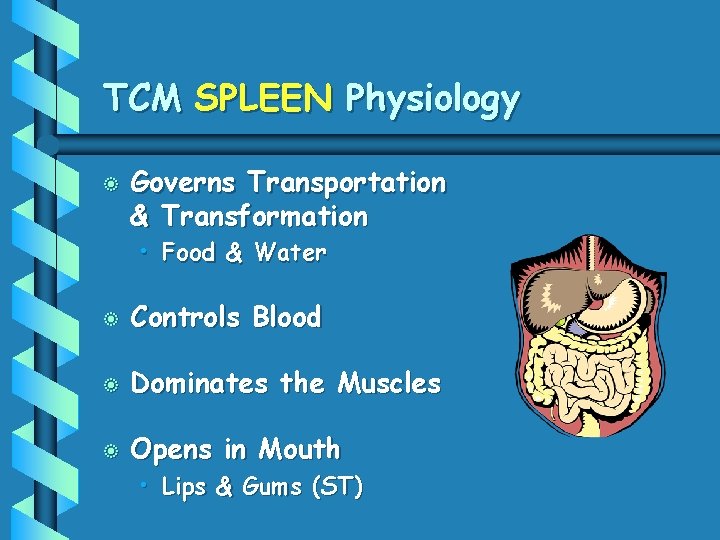
TCM SPLEEN Physiology b Governs Transportation & Transformation • Food & Water b Controls Blood b Dominates the Muscles b Opens in Mouth • Lips & Gums (ST)
TCM SPLEEN Physiology b Governs Transportation & Transformation • Distribution, digestion & absorption of nutrients and water • Dominates post-natal life • SP Qi up- -ST Qi down
TCM SPLEEN Physiology b Controls Blood • Keeps blood in vessels & prevents extravasation • SP important for holding substance – Blood – Hernias – Prolapses
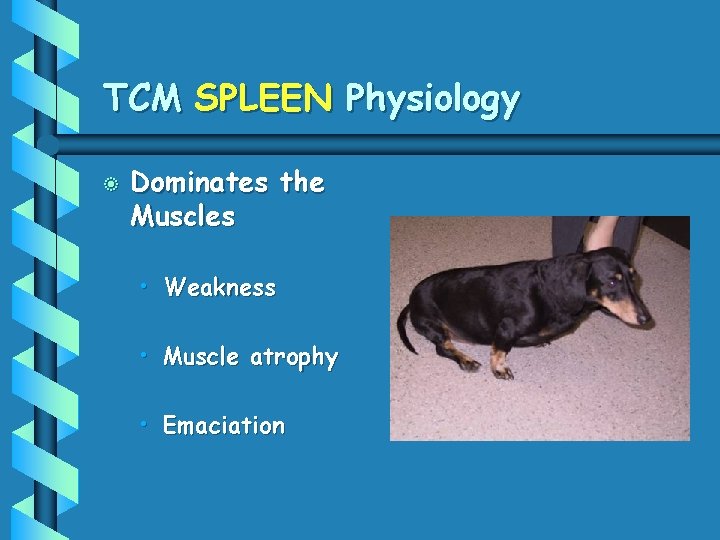
TCM SPLEEN Physiology b Dominates the Muscles • Weakness • Muscle atrophy • Emaciation
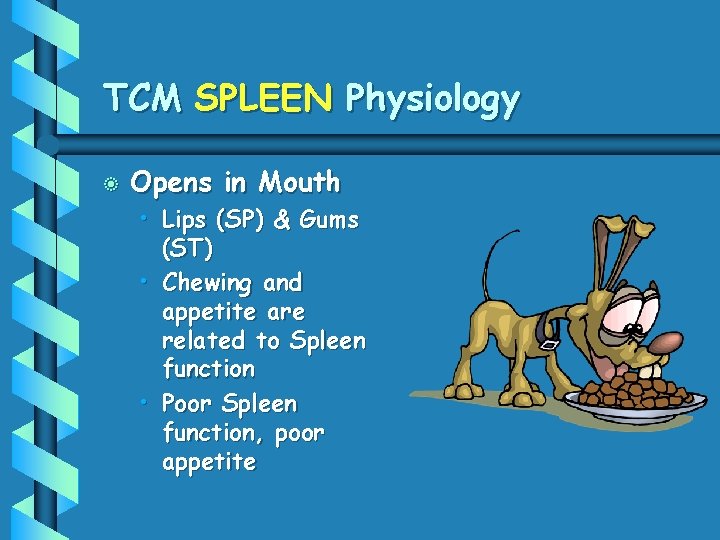
TCM SPLEEN Physiology b Opens in Mouth • Lips (SP) & Gums (ST) • Chewing and appetite are related to Spleen function • Poor Spleen function, poor appetite
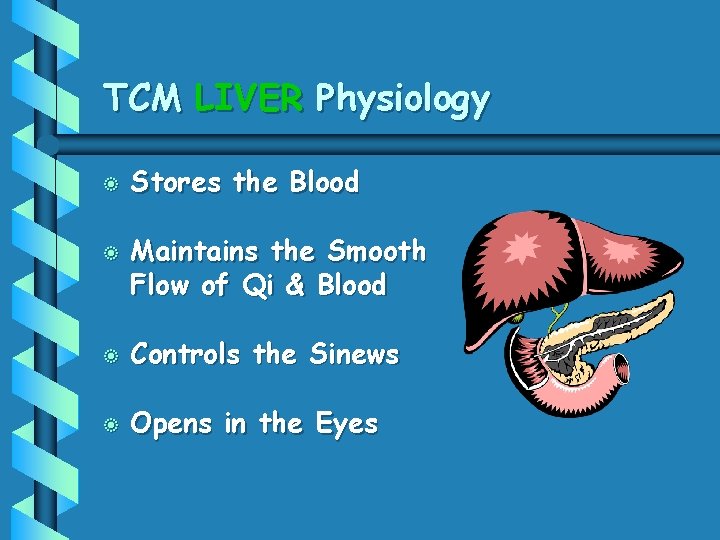
TCM LIVER Physiology b b Stores the Blood Maintains the Smooth Flow of Qi & Blood b Controls the Sinews b Opens in the Eyes
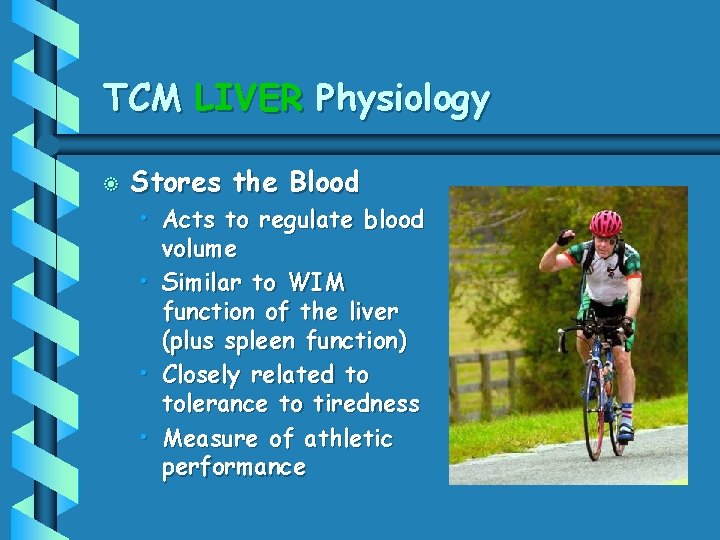
TCM LIVER Physiology b Stores the Blood • Acts to regulate blood volume • Similar to WIM function of the liver (plus spleen function) • Closely related to tolerance to tiredness • Measure of athletic performance
TCM LIVER Physiology b Maintains the Smooth Flow of Qi & Blood • Ensuring SP/ST digestive function • Maintaining vital activities of the body • Maintaining smooth flow of water-damp
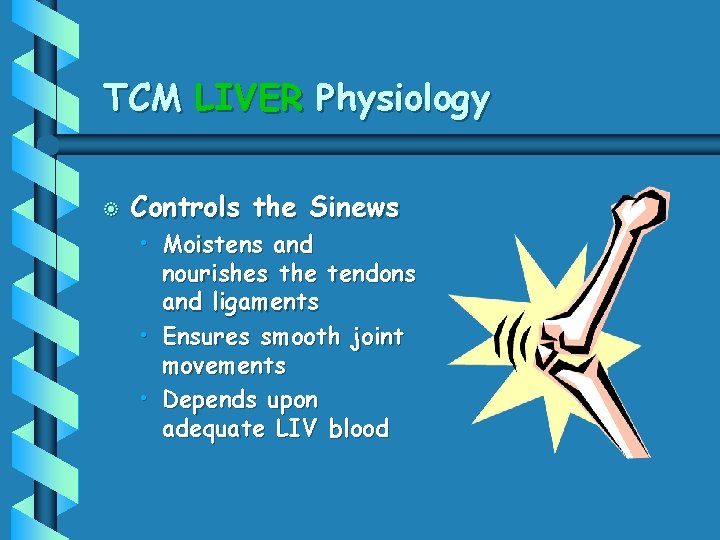
TCM LIVER Physiology b Controls the Sinews • Moistens and nourishes the tendons and ligaments • Ensures smooth joint movements • Depends upon adequate LIV blood
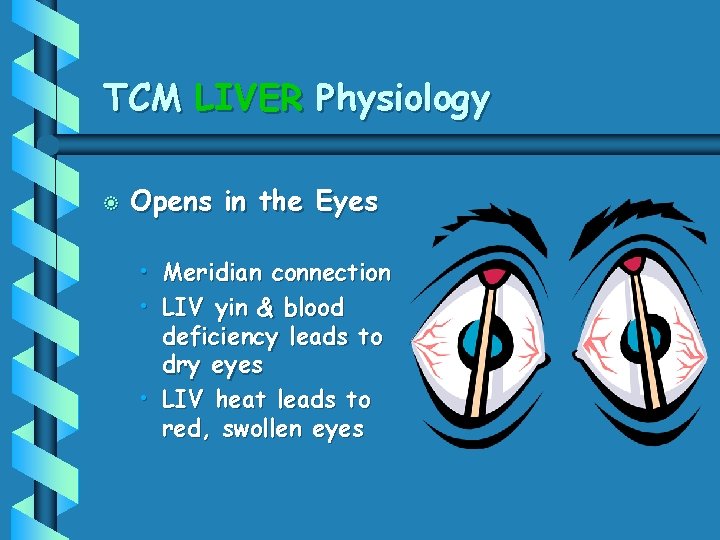
TCM LIVER Physiology b Opens in the Eyes • Meridian connection • LIV yin & blood deficiency leads to dry eyes • LIV heat leads to red, swollen eyes
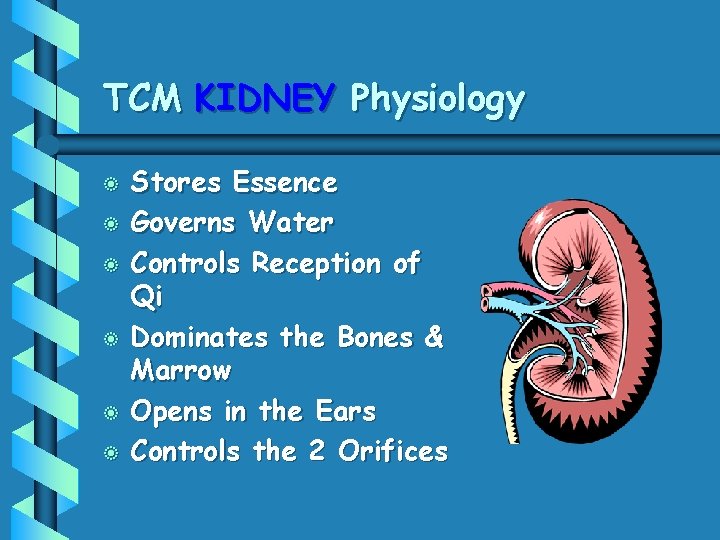
TCM KIDNEY Physiology b b b Stores Essence Governs Water Controls Reception of Qi Dominates the Bones & Marrow Opens in the Ears Controls the 2 Orifices
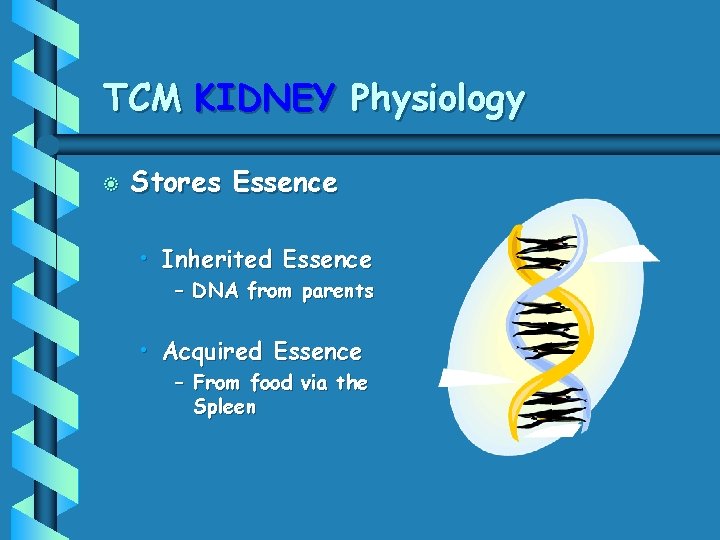
TCM KIDNEY Physiology b Stores Essence • Inherited Essence – DNA from parents • Acquired Essence – From food via the Spleen
TCM KIDNEY Physiology b Governs Water • Gate that regulates water • Separates clear from turbid water • Clear water is boiled to Lung • Turbid water is sent to Bladder
TCM KIDNEY Physiology b Controls Reception of Qi • Holds down Qi received from the Lung • Kidney deficiency leads to asthma
TCM KIDNEY Physiology b Dominates the Bones & Marrow • • Osteoarthritis Teeth Brain & Spinal Cord Bone Marrow (Blood)
TCM KIDNEY Physiology b Opens in the Ears • Associated with hearing and deafness
TCM KIDNEY Physiology b Controls the 2 Orifices • • • Urination Defecation Reproduction
Six Fu Organs b b b Gallbladder Stomach Small Intestine Large Intestine Urinary Bladder Triple Heater
Extraordinary Fu Organs b Brain b Marrow b Bone b Vessels b Gallbladder b Uterus
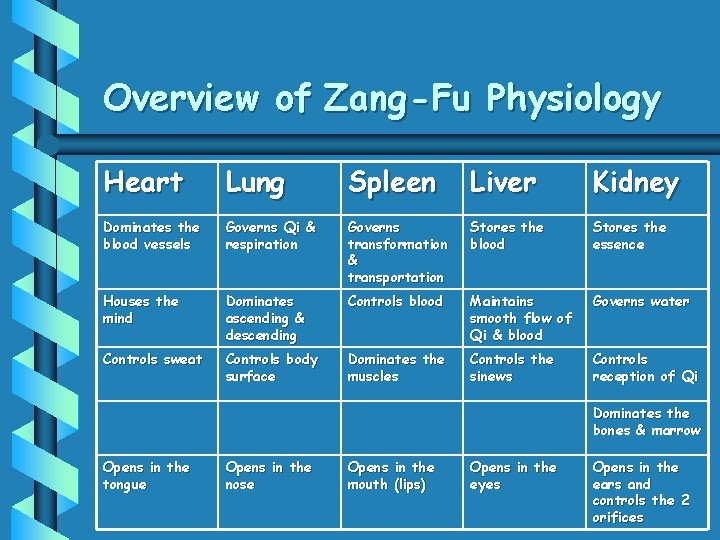
Overview of Zang -Fu Physiology Heart Lung Spleen Liver Kidney Dominates the blood vessels Governs Qi & respiration Governs transformation & transportation Stores the blood Stores the essence Houses the mind Dominates ascending & descending Controls blood Maintains smooth flow of Qi & blood Governs water Controls sweat Controls body surface Dominates the muscles Controls the sinews Controls reception of Qi Dominates the bones & marrow Opens in the tongue Opens in the nose Opens in the mouth (lips) Opens in the eyes Opens in the ears and controls the 2 orifices
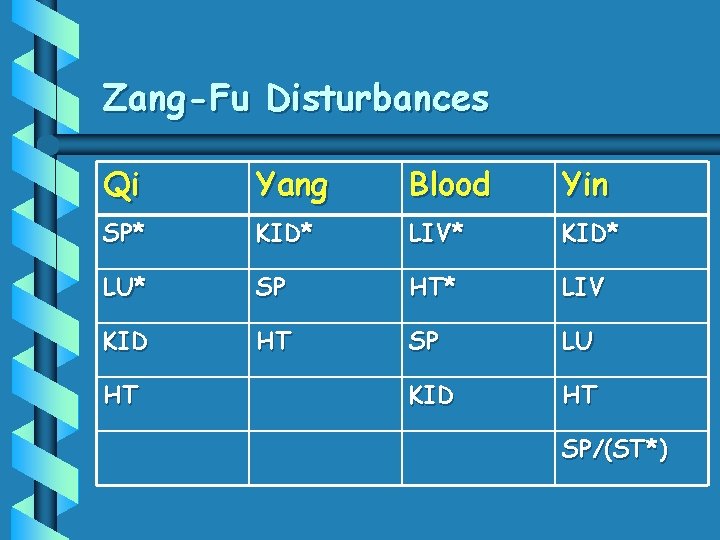
Zang -Fu Disturbances Qi Yang Blood Yin SP* KID* LIV* KID* LU* SP HT* LIV KID HT SP LU KID HT HT SP/(ST*)