
Z SCORESPERCENTILE LEARNING GOALSBIG IDEA Learning goal Students
Z SCORES/PERCENTILE
LEARNING GOALS/BIG IDEA • Learning goal: Students will learn to calculate z-scores, percentiles and will explore the connection between them. • Big Ideas: How data is displayed can affect what conclusions are drawn from the data • Minds On: what is the point of learning Mean, Median, Mode, variance and standard deviation?
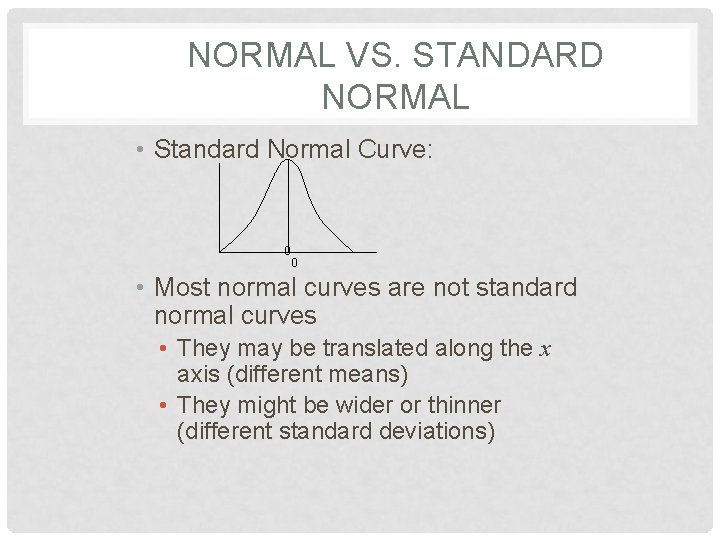
NORMAL VS. STANDARD NORMAL • Standard Normal Curve: 0 0 • Most normal curves are not standard normal curves • They may be translated along the x axis (different means) • They might be wider or thinner (different standard deviations)
WHY IS THIS A PROBLEM? • Imagine there are two MDM 4 U classes. • Mr. X teaches one section, while Ms. Y teaches the other one. • They both have a quiz • Ali scored 60% on Mr. X’s test, while Sandy scored a 70% on Ms. Y’s test. Who did better?
WORKING BETWEEN DISTRIBUTIONS • Ali scored 60% on Mr. X’s test, while Sandy scored a 70% on Ms. Y’s test. Who did better? • It is hard to compare these two different quizzes… maybe Mr. X’s was tougher, and a 60% on his quiz is better than a 70% on Ms. Y’s quiz How many standard deviations away from the means are these scores – this would tell us how we should compare them.
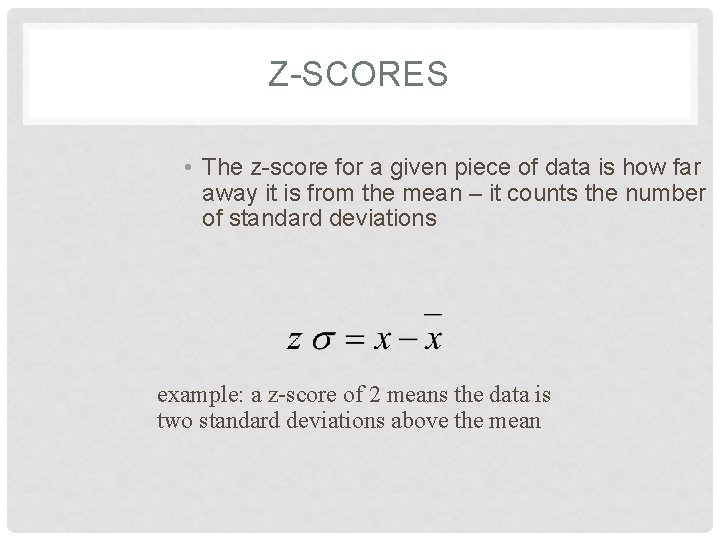
Z-SCORES • The z-score for a given piece of data is how far away it is from the mean – it counts the number of standard deviations example: a z-score of 2 means the data is two standard deviations above the mean
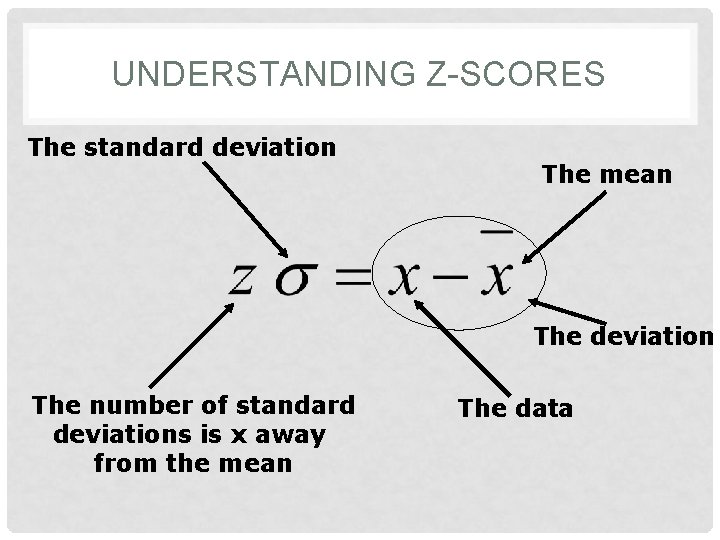
UNDERSTANDING Z-SCORES The standard deviation The mean The deviation The number of standard deviations is x away from the mean The data

CALCULATING Z-SCORES The data The mean number of standard deviations is x away from the mean The deviation The z-score is the deviation divided by the standard deviation The standard deviation
WHY Z-SCORES? • Z-Scores allow us to convert any normal distribution to a standard normal distribution • This lets us compare distributions
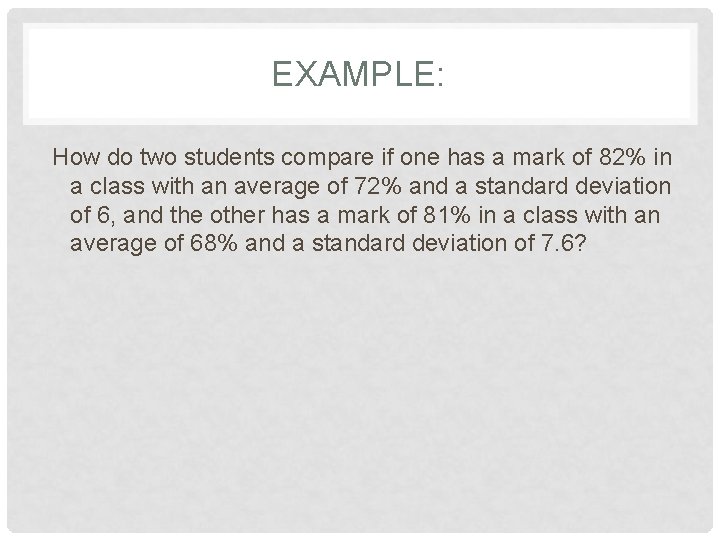
EXAMPLE: How do two students compare if one has a mark of 82% in a class with an average of 72% and a standard deviation of 6, and the other has a mark of 81% in a class with an average of 68% and a standard deviation of 7. 6?
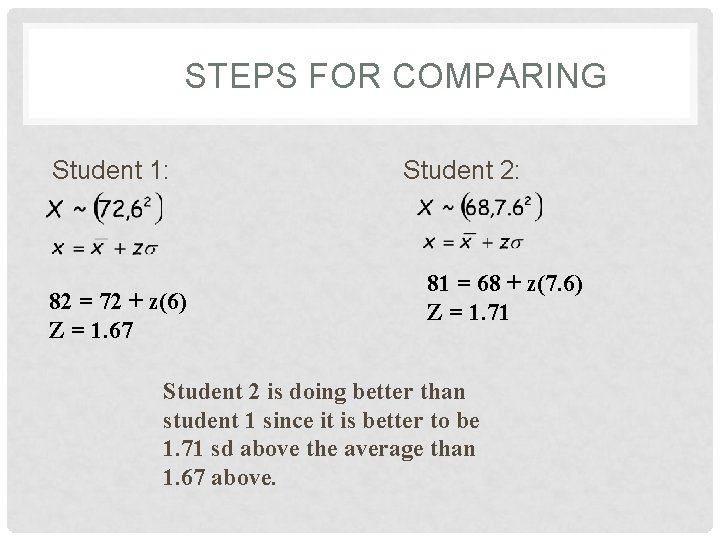
STEPS FOR COMPARING Student 1: 82 = 72 + z(6) Z = 1. 67 Student 2: 81 = 68 + z(7. 6) Z = 1. 71 Student 2 is doing better than student 1 since it is better to be 1. 71 sd above the average than 1. 67 above.
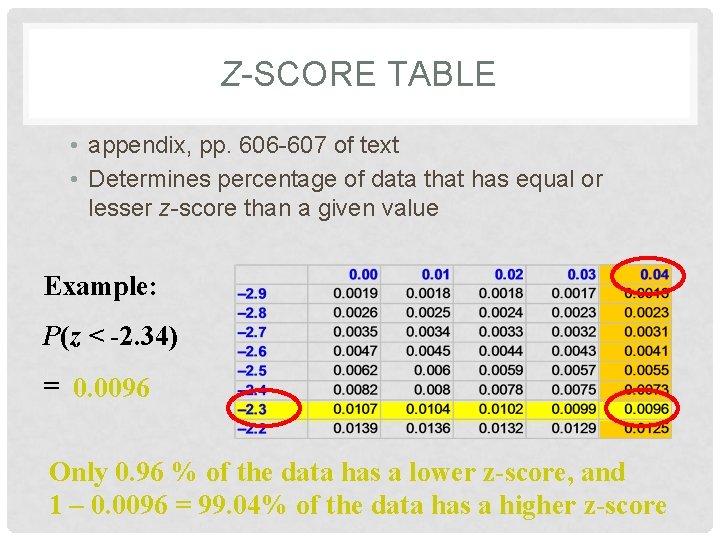
Z-SCORE TABLE • appendix, pp. 606 -607 of text • Determines percentage of data that has equal or lesser z-score than a given value Example: P(z < -2. 34) = 0. 0096 Only 0. 96 % of the data has a lower z-score, and 1 – 0. 0096 = 99. 04% of the data has a higher z-score
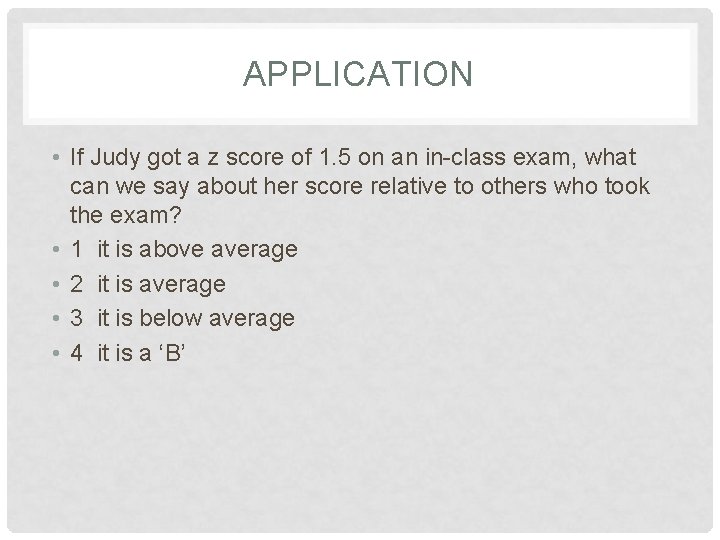
APPLICATION • If Judy got a z score of 1. 5 on an in-class exam, what can we say about her score relative to others who took the exam? • 1 it is above average • 2 it is average • 3 it is below average • 4 it is a ‘B’
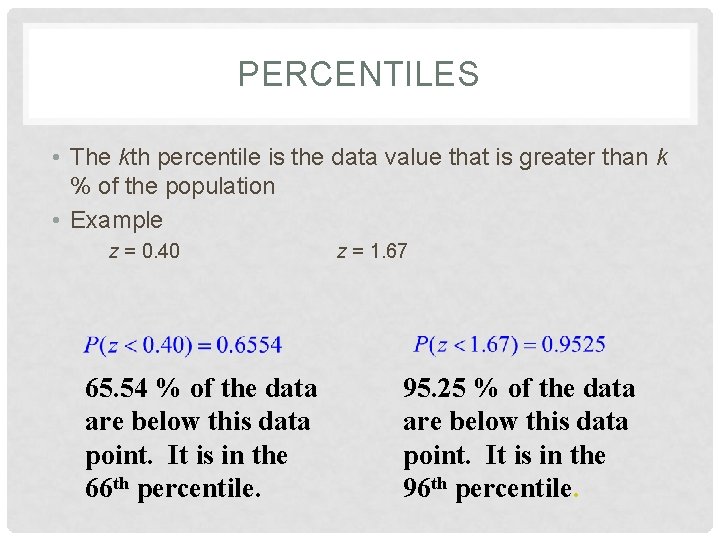
PERCENTILES • The kth percentile is the data value that is greater than k % of the population • Example z = 0. 40 65. 54 % of the data are below this data point. It is in the 66 th percentile. z = 1. 67 95. 25 % of the data are below this data point. It is in the 96 th percentile.
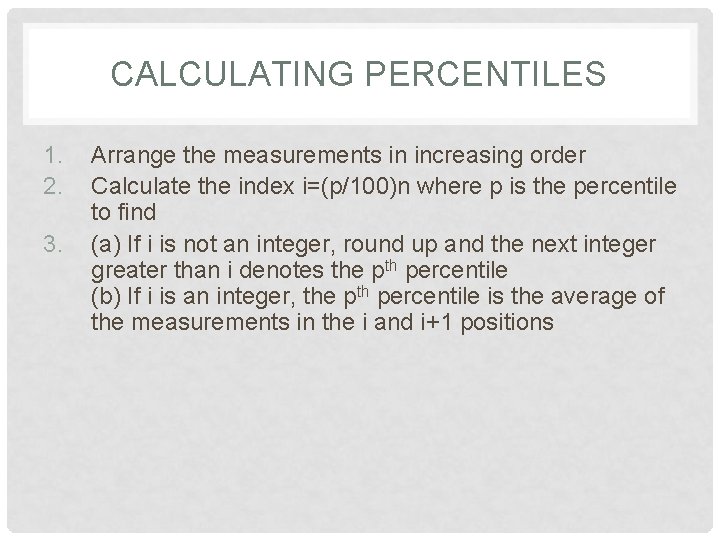
CALCULATING PERCENTILES 1. 2. 3. Arrange the measurements in increasing order Calculate the index i=(p/100)n where p is the percentile to find (a) If i is not an integer, round up and the next integer greater than i denotes the pth percentile (b) If i is an integer, the pth percentile is the average of the measurements in the i and i+1 positions
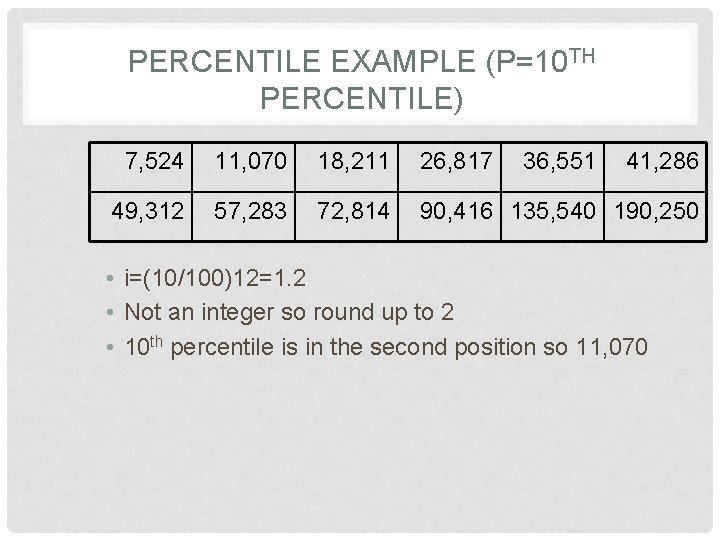
PERCENTILE EXAMPLE (P=10 TH PERCENTILE) 7, 524 11, 070 18, 211 26, 817 36, 551 41, 286 49, 312 57, 283 72, 814 90, 416 135, 540 190, 250 • i=(10/100)12=1. 2 • Not an integer so round up to 2 • 10 th percentile is in the second position so 11, 070
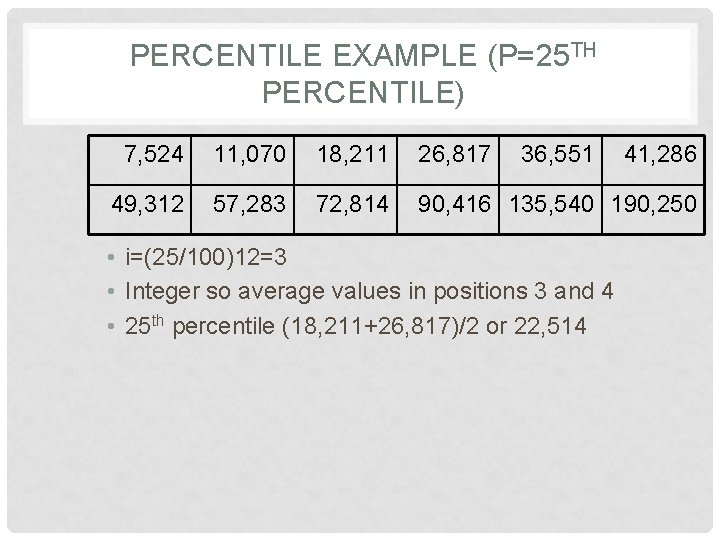
PERCENTILE EXAMPLE (P=25 TH PERCENTILE) 7, 524 11, 070 18, 211 26, 817 36, 551 49, 312 57, 283 72, 814 90, 416 135, 540 190, 250 • i=(25/100)12=3 • Integer so average values in positions 3 and 4 • 25 th percentile (18, 211+26, 817)/2 or 22, 514 41, 286
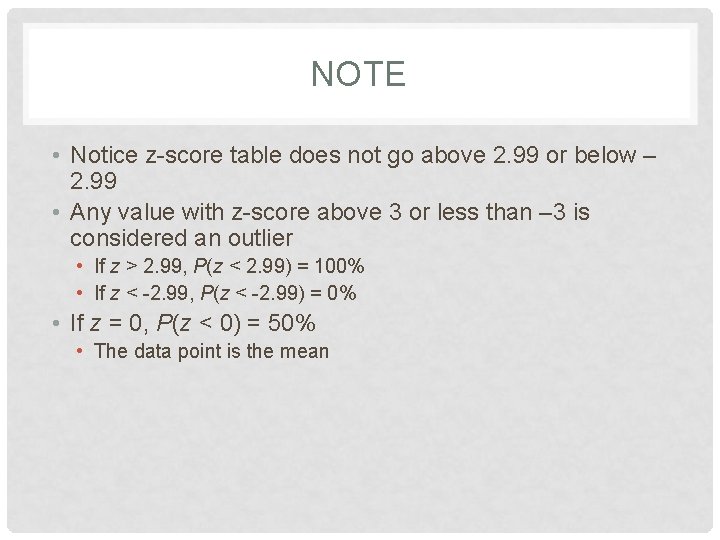
NOTE • Notice z-score table does not go above 2. 99 or below – 2. 99 • Any value with z-score above 3 or less than – 3 is considered an outlier • If z > 2. 99, P(z < 2. 99) = 100% • If z < -2. 99, P(z < -2. 99) = 0% • If z = 0, P(z < 0) = 50% • The data point is the mean
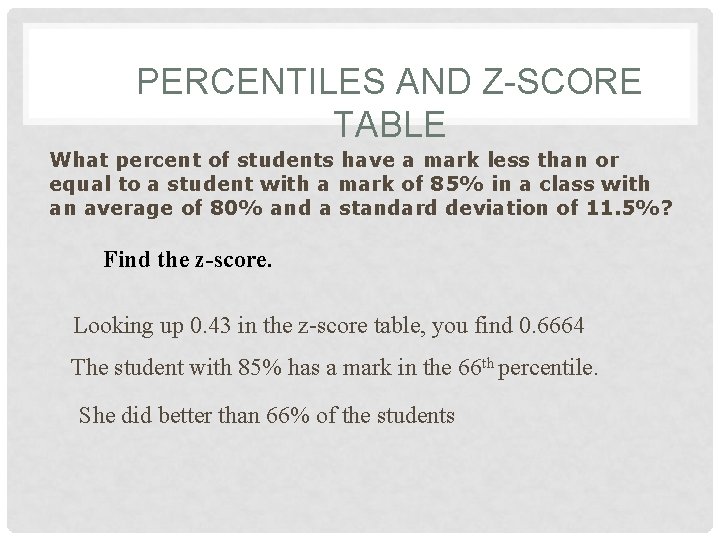
PERCENTILES AND Z-SCORE TABLE What percent of students have a mark less than or equal to a student with a mark of 85% in a class with an average of 80% and a standard deviation of 11. 5%? Find the z-score. Looking up 0. 43 in the z-score table, you find 0. 6664 The student with 85% has a mark in the 66 th percentile. She did better than 66% of the students
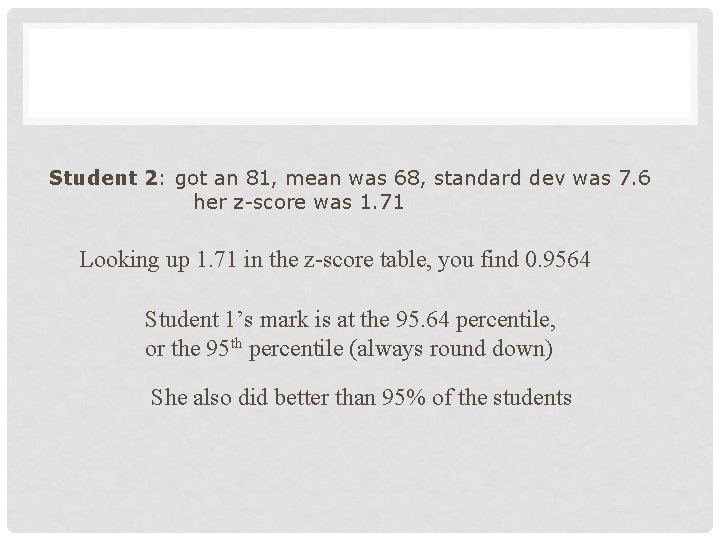
Student 2: got an 81, mean was 68, standard dev was 7. 6 her z-score was 1. 71 Looking up 1. 71 in the z-score table, you find 0. 9564 Student 1’s mark is at the 95. 64 percentile, or the 95 th percentile (always round down) She also did better than 95% of the students
EXIT TICKET • Pg 149 Question 15
- Slides: 21