
z Chapter 8 An Introduction to Metabolism z
z Chapter 8 An Introduction to Metabolism
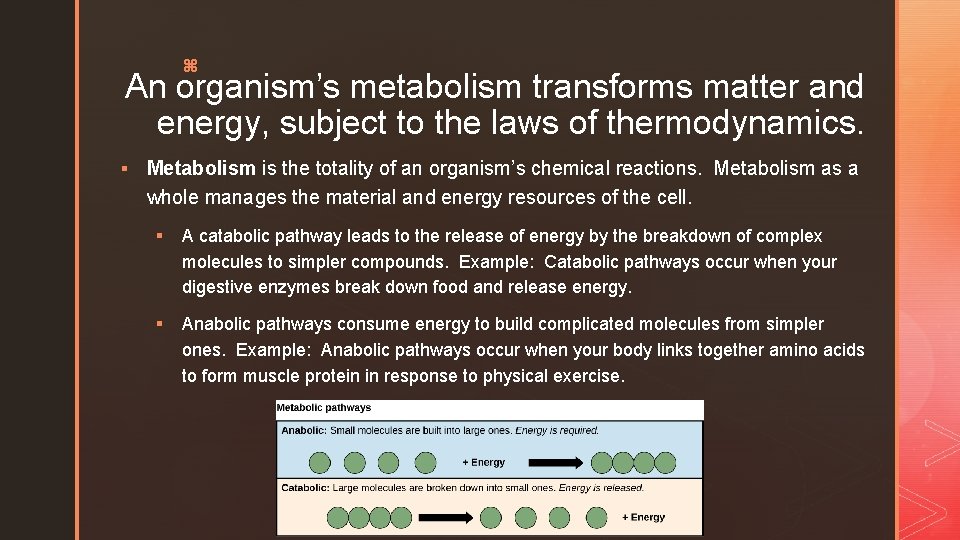
z An organism’s metabolism transforms matter and energy, subject to the laws of thermodynamics. § Metabolism is the totality of an organism’s chemical reactions. Metabolism as a whole manages the material and energy resources of the cell. § A catabolic pathway leads to the release of energy by the breakdown of complex molecules to simpler compounds. Example: Catabolic pathways occur when your digestive enzymes break down food and release energy. § Anabolic pathways consume energy to build complicated molecules from simpler ones. Example: Anabolic pathways occur when your body links together amino acids to form muscle protein in response to physical exercise.
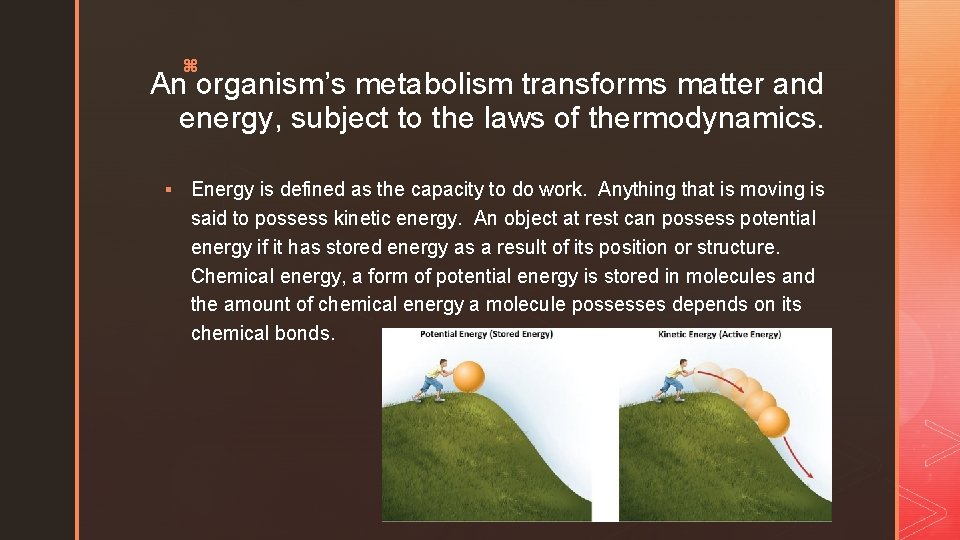
z An organism’s metabolism transforms matter and energy, subject to the laws of thermodynamics. § Energy is defined as the capacity to do work. Anything that is moving is said to possess kinetic energy. An object at rest can possess potential energy if it has stored energy as a result of its position or structure. Chemical energy, a form of potential energy is stored in molecules and the amount of chemical energy a molecule possesses depends on its chemical bonds.
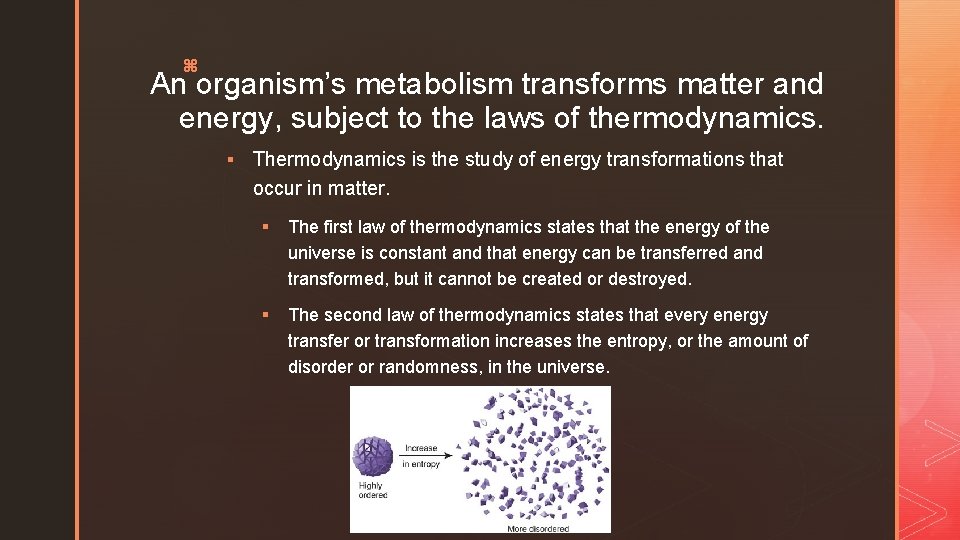
z An organism’s metabolism transforms matter and energy, subject to the laws of thermodynamics. § Thermodynamics is the study of energy transformations that occur in matter. § The first law of thermodynamics states that the energy of the universe is constant and that energy can be transferred and transformed, but it cannot be created or destroyed. § The second law of thermodynamics states that every energy transfer or transformation increases the entropy, or the amount of disorder or randomness, in the universe.
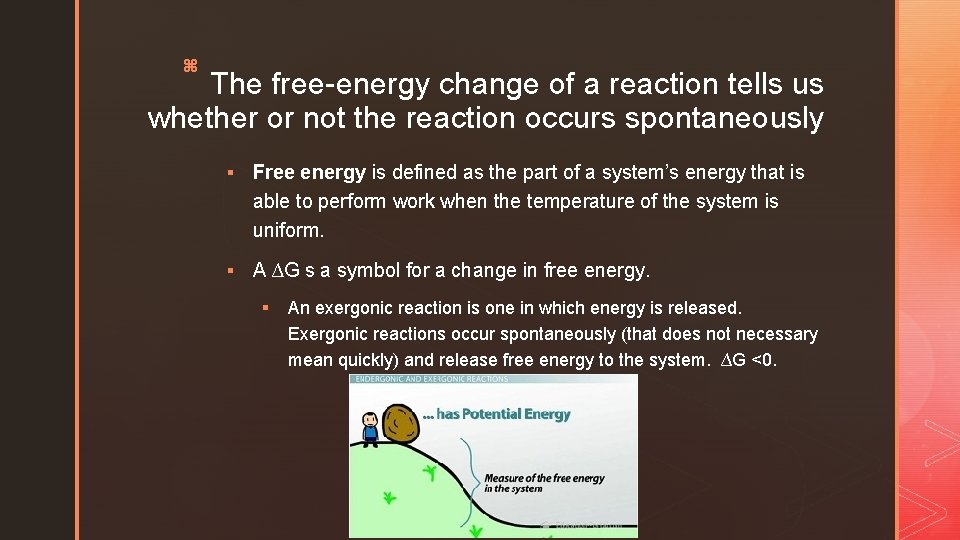
z The free-energy change of a reaction tells us whether or not the reaction occurs spontaneously § Free energy is defined as the part of a system’s energy that is able to perform work when the temperature of the system is uniform. § A ∆G s a symbol for a change in free energy. § An exergonic reaction is one in which energy is released. Exergonic reactions occur spontaneously (that does not necessary mean quickly) and release free energy to the system. ∆G <0.
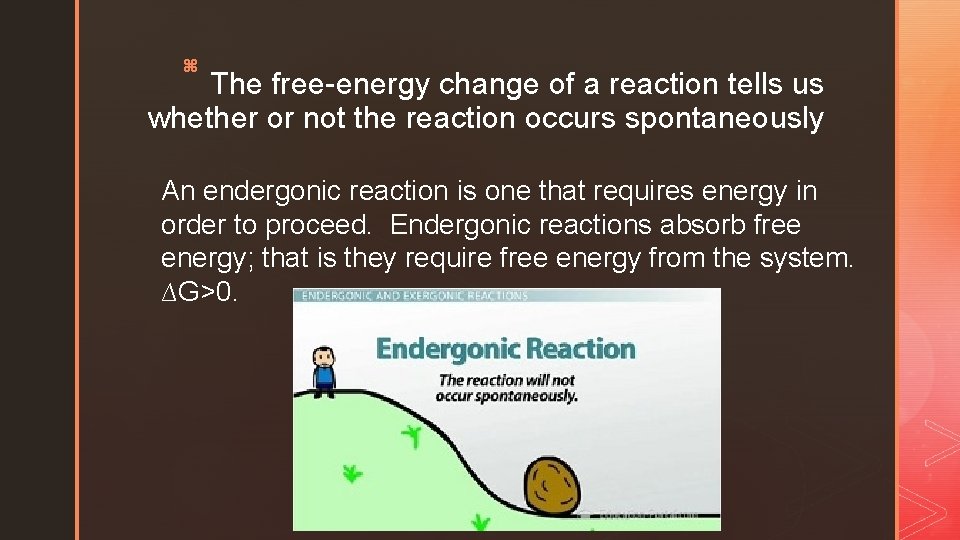
z The free-energy change of a reaction tells us whether or not the reaction occurs spontaneously An endergonic reaction is one that requires energy in order to proceed. Endergonic reactions absorb free energy; that is they require free energy from the system. ∆G>0.

z ATP powers cellular work by coupling exergonic reactions to endergonic reactions § A key feature I the way cells manage their energy resources to do cell work is energy coupling, the use of an exergonic process to drive an endergonic one.
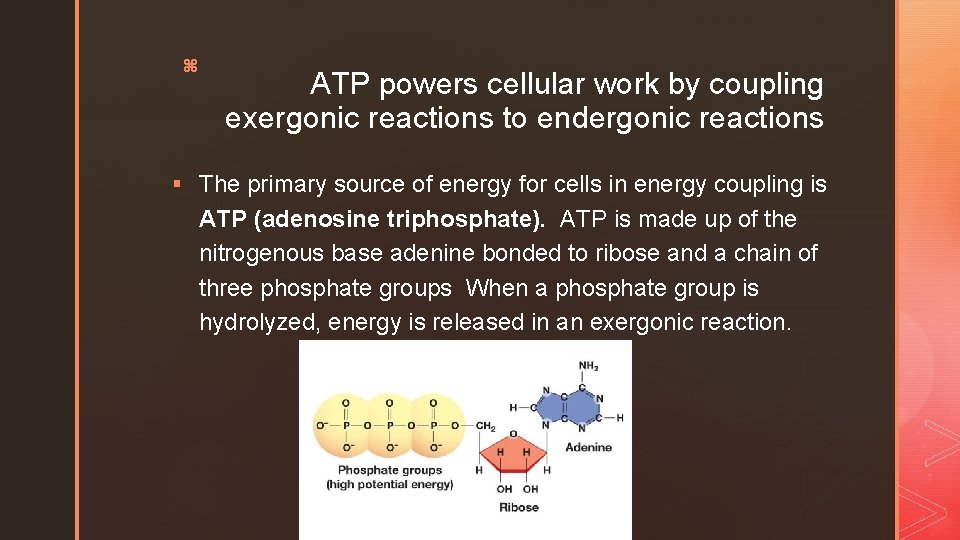
z ATP powers cellular work by coupling exergonic reactions to endergonic reactions § The primary source of energy for cells in energy coupling is ATP (adenosine triphosphate). ATP is made up of the nitrogenous base adenine bonded to ribose and a chain of three phosphate groups When a phosphate group is hydrolyzed, energy is released in an exergonic reaction.
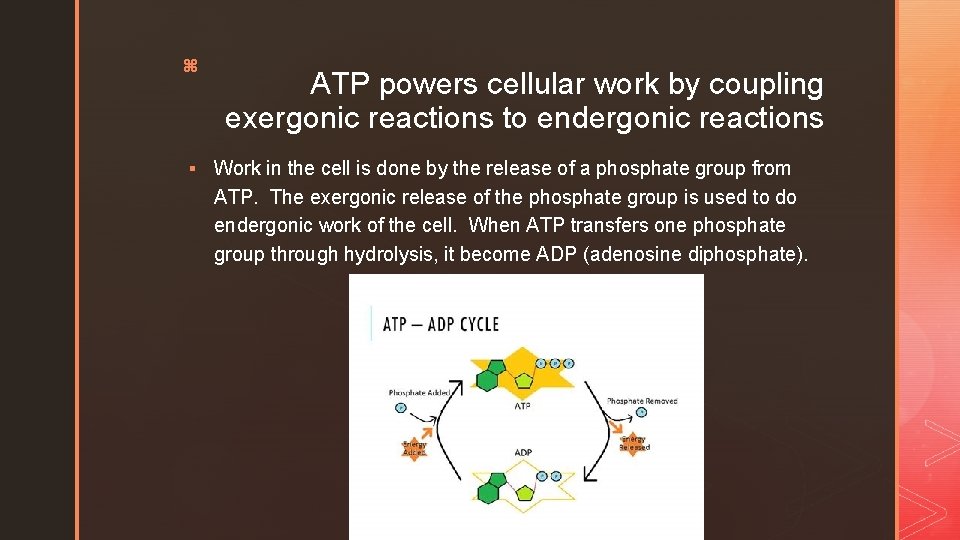
z ATP powers cellular work by coupling exergonic reactions to endergonic reactions § Work in the cell is done by the release of a phosphate group from ATP. The exergonic release of the phosphate group is used to do endergonic work of the cell. When ATP transfers one phosphate group through hydrolysis, it become ADP (adenosine diphosphate).
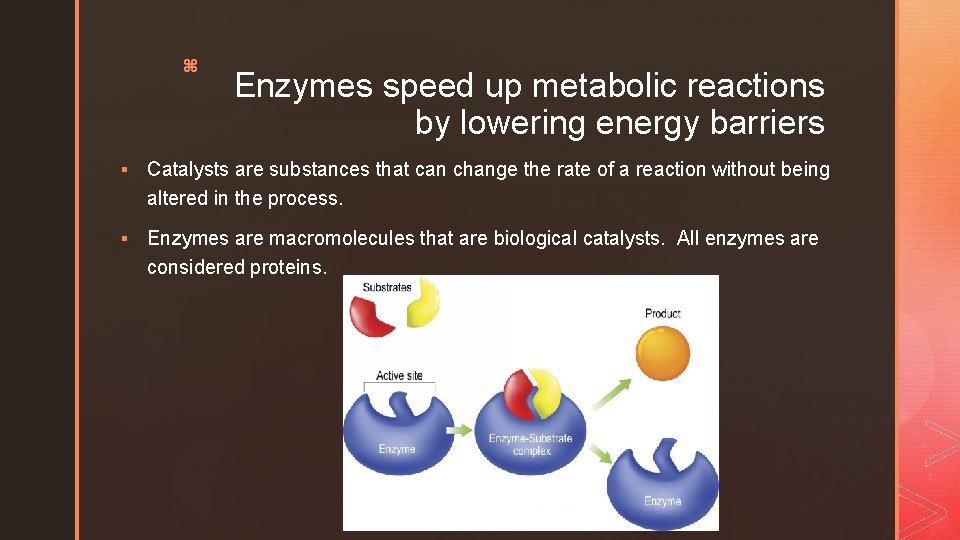
z Enzymes speed up metabolic reactions by lowering energy barriers § Catalysts are substances that can change the rate of a reaction without being altered in the process. § Enzymes are macromolecules that are biological catalysts. All enzymes are considered proteins.
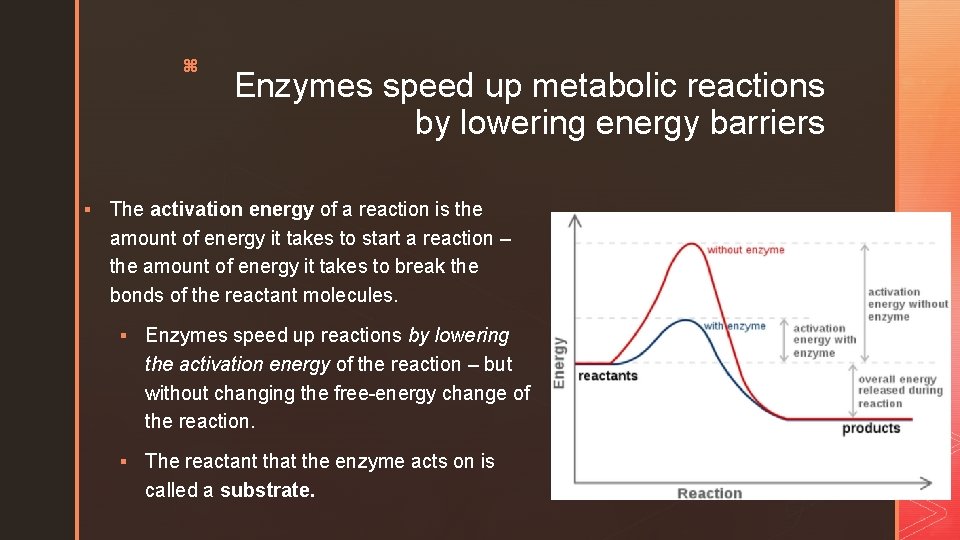
z Enzymes speed up metabolic reactions by lowering energy barriers § The activation energy of a reaction is the amount of energy it takes to start a reaction – the amount of energy it takes to break the bonds of the reactant molecules. § Enzymes speed up reactions by lowering the activation energy of the reaction – but without changing the free-energy change of the reaction. § The reactant that the enzyme acts on is called a substrate.
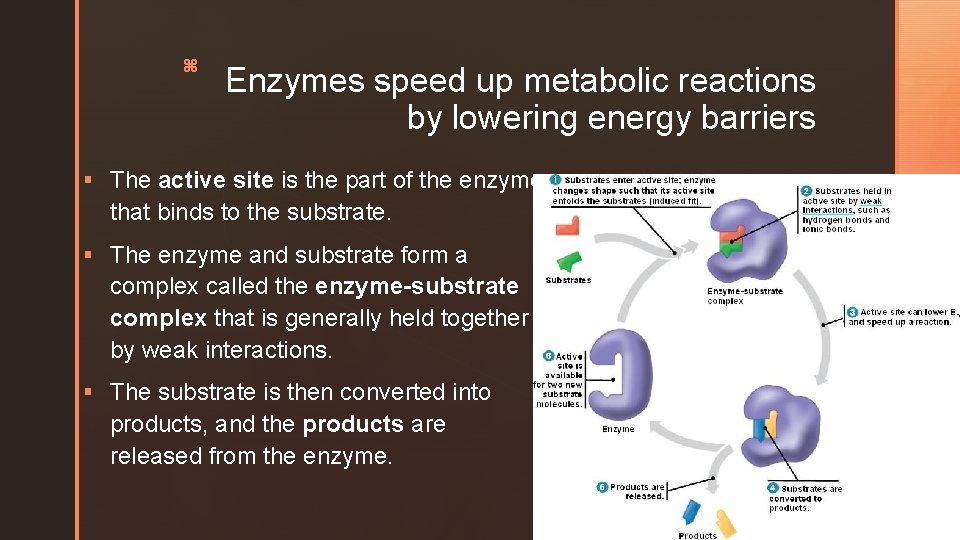
z Enzymes speed up metabolic reactions by lowering energy barriers § The active site is the part of the enzyme that binds to the substrate. § The enzyme and substrate form a complex called the enzyme-substrate complex that is generally held together by weak interactions. § The substrate is then converted into products, and the products are released from the enzyme.
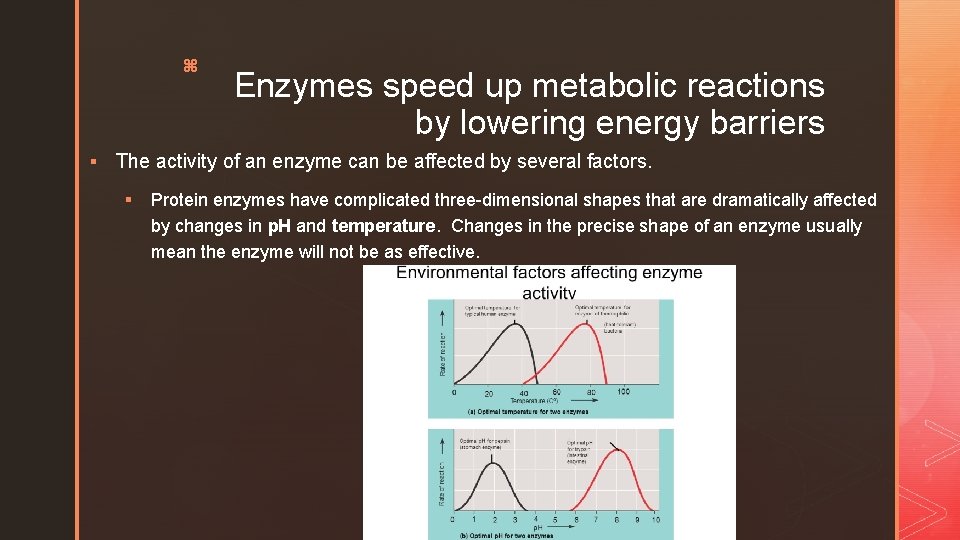
z Enzymes speed up metabolic reactions by lowering energy barriers § The activity of an enzyme can be affected by several factors. § Protein enzymes have complicated three-dimensional shapes that are dramatically affected by changes in p. H and temperature. Changes in the precise shape of an enzyme usually mean the enzyme will not be as effective.
z Enzymes speed up metabolic reactions by lowering energy barriers § Many enzymes require nonprotein helper, termed cofactors, to function properly. § Cofactors include metal ions like zinc, iron, and copper and function in some crucial way to allow catalysis to occur. § If the cofactor is organic, it is more properly referred to as a coenzyme. § Coenzymes are organic cofactors; vitamins are examples of coenzymes.
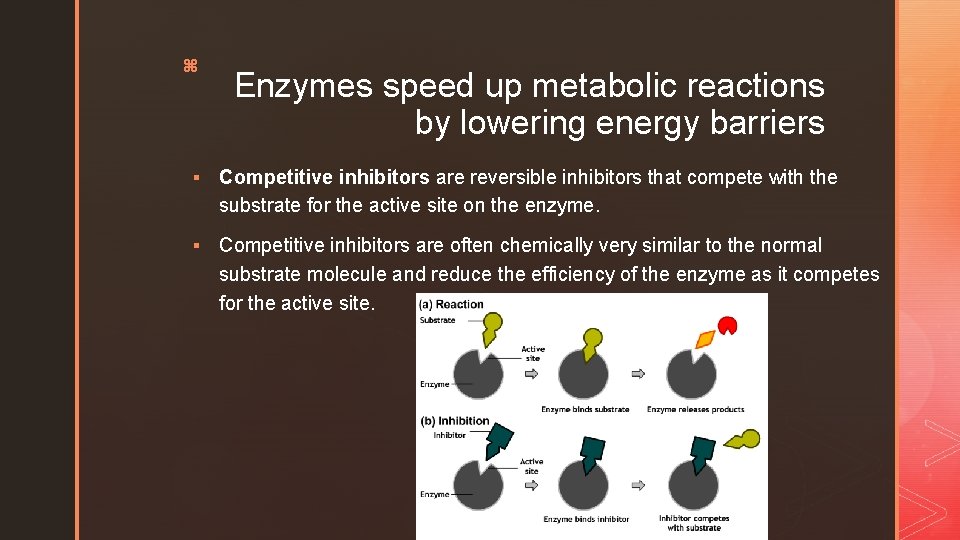
z Enzymes speed up metabolic reactions by lowering energy barriers § Competitive inhibitors are reversible inhibitors that compete with the substrate for the active site on the enzyme. § Competitive inhibitors are often chemically very similar to the normal substrate molecule and reduce the efficiency of the enzyme as it competes for the active site.
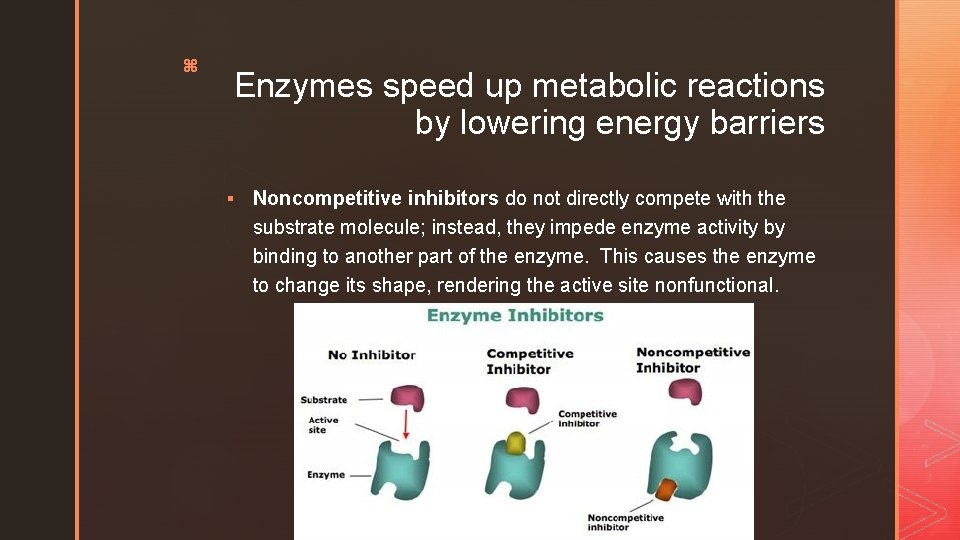
z Enzymes speed up metabolic reactions by lowering energy barriers § Noncompetitive inhibitors do not directly compete with the substrate molecule; instead, they impede enzyme activity by binding to another part of the enzyme. This causes the enzyme to change its shape, rendering the active site nonfunctional.
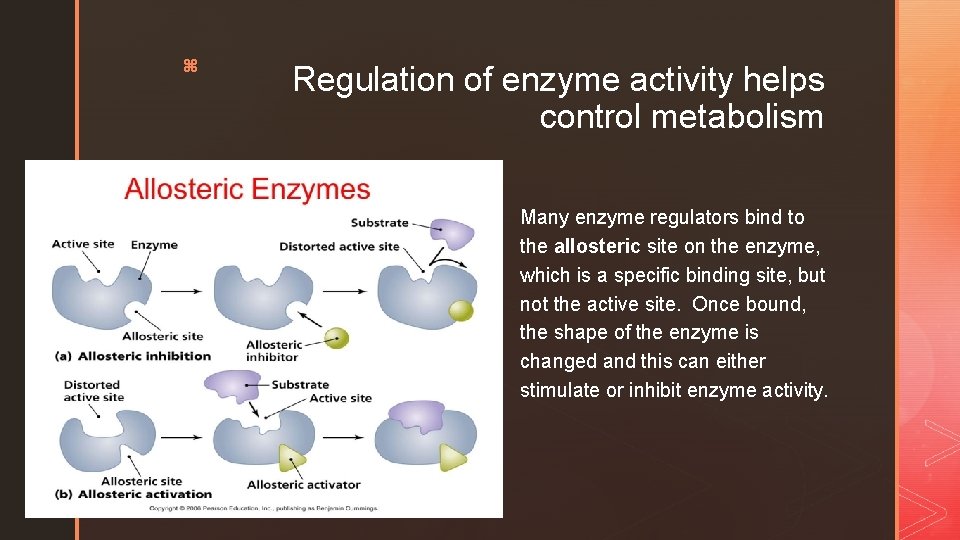
z Regulation of enzyme activity helps control metabolism § Many enzyme regulators bind to the allosteric site on the enzyme, which is a specific binding site, but not the active site. Once bound, the shape of the enzyme is changed and this can either stimulate or inhibit enzyme activity.
z Regulation of enzyme activity helps control metabolism § The end product on an enzymatic pathway can switch off its pathway by binding to the allosteric site of an enzyme in the pathway. This type of allosteric inhibition is termed feedback inhibition. Feedback inhibition increases the efficiency of the pathway by turning it off when the end product accumulates in the cell. https: //www. youtube. com/watch? v=LKi. Xfqa. WNHI
- Slides: 18