
Z boson mass reconstruction Caroline Steiblin Prof Al
Z boson mass reconstruction Caroline Steiblin Prof. Al Goshaw Dr. Andrea Bocci Duke University 1
Purpose • Comparing Monte-Carlo (MC) simulations of Z boson mass reconstruction from muons, photons, and electrons to LHC data, to find agreement and qualitative proof of electron-photon fake rates • Identify the Z boson as a true photon source for identification tests 2
ATLAS Detector A Toroidal LHC Apparatu. S • The ATLAS detector consists of four major components: • The inner detector to measure the momentum of charged particles • A calorimeter to measure particle energy (main part used) • A muon spectrometer to identify muons and measure their momenta • A magnet system to bend charged particles for measurement • Reconstruction algorithms are used to identify different particle trajectories for identification and analysis 3
Standard Model • The Standard Model allows the Z boson to decay into a lepton and anti-lepton (eg. +/- muon) and a photon, but not three leptons (eg. +/- muon and an electron). • Data can show a violation of the Standard Model with three leptons, which may demonstrate the possibility of an electron faking a photon. 4
Z boson • Charge-less, spin 1, 91 Ge. V particle • Decays to a an fermion/anti-fermion pair • Experimentally well understood and easy to reconstruct with low background • Focused on Z μ+μ-γ and Z μ+μ-e- decay, as muons are efficiently reconstructed, and offer a sample of pure photons • Data used from full 2012 8 Te. V data and simulated Monte Carlo program 5
Photon reconstruction • Reconstruction of photons, which do not leave tracks in the calorimeter • Electrons leave tracks though, and are placed with similar electromagnetic clusters, so interchanging one for the other is not uncommon • While traversing a material, a photon can decay into an electron and positron, which leads to misidentification 6
Fake rate of electrons and photons • Misidentification of photons during Z boson reconstruction can lead to anomalies in data, which can lead to inaccurate results, and mass predictions • Number of electrons present in both full data sample and Monte Carlo is much lower than that of photons produced in the muon channel 7
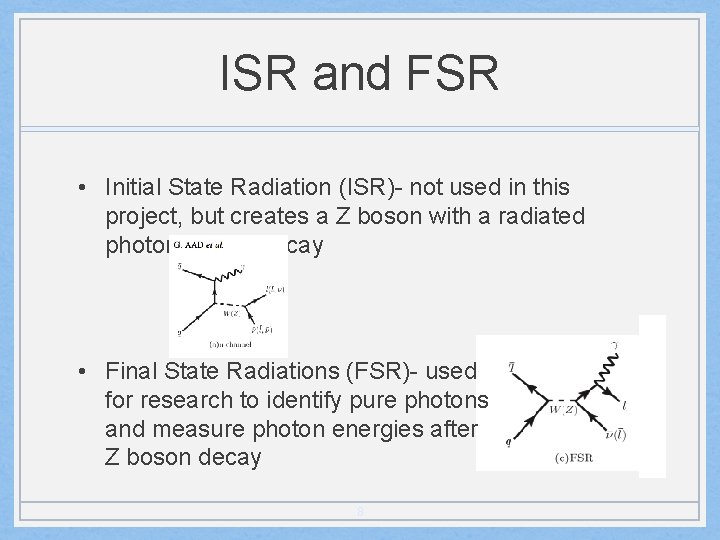
ISR and FSR • Initial State Radiation (ISR)- not used in this project, but creates a Z boson with a radiated photon before decay • Final State Radiations (FSR)- used for research to identify pure photons and measure photon energies after Z boson decay 8
Monte Carlo (MC) Simulation • MC used to simulate events from pp collision and particles produced • “Data” reconstructed similarly to that of LHC data • Can find agreement with LHC to test the performance of the ATLAS detector 9
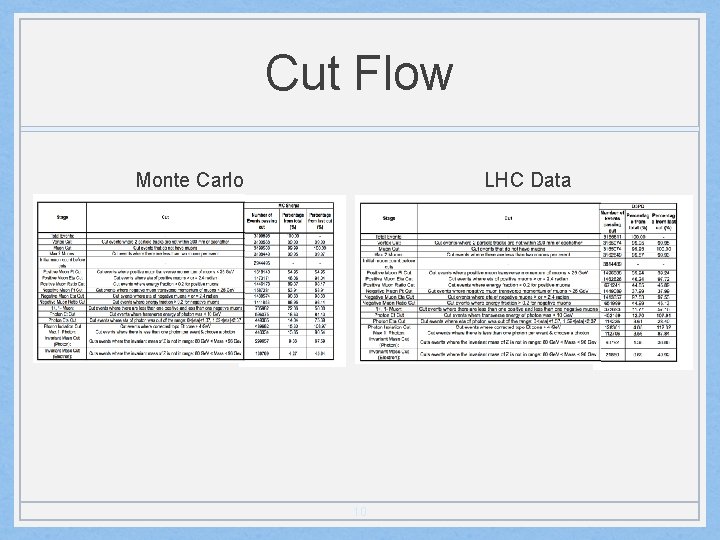
Cut Flow Monte Carlo LHC Data 10
Analysis Cuts Specific • Vertex where two particle tracks are present within 200 mm of each-other (MC: 99. 99% Data: 99. 95%) • Muon where both a positive and negative muon exist in an event, with a transverse momentum over 25 Ge. V, eta under 2. 4 radians, and energy ratio is under 0. 2 (MC: 22. 06% Data: 11. 7%) • Photon where a photon exists with a transverse energy over 10 Ge. V, eta in the range of 0<|eta|<1. 37, 1. 52<|eta|<2. 37 radians, isolation under 4 Ge. V (MC: 13. 85% Data: 3. 56%) Symbol: P 1 • Photon Invariant Mass where the reconstructed events yield results in the range of the Z boson 80 Ge. V < Mass < 96 Ge. V (MC: 9. 36% Data: 1. 38%) Symbol: P 2 • Electron when an electron exists with a transverse energy over 10 Ge. V, eta in the range of 0<|eta|<1. 37, 1. 52<|eta|<2. 37 radians, isolation under 4 Ge. V (MC: 5. 50% Data: 0. 86%) Symbol: E 1 • Electron Invariant Mass where the reconstructed events yield results in the range of the Z boson 80 Ge. V < Mass < 96 Ge. V (MC: 4. 27% Data: 0. 69%) Symbol: E 2 11
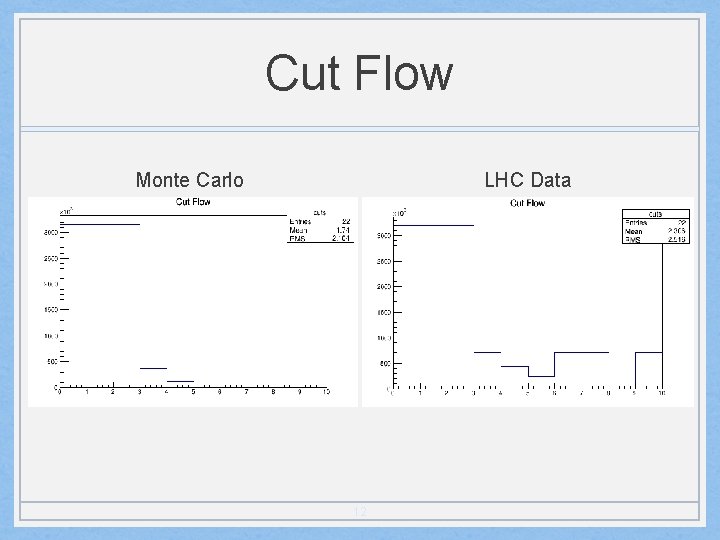
Cut Flow Monte Carlo LHC Data 12
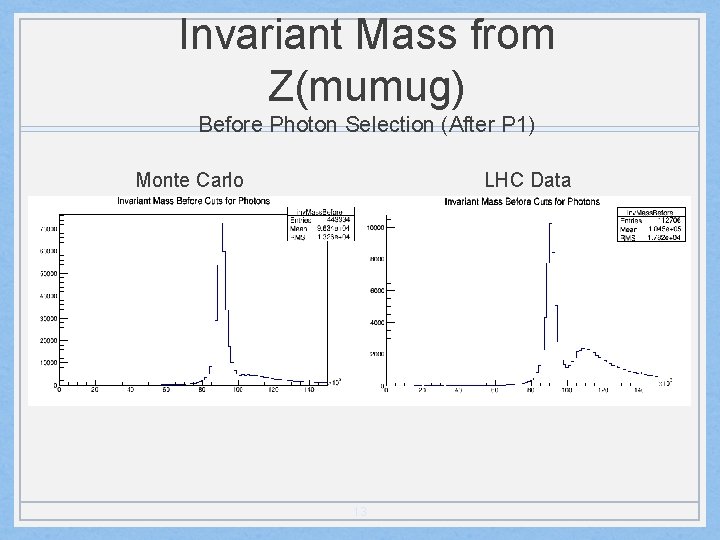
Invariant Mass from Z(mumug) Before Photon Selection (After P 1) Monte Carlo LHC Data 13
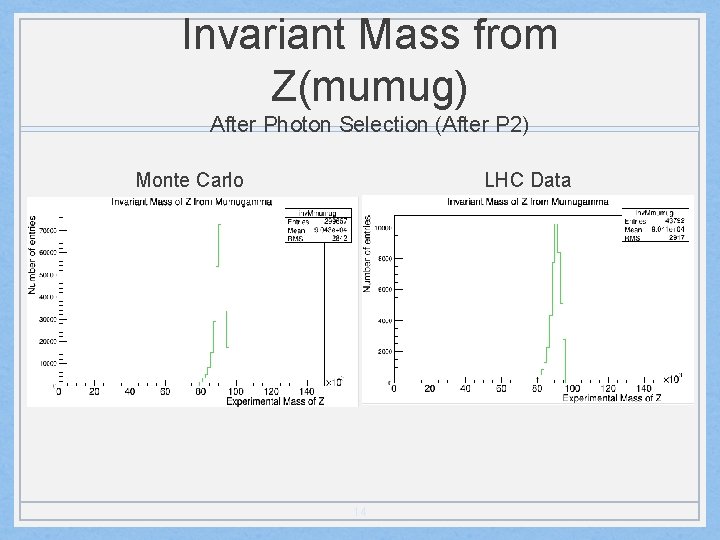
Invariant Mass from Z(mumug) After Photon Selection (After P 2) Monte Carlo LHC Data 14
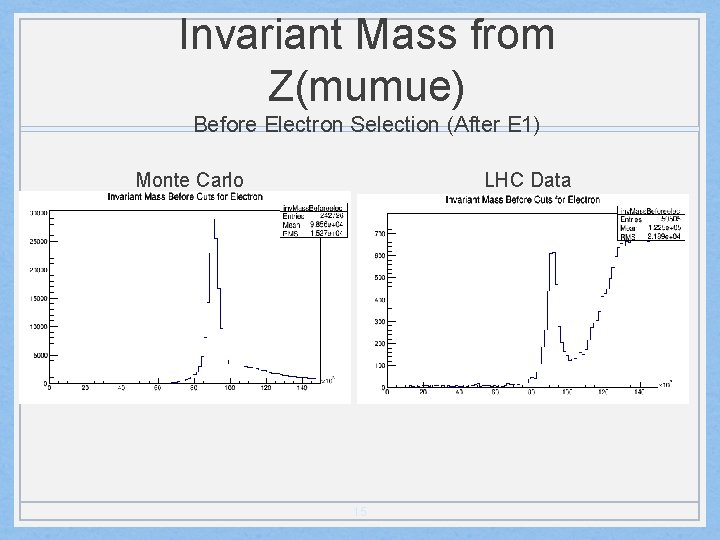
Invariant Mass from Z(mumue) Before Electron Selection (After E 1) Monte Carlo LHC Data 15
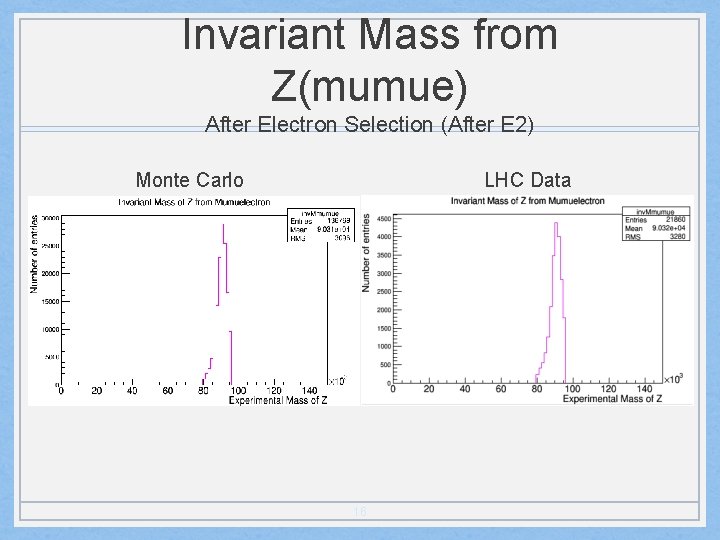
Invariant Mass from Z(mumue) After Electron Selection (After E 2) Monte Carlo LHC Data 16
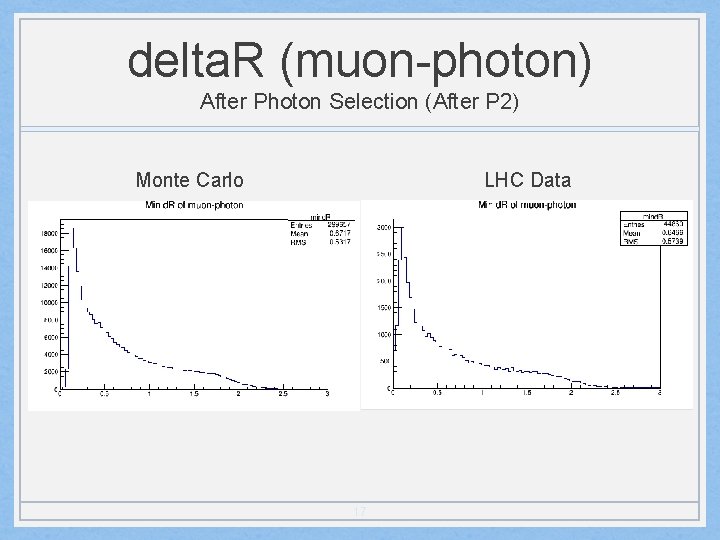
delta. R (muon-photon) After Photon Selection (After P 2) Monte Carlo LHC Data 17
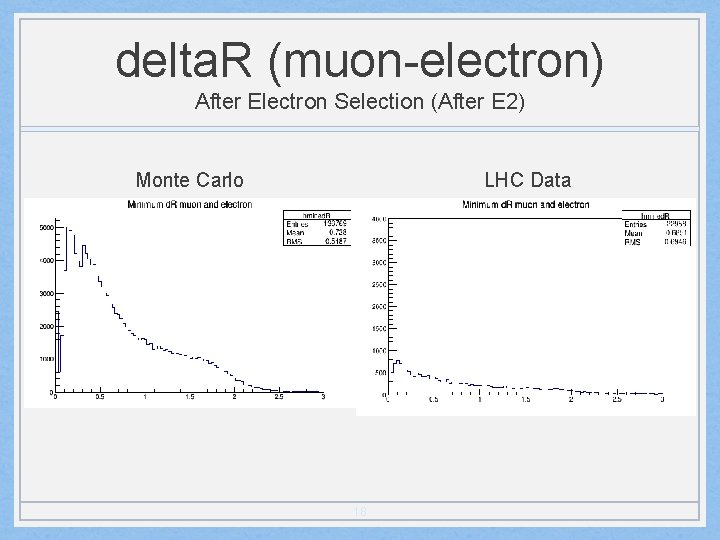
delta. R (muon-electron) After Electron Selection (After E 2) Monte Carlo LHC Data 18
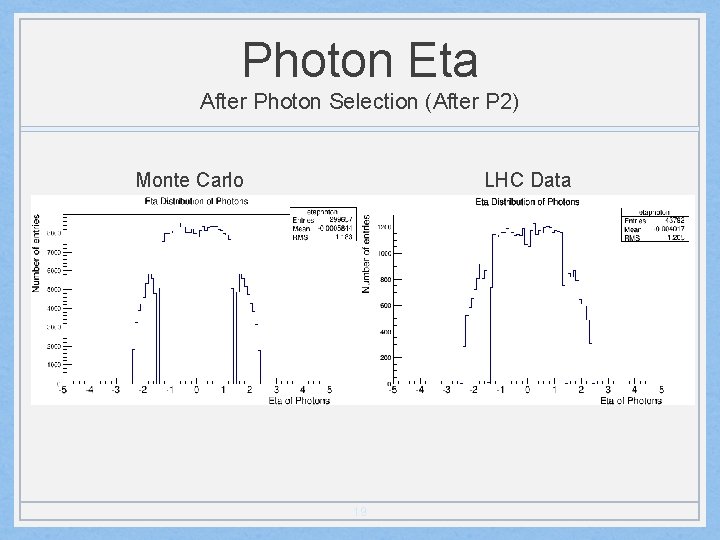
Photon Eta After Photon Selection (After P 2) Monte Carlo LHC Data 19
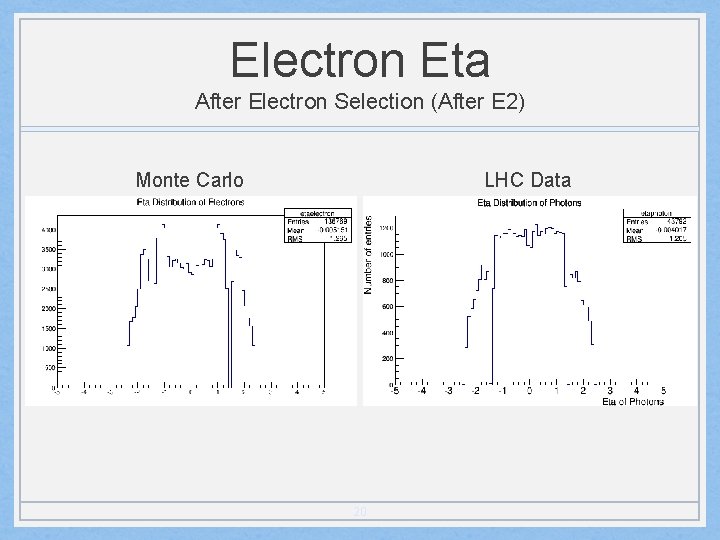
Electron Eta After Electron Selection (After E 2) Monte Carlo LHC Data 20
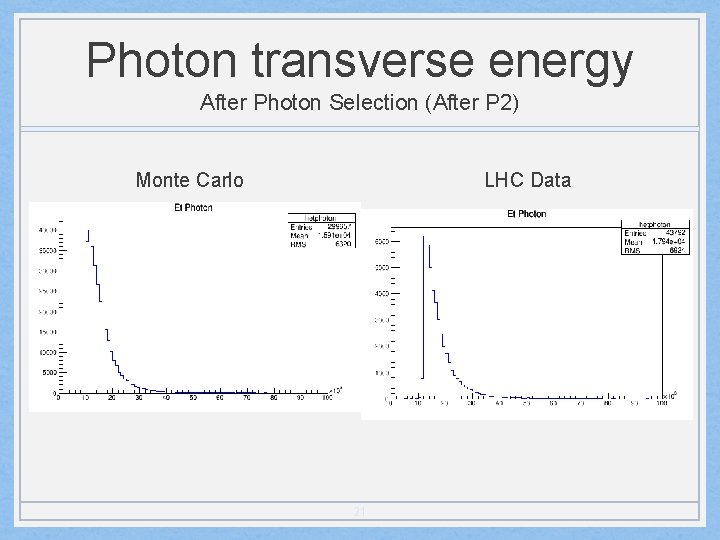
Photon transverse energy After Photon Selection (After P 2) Monte Carlo LHC Data 21
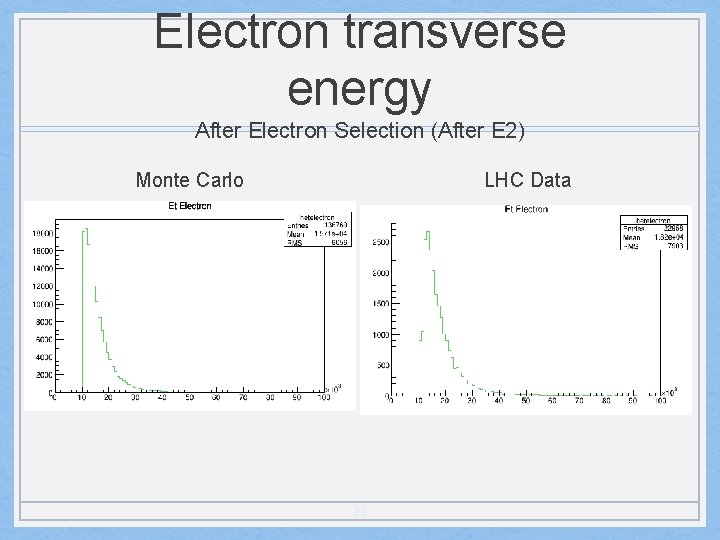
Electron transverse energy After Electron Selection (After E 2) Monte Carlo LHC Data 22
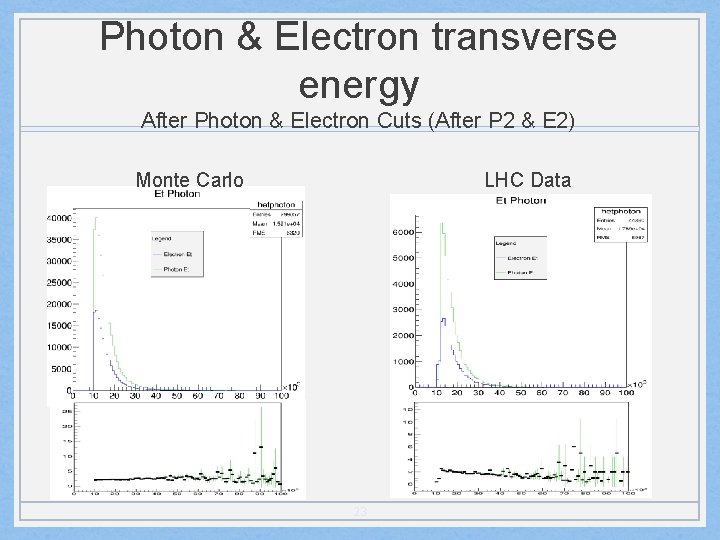
Photon & Electron transverse energy After Photon & Electron Cuts (After P 2 & E 2) Monte Carlo LHC Data 23
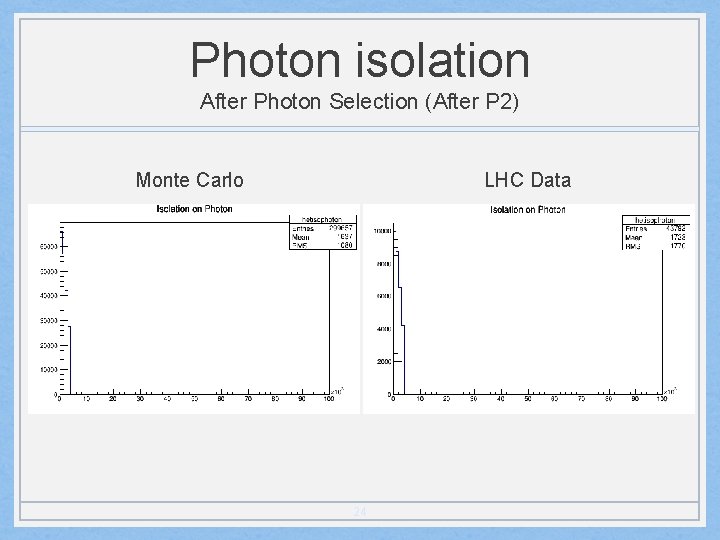
Photon isolation After Photon Selection (After P 2) Monte Carlo LHC Data 24
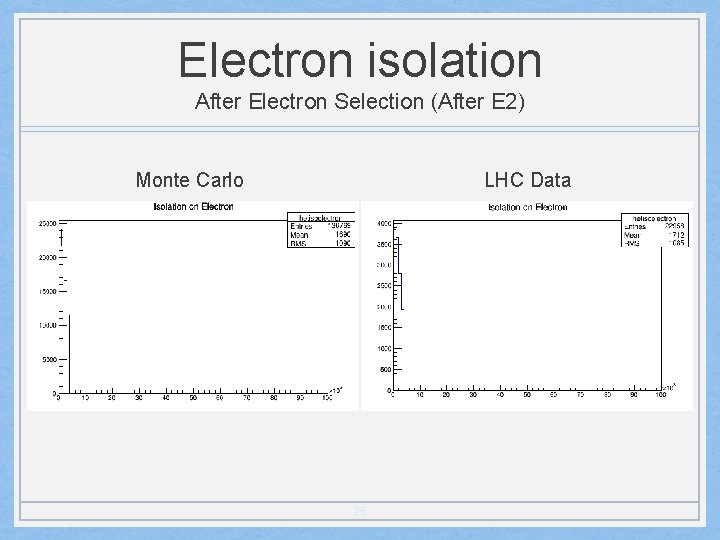
Electron isolation After Electron Selection (After E 2) Monte Carlo LHC Data 25
Summary • No way to accurately measure the fake-rate quantitatively • Monte Carlo and LHC Data results demonstrate similar trends • Standard Model predictions reaffirmed 26
- Slides: 26