
Z Boson Cross Section Measurement using CMS at
Z Boson Cross Section Measurement using CMS at the LHC Jessica Leonard University of Wisconsin – Madison 22 July, 2011 U. Wisconsin 1
Outline Standard Model – Z → ee Large Hadron Collider Compact Muon Solenoid Simulation Event Selection Results Conclusions U. Wisconsin 2
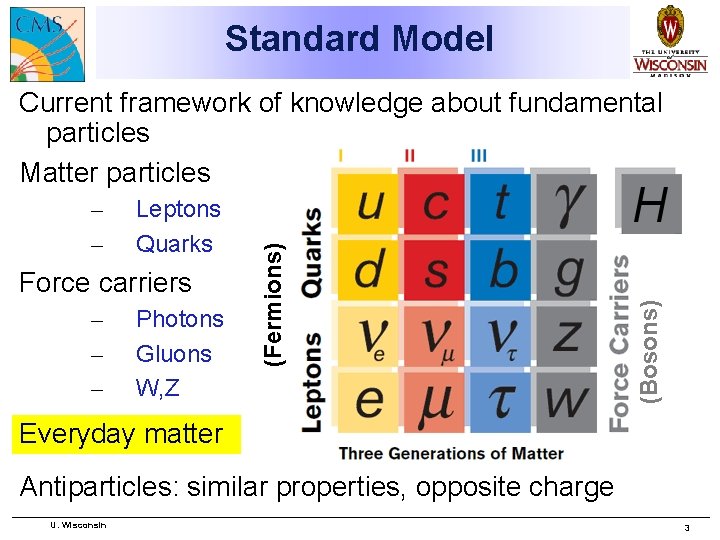
Standard Model Leptons Quarks Force carriers – – – Photons Gluons W, Z (Bosons) – – (Fermions) Current framework of knowledge about fundamental particles Matter particles Everyday matter Antiparticles: similar properties, opposite charge U. Wisconsin 3
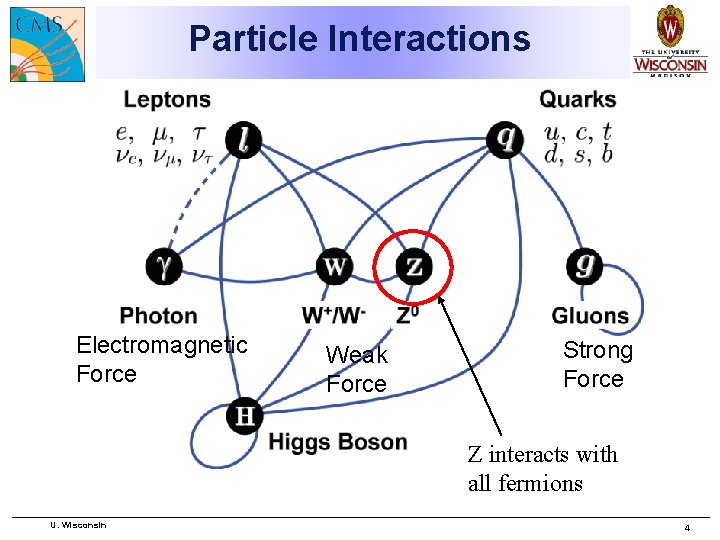
Particle Interactions Electromagnetic Force Weak Force Strong Force Z interacts with all fermions U. Wisconsin 4
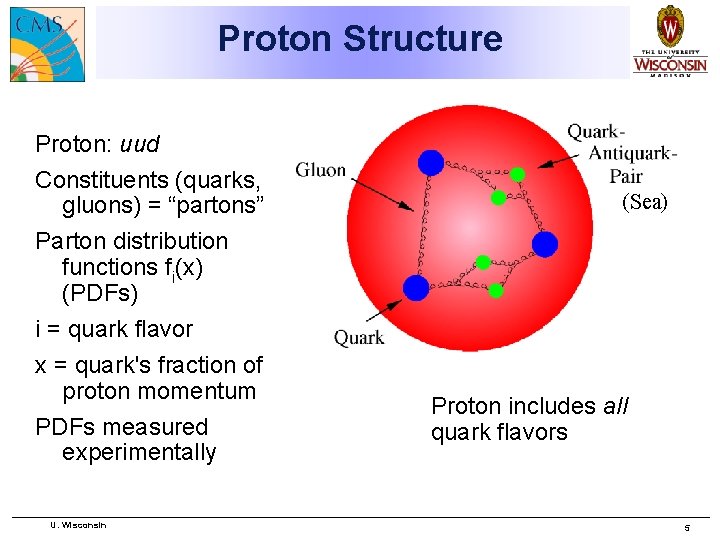
Proton Structure Proton: uud Constituents (quarks, gluons) = “partons” (Sea) Parton distribution functions fi(x) (PDFs) i = quark flavor x = quark's fraction of proton momentum PDFs measured experimentally U. Wisconsin Proton includes all quark flavors 5
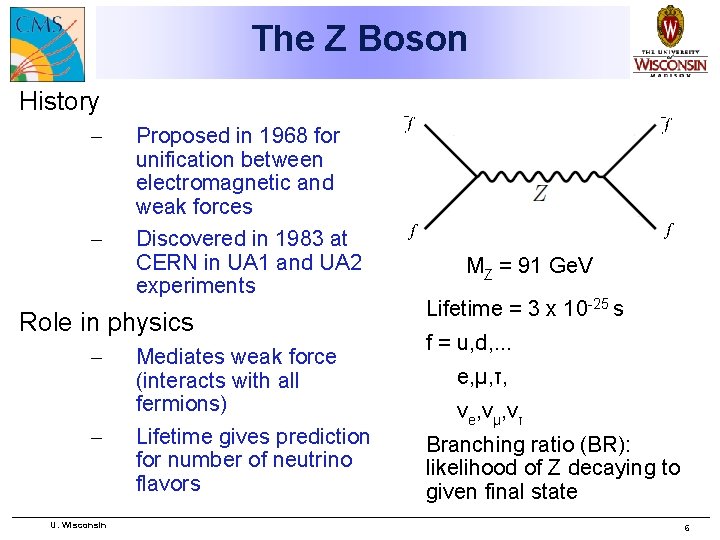
The Z Boson History – – Proposed in 1968 for unification between electromagnetic and weak forces Discovered in 1983 at CERN in UA 1 and UA 2 experiments Role in physics – – U. Wisconsin Mediates weak force (interacts with all fermions) Lifetime gives prediction for number of neutrino flavors MZ = 91 Ge. V Lifetime = 3 x 10 -25 s f = u, d, . . . e, μ, τ, νe, νμ, ντ Branching ratio (BR): likelihood of Z decaying to given final state 6
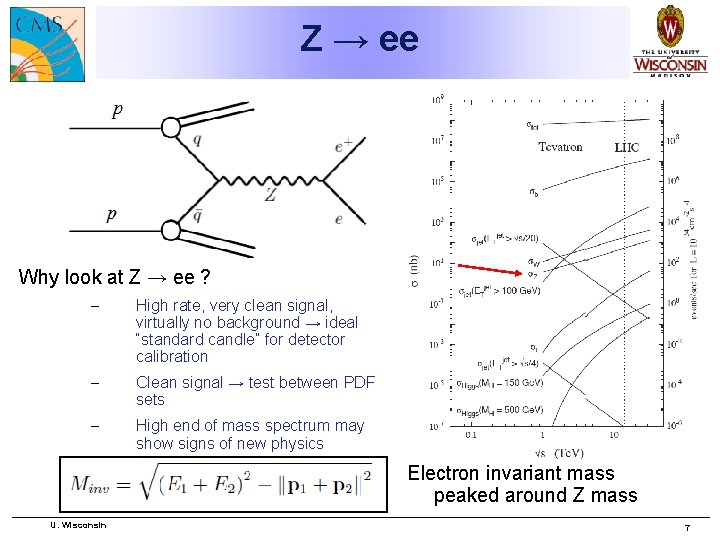
Z → ee Why look at Z → ee ? – High rate, very clean signal, virtually no background → ideal “standard candle” for detector calibration – Clean signal → test between PDF sets – High end of mass spectrum may show signs of new physics Electron invariant mass peaked around Z mass U. Wisconsin 7
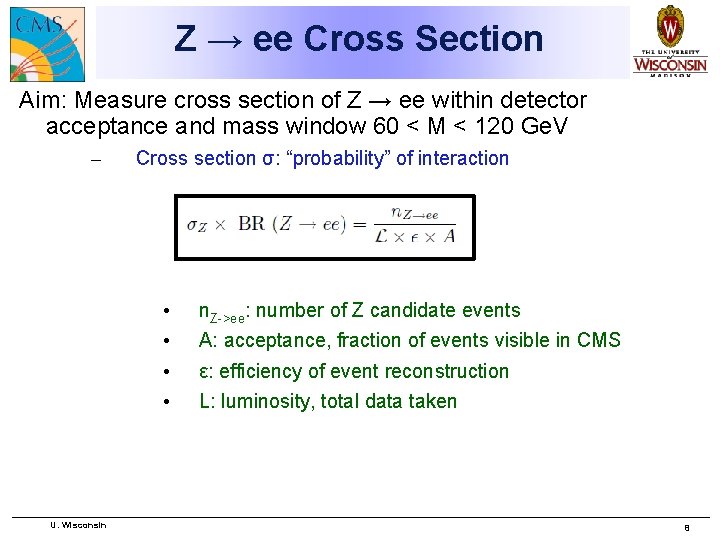
Z → ee Cross Section Aim: Measure cross section of Z → ee within detector acceptance and mass window 60 < M < 120 Ge. V – Cross section σ: “probability” of interaction • • U. Wisconsin n. Z->ee: number of Z candidate events A: acceptance, fraction of events visible in CMS ε: efficiency of event reconstruction L: luminosity, total data taken 8
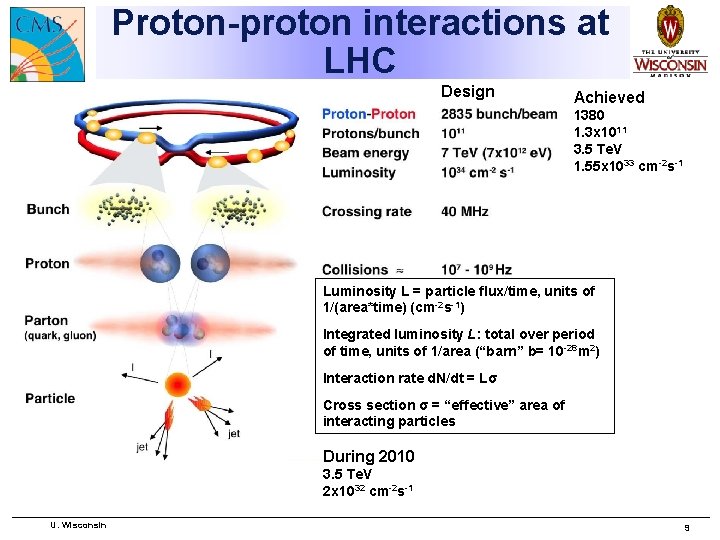
Proton-proton interactions at LHC Design Achieved 1380 1. 3 x 10¹¹ 3. 5 Te. V 1. 55 x 1033 cm-2 s-1 Luminosity L = particle flux/time, units of 1/(area*time) (cm-2 s-1) Integrated luminosity L: total over period of time, units of 1/area (“barn” b= 10 -28 m 2) Interaction rate d. N/dt = Lσ Cross section σ = “effective” area of interacting particles During 2010 3. 5 Te. V 2 x 1032 cm-2 s-1 U. Wisconsin 9
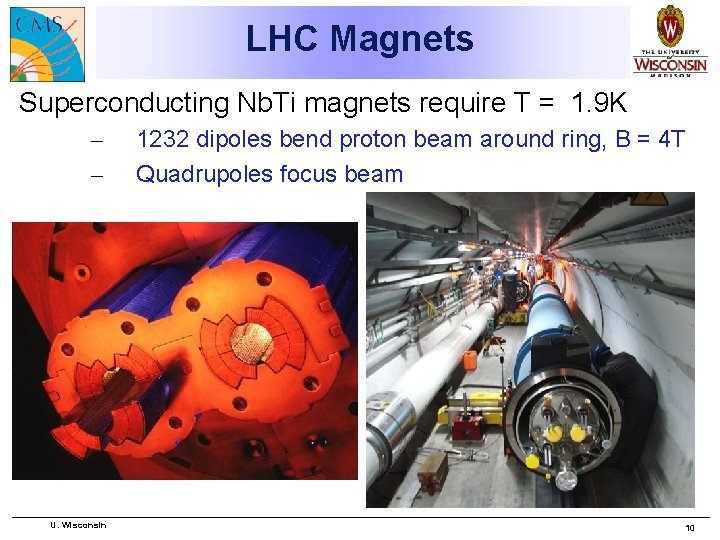
LHC Magnets Superconducting Nb. Ti magnets require T = 1. 9 K – – U. Wisconsin 1232 dipoles bend proton beam around ring, B = 4 T Quadrupoles focus beam 10
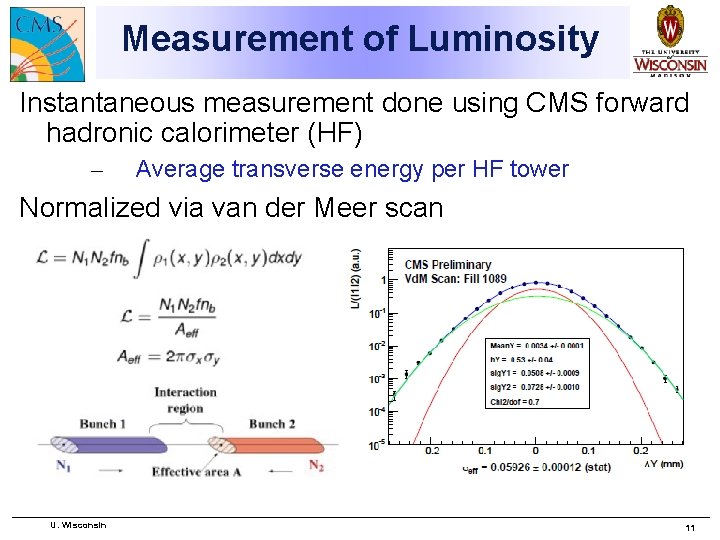
Measurement of Luminosity Instantaneous measurement done using CMS forward hadronic calorimeter (HF) – Average transverse energy per HF tower Normalized via van der Meer scan U. Wisconsin 11
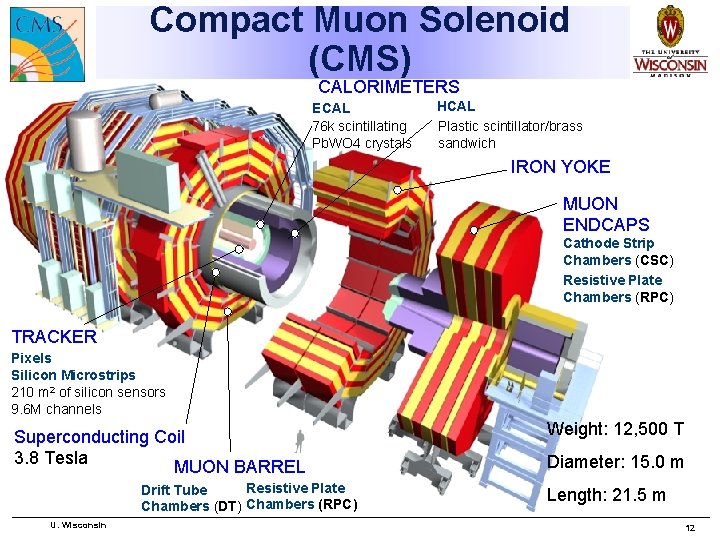
Compact Muon Solenoid (CMS) CALORIMETERS ECAL 76 k scintillating Pb. WO 4 crystals HCAL Plastic scintillator/brass Plastic sandwich IRON YOKE MUON ENDCAPS Cathode Strip Chambers (CSC) Resistive Plate Chambers (RPC) TRACKER Pixels Silicon Microstrips 210 m 2 of silicon sensors 9. 6 M channels Superconducting Coil 3. 8 Tesla MUON BARREL Resistive Plate Drift Tube Chambers (DT) Chambers (RPC) U. Wisconsin Weight: 12, 500 T Diameter: 15. 0 m Length: 21. 5 m 12
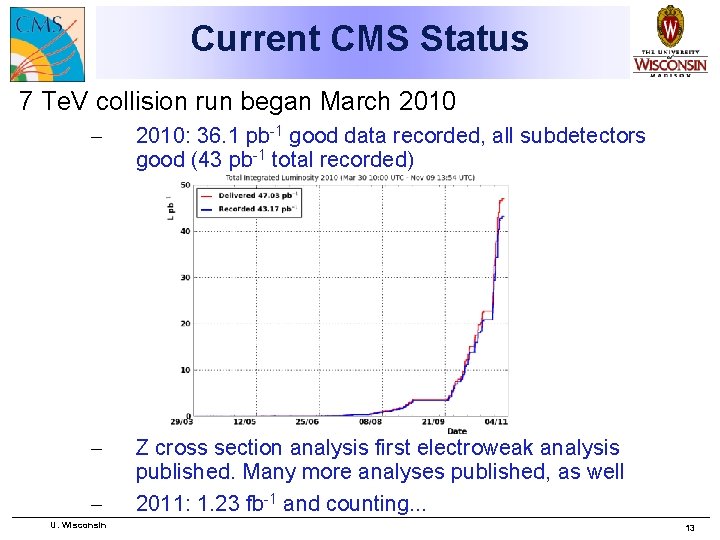
Current CMS Status 7 Te. V collision run began March 2010 – 2010: 36. 1 pb-1 good data recorded, all subdetectors good (43 pb-1 total recorded) – Z cross section analysis first electroweak analysis published. Many more analyses published, as well 2011: 1. 23 fb-1 and counting. . . – U. Wisconsin 13
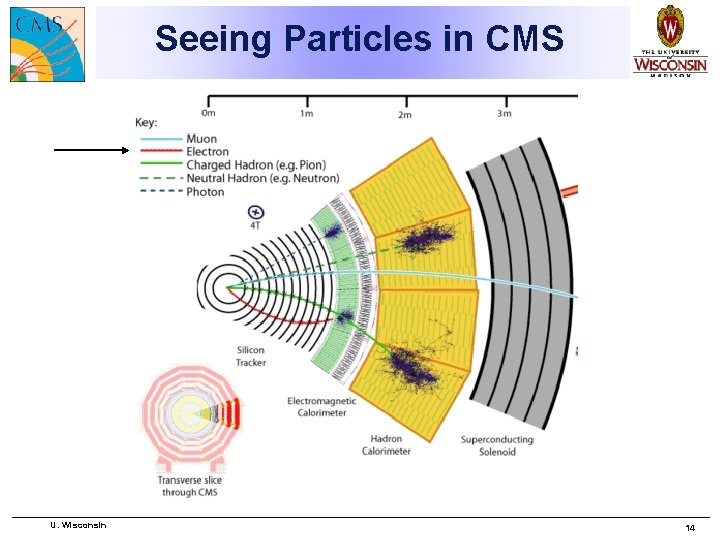
Seeing Particles in CMS U. Wisconsin 14
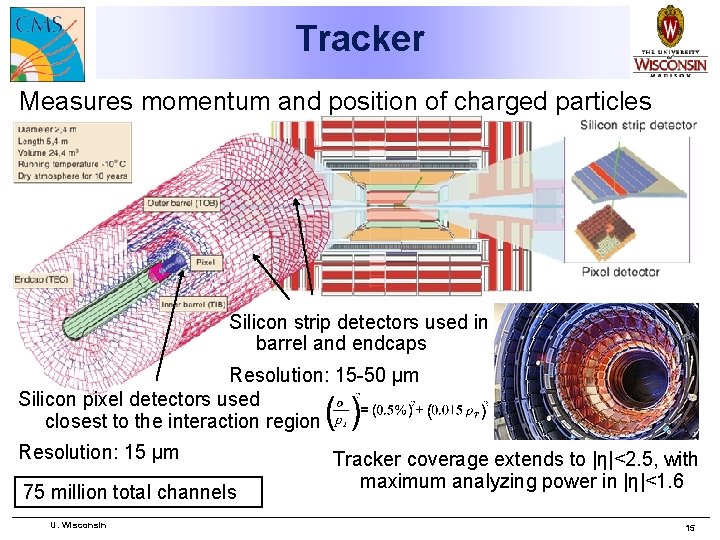
Tracker Measures momentum and position of charged particles Silicon strip detectors used in barrel and endcaps Resolution: 15 -50 μm Silicon pixel detectors used closest to the interaction region Resolution: 15 μm 75 million total channels U. Wisconsin Tracker coverage extends to |η|<2. 5, with maximum analyzing power in |η|<1. 6 15
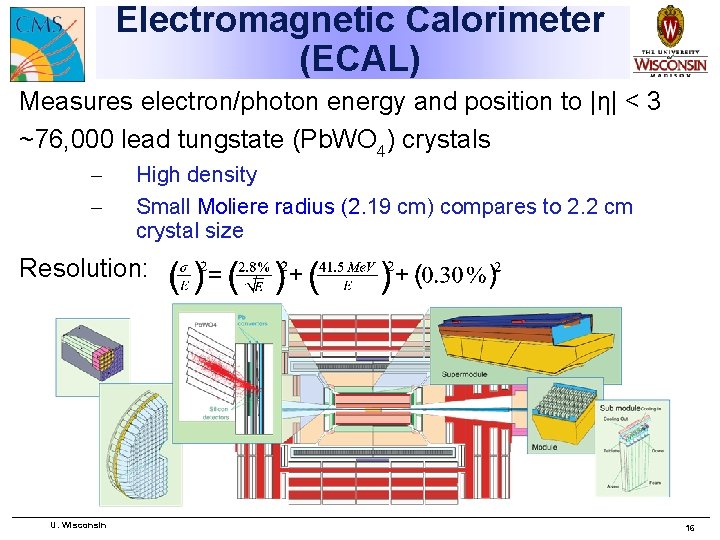
Electromagnetic Calorimeter (ECAL) Measures electron/photon energy and position to |η| < 3 ~76, 000 lead tungstate (Pb. WO 4) crystals – – High density Small Moliere radius (2. 19 cm) compares to 2. 2 cm crystal size Resolution: U. Wisconsin 16
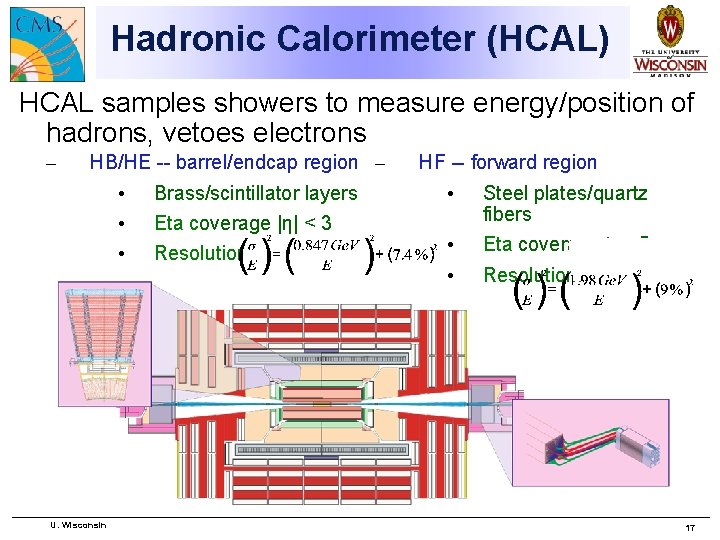
Hadronic Calorimeter (HCAL) HCAL samples showers to measure energy/position of hadrons, vetoes electrons – HB/HE -- barrel/endcap region – • • • U. Wisconsin Brass/scintillator layers Eta coverage |η| < 3 Resolution: HF -- forward region • Steel plates/quartz fibers • • Eta coverage to ± 5 Resolution: 17
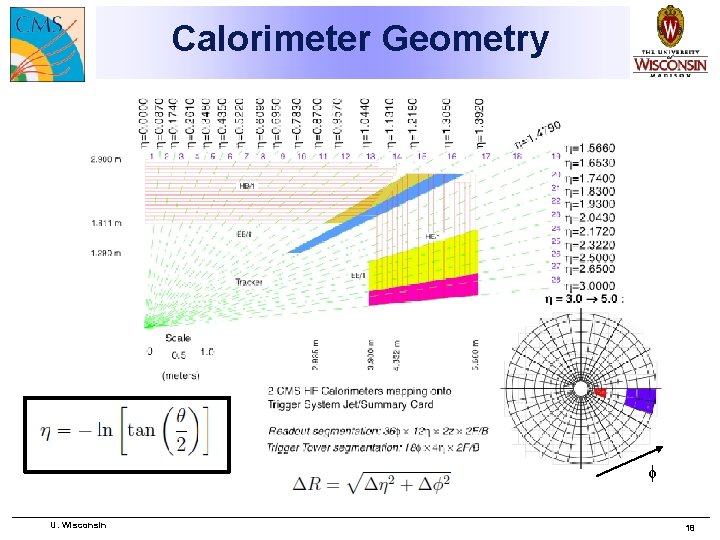
Calorimeter Geometry test ϕ U. Wisconsin 18
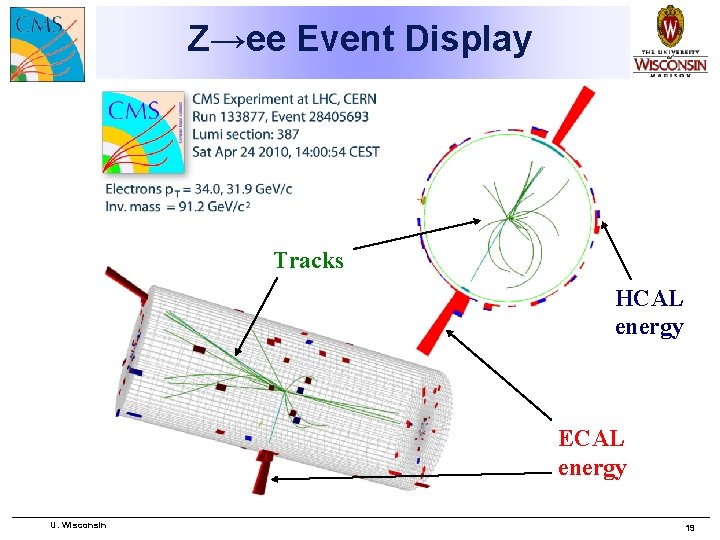
Z→ee Event Display Tracks HCAL energy ECAL energy U. Wisconsin 19
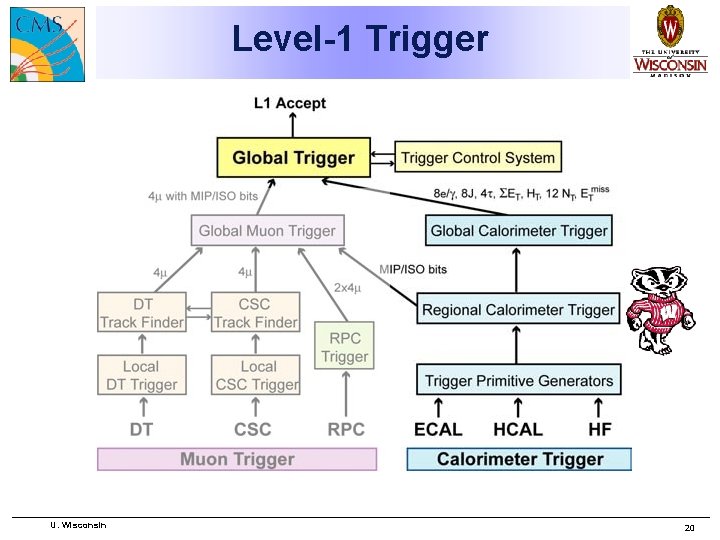
Level-1 Trigger text U. Wisconsin 20
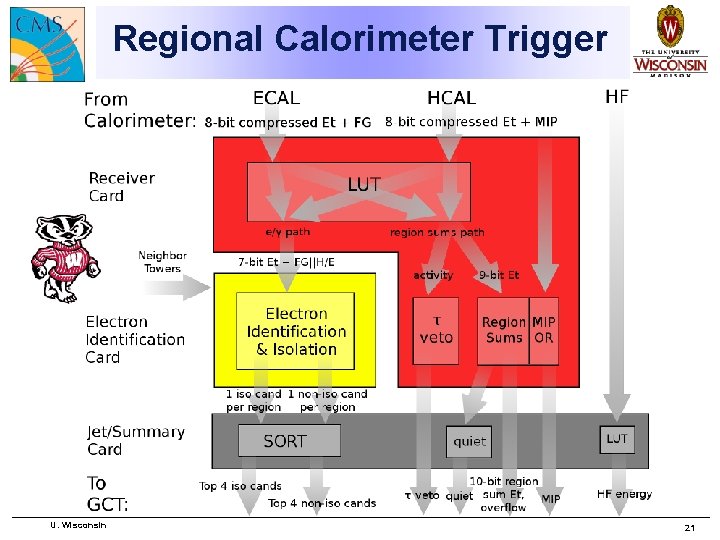
Regional Calorimeter Trigger Yay Wisconsin! U. Wisconsin 21
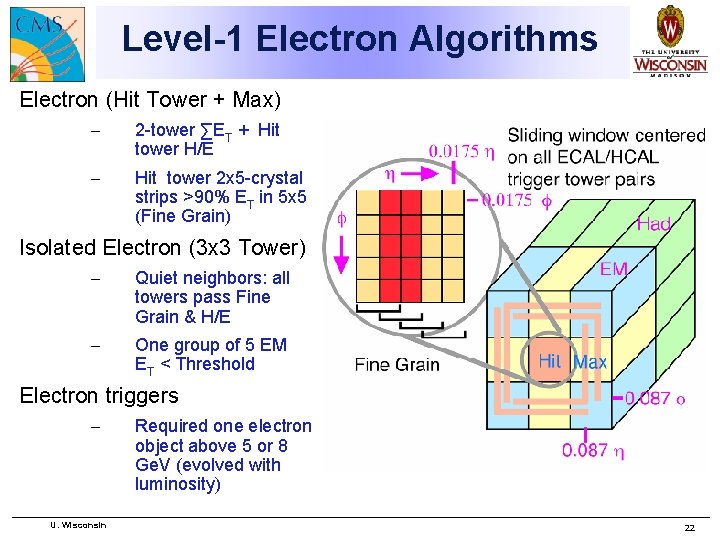
Level-1 Electron Algorithms Electron (Hit Tower + Max) – 2 -tower ∑ET + Hit tower H/E – Hit tower 2 x 5 -crystal strips >90% ET in 5 x 5 (Fine Grain) Isolated Electron (3 x 3 Tower) – Quiet neighbors: all towers pass Fine Grain & H/E – One group of 5 EM ET < Threshold Electron triggers – U. Wisconsin Required one electron object above 5 or 8 Ge. V (evolved with luminosity) 22
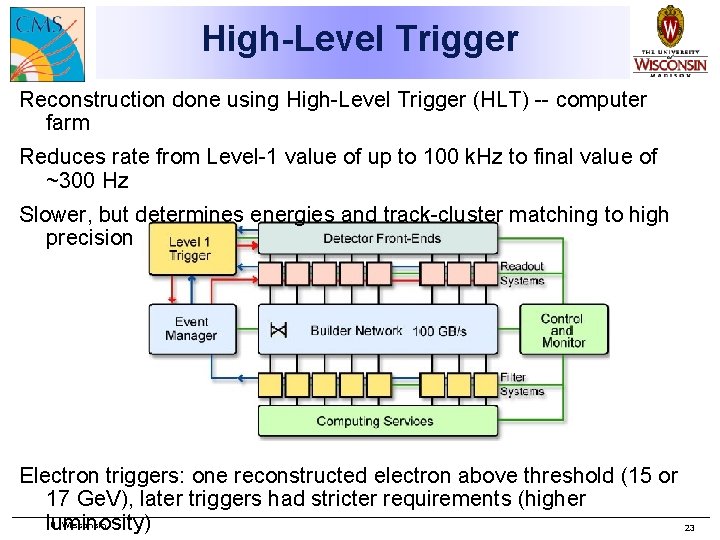
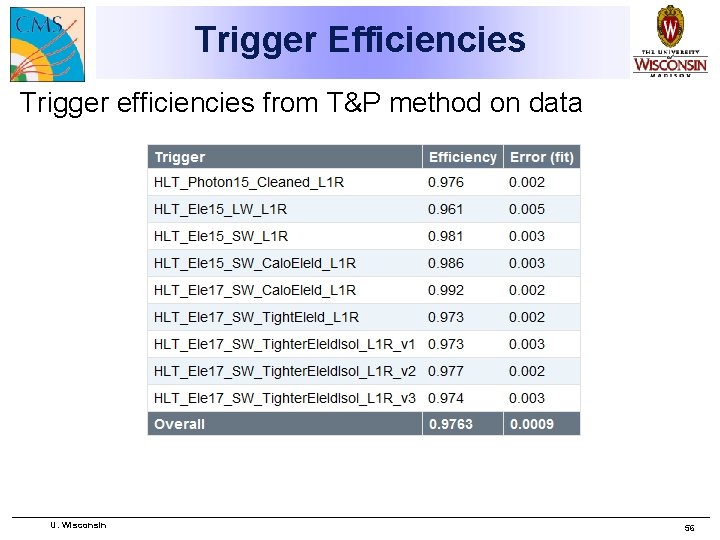
High-Level Trigger Reconstruction done using High-Level Trigger (HLT) -- computer farm Reduces rate from Level-1 value of up to 100 k. Hz to final value of ~300 Hz Slower, but determines energies and track-cluster matching to high precision Electron triggers: one reconstructed electron above threshold (15 or 17 Ge. V), later triggers had stricter requirements (higher U. Wisconsin luminosity) 23
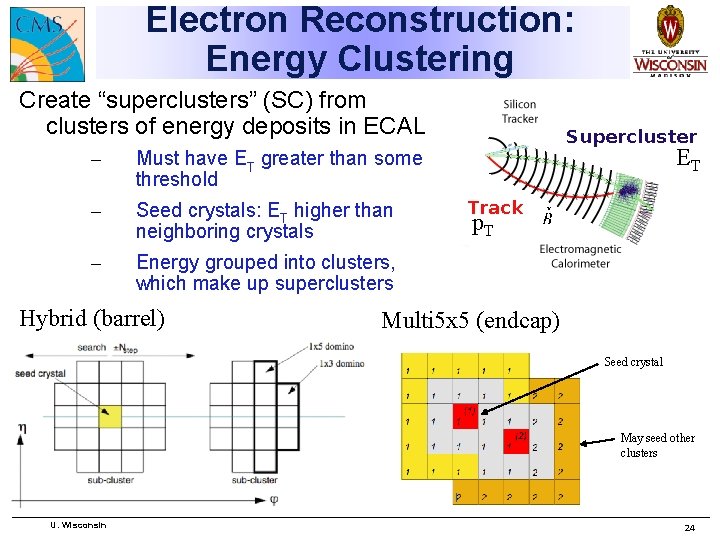
Electron Reconstruction: Energy Clustering Create “superclusters” (SC) from clusters of energy deposits in ECAL – Must have ET greater than some threshold – Seed crystals: ET higher than neighboring crystals – Energy grouped into clusters, which make up superclusters Hybrid (barrel) ET p. T Multi 5 x 5 (endcap) Seed crystal May seed other clusters U. Wisconsin 24
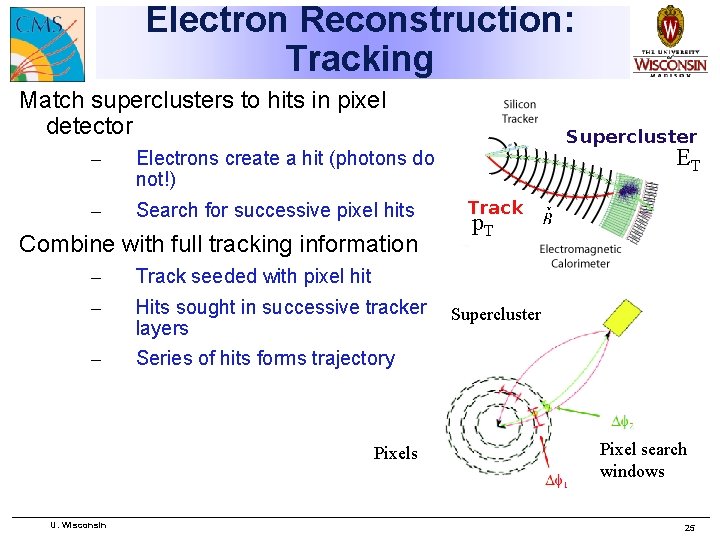
Electron Reconstruction: Tracking Match superclusters to hits in pixel detector – Electrons create a hit (photons do not!) – Search for successive pixel hits Combine with full tracking information – – Track seeded with pixel hit – Series of hits forms trajectory Hits sought in successive tracker layers Pixels U. Wisconsin ET p. T Supercluster Pixel search windows 25
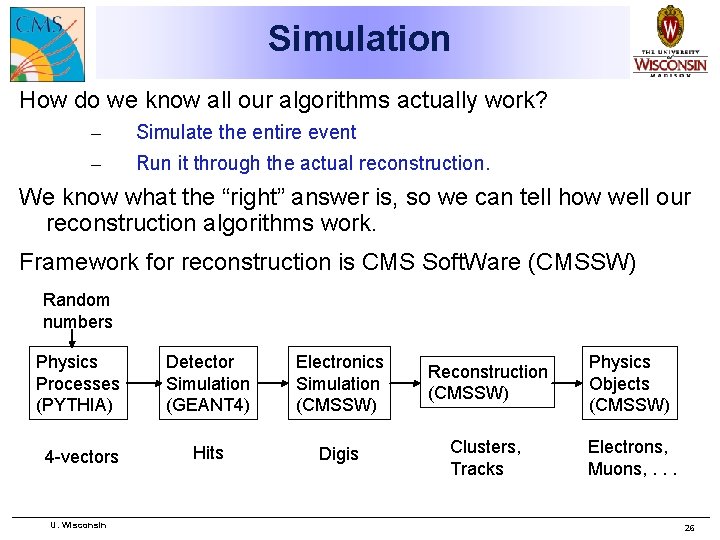
Simulation How do we know all our algorithms actually work? – – Simulate the entire event Run it through the actual reconstruction. We know what the “right” answer is, so we can tell how well our reconstruction algorithms work. Framework for reconstruction is CMS Soft. Ware (CMSSW) Random numbers Physics Processes (PYTHIA) Detector Simulation (GEANT 4) Electronics Simulation (CMSSW) Reconstruction (CMSSW) Physics Objects (CMSSW) 4 -vectors Hits Digis Clusters, Tracks Electrons, Muons, . . . U. Wisconsin 26
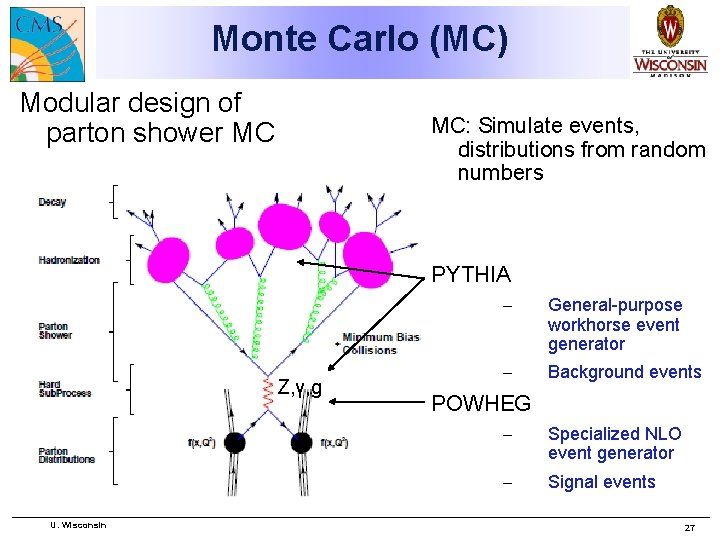
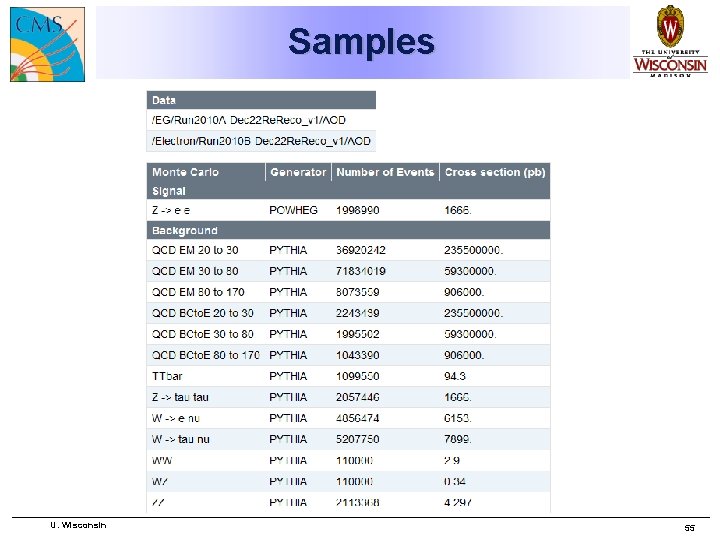
Monte Carlo (MC) Modular design of parton shower MC MC: Simulate events, distributions from random numbers PYTHIA Z, γ, g U. Wisconsin – General-purpose workhorse event generator – Background events POWHEG – Specialized NLO event generator – Signal events 27
Acceptance: Definition Acceptance (A): Fraction of events that can theoretically be seen by detector – Determined by solid-angle coverage, low end of energy sensitivity Must be determined from MC: need to know how many events the detector didn't see U. Wisconsin 28
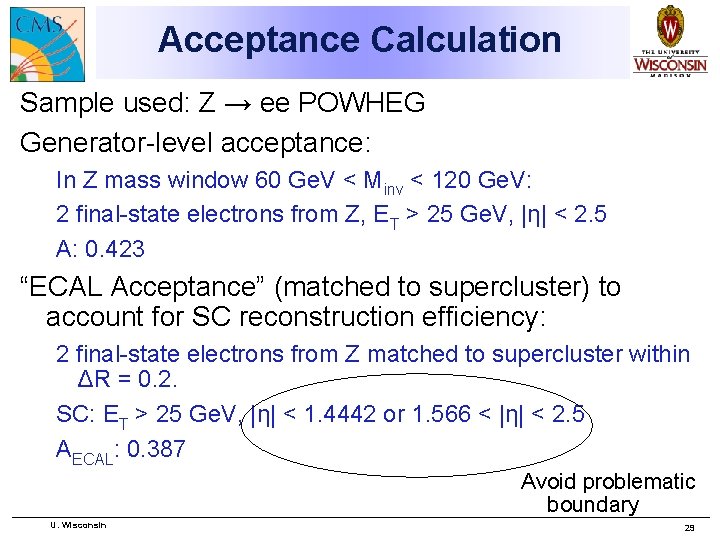
Acceptance Calculation Sample used: Z → ee POWHEG Generator-level acceptance: In Z mass window 60 Ge. V < Minv < 120 Ge. V: 2 final-state electrons from Z, ET > 25 Ge. V, |η| < 2. 5 A: 0. 423 “ECAL Acceptance” (matched to supercluster) to account for SC reconstruction efficiency: 2 final-state electrons from Z matched to supercluster within ΔR = 0. 2. SC: ET > 25 Ge. V, |η| < 1. 4442 or 1. 566 < |η| < 2. 5 AECAL: 0. 387 Avoid problematic boundary U. Wisconsin 29
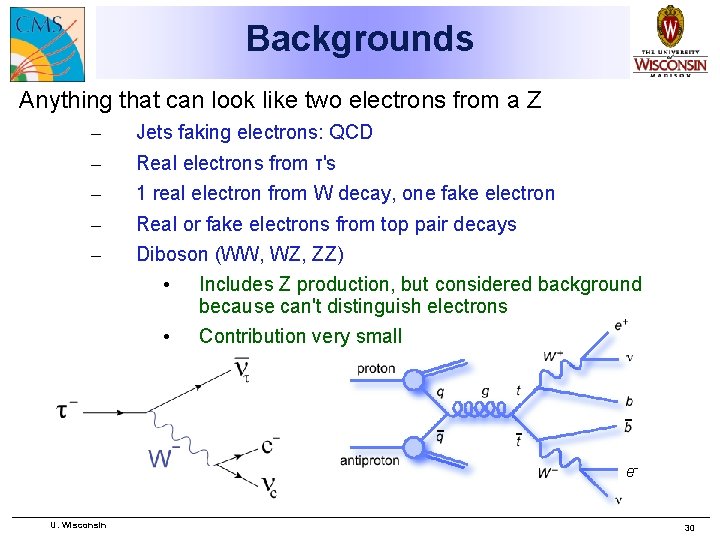
Backgrounds Anything that can look like two electrons from a Z – – – Jets faking electrons: QCD Real electrons from τ's 1 real electron from W decay, one fake electron Real or fake electrons from top pair decays Diboson (WW, WZ, ZZ) • Includes Z production, but considered background because can't distinguish electrons • Contribution very small e- U. Wisconsin 30
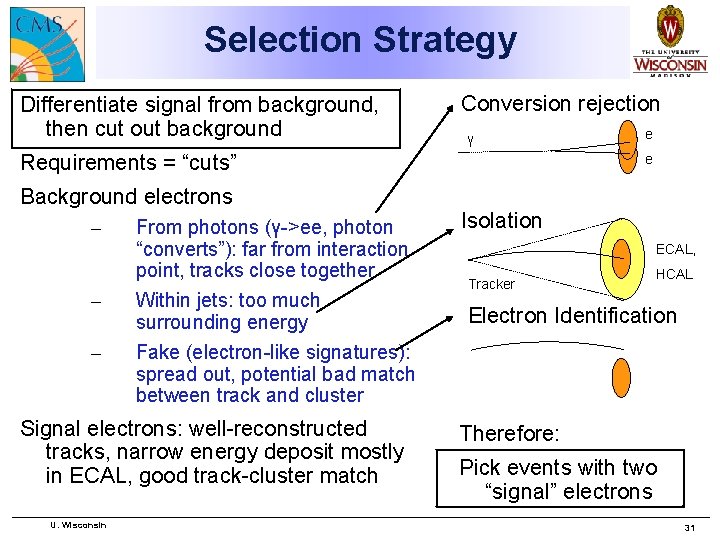
Selection Strategy Differentiate signal from background, then cut out background Conversion rejection γ Requirements = “cuts” Background electrons – From photons (γ->ee, photon “converts”): far from interaction point, tracks close together – Within jets: too much surrounding energy – Fake (electron-like signatures): spread out, potential bad match between track and cluster Signal electrons: well-reconstructed tracks, narrow energy deposit mostly in ECAL, good track-cluster match U. Wisconsin e e Isolation ECAL, Tracker HCAL Electron Identification Therefore: Pick events with two “signal” electrons 31
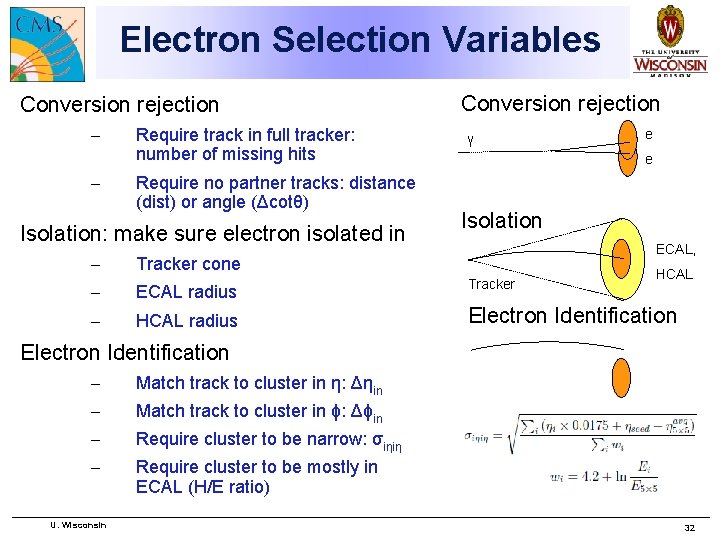
Electron Selection Variables Conversion rejection – – Require track in full tracker: number of missing hits Require no partner tracks: distance (dist) or angle (Δcotθ) Isolation: make sure electron isolated in – Conversion rejection γ e Isolation ECAL, Tracker cone – ECAL radius – HCAL radius e Tracker HCAL Electron Identification – Match track to cluster in η: Δηin – Match track to cluster in ϕ: Δϕin – Require cluster to be narrow: σiηiη – Require cluster to be mostly in ECAL (H/E ratio) U. Wisconsin 32
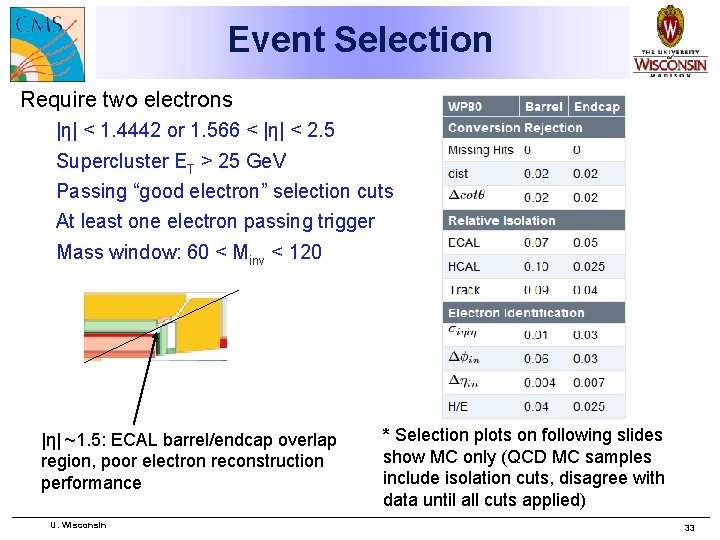
Event Selection Require two electrons |η| < 1. 4442 or 1. 566 < |η| < 2. 5 Supercluster ET > 25 Ge. V Passing “good electron” selection cuts At least one electron passing trigger Mass window: 60 < Minv < 120 |η| ~1. 5: ECAL barrel/endcap overlap region, poor electron reconstruction performance U. Wisconsin * Selection plots on following slides show MC only (QCD MC samples include isolation cuts, disagree with data until all cuts applied) 33
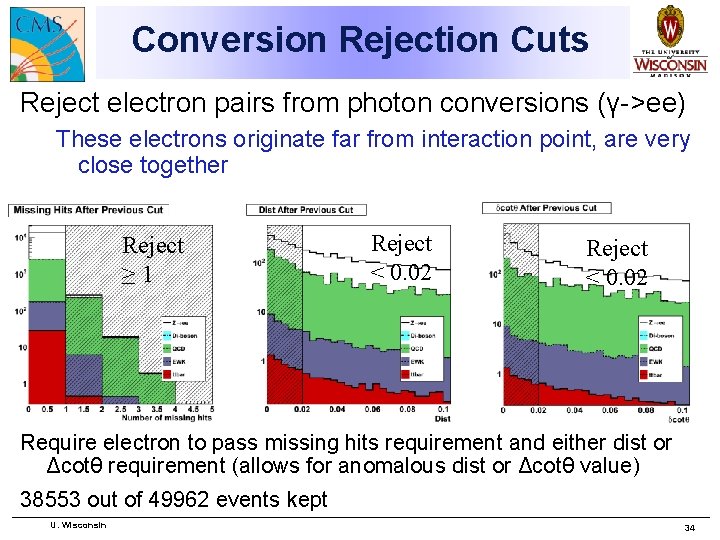
Conversion Rejection Cuts Reject electron pairs from photon conversions (γ->ee) These electrons originate far from interaction point, are very close together Reject ≥ 1 Reject < 0. 02 Require electron to pass missing hits requirement and either dist or Δcotθ requirement (allows for anomalous dist or Δcotθ value) 38553 out of 49962 events kept U. Wisconsin 34
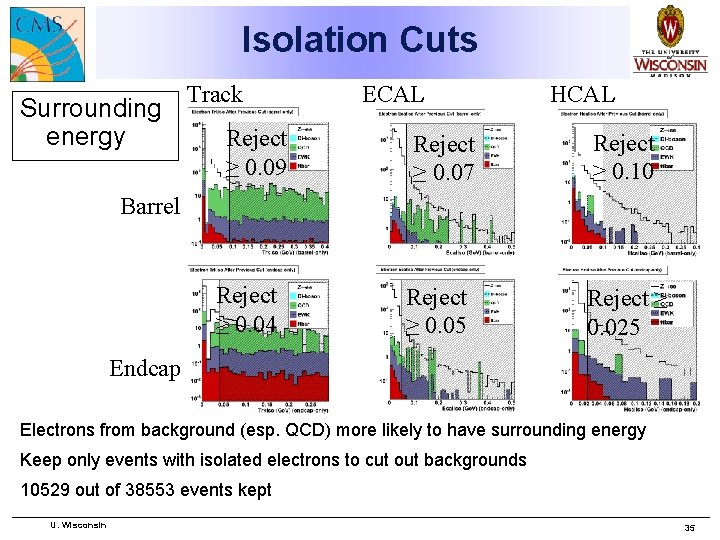
Isolation Cuts Surrounding energy Track Reject ≥ 0. 09 ECAL Reject ≥ 0. 07 HCAL Reject ≥ 0. 10 Barrel Reject ≥ 0. 04 Reject ≥ 0. 05 Reject ≥ 0. 025 Endcap Electrons from background (esp. QCD) more likely to have surrounding energy Keep only events with isolated electrons to cut out backgrounds 10529 out of 38553 events kept U. Wisconsin 35
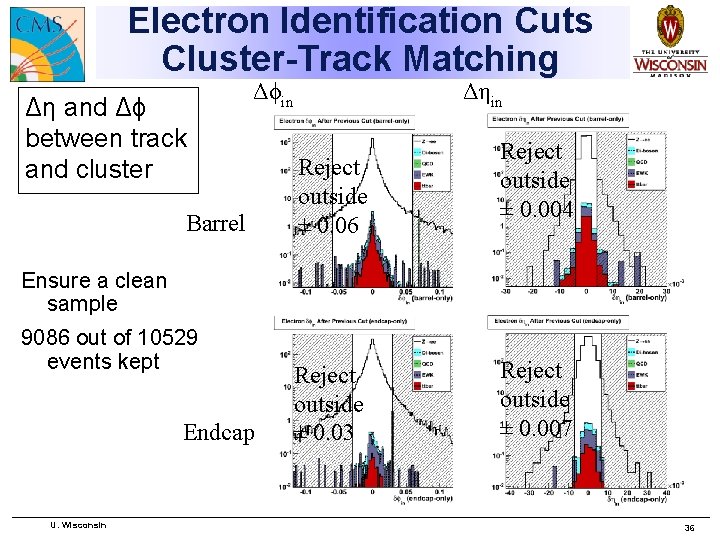
Electron Identification Cuts Cluster-Track Matching Δη and Δϕ between track and cluster Δηin Δϕin Barrel Reject outside ± 0. 06 Reject outside ± 0. 004 Ensure a clean sample 9086 out of 10529 events kept Endcap U. Wisconsin Reject outside ± 0. 03 Reject outside ± 0. 007 36
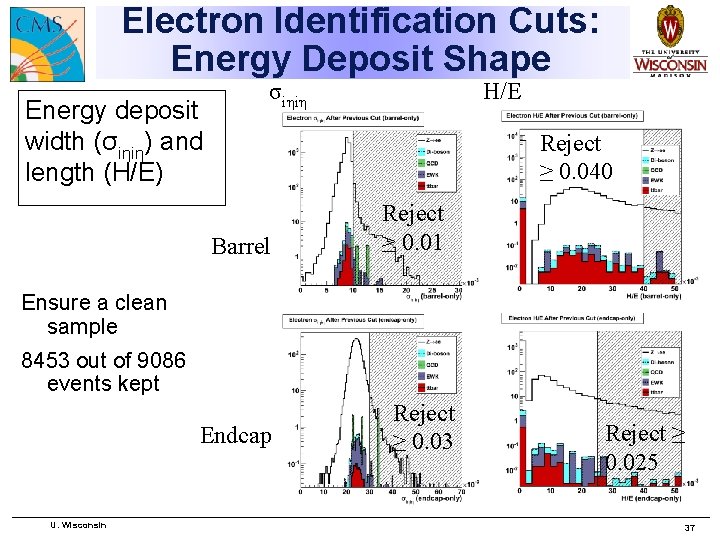
Electron Identification Cuts: Energy Deposit Shape Energy deposit width (σiηiη) and length (H/E) σiηiη H/E Reject ≥ 0. 040 Barrel Reject ≥ 0. 01 Ensure a clean sample 8453 out of 9086 events kept Endcap U. Wisconsin Reject ≥ 0. 03 Reject ≥ 0. 025 37
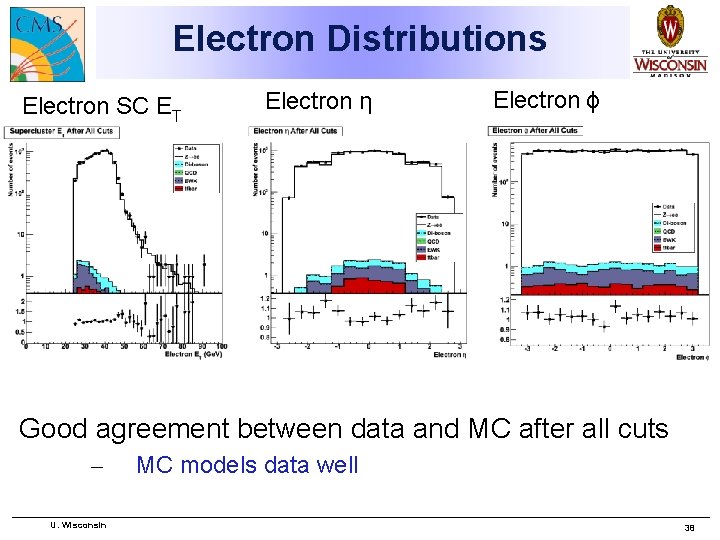
Electron Distributions Electron SC ET Electron η Electron ϕ Good agreement between data and MC after all cuts – U. Wisconsin MC models data well 38
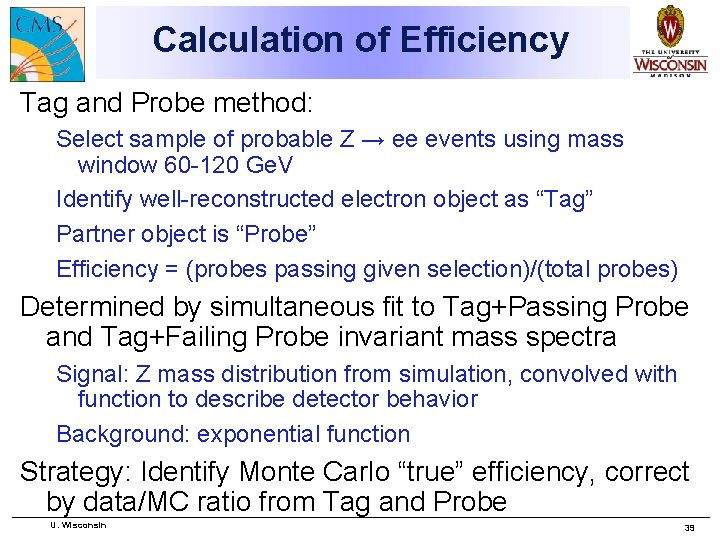
Calculation of Efficiency Tag and Probe method: Select sample of probable Z → ee events using mass window 60 -120 Ge. V Identify well-reconstructed electron object as “Tag” Partner object is “Probe” Efficiency = (probes passing given selection)/(total probes) Determined by simultaneous fit to Tag+Passing Probe and Tag+Failing Probe invariant mass spectra Signal: Z mass distribution from simulation, convolved with function to describe detector behavior Background: exponential function Strategy: Identify Monte Carlo “true” efficiency, correct by data/MC ratio from Tag and Probe U. Wisconsin 39
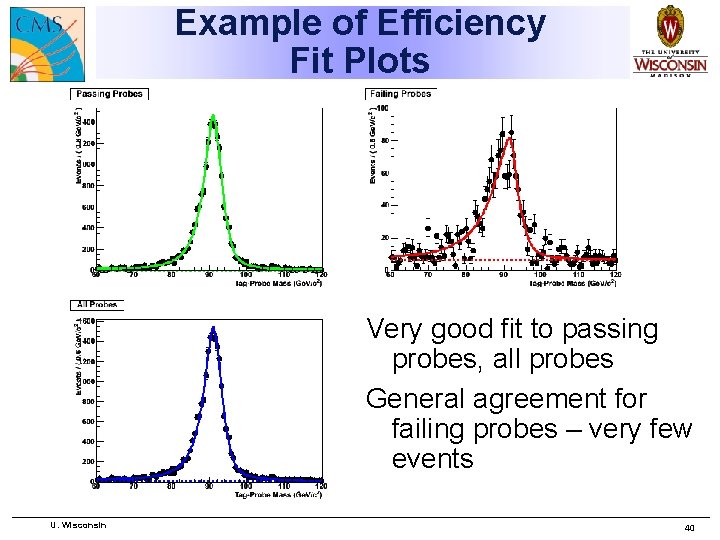
Example of Efficiency Fit Plots Very good fit to passing probes, all probes General agreement for failing probes – very few events U. Wisconsin 40
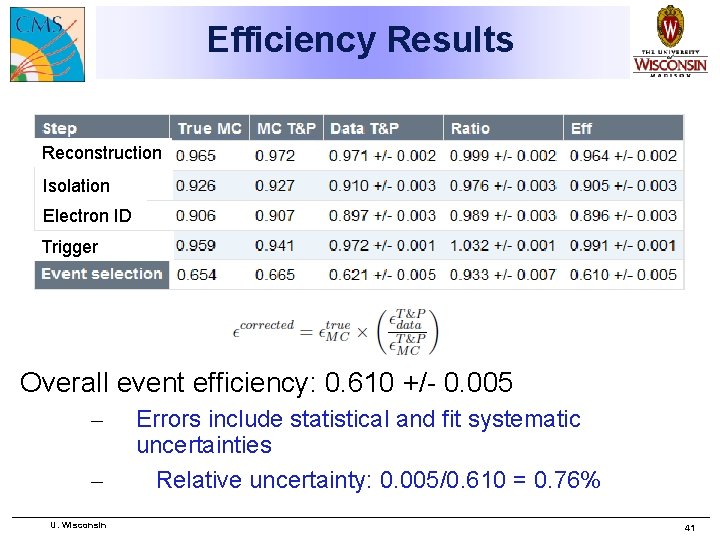
Efficiency Results Reconstruction Isolation Electron ID Trigger Overall event efficiency: 0. 610 +/- 0. 005 – – U. Wisconsin Errors include statistical and fit systematic uncertainties Relative uncertainty: 0. 005/0. 610 = 0. 76% 41
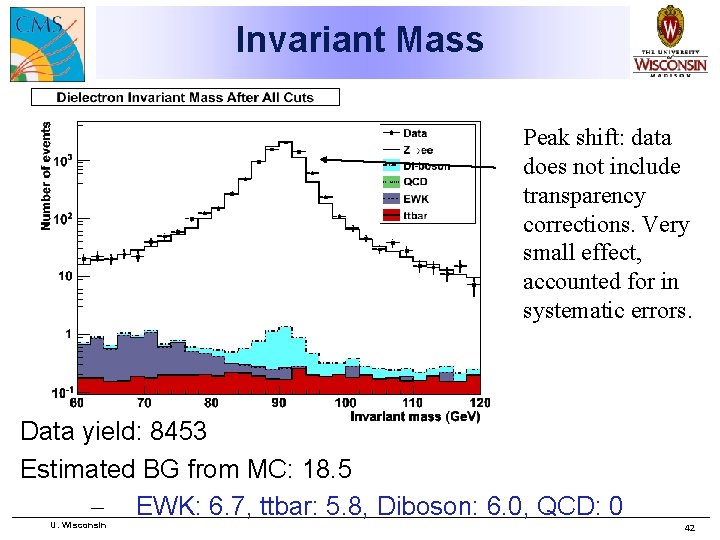
Invariant Mass Peak shift: data does not include transparency corrections. Very small effect, accounted for in systematic errors. Data yield: 8453 Estimated BG from MC: 18. 5 – EWK: 6. 7, ttbar: 5. 8, Diboson: 6. 0, QCD: 0 U. Wisconsin 42
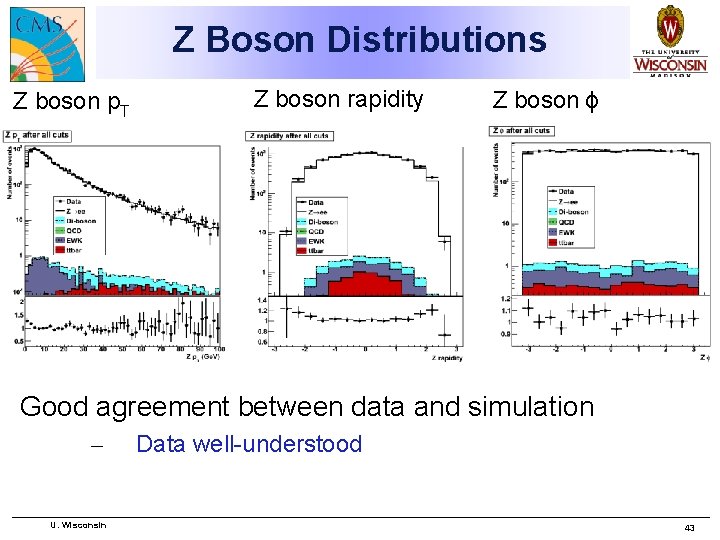
Z Boson Distributions Z boson p. T Z boson rapidity Z boson ϕ Good agreement between data and simulation – U. Wisconsin Data well-understood 43
Confirmation of Background Estimate Verify MC prediction of zero QCD background Template Technique 1. Choose variable with different signal/background distributions (here, track isolation) 2. Get “signal-rich” and “background-rich” data samples with adjusted selections, as well as “standard data” sample 3. Find composition of signal+background samples that best fits standard data sample Only useful for QCD background (EWK background too similar to signal) U. Wisconsin 44
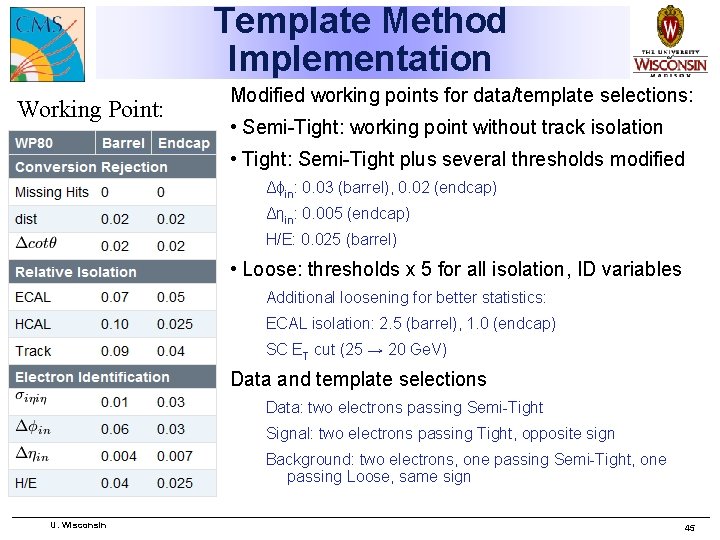
Template Method Implementation Working Point: Modified working points for data/template selections: • Semi-Tight: working point without track isolation • Tight: Semi-Tight plus several thresholds modified Δϕin: 0. 03 (barrel), 0. 02 (endcap) Δηin: 0. 005 (endcap) H/E: 0. 025 (barrel) • Loose: thresholds x 5 for all isolation, ID variables Additional loosening for better statistics: ECAL isolation: 2. 5 (barrel), 1. 0 (endcap) SC ET cut (25 → 20 Ge. V) Data and template selections Data: two electrons passing Semi-Tight Signal: two electrons passing Tight, opposite sign Background: two electrons, one passing Semi-Tight, one passing Loose, same sign U. Wisconsin 45
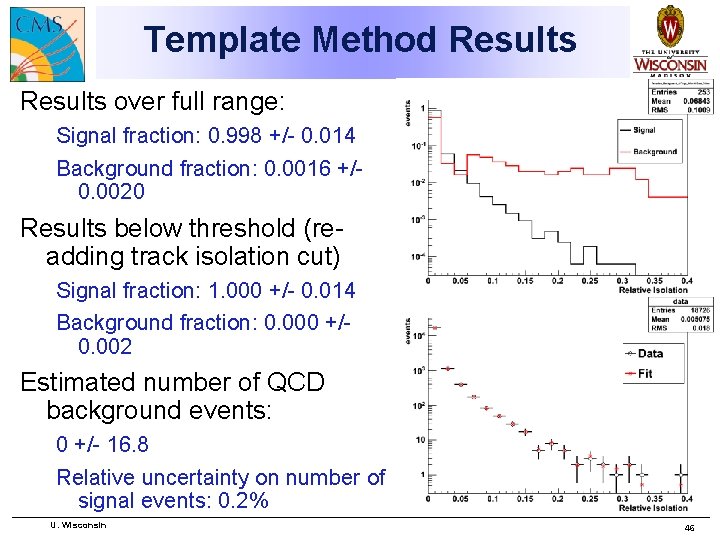
Template Method Results over full range: Signal fraction: 0. 998 +/- 0. 014 Background fraction: 0. 0016 +/0. 0020 Results below threshold (readding track isolation cut) Signal fraction: 1. 000 +/- 0. 014 Background fraction: 0. 000 +/0. 002 Estimated number of QCD background events: 0 +/- 16. 8 Relative uncertainty on number of signal events: 0. 2% U. Wisconsin 46
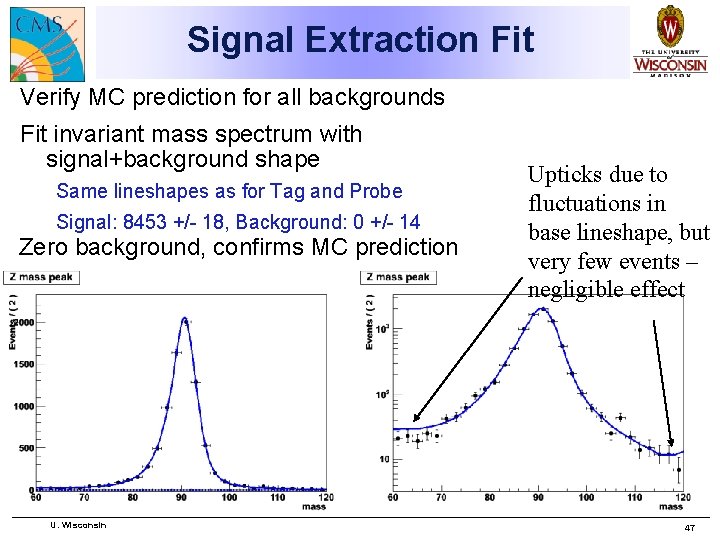
Signal Extraction Fit Verify MC prediction for all backgrounds Fit invariant mass spectrum with signal+background shape Same lineshapes as for Tag and Probe Signal: 8453 +/- 18, Background: 0 +/- 14 Zero background, confirms MC prediction U. Wisconsin Upticks due to fluctuations in base lineshape, but very few events – negligible effect 47
Background Estimation Summary All estimates consistent: MC: 18. 6 events Template fit: 0 +/- 16. 8 Z mass fit: 0 +/- 14 Take most conservative value, error Value: 19 events (MC estimate) Error: 17 events (template method) U. Wisconsin 48
Systematic Errors Theoretical uncertainty – Varied PDF, renormalization scale; calculated ISR/FSR corrections, other >LO corrections – Total theoretical uncertainty on yield: +/-1. 7% Electron energy scale – Varied electron energy by ECAL energy scale uncertainty: 2/3% in barrel/endcap (conservative) – Uncertainty on yield: +0. 82%, -1. 1%. Average = 0. 95% Varied sample for MC efficiency – POWHEG vs. PYTHIA, different parameter sets for underlying event – – – Evaluated efficiency using each sample U. Wisconsin Systematic = spread/2 between values for the three samples Syst = 1. 2% 49
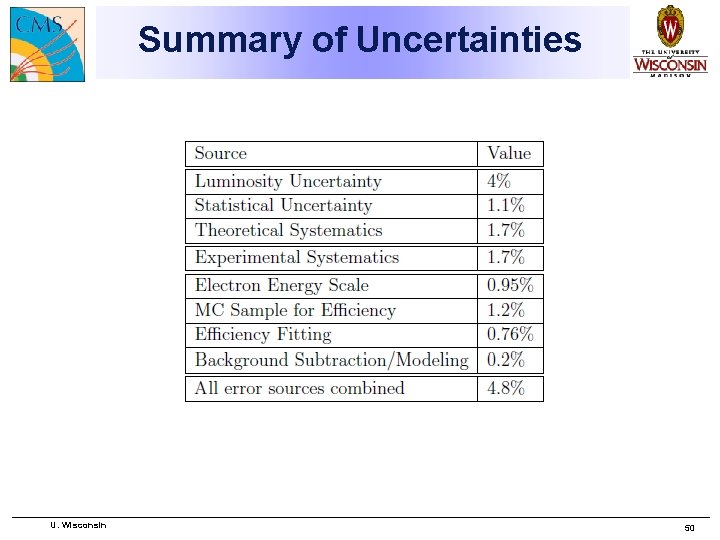
Summary of Uncertainties U. Wisconsin 50
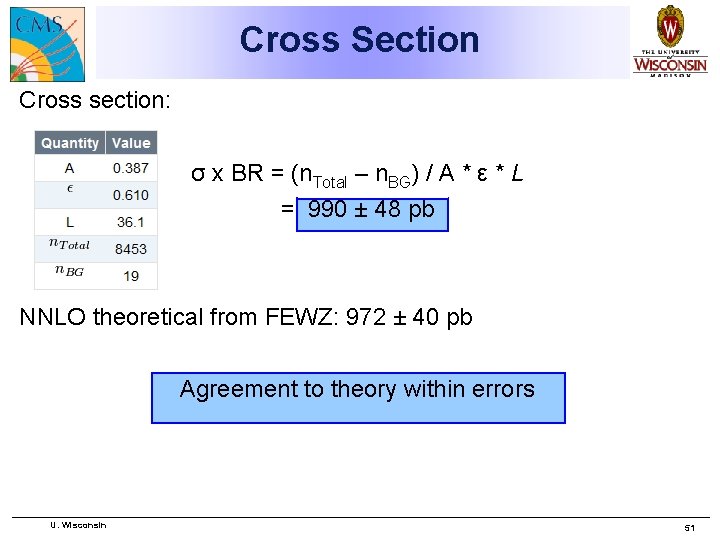
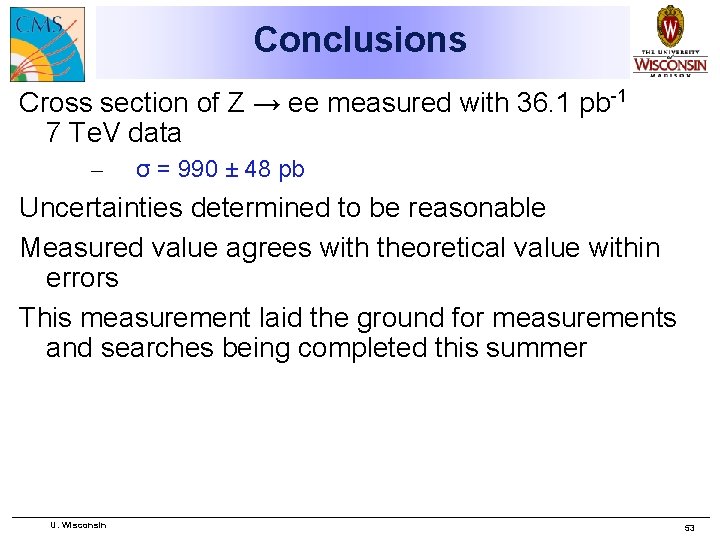
Cross Section Cross section: σ x BR = (n. Total – n. BG) / A * ε * L = 990 ± 48 pb NNLO theoretical from FEWZ: 972 ± 40 pb VBTF measured from Z→ee: 992 pb (0. 2% diff. ) Agreement to theory within errors U. Wisconsin 51
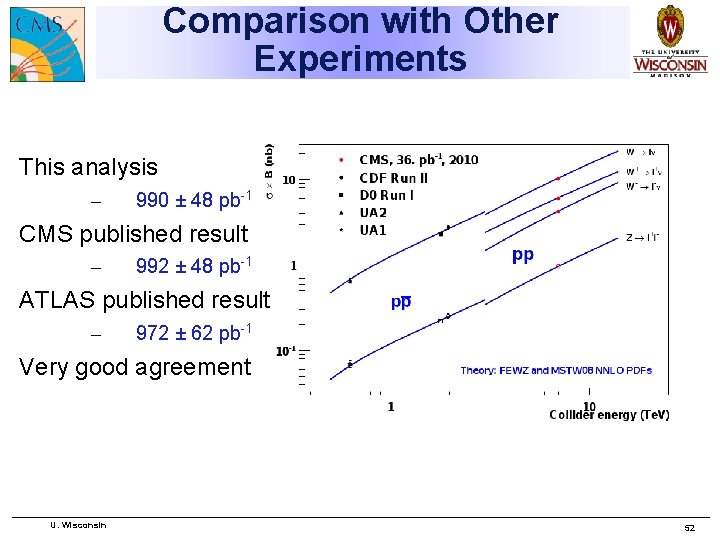
Comparison with Other Experiments This analysis – 990 ± 48 pb-1 CMS published result – 992 ± 48 pb-1 ATLAS published result – 972 ± 62 pb-1 Very good agreement U. Wisconsin 52
Conclusions Cross section of Z → ee measured with 36. 1 pb-1 7 Te. V data – σ = 990 ± 48 pb Uncertainties determined to be reasonable Measured value agrees with theoretical value within errors This measurement laid the ground for measurements and searches being completed this summer U. Wisconsin 53
U. Wisconsin 54
Samples U. Wisconsin 55
Trigger Efficiencies Trigger efficiencies from T&P method on data U. Wisconsin 56
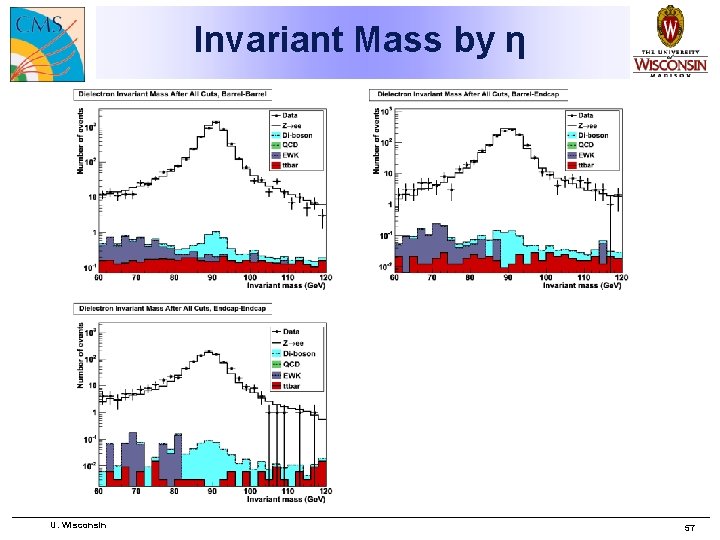
Invariant Mass by η U. Wisconsin 57
- Slides: 57