
z 2 c NV Assumes volume swept out


- Slides: 20
z = 2 c (N/V) Assumes volume swept out is independent of whether collisions occur (not a bad assumption in most cases) = 1/[ 2(N/V)] Some typical numbers: STP: 6. 02 1023 molecules / 22. 4 liters
P = 1 Torr z = 5. 45 106 sec -1 (P = 1/760 atm)
Distribution of Molecular Speeds Real gases do not have a single fixed speed. Rather molecules have speeds that vary giving a speed distribution. This distribution can be measured in a laboratory (done at Columbia by Polykarp Kusch) or derived from theoretical principles.
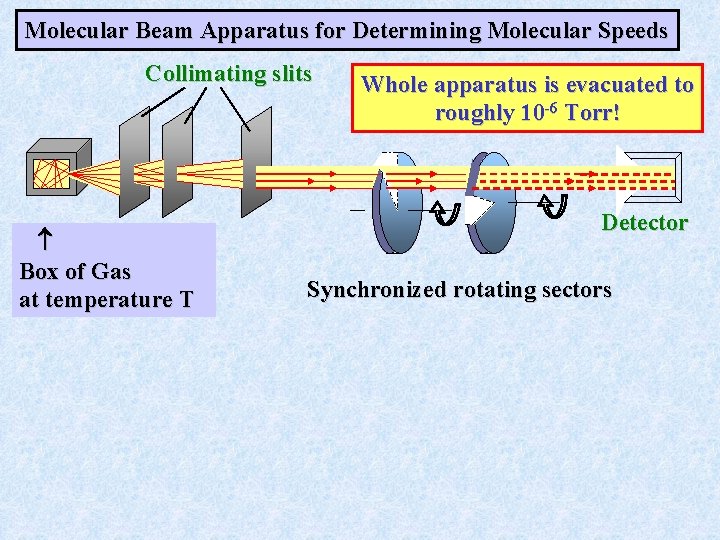
Molecular Beam Apparatus for Determining Molecular Speeds Collimating slits Box of Gas at temperature T Whole apparatus is evacuated to roughly 10 -6 Torr! Detector Synchronized rotating sectors
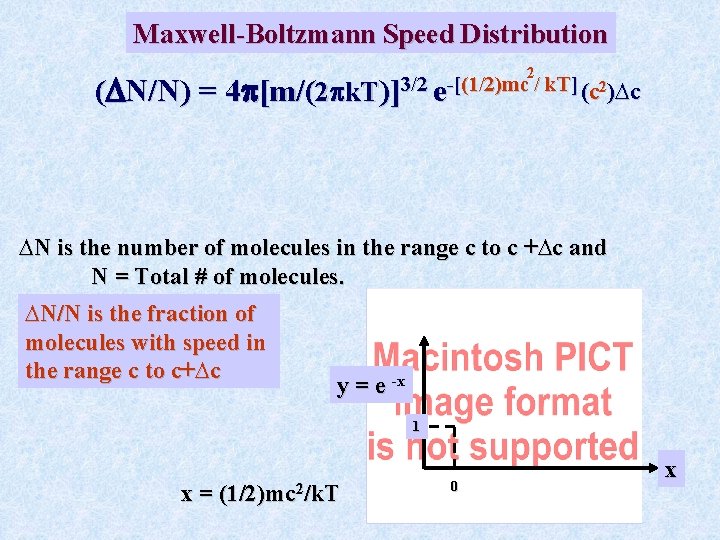
Maxwell-Boltzmann Speed Distribution ( N/N) = 2 4 [m/(2 k. T)]3/2 e-[(1/2)mc / k. T] (c 2)∆c ∆N is the number of molecules in the range c to c +∆c and N = Total # of molecules. ∆N/N is the fraction of molecules with speed in the range c to c+∆c y = e -x 1 x = (1/2)mc 2/k. T 0 x
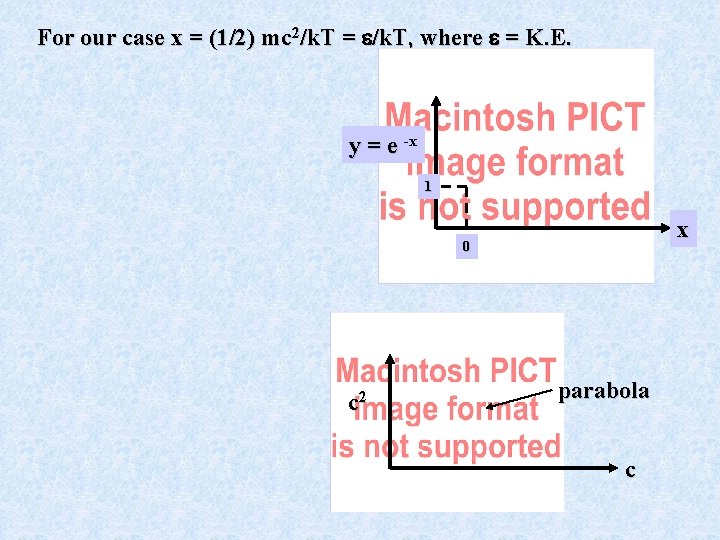
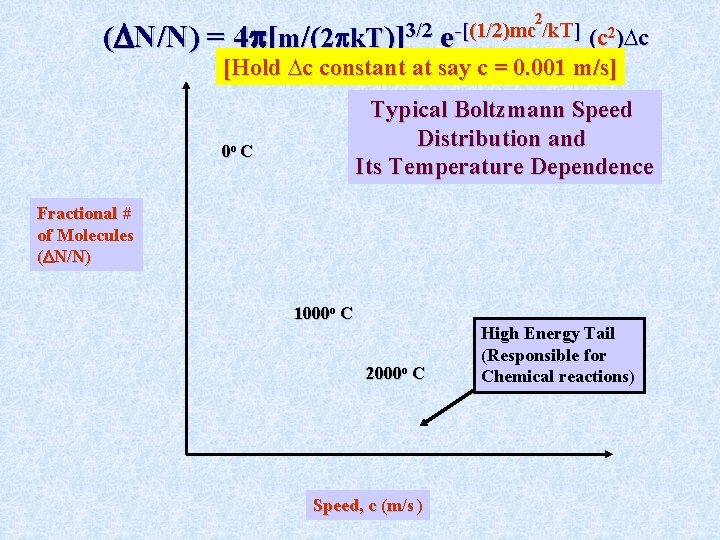
For our case x = (1/2) mc 2/k. T = /k. T, where = K. E. y = e -x 1 x 0 c 2 parabola c
c 2 or peak c
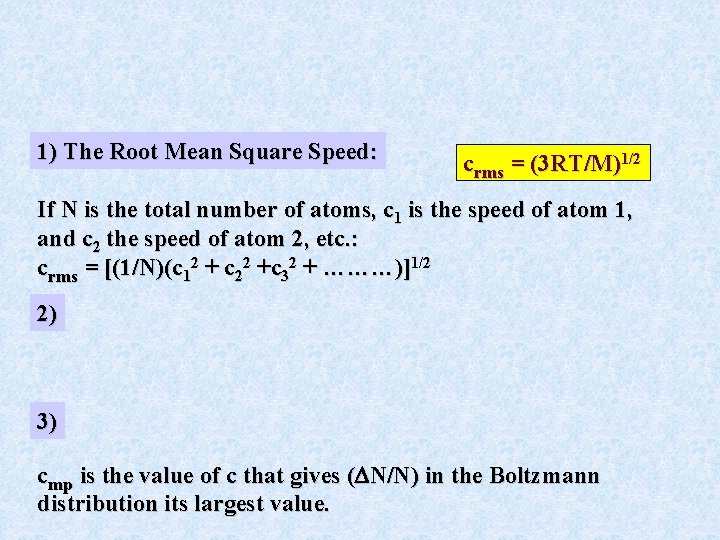
2 ( N/N) = 4 [m/(2 k. T)]3/2 e-[(1/2)mc /k. T] (c 2)∆c [Hold ∆c constant at say c = 0. 001 m/s] Typical Boltzmann Speed Distribution and Its Temperature Dependence 0 o C Fractional # of Molecules ( N/N) 1000 o C 2000 o C Speed, c (m/s ) High Energy Tail (Responsible for Chemical reactions)
1) The Root Mean Square Speed: crms = (3 RT/M)1/2 If N is the total number of atoms, c 1 is the speed of atom 1, and c 2 the speed of atom 2, etc. : crms = [(1/N)(c 12 + c 22 +c 32 + ………)]1/2 2) 3) cmp is the value of c that gives ( N/N) in the Boltzmann distribution its largest value.
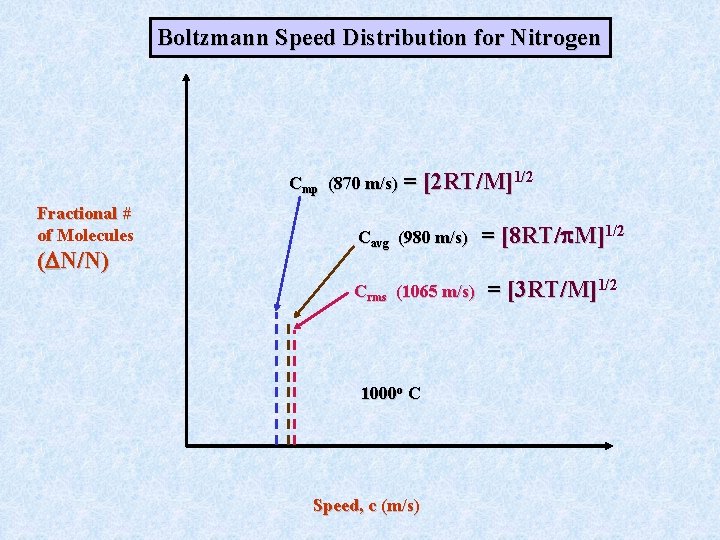
Boltzmann Speed Distribution for Nitrogen Cmp (870 m/s) = [2 RT/M]1/2 Fractional # of Molecules ( N/N) Cavg (980 m/s) = [8 RT/ M]1/2 Crms (1065 m/s) = [3 RT/M]1/2 1000 o C Speed, c (m/s)
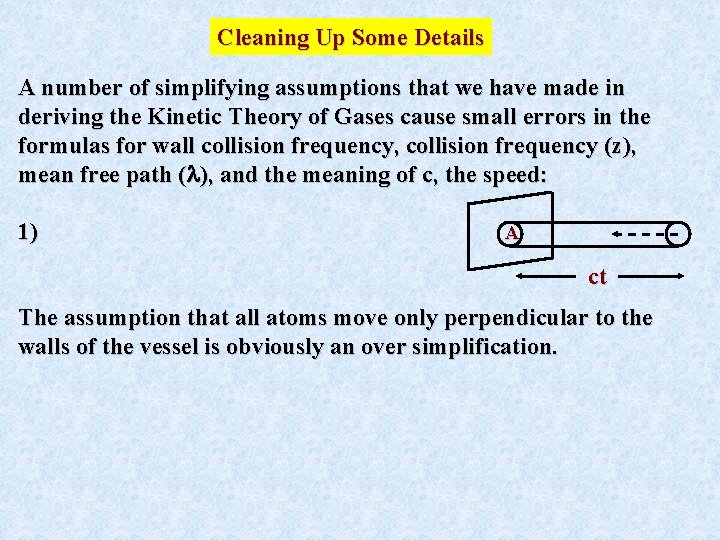
Cleaning Up Some Details A number of simplifying assumptions that we have made in deriving the Kinetic Theory of Gases cause small errors in the formulas for wall collision frequency, collision frequency (z), mean free path ( ), and the meaning of c, the speed: 1) A ct The assumption that all atoms move only perpendicular to the walls of the vessel is obviously an over simplification.
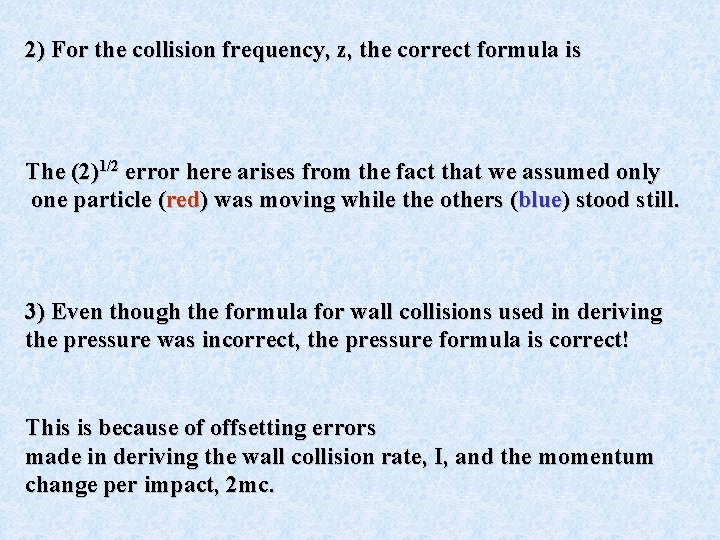
2) For the collision frequency, z, the correct formula is The (2)1/2 error here arises from the fact that we assumed only one particle (red) was moving while the others (blue) stood still. 3) Even though the formula for wall collisions used in deriving the pressure was incorrect, the pressure formula is correct! This is because of offsetting errors made in deriving the wall collision rate, I, and the momentum change per impact, 2 mc.
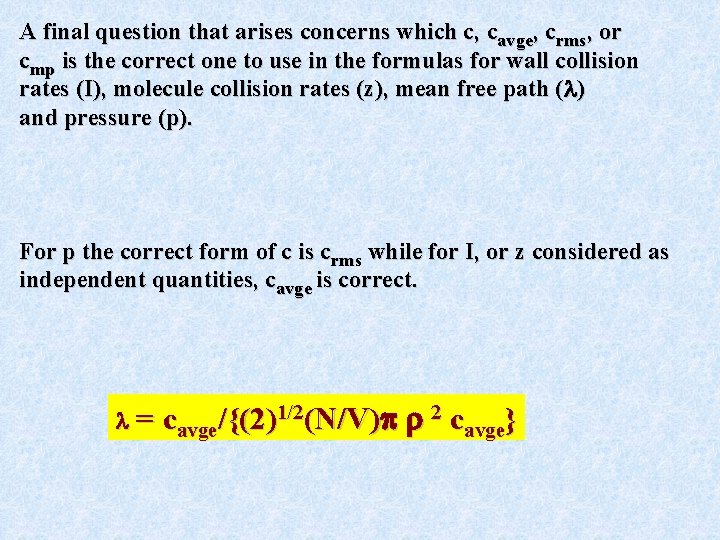
A final question that arises concerns which c, cavge, crms, or cmp is the correct one to use in the formulas for wall collision rates (I), molecule collision rates (z), mean free path ( ) and pressure (p). For p the correct form of c is crms while for I, or z considered as independent quantities, cavge is correct. = cavge/{(2)1/2(N/V) 2 cavge}
Bonus * Bonus * Bonus Summary of correct Kinetic Theory formulas:
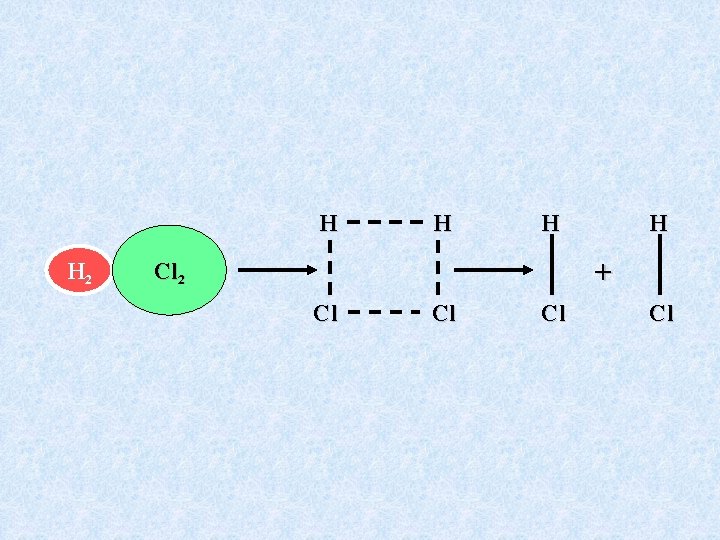
Chemical Kinetics The Binary Collision Model Must actually have a hydrogen molecule bump into a chlorine molecule to have chemistry occur. Reaction during such a collision might look like the following picture:
H H 2 H H H + Cl 2 Cl Cl
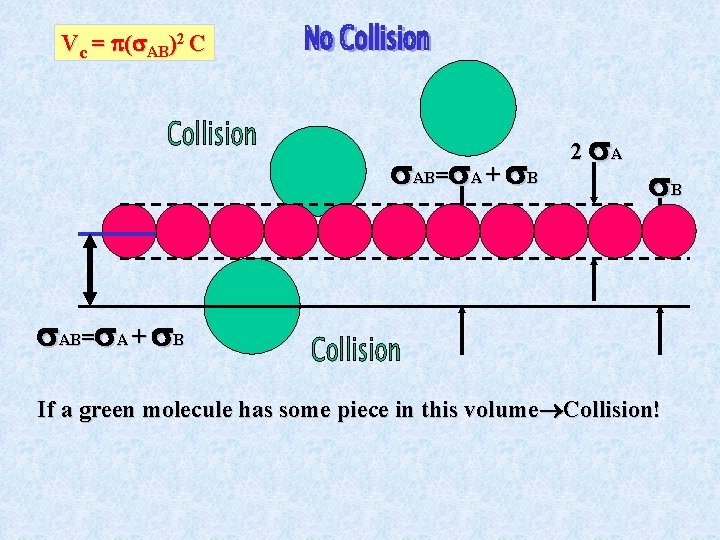
Collision Frequency Real gases consist of particles of finite size that bump into each other at some finite rate. Assume first that the red molecule has a constant speed C and the green ones are standing still.
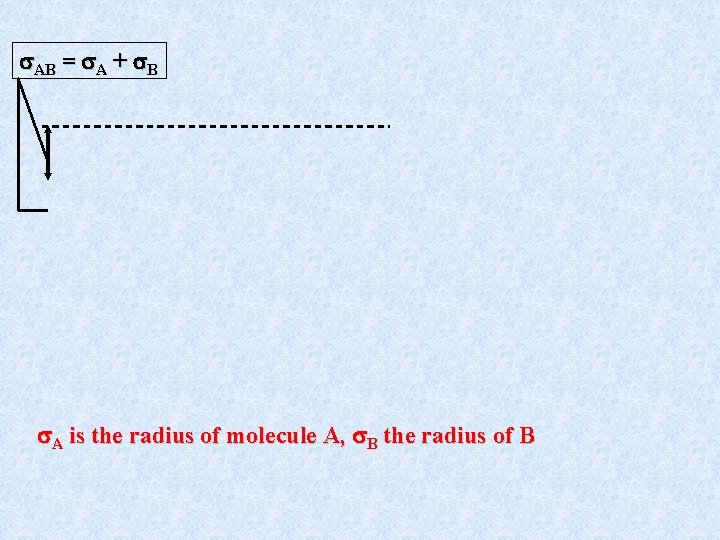
Vc = ( AB)2 C AB= A + B 2 A B AB= A + B If a green molecule has some piece in this volume Collision!
AB = A + B A is the radius of molecule A, B the radius of B
There is one subtlety. In deriving z, we assumed the red molecule flew through a cloud of motionless green ones at a speed of C. In reality, of course, all the molecules are moving. <urel> is the mean speed of molecule A with respect to molecule B. Where =m. A m. B/(m. A+m. B) is called the reduced mass and can be thought of as a kind of (geometric) average of the masses of A, B.