
Yukon Larger Than Life By Lynell and Marina
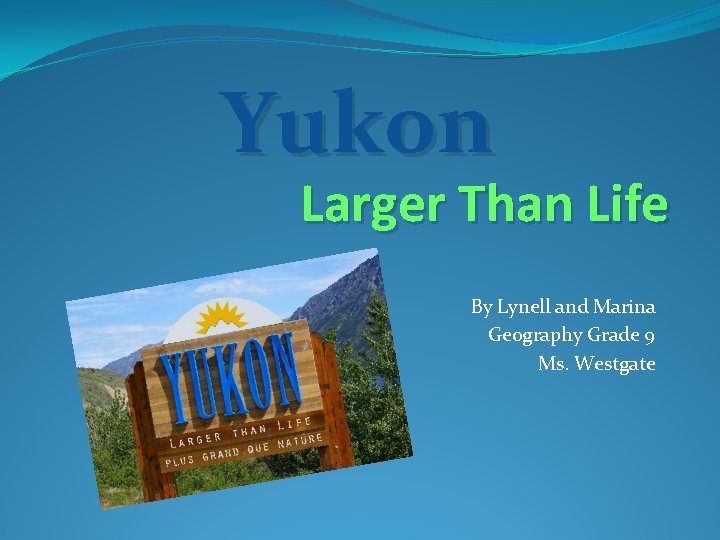
Yukon Larger Than Life By Lynell and Marina Geography Grade 9 Ms. Westgate
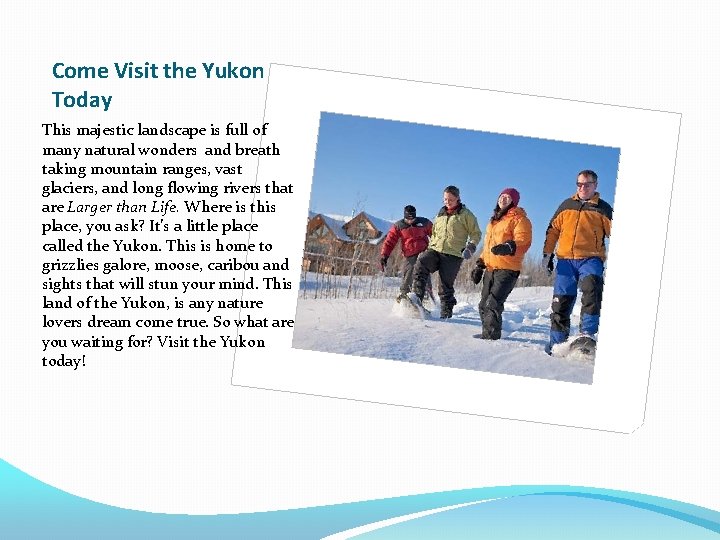
Come Visit the Yukon Today This majestic landscape is full of many natural wonders and breath taking mountain ranges, vast glaciers, and long flowing rivers that are Larger than Life. Where is this place, you ask? It’s a little place called the Yukon. This is home to grizzlies galore, moose, caribou and sights that will stun your mind. This land of the Yukon, is any nature lovers dream come true. So what are you waiting for? Visit the Yukon today!
The Climate of the Yukon Many people believe that the Yukon is a year round below freezing climate. This assumption is untrue. The average temperature in the winter months in the Yukon is -22 degrees Celsius. As for the summer climate the average temperature is 21 degrees Celsius, which is much warmer than the average Canadian would expect. The record low for the Yukon Territory was in January 1947 with a temperature of -52 degrees Celsius. While the record high was recorded in June 1969 with a temperature reaching to 34 degrees. The seasons of the Yukon are similar to other provincial season lengths and temperatures. Yukon summers are sunny and warm but often unpredictable. When traveling in the Yukon, no matter what season, it would be smart to have a sweater or jacket with you. Northern winters require layering while spending long periods in the outdoors.

Temperature and Precipitation Averages Representative Climate Normal’s Zone North (Old Crow) Centra l (Daws on City) South (White horse) Southe ast (Wats on Lake) Average annual tempera ture -9. 0 °C -4. 4 °C -0. 7 °C -2. 9 °C Average July daily high 21 °C 23 °C 21 °C Average January daily low Av era Average ge snowfall rai nfa ll -36 °C 129 cm 144 m m 160 cm 200 m m 145 cm 163 m m 197 cm 255 m m -31 °C -22 °C -29 °C
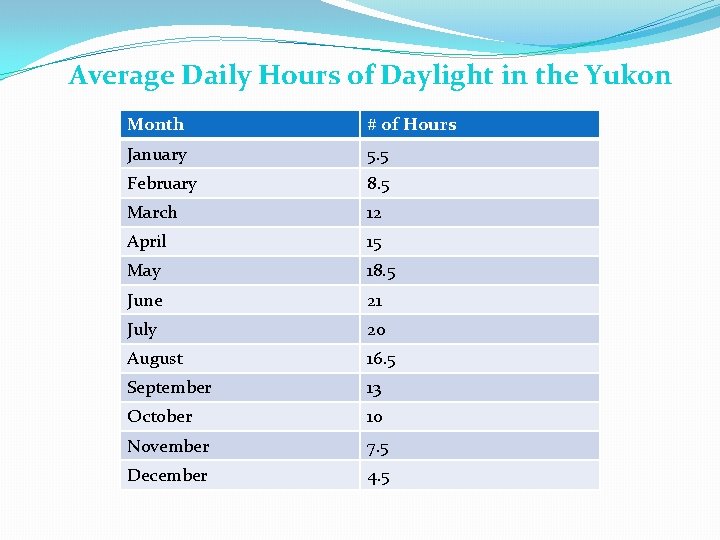
Average Daily Hours of Daylight in the Yukon Month # of Hours January 5. 5 February 8. 5 March 12 April 15 May 18. 5 June 21 July 20 August 16. 5 September 13 October 10 November 7. 5 December 4. 5

The Population of the Yukon Territory has a very small population compared to many provinces in Canada. The Yukon’s overall population is estimated to be around 30, 989 in 2007. ¾ of this population is located in Whitehorse, the population of Whitehorse is 22, 898, the largest city out of all 3 of Canada’s territories.
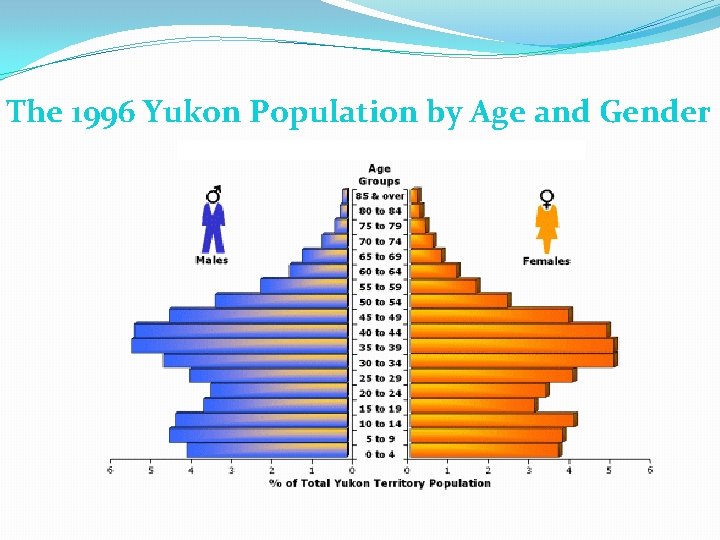
The 1996 Yukon Population by Age and Gender
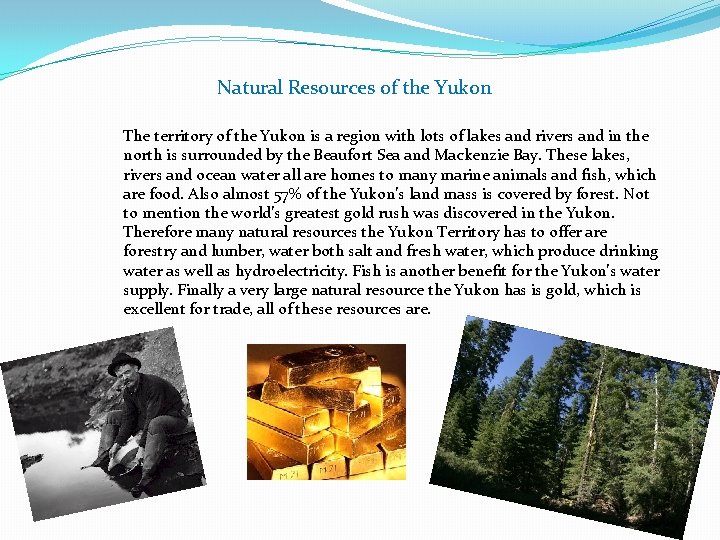
Natural Resources of the Yukon The territory of the Yukon is a region with lots of lakes and rivers and in the north is surrounded by the Beaufort Sea and Mackenzie Bay. These lakes, rivers and ocean water all are homes to many marine animals and fish, which are food. Also almost 57% of the Yukon’s land mass is covered by forest. Not to mention the world’s greatest gold rush was discovered in the Yukon. Therefore many natural resources the Yukon Territory has to offer are forestry and lumber, water both salt and fresh water, which produce drinking water as well as hydroelectricity. Fish is another benefit for the Yukon’s water supply. Finally a very large natural resource the Yukon has is gold, which is excellent for trade, all of these resources are.
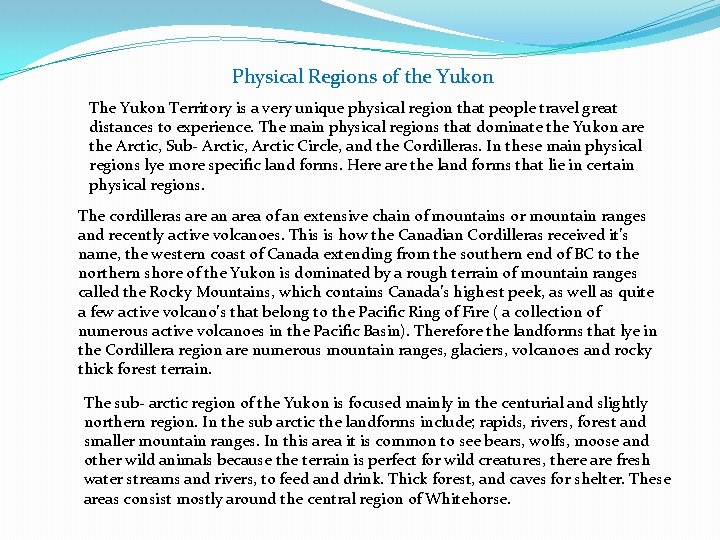
Physical Regions of the Yukon Territory is a very unique physical region that people travel great distances to experience. The main physical regions that dominate the Yukon are the Arctic, Sub- Arctic, Arctic Circle, and the Cordilleras. In these main physical regions lye more specific land forms. Here are the land forms that lie in certain physical regions. The cordilleras are an area of an extensive chain of mountains or mountain ranges and recently active volcanoes. This is how the Canadian Cordilleras received it’s name, the western coast of Canada extending from the southern end of BC to the northern shore of the Yukon is dominated by a rough terrain of mountain ranges called the Rocky Mountains, which contains Canada’s highest peek, as well as quite a few active volcano’s that belong to the Pacific Ring of Fire ( a collection of numerous active volcanoes in the Pacific Basin). Therefore the landforms that lye in the Cordillera region are numerous mountain ranges, glaciers, volcanoes and rocky thick forest terrain. The sub- arctic region of the Yukon is focused mainly in the centurial and slightly northern region. In the sub arctic the landforms include; rapids, rivers, forest and smaller mountain ranges. In this area it is common to see bears, wolfs, moose and other wild animals because the terrain is perfect for wild creatures, there are fresh water streams and rivers, to feed and drink. Thick forest, and caves for shelter. These areas consist mostly around the central region of Whitehorse.
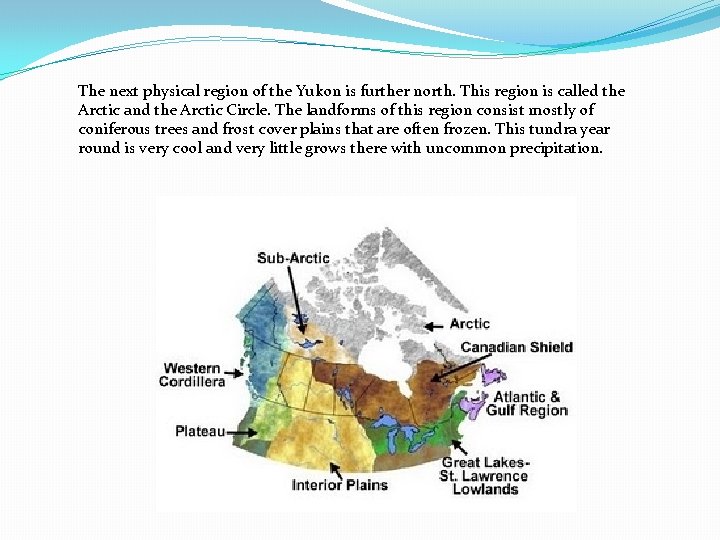
The next physical region of the Yukon is further north. This region is called the Arctic and the Arctic Circle. The landforms of this region consist mostly of coniferous trees and frost cover plains that are often frozen. This tundra year round is very cool and very little grows there with uncommon precipitation.
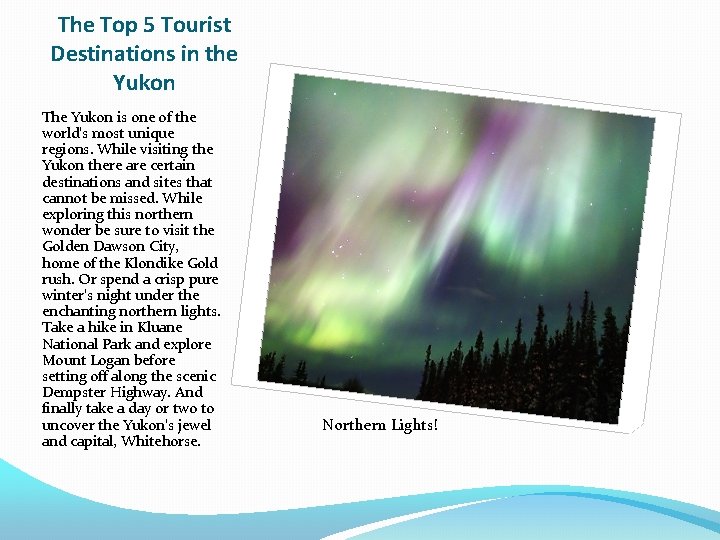
The Top 5 Tourist Destinations in the Yukon The Yukon is one of the world’s most unique regions. While visiting the Yukon there are certain destinations and sites that cannot be missed. While exploring this northern wonder be sure to visit the Golden Dawson City, home of the Klondike Gold rush. Or spend a crisp pure winter’s night under the enchanting northern lights. Take a hike in Kluane National Park and explore Mount Logan before setting off along the scenic Dempster Highway. And finally take a day or two to uncover the Yukon’s jewel and capital, Whitehorse. Northern Lights!
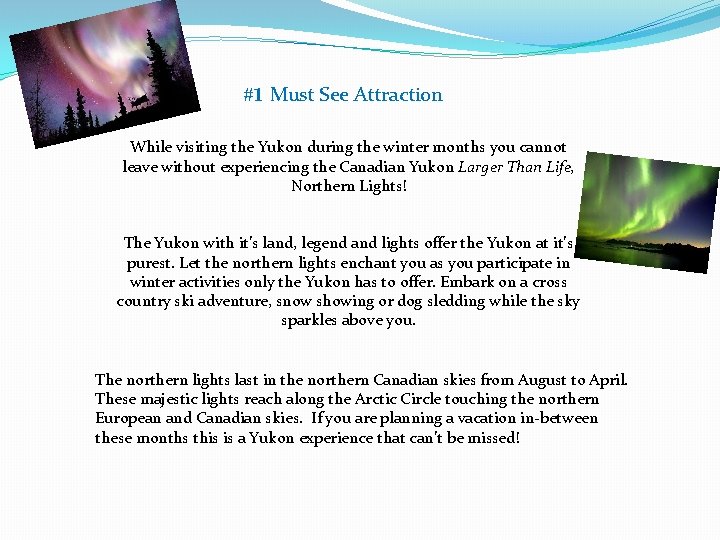
#1 Must See Attraction While visiting the Yukon during the winter months you cannot leave without experiencing the Canadian Yukon Larger Than Life, Northern Lights! The Yukon with it’s land, legend and lights offer the Yukon at it’s purest. Let the northern lights enchant you as you participate in winter activities only the Yukon has to offer. Embark on a cross country ski adventure, snow showing or dog sledding while the sky sparkles above you. The northern lights last in the northern Canadian skies from August to April. These majestic lights reach along the Arctic Circle touching the northern European and Canadian skies. If you are planning a vacation in-between these months this is a Yukon experience that can’t be missed!
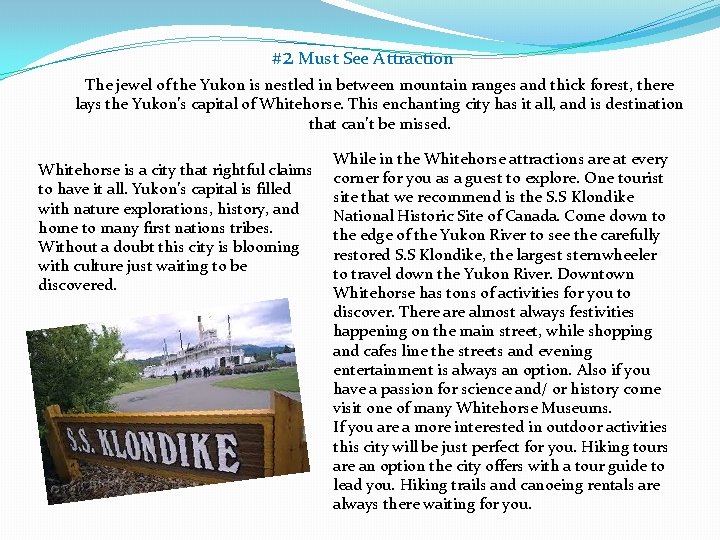
#2 Must See Attraction The jewel of the Yukon is nestled in between mountain ranges and thick forest, there lays the Yukon’s capital of Whitehorse. This enchanting city has it all, and is destination that can’t be missed. Whitehorse is a city that rightful claims to have it all. Yukon’s capital is filled with nature explorations, history, and home to many first nations tribes. Without a doubt this city is blooming with culture just waiting to be discovered. While in the Whitehorse attractions are at every corner for you as a guest to explore. One tourist site that we recommend is the S. S Klondike National Historic Site of Canada. Come down to the edge of the Yukon River to see the carefully restored S. S Klondike, the largest sternwheeler to travel down the Yukon River. Downtown Whitehorse has tons of activities for you to discover. There almost always festivities happening on the main street, while shopping and cafes line the streets and evening entertainment is always an option. Also if you have a passion for science and/ or history come visit one of many Whitehorse Museums. If you are a more interested in outdoor activities this city will be just perfect for you. Hiking tours are an option the city offers with a tour guide to lead you. Hiking trails and canoeing rentals are always there waiting for you.
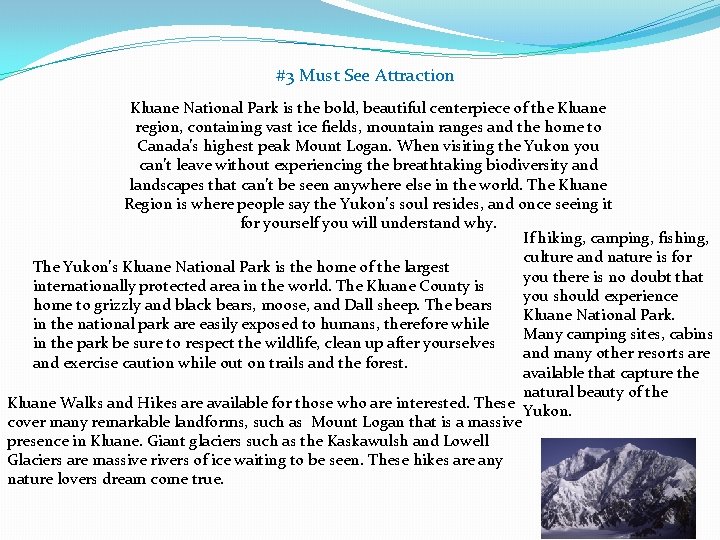
#3 Must See Attraction Kluane National Park is the bold, beautiful centerpiece of the Kluane region, containing vast ice fields, mountain ranges and the home to Canada’s highest peak Mount Logan. When visiting the Yukon you can’t leave without experiencing the breathtaking biodiversity and landscapes that can’t be seen anywhere else in the world. The Kluane Region is where people say the Yukon’s soul resides, and once seeing it for yourself you will understand why. If hiking, camping, fishing, culture and nature is for The Yukon’s Kluane National Park is the home of the largest you there is no doubt that internationally protected area in the world. The Kluane County is you should experience home to grizzly and black bears, moose, and Dall sheep. The bears Kluane National Park. in the national park are easily exposed to humans, therefore while Many camping sites, cabins in the park be sure to respect the wildlife, clean up after yourselves and many other resorts are and exercise caution while out on trails and the forest. available that capture the natural beauty of the Kluane Walks and Hikes are available for those who are interested. These Yukon. cover many remarkable landforms, such as Mount Logan that is a massive presence in Kluane. Giant glaciers such as the Kaskawulsh and Lowell Glaciers are massive rivers of ice waiting to be seen. These hikes are any nature lovers dream come true.
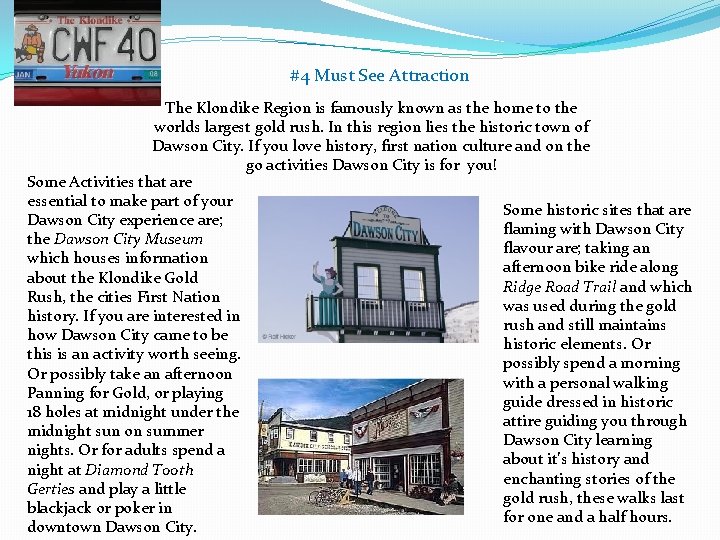
#4 Must See Attraction The Klondike Region is famously known as the home to the worlds largest gold rush. In this region lies the historic town of Dawson City. If you love history, first nation culture and on the go activities Dawson City is for you! Some Activities that are essential to make part of your Some historic sites that are Dawson City experience are; flaming with Dawson City the Dawson City Museum flavour are; taking an which houses information afternoon bike ride along about the Klondike Gold Ridge Road Trail and which Rush, the cities First Nation was used during the gold history. If you are interested in rush and still maintains how Dawson City came to be historic elements. Or this is an activity worth seeing. possibly spend a morning Or possibly take an afternoon with a personal walking Panning for Gold, or playing guide dressed in historic 18 holes at midnight under the attire guiding you through midnight sun on summer Dawson City learning nights. Or for adults spend a about it’s history and night at Diamond Tooth enchanting stories of the Gerties and play a little gold rush, these walks last blackjack or poker in for one and a half hours. downtown Dawson City.
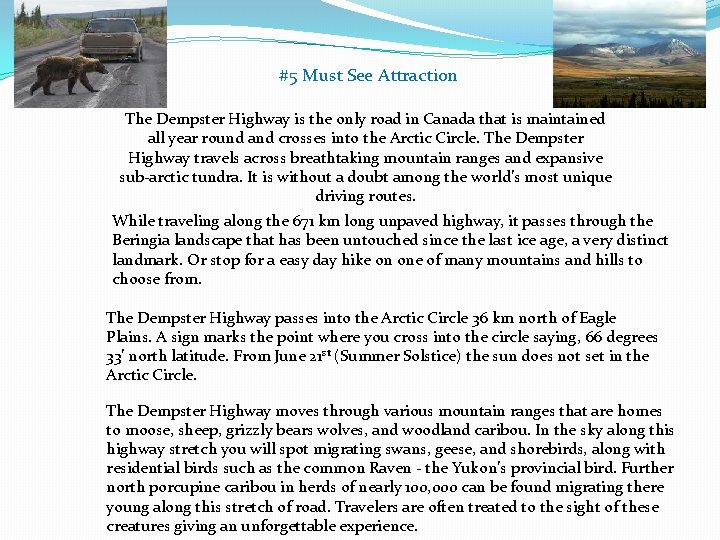
#5 Must See Attraction The Dempster Highway is the only road in Canada that is maintained all year round and crosses into the Arctic Circle. The Dempster Highway travels across breathtaking mountain ranges and expansive sub-arctic tundra. It is without a doubt among the world’s most unique driving routes. While traveling along the 671 km long unpaved highway, it passes through the Beringia landscape that has been untouched since the last ice age, a very distinct landmark. Or stop for a easy day hike on one of many mountains and hills to choose from. The Dempster Highway passes into the Arctic Circle 36 km north of Eagle Plains. A sign marks the point where you cross into the circle saying, 66 degrees 33’ north latitude. From June 21 st (Summer Solstice) the sun does not set in the Arctic Circle. The Dempster Highway moves through various mountain ranges that are homes to moose, sheep, grizzly bears wolves, and woodland caribou. In the sky along this highway stretch you will spot migrating swans, geese, and shorebirds, along with residential birds such as the common Raven - the Yukon’s provincial bird. Further north porcupine caribou in herds of nearly 100, 000 can be found migrating there young along this stretch of road. Travelers are often treated to the sight of these creatures giving an unforgettable experience.
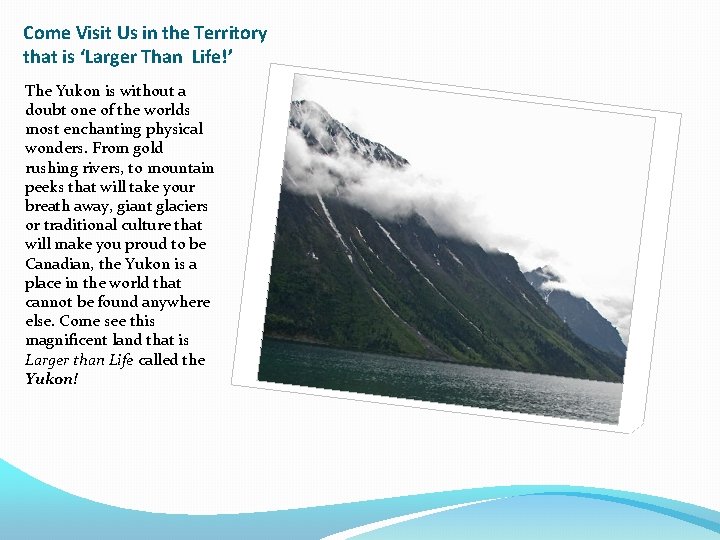
Come Visit Us in the Territory that is ‘Larger Than Life!’ The Yukon is without a doubt one of the worlds most enchanting physical wonders. From gold rushing rivers, to mountain peeks that will take your breath away, giant glaciers or traditional culture that will make you proud to be Canadian, the Yukon is a place in the world that cannot be found anywhere else. Come see this magnificent land that is Larger than Life called the Yukon!

Sources -Yukon Larger Than Life vacation planner 2010 - Internet (Google) -Ms. Westgate -Marina’s Parents
- Slides: 18