
Yr 11 Physics Astronomy Sun Observational Activity Local
Yr. 11 Physics - Astronomy Sun Observational Activity • Local Midday & Latitude • Finding True North/South
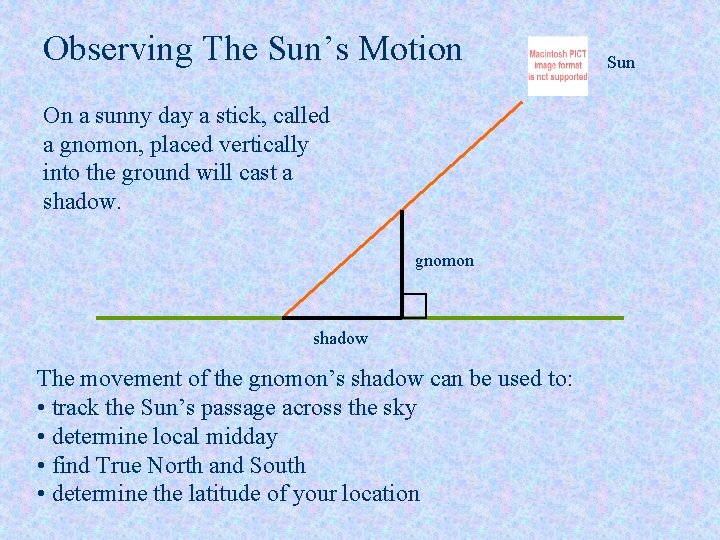
Observing The Sun’s Motion On a sunny day a stick, called a gnomon, placed vertically into the ground will cast a shadow. gnomon shadow The movement of the gnomon’s shadow can be used to: • track the Sun’s passage across the sky • determine local midday • find True North and South • determine the latitude of your location Sun
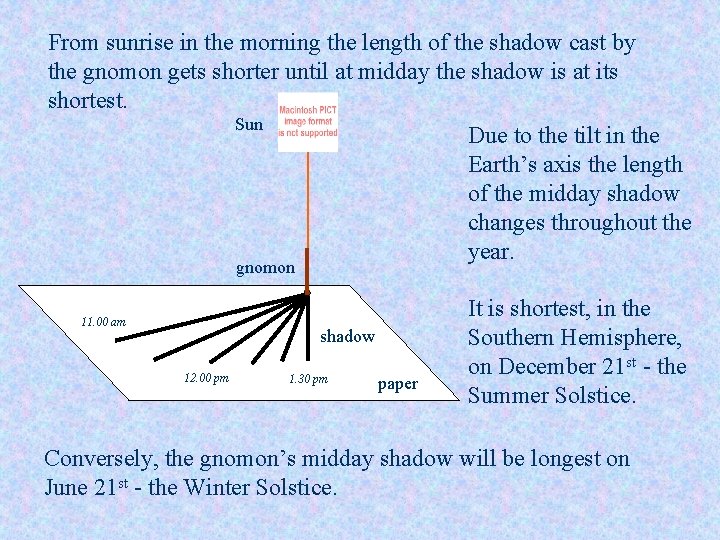
From sunrise in the morning the length of the shadow cast by the gnomon gets shorter until at midday the shadow is at its shortest. Sun Due to the tilt in the Earth’s axis the length of the midday shadow changes throughout the year. gnomon 11. 00 am shadow 12. 00 pm 1. 30 pm paper It is shortest, in the Southern Hemisphere, on December 21 st - the Summer Solstice. Conversely, the gnomon’s midday shadow will be longest on June 21 st - the Winter Solstice.
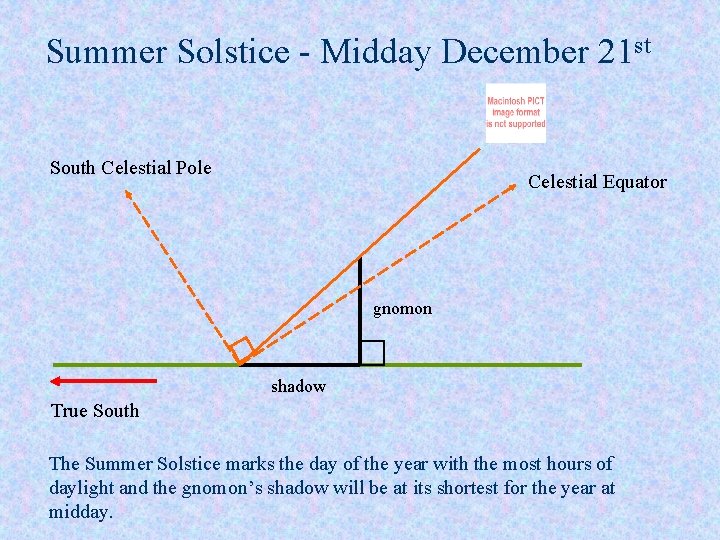
Summer Solstice - Midday December 21 st South Celestial Pole Celestial Equator gnomon shadow True South The Summer Solstice marks the day of the year with the most hours of daylight and the gnomon’s shadow will be at its shortest for the year at midday.
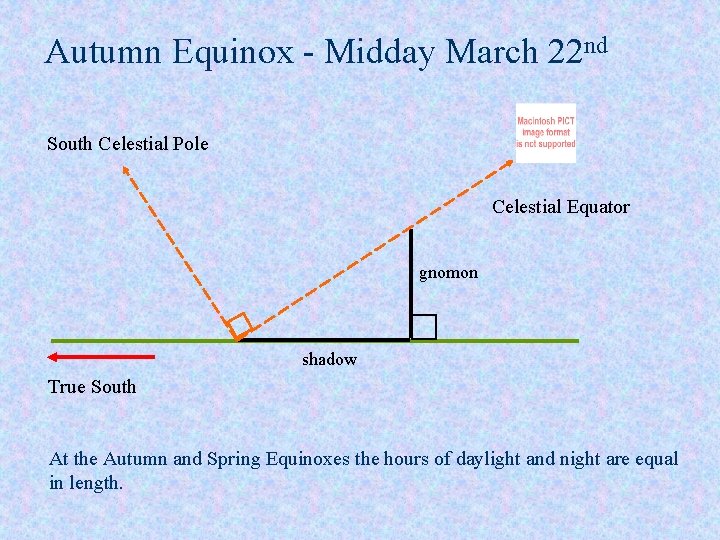
Autumn Equinox - Midday March 22 nd South Celestial Pole Celestial Equator gnomon shadow True South At the Autumn and Spring Equinoxes the hours of daylight and night are equal in length.

Winter Solstice - Midday June 21 st South Celestial Pole Celestial Equator gnomon shadow True South The Winter Solstice marks the day of the year with the least hours of daylight and the gnomon’s midday shadow will be at its longest for the year.
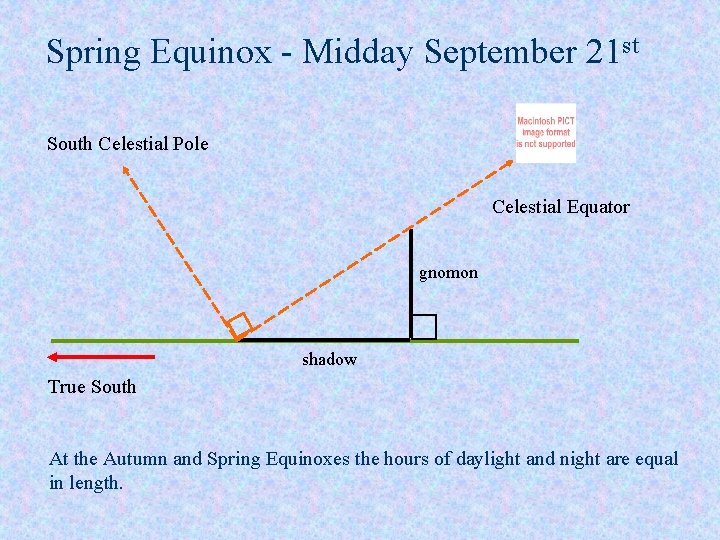
Spring Equinox - Midday September 21 st South Celestial Pole Celestial Equator gnomon shadow True South At the Autumn and Spring Equinoxes the hours of daylight and night are equal in length.
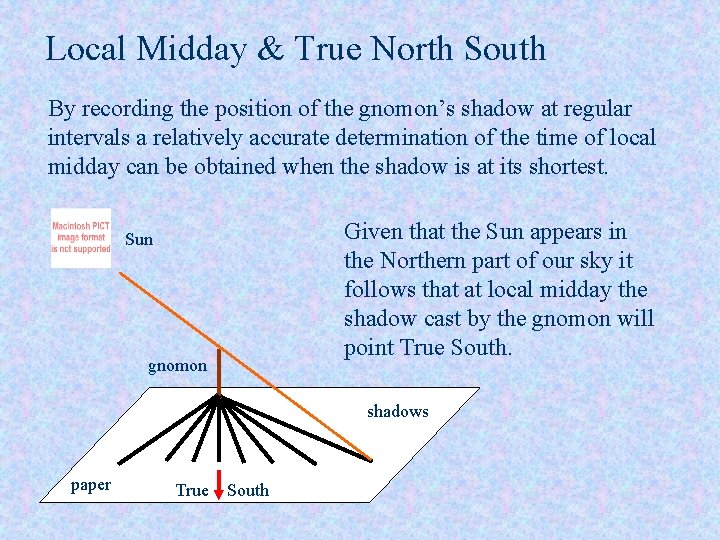
Local Midday & True North South By recording the position of the gnomon’s shadow at regular intervals a relatively accurate determination of the time of local midday can be obtained when the shadow is at its shortest. Given that the Sun appears in the Northern part of our sky it follows that at local midday the shadow cast by the gnomon will point True South. Sun gnomon shadows paper True South
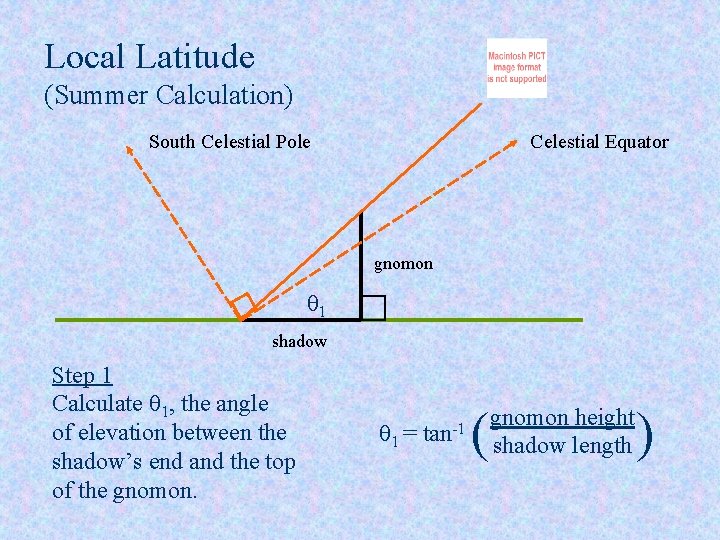
Local Latitude (Summer Calculation) South Celestial Pole Celestial Equator gnomon q 1 shadow Step 1 Calculate q 1, the angle of elevation between the shadow’s end and the top of the gnomon. q 1 = tan-1 ( gnomon height shadow length )
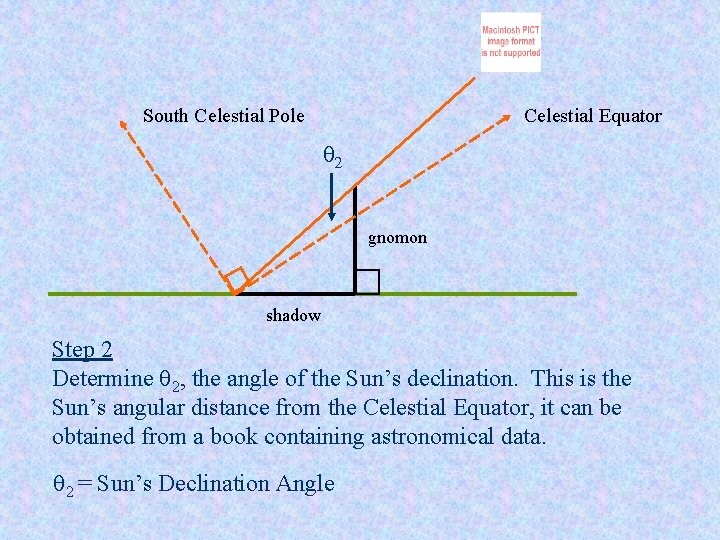
South Celestial Pole Celestial Equator q 2 gnomon shadow Step 2 Determine q 2, the angle of the Sun’s declination. This is the Sun’s angular distance from the Celestial Equator, it can be obtained from a book containing astronomical data. q 2 = Sun’s Declination Angle
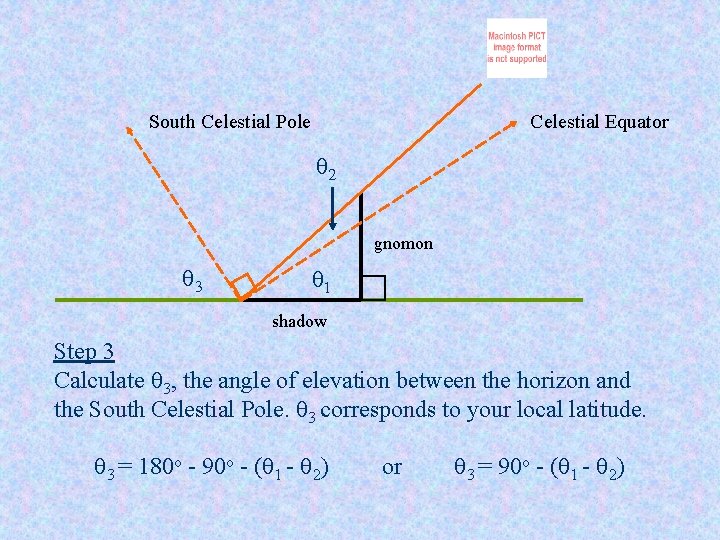
South Celestial Pole Celestial Equator q 2 gnomon q 3 q 1 shadow Step 3 Calculate q 3, the angle of elevation between the horizon and the South Celestial Pole. q 3 corresponds to your local latitude. q 3 = 180 o - 90 o - (q 1 - q 2) or q 3 = 90 o - (q 1 - q 2)
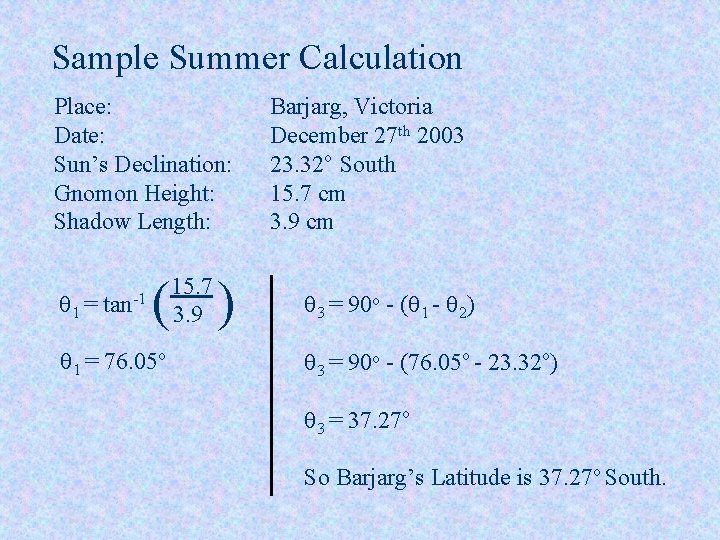
Sample Summer Calculation Place: Date: Sun’s Declination: Gnomon Height: Shadow Length: q 1 = tan-1 ( ) q 1 = 76. 05 o 15. 7 3. 9 Barjarg, Victoria December 27 th 2003 23. 32 o South 15. 7 cm 3. 9 cm q 3 = 90 o - (q 1 - q 2) q 3 = 90 o - (76. 05 o - 23. 32 o) q 3 = 37. 27 o So Barjarg’s Latitude is 37. 27 o South.
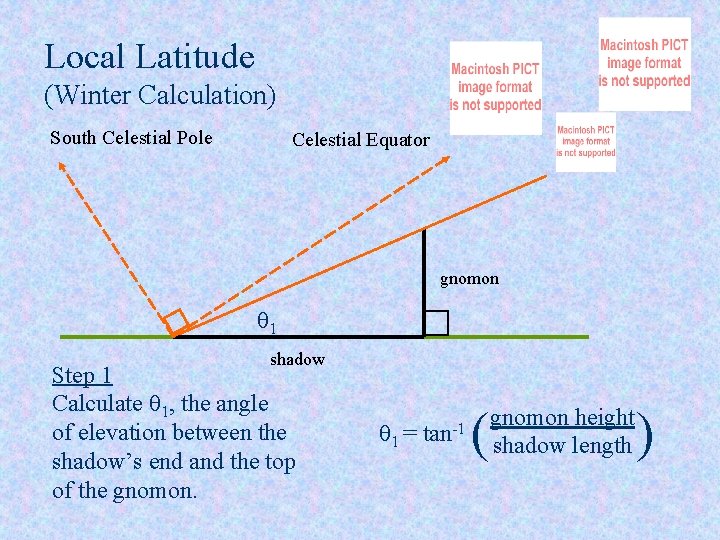
Local Latitude (Winter Calculation) South Celestial Pole Celestial Equator gnomon q 1 shadow Step 1 Calculate q 1, the angle of elevation between the shadow’s end and the top of the gnomon. q 1 = tan-1 ( gnomon height shadow length )
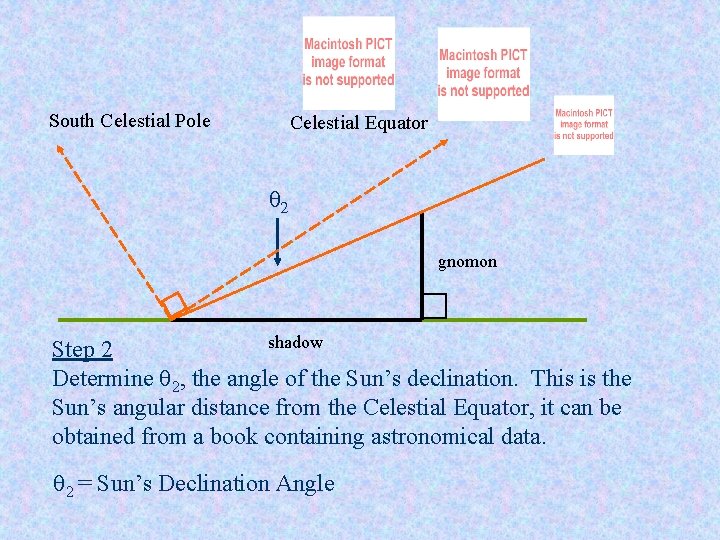
South Celestial Pole Celestial Equator q 2 gnomon shadow Step 2 Determine q 2, the angle of the Sun’s declination. This is the Sun’s angular distance from the Celestial Equator, it can be obtained from a book containing astronomical data. q 2 = Sun’s Declination Angle
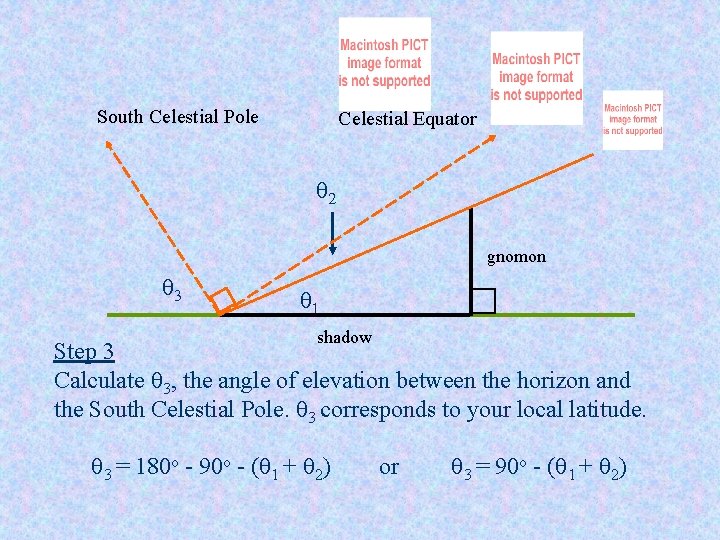
South Celestial Pole Celestial Equator q 2 gnomon q 3 q 1 shadow Step 3 Calculate q 3, the angle of elevation between the horizon and the South Celestial Pole. q 3 corresponds to your local latitude. q 3 = 180 o - 90 o - (q 1 + q 2) or q 3 = 90 o - (q 1 + q 2)
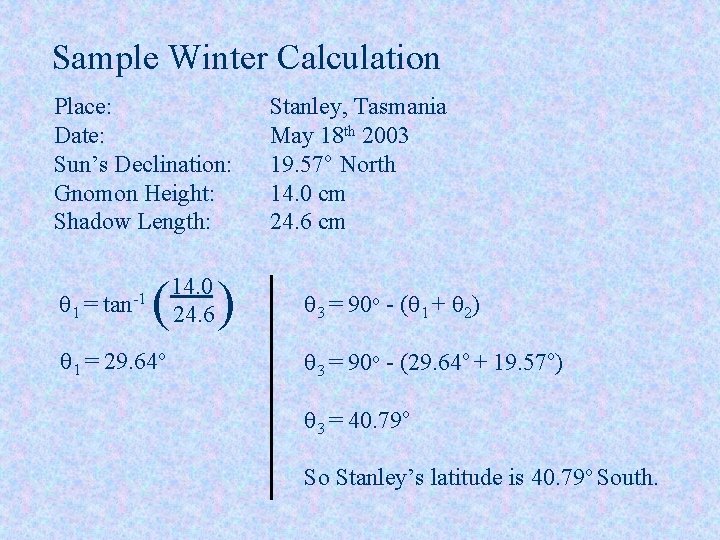
Sample Winter Calculation Place: Date: Sun’s Declination: Gnomon Height: Shadow Length: q 1 = tan-1 ( ) q 1 = 29. 64 o 14. 0 24. 6 Stanley, Tasmania May 18 th 2003 19. 57 o North 14. 0 cm 24. 6 cm q 3 = 90 o - (q 1 + q 2) q 3 = 90 o - (29. 64 o + 19. 57 o) q 3 = 40. 79 o So Stanley’s latitude is 40. 79 o South.
- Slides: 16