
Youth Justice Youth Justice Lesson Objectives Share your
Youth Justice
Youth Justice Lesson Objectives § Share your thoughts about justice § Understand your rights within the criminal justice system § Understand why we punish criminals § Be able to discuss different types of punishment and their advantages and disadvantages 2 © Young Citizens
Youth Justice What should the justice system look like? ts r u o c e sent rrest enci a Use the sheet to think about the justice system you would like to see. crime ques tioni 3 polic ng © Young Citizens ss e n r i fa punish ment ng trials y lit a u q e
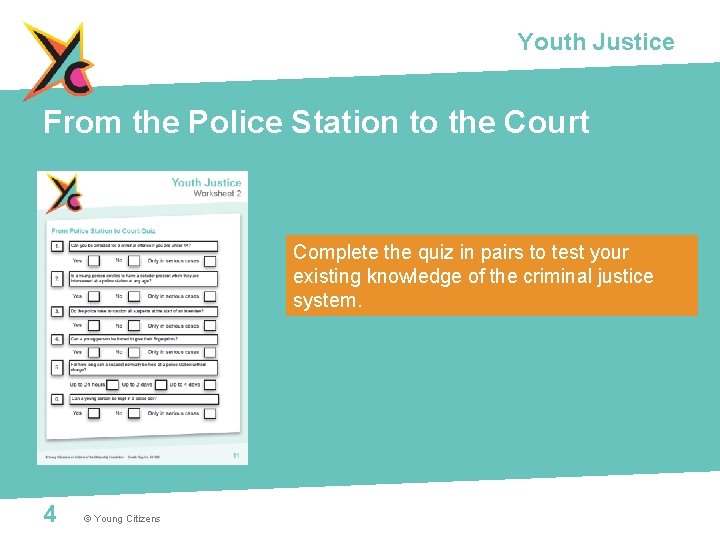
Youth Justice From the Police Station to the Court Complete the quiz in pairs to test your existing knowledge of the criminal justice system. 4 © Young Citizens
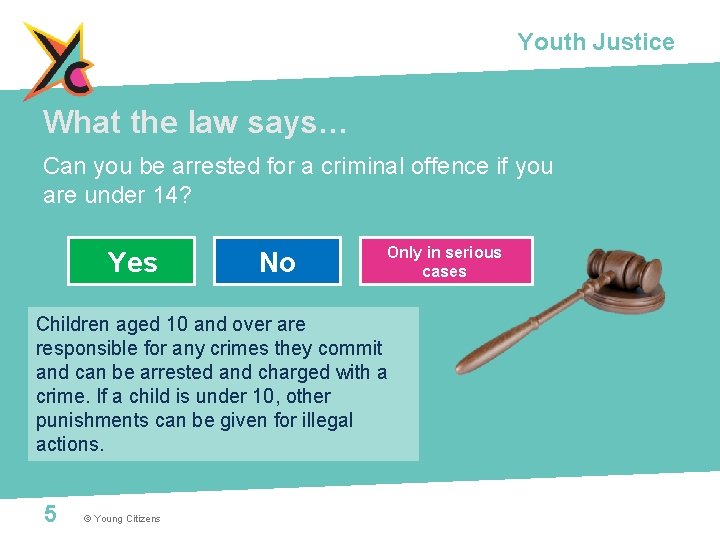
Youth Justice What the law says… Can you be arrested for a criminal offence if you are under 14? Yes No Only in serious cases Children aged 10 and over are responsible for any crimes they commit and can be arrested and charged with a crime. If a child is under 10, other punishments can be given for illegal actions. 5 © Young Citizens
Youth Justice What the law says… Is a young person entitled to a solicitor when interviewed at a police station at any age? Yes No Only in serious cases The duty solicitor is available 24 hours a day and is not employed by the police. This is free of charge. If you are under 16 in addition to a solicitor an appropriate adult needs to be present during questioning and searching, e. g. a parent, social worker, family member over 18 or volunteer. 6 © Young Citizens
Youth Justice What the law says… Do the police have to caution all suspects at the start of an interview? Yes No Only in serious cases What is a caution? A caution is a warning that anything that a suspect says may be used as evidence in court. 7 © Young Citizens
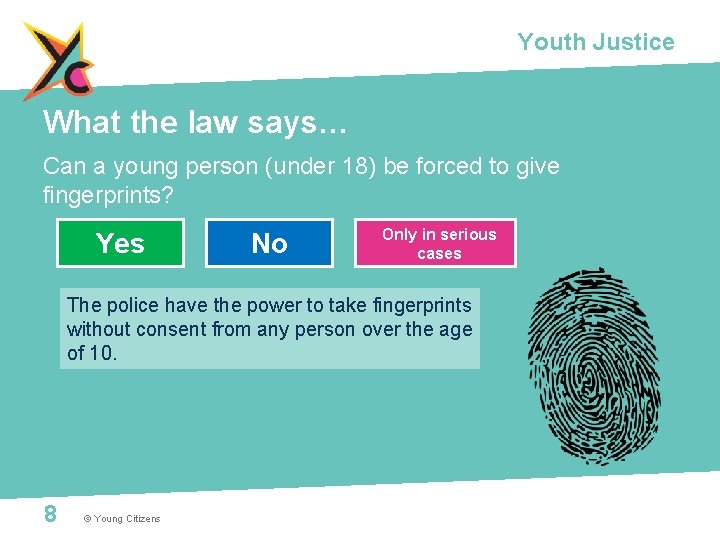
Youth Justice What the law says… Can a young person (under 18) be forced to give fingerprints? Yes No Only in serious cases The police have the power to take fingerprints without consent from any person over the age of 10. 8 © Young Citizens
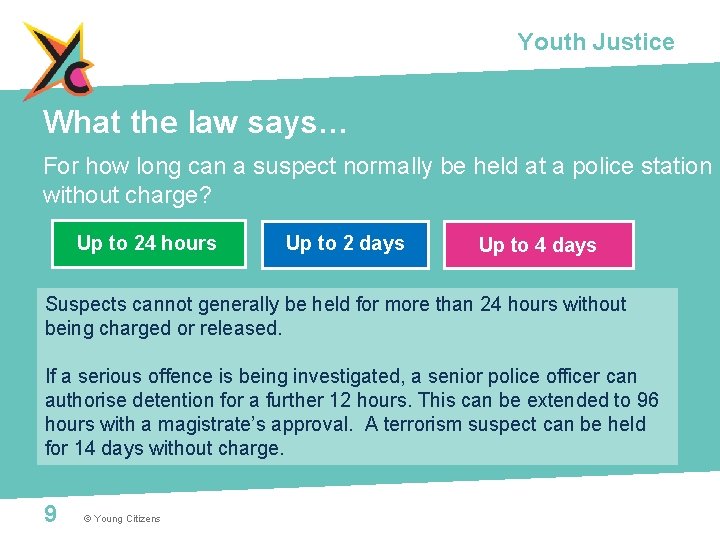
Youth Justice What the law says… For how long can a suspect normally be held at a police station without charge? Up to 24 hours Up to 2 days Up to 4 days Suspects cannot generally be held for more than 24 hours without being charged or released. If a serious offence is being investigated, a senior police officer can authorise detention for a further 12 hours. This can be extended to 96 hours with a magistrate’s approval. A terrorism suspect can be held for 14 days without charge. 9 © Young Citizens
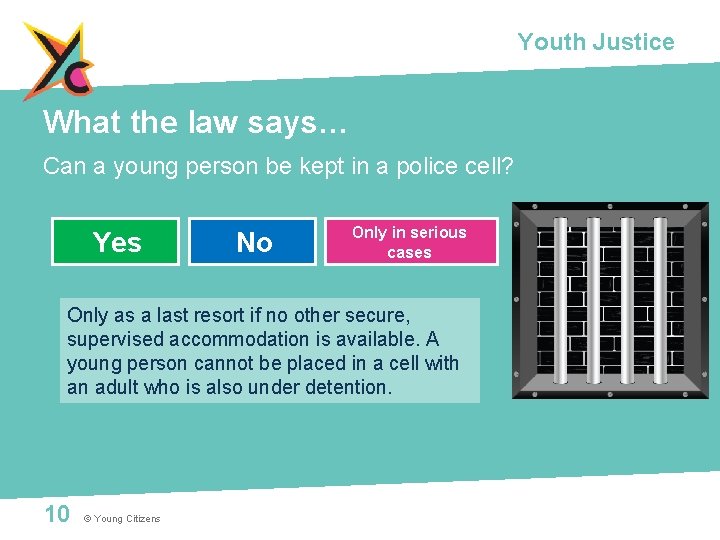
Youth Justice What the law says… Can a young person be kept in a police cell? Yes No Only in serious cases Only as a last resort if no other secure, supervised accommodation is available. A young person cannot be placed in a cell with an adult who is also under detention. 10 © Young Citizens
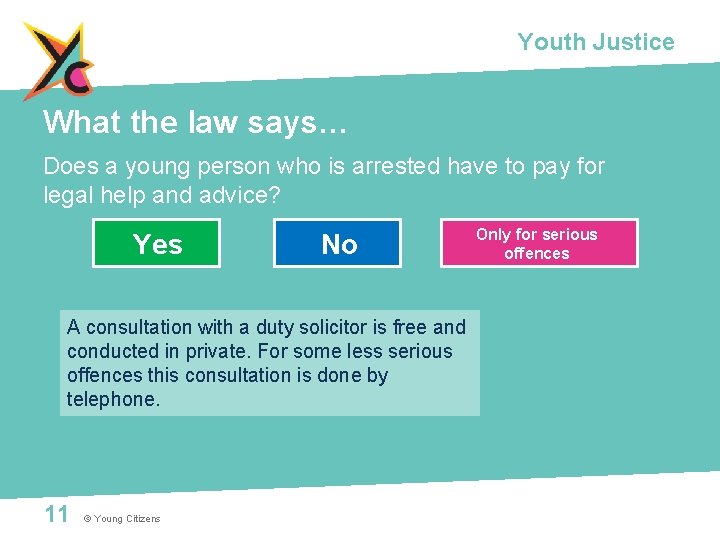
Youth Justice What the law says… Does a young person who is arrested have to pay for legal help and advice? Yes No A consultation with a duty solicitor is free and conducted in private. For some less serious offences this consultation is done by telephone. 11 © Young Citizens Only for serious offences
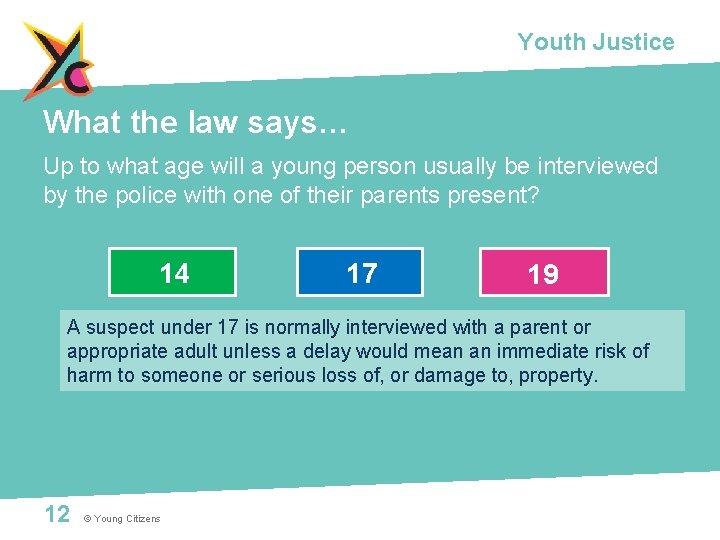
Youth Justice What the law says… Up to what age will a young person usually be interviewed by the police with one of their parents present? 14 17 19 A suspect under 17 is normally interviewed with a parent or appropriate adult unless a delay would mean an immediate risk of harm to someone or serious loss of, or damage to, property. 12 © Young Citizens
Youth Justice What the law says… Does a person who is arrested have to answer a police officer’s questions? Yes No Only in serious cases A person must give the police their name and address, but then has the right to remain silent and not answer any further questions. However, if the case goes to trial the court will be told of this and it may strengthen the case against the suspect. 13 © Young Citizens
Youth Justice What the law says… Until what age are young people tried in a Youth Court? 17 19 21 Cases where the accused is aged up to and including 17 are generally heard in a youth court. However, a young person charged alongside an adult will be sent for trial at the magistrates’ court. In exceptional cases, such as when a young person is charged with murder, the trial will be held in a crown court. 14 © Young Citizens
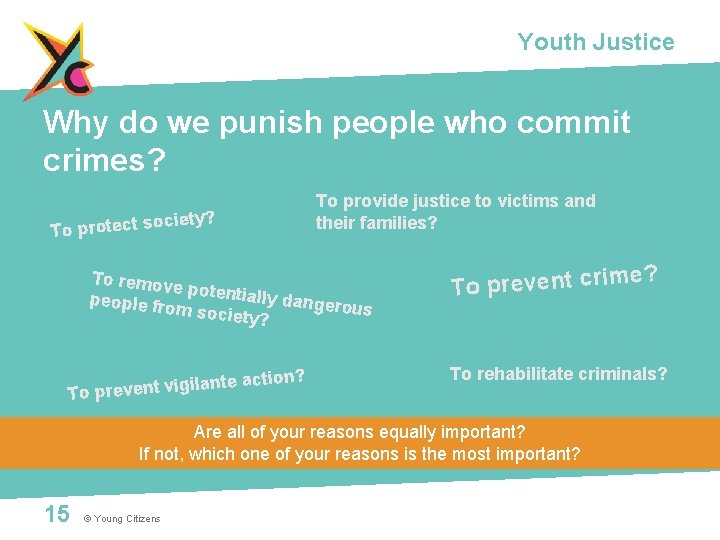
Youth Justice Why do we punish people who commit crimes? ty? ocie To protect s To provide justice to victims and their families? To remov ep people fro otentially dangero us m society ? action? te n a il ig v t n e v To pre e? To prevent crim To rehabilitate criminals? Are all of your reasons equally important? If not, which one of your reasons is the most important? 15 © Young Citizens
Youth Justice From Crime to Punishment We are going to look at the different stages that someone suspected of committing a crime might go through 16 © Young Citizens
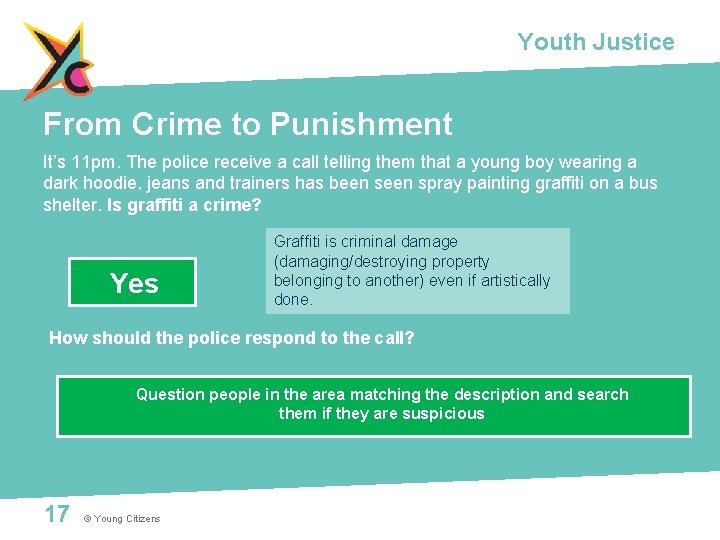
Youth Justice From Crime to Punishment It’s 11 pm. The police receive a call telling them that a young boy wearing a dark hoodie, jeans and trainers has been spray painting graffiti on a bus shelter. Is graffiti a crime? Yes Graffiti is criminal damage (damaging/destroying property belonging to another) even if artistically done. How should the police respond to the call? Question people in the area matching the description and search them if they are suspicious 17 © Young Citizens
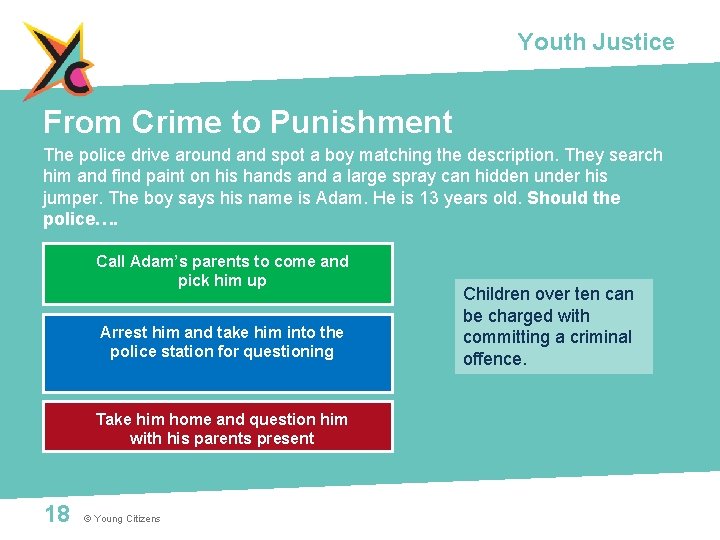
Youth Justice From Crime to Punishment The police drive around and spot a boy matching the description. They search him and find paint on his hands and a large spray can hidden under his jumper. The boy says his name is Adam. He is 13 years old. Should the police…. Call Adam’s parents to come and pick him up Arrest him and take him into the police station for questioning Take him home and question him with his parents present 18 © Young Citizens Children over ten can be charged with committing a criminal offence.
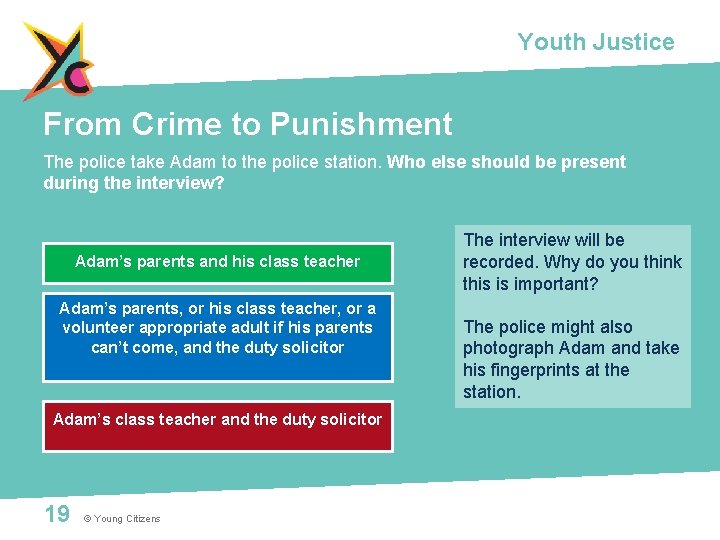
Youth Justice From Crime to Punishment The police take Adam to the police station. Who else should be present during the interview? Adam’s parents and his class teacher Adam’s parents, or his class teacher, or a volunteer appropriate adult if his parents can’t come, and the duty solicitor Adam’s class teacher and the duty solicitor 19 © Young Citizens The interview will be recorded. Why do you think this is important? The police might also photograph Adam and take his fingerprints at the station.
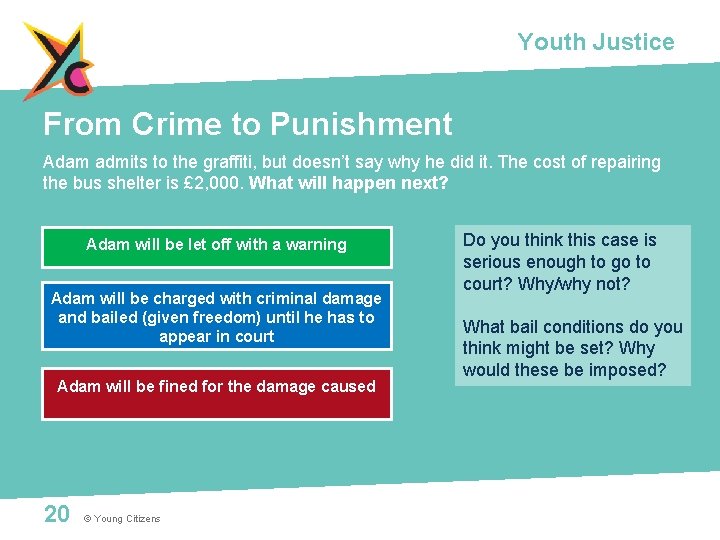
Youth Justice From Crime to Punishment Adam admits to the graffiti, but doesn’t say why he did it. The cost of repairing the bus shelter is £ 2, 000. What will happen next? Adam will be let off with a warning Adam will be charged with criminal damage and bailed (given freedom) until he has to appear in court Adam will be fined for the damage caused 20 © Young Citizens Do you think this case is serious enough to go to court? Why/why not? What bail conditions do you think might be set? Why would these be imposed?
Youth Justice From Crime to Punishment A couple of weeks later Adam appears in the Youth Court. This is his first offence. He pleads guilty and the magistrates decide to sentence him straight away. Will it make a difference to Adam’s sentence that he plead guilty? Yes No Only if he tells the court why he grafitied the shelter 21 © Young Citizens You can get up to a one-third reduction on your sentence by pleading guilty at the first opportunity.
Youth Justice From Crime to Punishment What is the most likely sentence Adam will receive? A short time in prison/Youth Offenders Institution A fine for the damage caused A referral order 22 © Young Citizens This means he’ll be ‘referred’ to a Youth Panel of three adults, who, with Adam and his parents, will agree on a programme lasting 3 -12 months designed to reduce the chances of him re-offending. Adam’s parents may also have to contribute financially towards repairing the bus shelter.
Youth Justice From Crime to Punishment Adam and his parents meet with the Youth Panel and someone from the local bus company. Together, they all draw up a contract agreeing that Adam will do certain things designed to prevent him offending in the same way again. What things might this contract include? How effective do you think each of these will be? Why? • Writing a letter of apology to the bus company • Carrying out some practical work for the bus company or local community • Creating a poster to show others the effects of vandalism • Agreeing to stay away from certain places or people. 23 © Young Citizens
Youth Justice Plenary Q: What have you most agreed or disagreed with in this lesson? Q: Do you think young people are aware of the processes involved when someone commits a crime? Q: Have any of your thoughts about the justice system changed? Q: Do you think that it is important to punish someone that has committed a crime? Why/why not? 24 © Young Citizens
- Slides: 24