
Youth Homelessness Demonstration Program YHDP Request for Proposals

- Slides: 41
Youth Homelessness Demonstration Program (YHDP) Request for Proposals (RFP) Informational Meeting Honolulu/ PIC March 30, 2020
Homebase Staff Piper Ehlen, Managing Director, Federal Programs Alicia Lehmer, Policy Analyst Nora Lally, Policy Analyst
Today’s Focus 1. 2. 3. 4. 5. 6. 7. Introductions Background Key YHDP Program Requirements YHDP NOFA Competition Overview & Funding Availability Local Timeline HUD and Co. C Program Specifics Wrap-Up and Q&A
Background
Local YHDP Planning Process • On August 29, 2019, HUD awarded $3. 8 million to Honolulu through the Youth Homelessness Demonstration Program (YHDP) • Honolulu joins 22 other communities selected in 2019 to create a coordinated community response to prevent and end homelessness for unaccompanied youth • HUD-approved Coordinated Community Plan provides a roadmap for Honolulu YHDP • Several innovative projects have been identified as priorities for funding
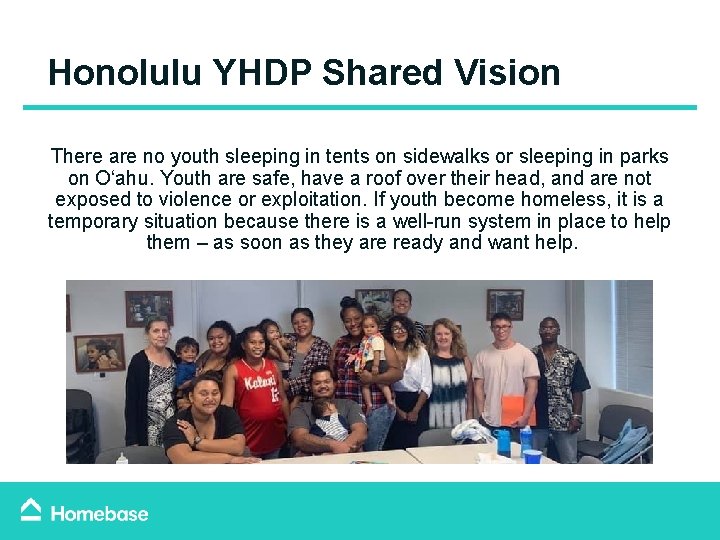
Honolulu YHDP Shared Vision There are no youth sleeping in tents on sidewalks or sleeping in parks on Oʻahu. Youth are safe, have a roof over their head, and are not exposed to violence or exploitation. If youth become homeless, it is a temporary situation because there is a well-run system in place to help them – as soon as they are ready and want help.
Key YHDP Project Requirements • Eligible applicants: Nonprofits, local governments. Partnerships/ collaborations encouraged!! • Grant term: 2 years, renewable through the Co. C on one-year terms • Match: 25% (except leasing) • Target population: Unaccompanied youth and young adults (YYA) and pregnant or parenting youth who meet HUD’s definition of “homeless” • Additional requirements (HMIS, Positive Youth Development, Trauma Informed Care, Housing First, etc. )
YHDP Project Types Partners in Care (PIC) is seeking applicants to implement 6 different project types: 1. Diversion: Services to unaccompanied youth under the age of 25 with short-term supportive services to divert from homelessness. Helps youth find alternative housing solutions to crisis housing. 2. Guide On The Side (Navigation and Long-Term Case Management): Provides a consistent point of contact to help youth navigate different resources, systems of care, and needs (i. e. education, employment, health/mental health, etc. ) 3. Host Homes: Flexible (short or medium term), crisis response community-based settings that offer youth 24/7 immediate access to a safe alternative to shelter. Financial and support services to sustain host homes.
YHDP Project Types (cont. ) 4. Joint Transitional Housing & Rapid Rehousing (TH-RRH): Combines Transitional Housing (TH), a service-intensive, frequently congregate-care component, with Rapid Re-Housing (RRH), a scattered site independent living component. YYA can skip right to RRH if they choose, but have the option of starting in TH (if they are younger, coming out of foster care, or want more structure). 5. Permanent Supportive Housing (PSH): Provides long-term, flexible rental subsidies for YYA experiencing homelessness and have disabilities/disabling conditions that affect their long-term ability to gain income/live independently without ongoing services. 6. Mobile Crisis Response: Supportive service elements connected to case management, drop-in centers, legal services, outpatient health services, substance abuse treatment, life
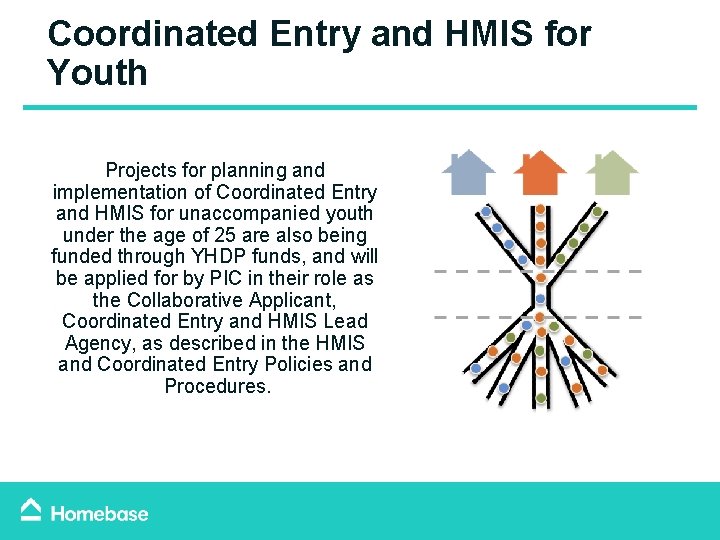
Coordinated Entry and HMIS for Youth Projects for planning and implementation of Coordinated Entry and HMIS for unaccompanied youth under the age of 25 are also being funded through YHDP funds, and will be applied for by PIC in their role as the Collaborative Applicant, Coordinated Entry and HMIS Lead Agency, as described in the HMIS and Coordinated Entry Policies and Procedures.
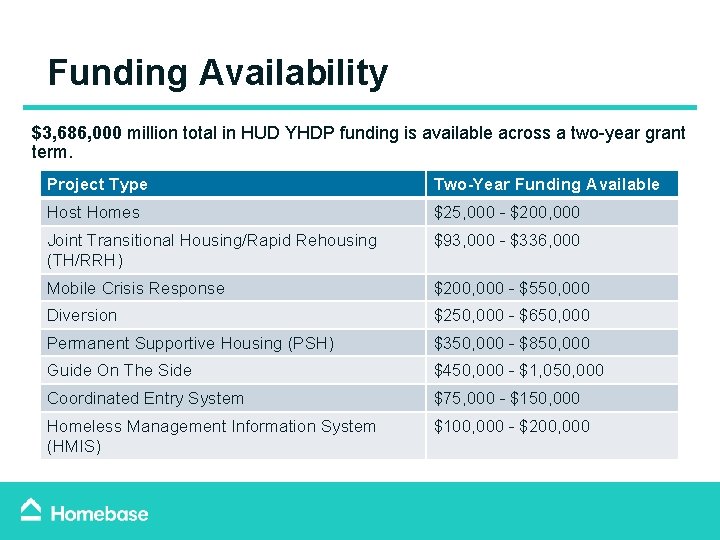
Funding Availability $3, 686, 000 million total in HUD YHDP funding is available across a two-year grant term. Project Type Two-Year Funding Available Host Homes $25, 000 - $200, 000 Joint Transitional Housing/Rapid Rehousing (TH/RRH) $93, 000 - $336, 000 Mobile Crisis Response $200, 000 - $550, 000 Diversion $250, 000 - $650, 000 Permanent Supportive Housing (PSH) $350, 000 - $850, 000 Guide On The Side $450, 000 - $1, 050, 000 Coordinated Entry System $75, 000 - $150, 000 Homeless Management Information System (HMIS) $100, 000 - $200, 000
Questions? • Questions about project types and requirements so far?
Project Selection Process
Project Term/Renewal If selected, each project would be awarded for a grant term two years with the possibility thereafter of renewal annually through the HUD Continuum of Care (Co. C) funding competition.
Joint Applications • Applicant may apply in partnership with one or more other organizations • Joint applicants should submit a Memorandum of Understanding (MOU) reflecting role of project partners, specify funding for each organization • Collaboration is encouraged!
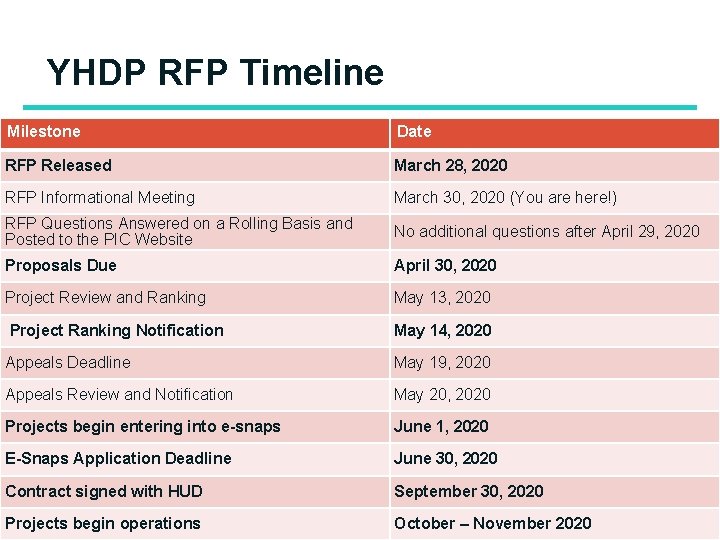
YHDP RFP Timeline Milestone Date RFP Released March 28, 2020 RFP Informational Meeting March 30, 2020 (You are here!) RFP Questions Answered on a Rolling Basis and Posted to the PIC Website No additional questions after April 29, 2020 Proposals Due April 30, 2020 Project Review and Ranking May 13, 2020 Project Ranking Notification May 14, 2020 Appeals Deadline May 19, 2020 Appeals Review and Notification May 20, 2020 Projects begin entering into e-snaps June 1, 2020 E-Snaps Application Deadline June 30, 2020 Contract signed with HUD September 30, 2020 Projects begin operations October – November 2020
Submission Requirements • Format: No more than 15 single spaced pages s (single-spaced, ragged right margin, times new roman 12 point font, 1" margins) • Deadline: Thursday, April 30, 2020 at 4: 30 p. m. • Submission: Mail or hand deliver proposal submissions – one (1) original hard copy, eight (8) copies of project proposal packets, and one (1) electronic PDF copy via flash drive – to: Partners In Care – Oahu Continuum of Care 200 North Vineyard Boulevard, Suite 210 Honolulu, HI 96817
e-snaps Project Applications • HUD requires that all applicants for YHDP funds submit an application through the web-based e-snaps system. • Selected projects will be required to enter their applications into e-snaps after the competitive proposal and selection process is complete.
Questions? Process? Timeline? Requirements? Others?
Project Components & Application Requirements
Exceptions • Process by which HUD can make exceptions to Co. C rules so that the community can test innovative models for ending youth homelessness • Exceptions must be submitted as attachment to project application in e-snaps, but if you would like to ask for an exception HUD wants to know now. Let Homebase know ASAP so we can start the process. • Not all requests for exceptions may be approved
Innovation • One of the great things about YHDP is that you are encouraged to innovate • If you are not familiar with HUD project types or if you have an idea that does not seem to fit with HUD’s requirements or components, that’s okay! • We can work with interested stakeholders to find a fit for project ideas within the YHDP
Questions on Exceptions?
Key Principles All applicants should ensure that their proposed project(s): 1. 2. 3. 4. 5. Incorporates innovative and creative models and strategies Furthers goals and objectives of Community Plan Contains strategies for measuring effectiveness Actively incorporates youth voice and is responsive to youthspecific needs Responds to wider community-wide priorities for preventing and ending homelessness
Requirements for Project Applicants 1. Submit innovative project applications to HUD via e-snaps, that achieves goals/objectives in Coordinated Community Plan, approved by PIC, O’ahu Youth Action Board (OYAB), and review and rank panel. 2. Comply with Honolulu Co. C Policies and Procedures, HUD Co. C Program Interim Rule, YHDP NOFA, HUD-approved exceptions. Participate in Coordinated Entry and HMIS. 3. Comply with all HUD Co. C and YHDP program reporting and evaluation requirements.
Proposal Requirements: Interest and Experience • Cover Page, Table of Contents • Interest • Organizational Experience • • History of Performance and Compliance Collaboration and Knowledge of Community Resources Staff Qualifications and Experience Compliance with Fair Housing and Equal Access Requirements
Proposal Requirements: Program Description The program description should include the following elements: • • • Program Design Supportive Services Linkages Youth Involvement and Leadership Populations of Focus Cultural Competency
Proposal Requirements: HUD Key Principles and Prioritized Elements • Alignment with HUD Principles and Prioritized Elements of Coordinated Community Plan • USICH Four Core Outcomes (stable housing, permanent connections, education/employment, social-emotional well-being) • Permanent Connections and Family Engagement • Youth Choice • Positive Youth Development and Trauma Informed Care • Social and Community Integration • Innovative elements to be incorporated into project
Proposal Requirements: Implementation Plan The implementation plan should provide the following details on how the project will be put into action: • • • Timeline Access Staff Training Budget Match
Evaluation Process • Proposals will be evaluated by: • Review and Rank Committee, including members of OYAB • HUD • YHDP Project Scoring Tool • All applicants will be informed in writing whether project accepted/rejected • Applications may be amended per feedback from OYAB, R&R, HUD
YHDP RFP Project Scoring Tool: Threshold Criteria There a number of criteria that are required but not scored for YHDP project proposals. All threshold criteria must be met to be eligible for funding. Highlights include: • HMIS Implementation • Coordinated Entry • Inclusion in and alignment with O’ahu YHDP Coordinated Community Plan (outlined in local NOFA) • Housing First • Positive Youth Development (PYD) and Trauma-Informed Care (TIC) • Youth Voice in Hiring • Social and Community Integration [See YHDP RFP Project Scoring Tool for full list]
YHDP RFP Project Scoring Tool: Scored Criteria The following presents some highlight of the scored criteria included in the YHDP RFP Project Scoring Tool: • • Interest and organizational experience Agency background/capacity Youth involvement and leadership Populations of focus Cultural competency HUD principles Innovation Plan for implementation [See YHDP RFP Project Scoring Tool for full list]
Questions? • Requirements? • Evaluation? • Process?
HUD Requirements
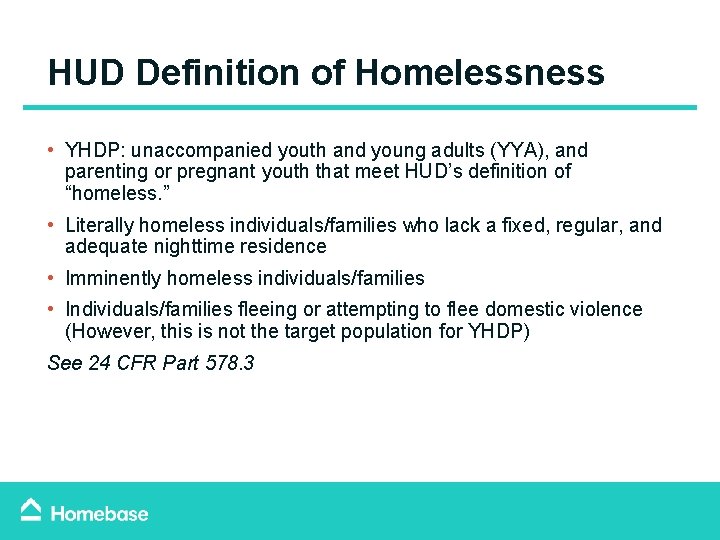
HUD Definition of Homelessness • YHDP: unaccompanied youth and young adults (YYA), and parenting or pregnant youth that meet HUD’s definition of “homeless. ” • Literally homeless individuals/families who lack a fixed, regular, and adequate nighttime residence • Imminently homeless individuals/families • Individuals/families fleeing or attempting to flee domestic violence (However, this is not the target population for YHDP) See 24 CFR Part 578. 3
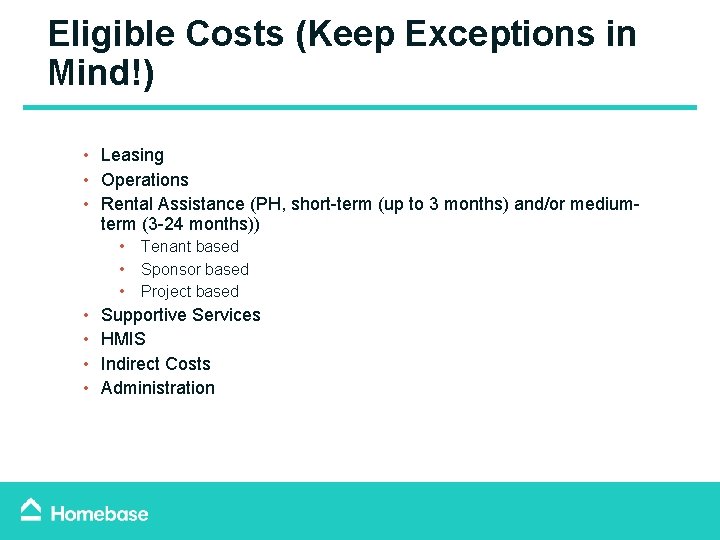
Eligible Costs (Keep Exceptions in Mind!) • Leasing • Operations • Rental Assistance (PH, short-term (up to 3 months) and/or mediumterm (3 -24 months)) • • Tenant based Sponsor based Project based Supportive Services HMIS Indirect Costs Administration
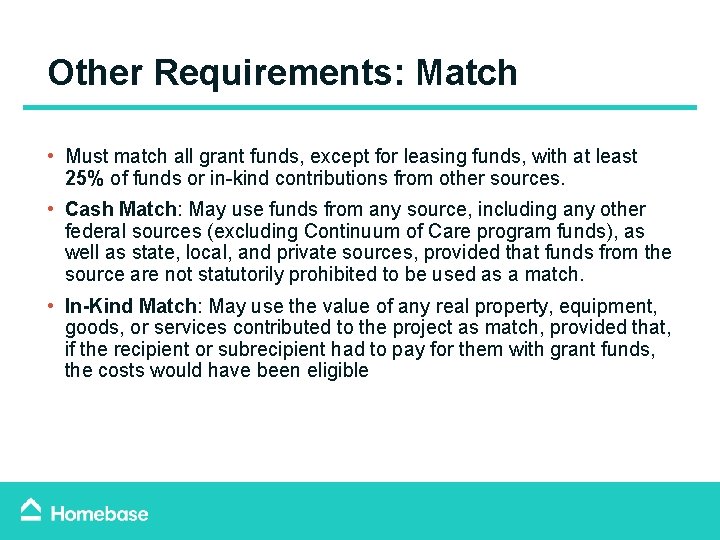
Other Requirements: Match • Must match all grant funds, except for leasing funds, with at least 25% of funds or in-kind contributions from other sources. • Cash Match: May use funds from any source, including any other federal sources (excluding Continuum of Care program funds), as well as state, local, and private sources, provided that funds from the source are not statutorily prohibited to be used as a match. • In-Kind Match: May use the value of any real property, equipment, goods, or services contributed to the project as match, provided that, if the recipient or subrecipient had to pay for them with grant funds, the costs would have been eligible
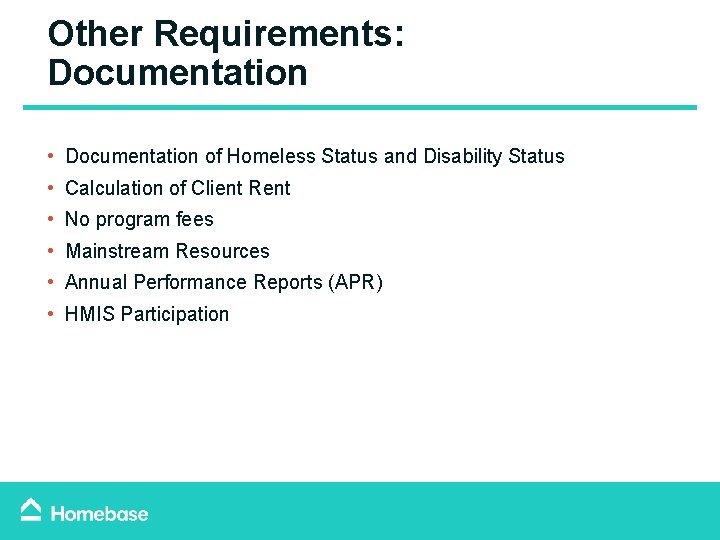
Other Requirements: Documentation • Documentation of Homeless Status and Disability Status • Calculation of Client Rent • No program fees • Mainstream Resources • Annual Performance Reports (APR) • HMIS Participation
Project Proposals are due April 30, 2020 Homebase is available to help: • Think through project ideas • Determine what components are eligible for HUD funding • Determine what exceptions should be requested, if any • Whatever else you need help with!! piper@homebaseccc. org alicia@homebaseccc. org
Wrap Up & Next Steps
Thank you!