
Youth Empowerment Services YES Josie Russell Adkinsdhw Idaho
- Slides: 23
Youth Empowerment Services (YES) Josie. Russell. Adkins@dhw. Idaho. gov
Objectives • What is Youth Empowerment Services (YES)? • Who can access YES and how is it funded? • How does a family access YES?
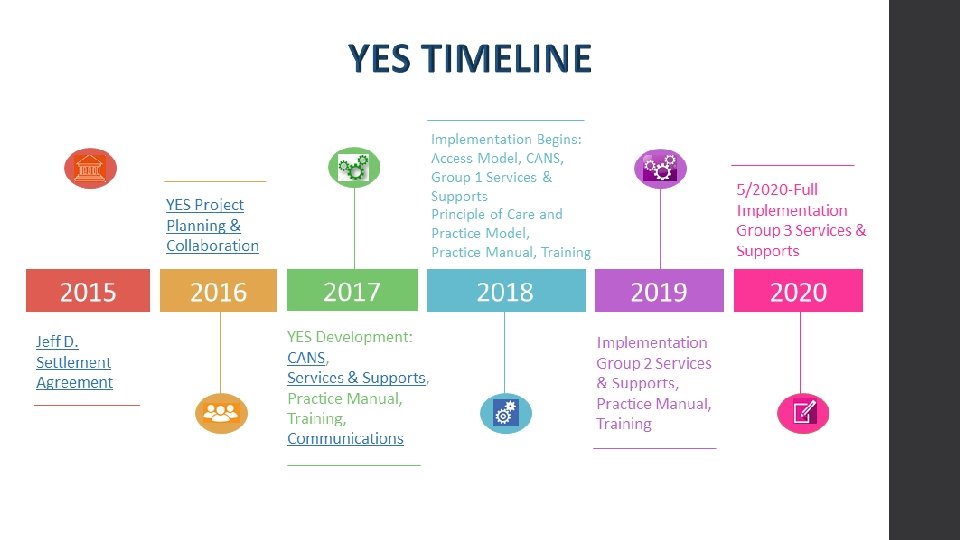
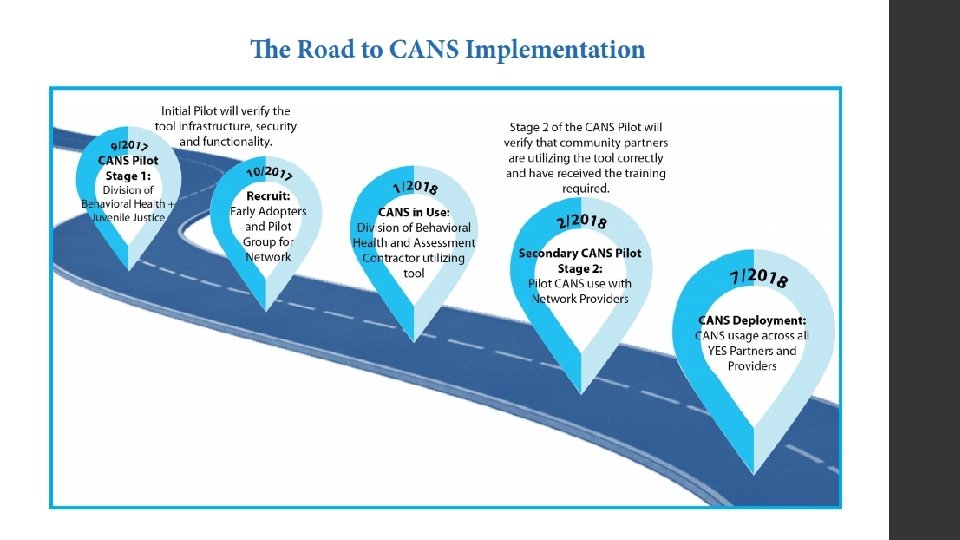
What is Youth Empowerment Services? • Background: settlement agreement for the Jeff D Lawsuit • Youth Empowerment Services (YES) is a new system of care that is being developed for Idaho children and youth with serious emotional disturbance (SED). It will provide: Improved access to services: Multiple ways to start services, more access to Medicaid, better information about services offered Improved choice of services: New services and supports available, more providers trained to provide services Improved quality of services: Collaborative, strengths-based, family-based, community-based • This new system of care will be rolled out in phases between 1/2018 and 5/2020.
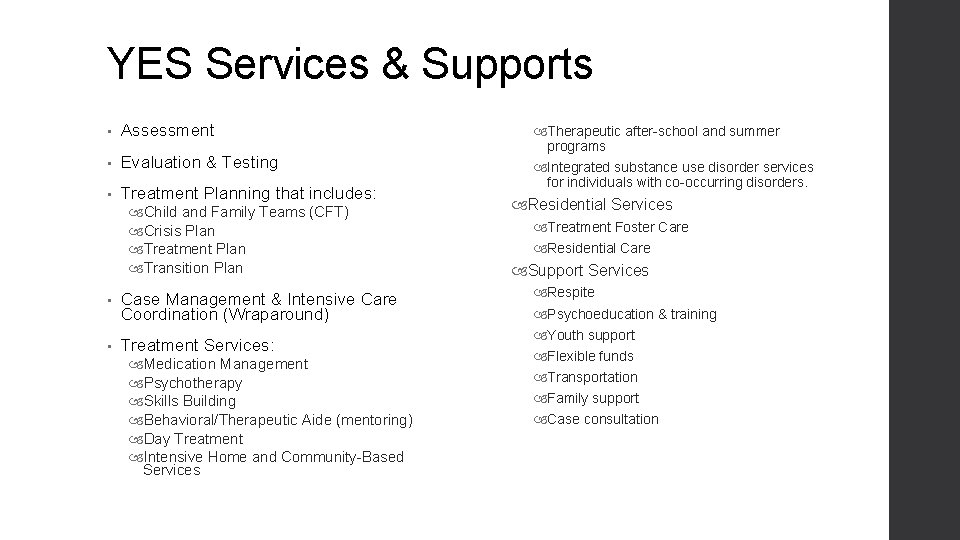
YES Services & Supports • Assessment • Evaluation & Testing • Treatment Planning that includes: Child and Family Teams (CFT) Crisis Plan Treatment Plan Transition Plan • Case Management & Intensive Care Coordination (Wraparound) • Treatment Services: Medication Management Psychotherapy Skills Building Behavioral/Therapeutic Aide (mentoring) Day Treatment Intensive Home and Community-Based Services Therapeutic after-school and summer programs Integrated substance use disorder services for individuals with co-occurring disorders. Residential Services Treatment Foster Care Residential Care Support Services Respite Psychoeducation & training Youth support Flexible funds Transportation Family support Case consultation
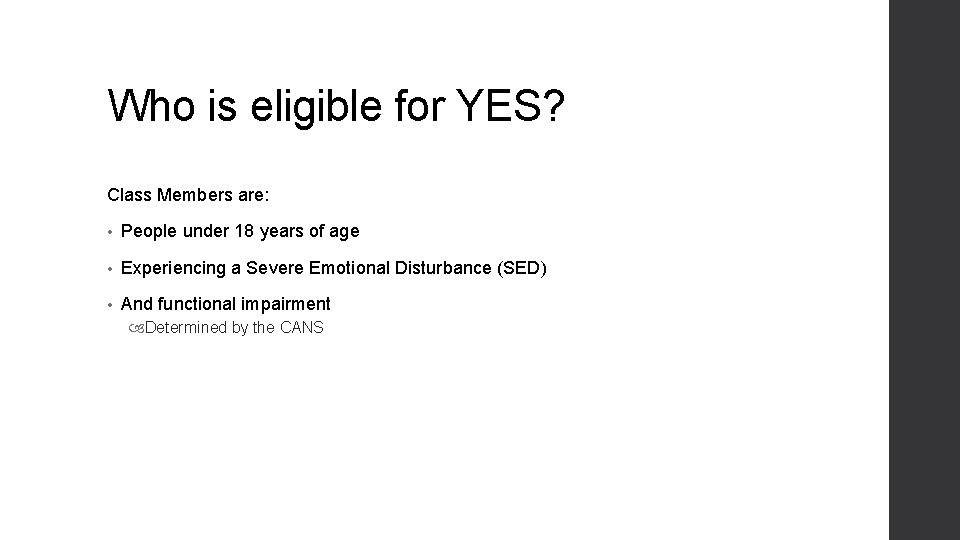
Who is eligible for YES? Class Members are: • People under 18 years of age • Experiencing a Severe Emotional Disturbance (SED) • And functional impairment Determined by the CANS
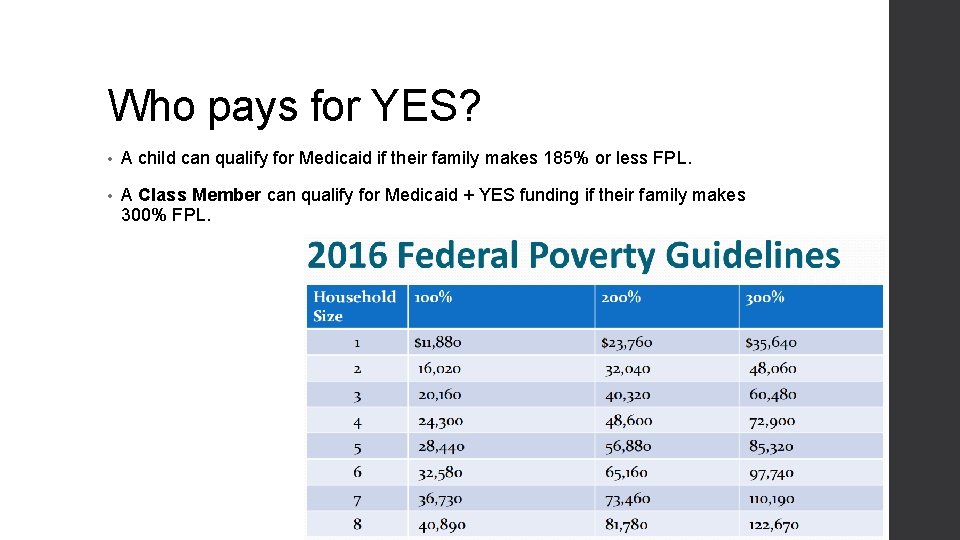
Who pays for YES? • A child can qualify for Medicaid if their family makes 185% or less FPL. • A Class Member can qualify for Medicaid + YES funding if their family makes 300% FPL.
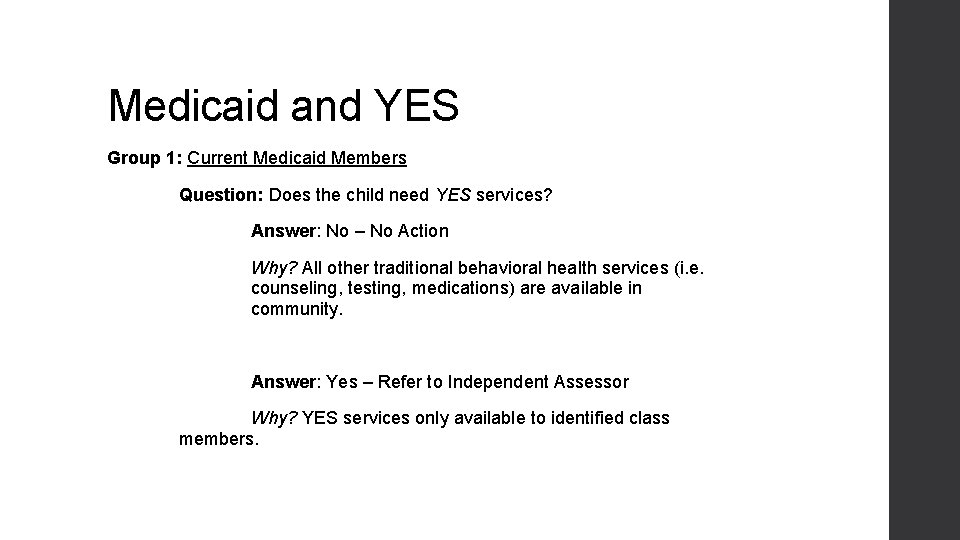
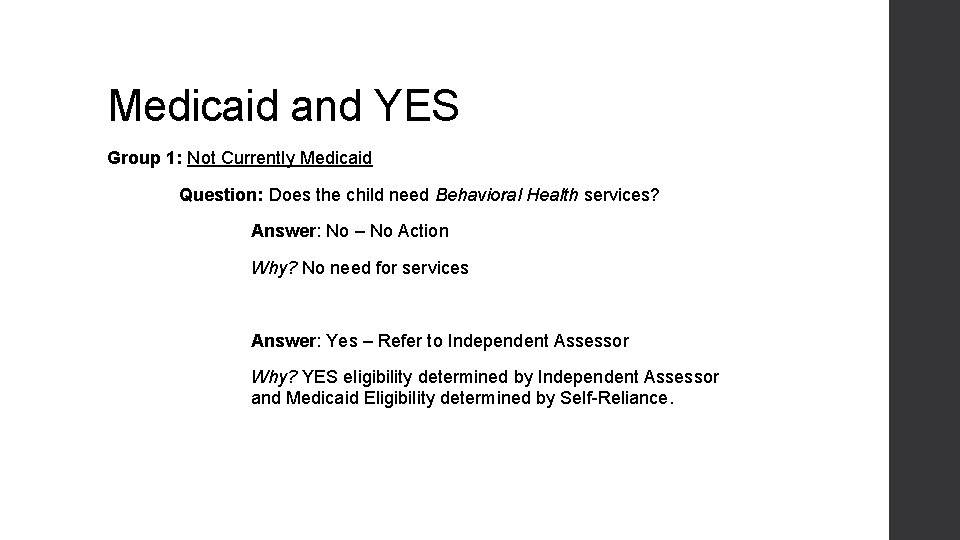
Medicaid and YES Two Groups of youth: 1. Current Medicaid Members 2. Not currently on Medicaid
Medicaid and YES Group 1: Current Medicaid Members Question: Does the child need YES services? Answer: No – No Action Why? All other traditional behavioral health services (i. e. counseling, testing, medications) are available in community. Answer: Yes – Refer to Independent Assessor Why? YES services only available to identified class members.
Medicaid and YES Group 1: Not Currently Medicaid Question: Does the child need Behavioral Health services? Answer: No – No Action Why? No need for services Answer: Yes – Refer to Independent Assessor Why? YES eligibility determined by Independent Assessor and Medicaid Eligibility determined by Self-Reliance.
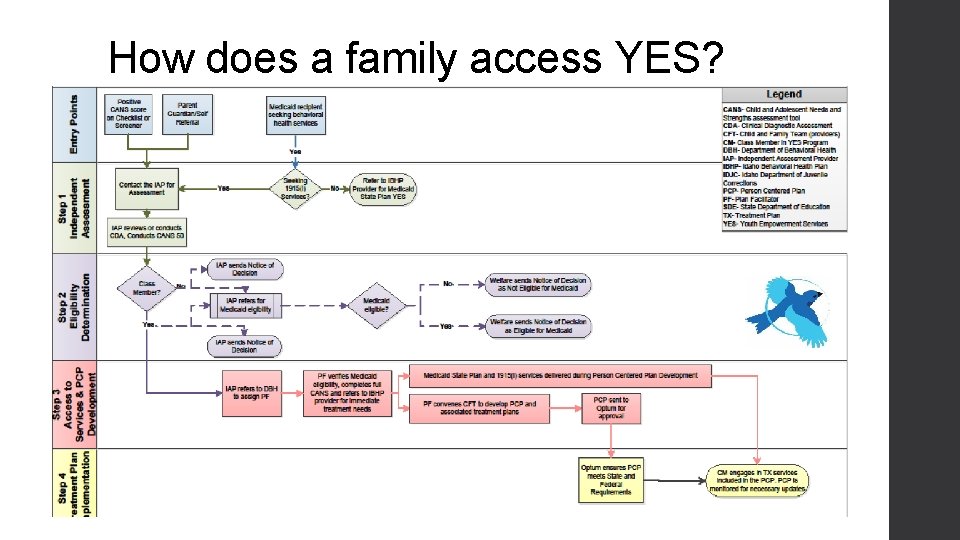
How does a family access YES?
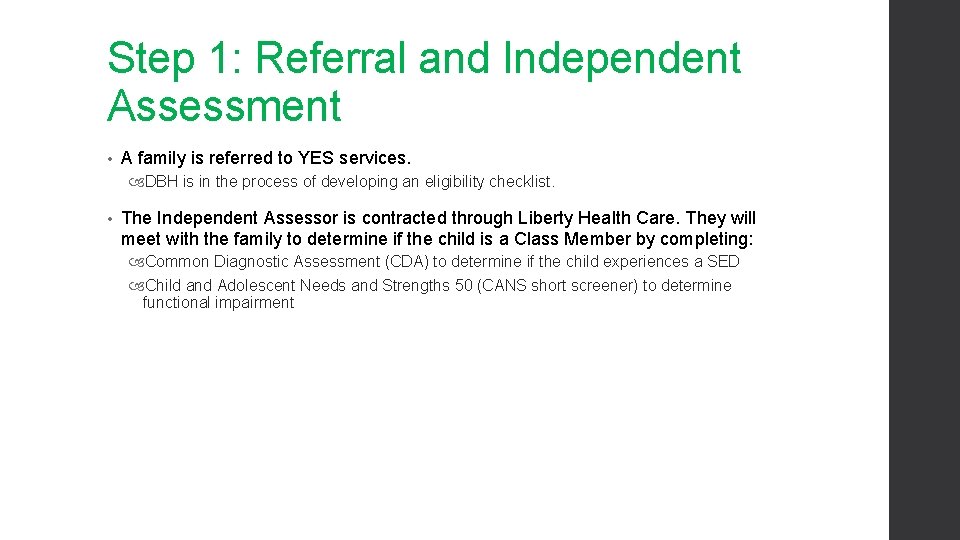
Step 1: Referral and Independent Assessment • A family is referred to YES services. DBH is in the process of developing an eligibility checklist. • The Independent Assessor is contracted through Liberty Health Care. They will meet with the family to determine if the child is a Class Member by completing: Common Diagnostic Assessment (CDA) to determine if the child experiences a SED Child and Adolescent Needs and Strengths 50 (CANS short screener) to determine functional impairment
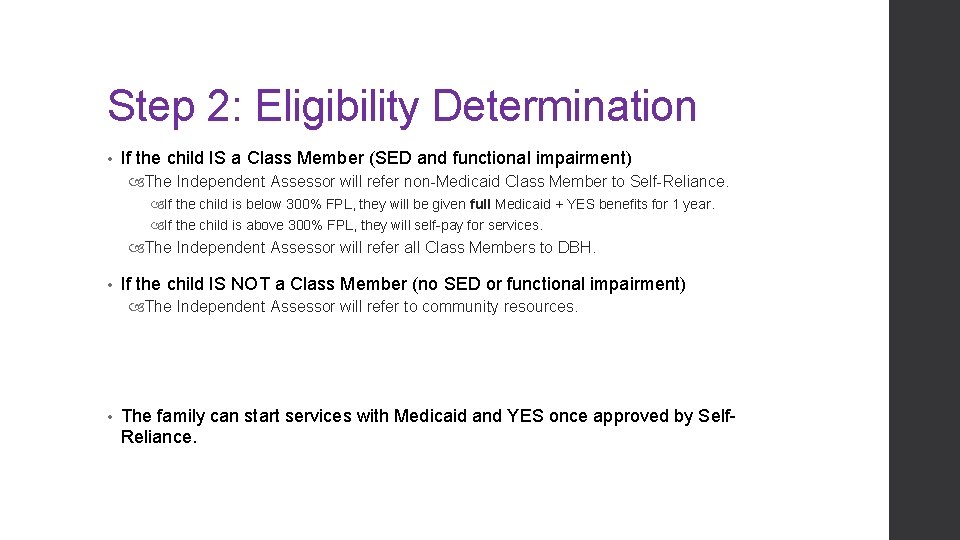
Step 2: Eligibility Determination • If the child IS a Class Member (SED and functional impairment) The Independent Assessor will refer non-Medicaid Class Member to Self-Reliance. If the child is below 300% FPL, they will be given full Medicaid + YES benefits for 1 year. If the child is above 300% FPL, they will self-pay for services. The Independent Assessor will refer all Class Members to DBH. • If the child IS NOT a Class Member (no SED or functional impairment) The Independent Assessor will refer to community resources. • The family can start services with Medicaid and YES once approved by Self. Reliance.
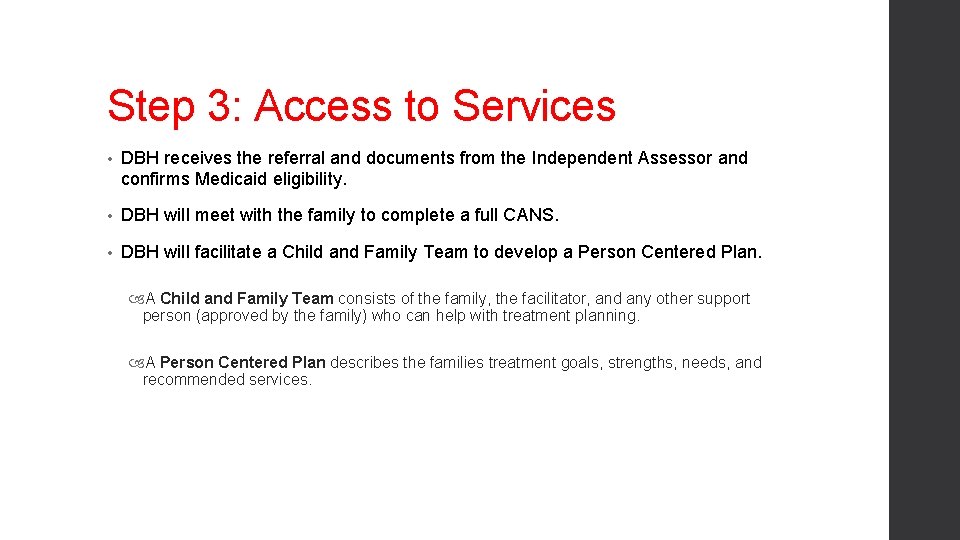
Step 3: Access to Services • DBH receives the referral and documents from the Independent Assessor and confirms Medicaid eligibility. • DBH will meet with the family to complete a full CANS. • DBH will facilitate a Child and Family Team to develop a Person Centered Plan. A Child and Family Team consists of the family, the facilitator, and any other support person (approved by the family) who can help with treatment planning. A Person Centered Plan describes the families treatment goals, strengths, needs, and recommended services.
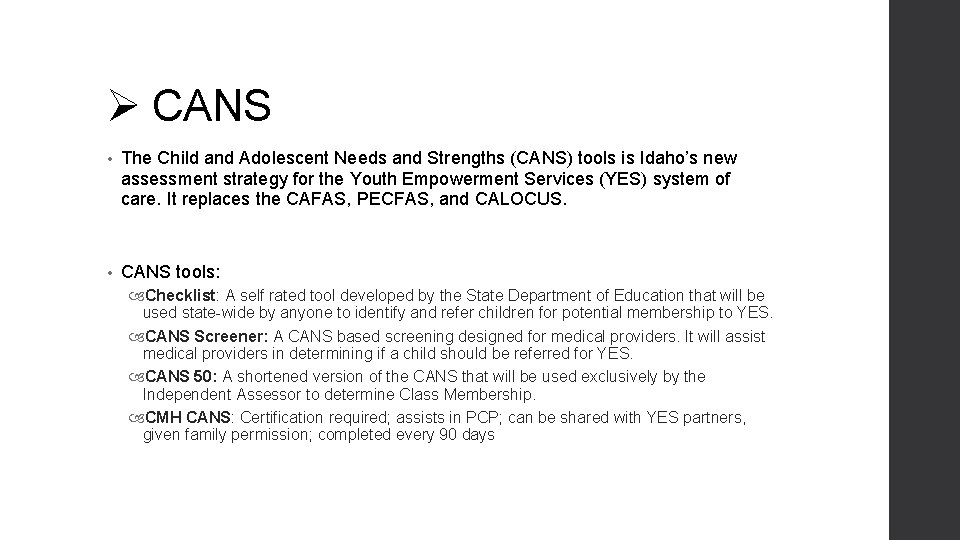
Ø CANS • The Child and Adolescent Needs and Strengths (CANS) tools is Idaho’s new assessment strategy for the Youth Empowerment Services (YES) system of care. It replaces the CAFAS, PECFAS, and CALOCUS. • CANS tools: Checklist: A self rated tool developed by the State Department of Education that will be used state-wide by anyone to identify and refer children for potential membership to YES. CANS Screener: A CANS based screening designed for medical providers. It will assist medical providers in determining if a child should be referred for YES. CANS 50: A shortened version of the CANS that will be used exclusively by the Independent Assessor to determine Class Membership. CMH CANS: Certification required; assists in PCP; can be shared with YES partners, given family permission; completed every 90 days
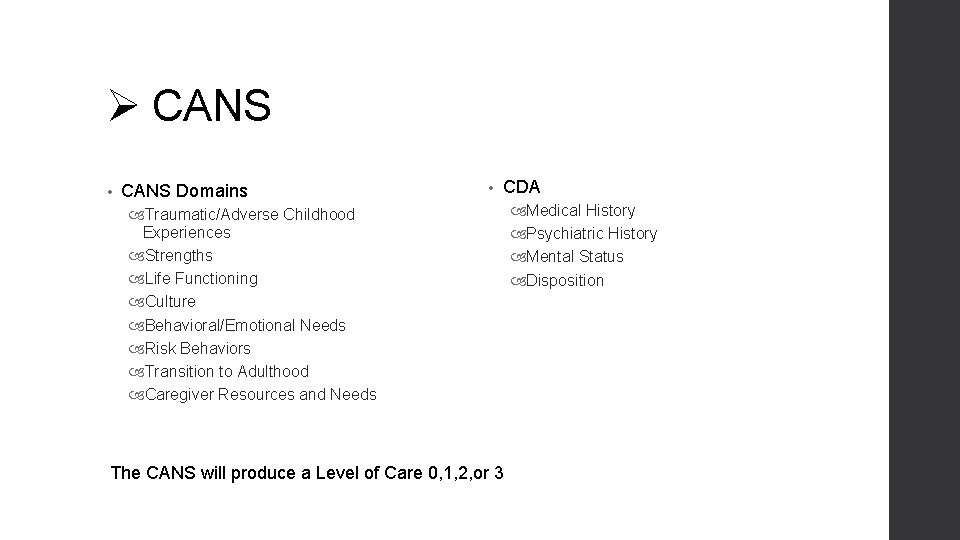
Ø CANS • CANS Domains • CDA Traumatic/Adverse Childhood Experiences Strengths Life Functioning Culture Behavioral/Emotional Needs Risk Behaviors Transition to Adulthood Caregiver Resources and Needs The CANS will produce a Level of Care 0, 1, 2, or 3 Medical History Psychiatric History Mental Status Disposition
Ø Child and Family Team (CFT) • The CFT approach is a teaming process that brings together the family and individuals that the Class Member and his or her family believe can help them develop and implement a care plan that will assist them in realizing their treatment goals. • All class members will be a part of a CFT. • The size, scope, and intensity of the involvement of CFT members is driven by the needs and desires of the Class Member and family. Members of the CFT may be added or removed as the needs and strengths of the Class Member and family change over time. • The CANS will recommend who should be involved in the CFT.
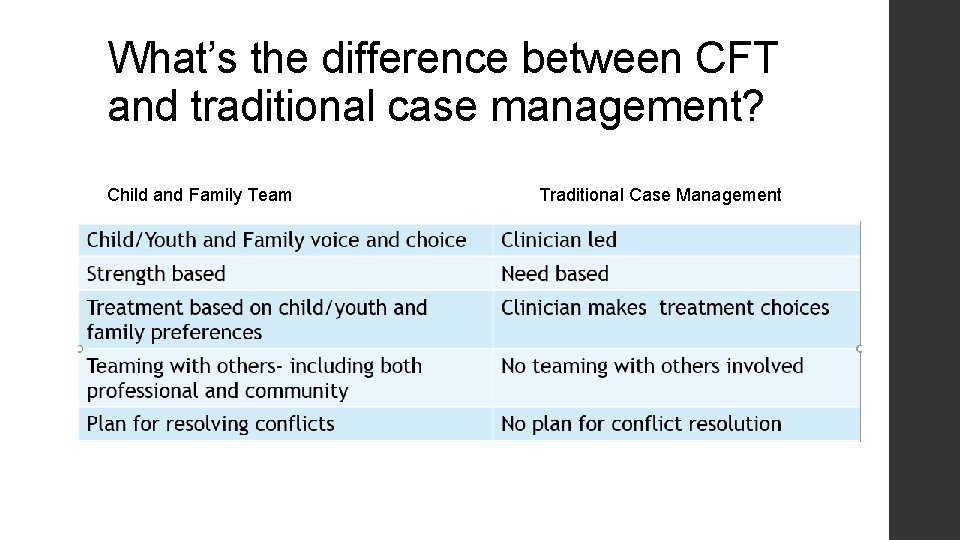
What’s the difference between CFT and traditional case management? Child and Family Team Traditional Case Management
Ø Person Centered Plan (PCP) • Is a document and a process, directed by the family or the individual with longterm care needs, intended to identify the strengths, capacities, preferences, needs and desired outcomes of the individual. • The PCP utilizes CANS results to help prioritize needs and strengths. • The PCP includes a risk management plan in the home, community, and school. • The PCP states services that can assist the family in meeting mental health goals as well as other goals identified by the family. • The PCP is a Federal Requirement.
Step 4: Implementation • The Person Centered Plan is sent to Optum for approval. • DBH will continue to meet with the family as needed, or at least every 90 days for follow up CANS. • The Independent Assessor will follow up with the family at 1 year to reassess.
Higher Levels of Care • But… what if the child has a CANS Level of Care 3, thus qualifying for Intensive Care Coordination? DBH will offer Wraparound to families (later covered by YES) DBH is still be the gatekeeper to State Hospital South. DBH will review out-of-home placements on a case-by-case basis. • What is Wraparound? Similar to Child and Family Teams, but with more structure. Wraparound is a process that uses the family’s strengths to address their needs. The family meets with their team often to create and implement individualized treatment plans. Wraparound follows 10 principles, and 4 Phases to maintain fidelity. More information can be found at the National Wraparound Initiative www. nwi. pdx. edu • DBH will begin to pilot Wraparound in February. Later in 2018, Wraparound will be provided by community partners as a YES funded service.
Couple more things… • Liberty phone number: 1 -877 -305 -3469 • YES website: http: //youthempowermentservices. idaho. gov