
Your Writing Is Informed by What You Read
Your Writing Is Informed by What You Read: Connecting Reading to Writing Development Maggie Heeney Pat Skinner Renison University College December 12, 2009 TESL Ontario Conference
This workshop is based on results of a semester-long in-class study Rationale for the study: Reading and writing expertise is essential for academic success in the university context University writing entails reading texts and writing skillfully about them by synthesising ideas and often critically assessing the ideas English Language Learners (ELL’s) are expected to read and write at a similar level to native speakers ELL’s are challenged with the volume of reading and the production of well-written texts
The problem according to research. . �Hirvela (2004) states that it is impossible to be a skilled writer without being a skilled reader �Hirvela comments about teaching: “. . . we construct the L 2 classroom as a place where literacy, not strictly writing skill, is the real focus of the course; where we believe that to learn about writing without learning about reading – and how reading contributes to writing – is to deprive our students of a true composing experience that is at the heart of writing” (p. 40).
The problems we see as teachers. . . Written work seems that of a novice, often with simple structures and simple vocabulary Synthesized information from readings is often plagiarized Learners seem to have underdeveloped awareness or knowledge of how to use effective strategies in both the reading and writing processes
Connecting Reading and Writing Knowledge and strategies from one skill transfer to the other (Eisterhold, 1990) One skill becomes the input for the other with a more common transfer from reading to writing Transfer from one skill to the other is not necessarily automatic and that direct instruction is integral to raising awareness of the structural components, as they are shared in both modalities
Two Literacy Building Dimensions �Reading-to-write �Reader transforms information in order to write �Explicit method of reading that points learners to �understanding choices writers make (Kroll, 1993) � learning cohesive devices and linguistic features (Hirvela, 2 oo 4) �developing lexical knowledge (Stoll, 1995) �building rhetorical knowledge (Hyland, 2003) �using extensive reading to build linguistic skill and improve writing (Cumming, 1989)
The Other Literacy Dimension �Writing-to-read �“writing before, during or after the reading enables the reader to make sense of his or her reading, which in turn strengthens the quality of the reading and contributes to the development of L 2 reading skills” (Hirvela, 2004, p. 74) �Writing-to-read includes � Writing margin notes while reading (Hirvela, 2004) � Writing critical thoughts about the reading after reading (Zamel, 1992) � Writing about the topic before reading to activate schema (Leki, 1993)
Metacognition in Learning �In complex tasks, learners engage in metacognitive processes that attend to and regulate cognitive processing �Entails in thinking about the self and the relationship to the task, and controlling learning (Flavell, 1987) �Metacognitive awareness – knowledge of the task and available strategies �Metacognitive experience – consciously planning to use strategies and monitoring and evaluating the success of their use �This is strategic knowledge
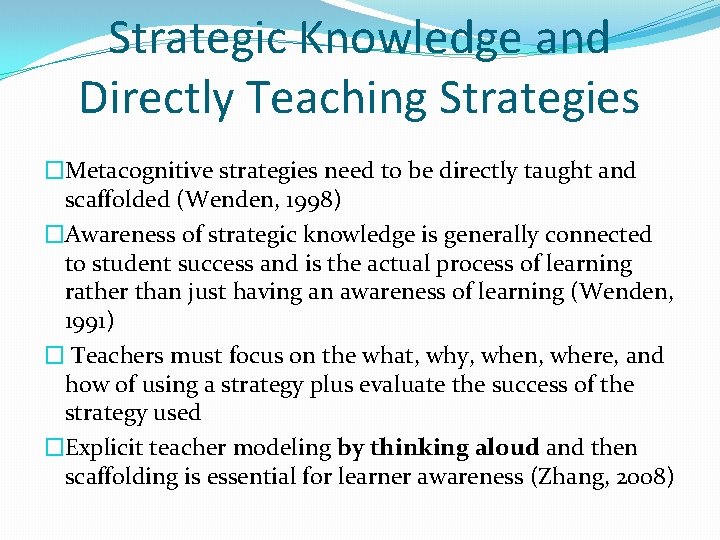
Strategic Knowledge and Directly Teaching Strategies �Metacognitive strategies need to be directly taught and scaffolded (Wenden, 1998) �Awareness of strategic knowledge is generally connected to student success and is the actual process of learning rather than just having an awareness of learning (Wenden, 1991) � Teachers must focus on the what, why, when, where, and how of using a strategy plus evaluate the success of the strategy used �Explicit teacher modeling by thinking aloud and then scaffolding is essential for learner awareness (Zhang, 2008)
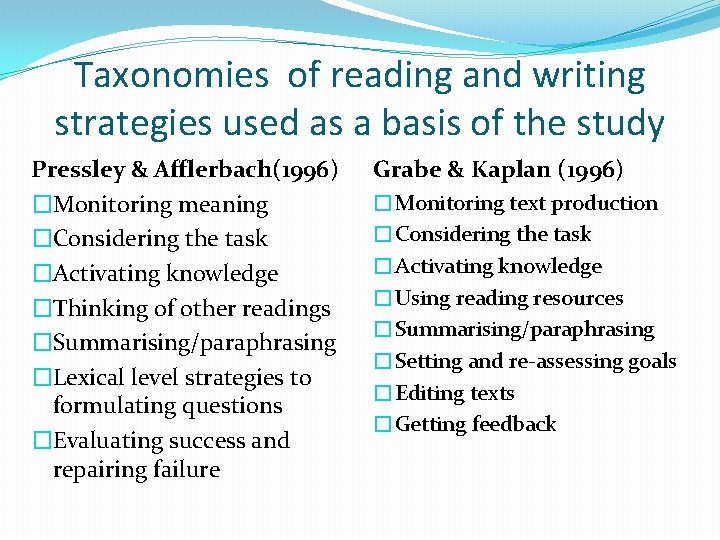
Taxonomies of reading and writing strategies used as a basis of the study Pressley & Afflerbach(1996) �Monitoring meaning �Considering the task �Activating knowledge �Thinking of other readings �Summarising/paraphrasing �Lexical level strategies to formulating questions �Evaluating success and repairing failure Grabe & Kaplan (1996) �Monitoring text production �Considering the task �Activating knowledge �Using reading resources �Summarising/paraphrasing �Setting and re-assessing goals �Editing texts �Getting feedback
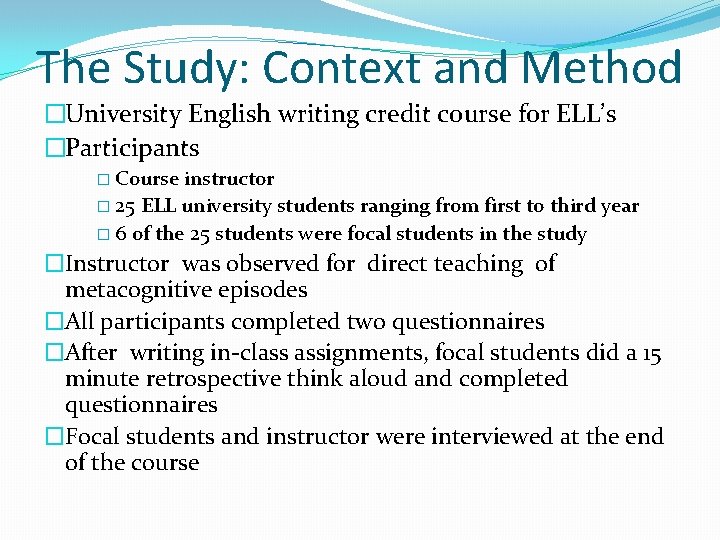
The Study: Context and Method �University English writing credit course for ELL’s �Participants � Course instructor � 25 ELL university students ranging from first to third year � 6 of the 25 students were focal students in the study �Instructor was observed for direct teaching of metacognitive episodes �All participants completed two questionnaires �After writing in-class assignments, focal students did a 15 minute retrospective think aloud and completed questionnaires �Focal students and instructor were interviewed at the end of the course
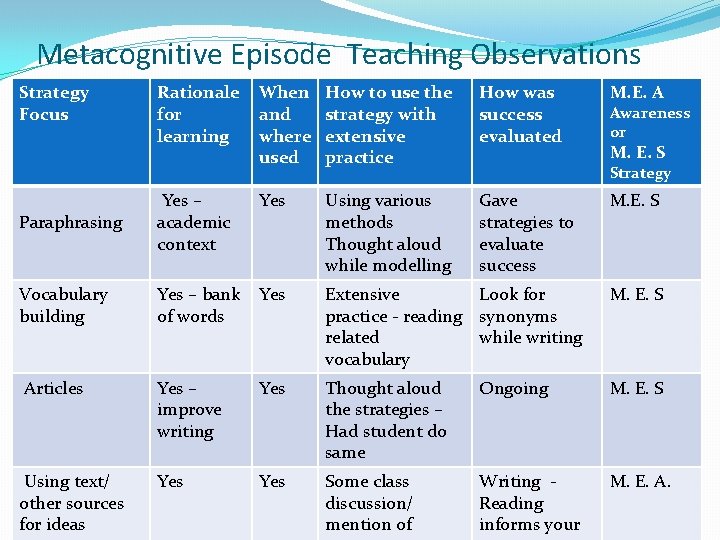
Metacognitive Episode Teaching Observations Strategy Focus Rationale for learning When and where used How to use the strategy with extensive practice How was success evaluated M. E. A Paraphrasing Yes – academic context Yes Using various methods Thought aloud while modelling Gave strategies to evaluate success Vocabulary building Yes – bank of words Yes Extensive Look for practice - reading synonyms related while writing vocabulary M. E. S Articles Yes – improve writing Yes Thought aloud the strategies – Had student do same Ongoing M. E. S Using text/ other sources for ideas Yes Some class discussion/ mention of Writing Reading informs your M. E. A. Awareness or M. E. S Strategy M. E. S
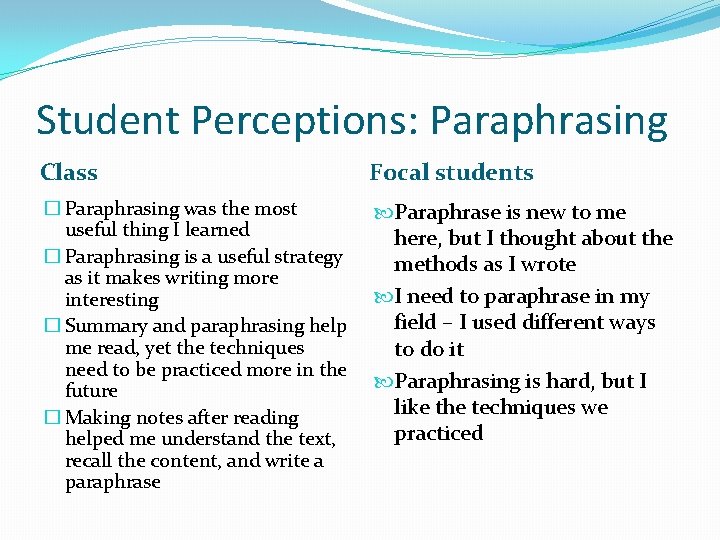
Student Perceptions: Paraphrasing Class Focal students � Paraphrasing was the most useful thing I learned � Paraphrasing is a useful strategy as it makes writing more interesting � Summary and paraphrasing help me read, yet the techniques need to be practiced more in the future � Making notes after reading helped me understand the text, recall the content, and write a paraphrase Paraphrase is new to me here, but I thought about the methods as I wrote I need to paraphrase in my field – I used different ways to do it Paraphrasing is hard, but I like the techniques we practiced
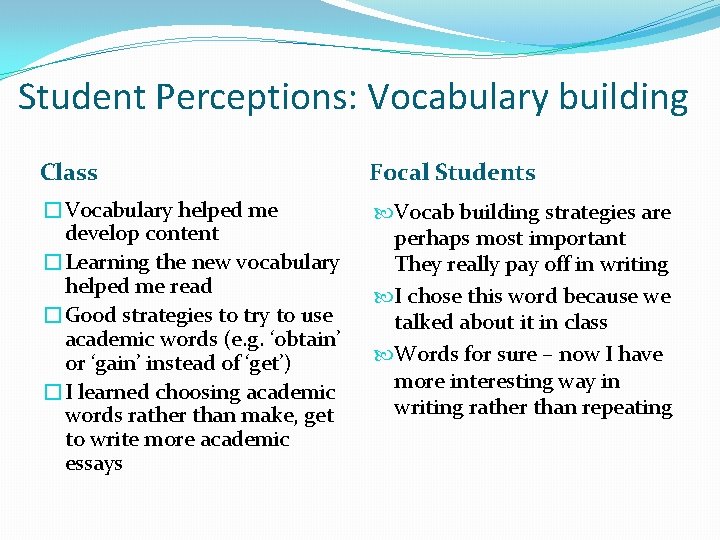
Student Perceptions: Vocabulary building Class Focal Students �Vocabulary helped me develop content �Learning the new vocabulary helped me read �Good strategies to try to use academic words (e. g. ‘obtain’ or ‘gain’ instead of ‘get’) �I learned choosing academic words rather than make, get to write more academic essays Vocab building strategies are perhaps most important They really pay off in writing I chose this word because we talked about it in class Words for sure – now I have more interesting way in writing rather than repeating
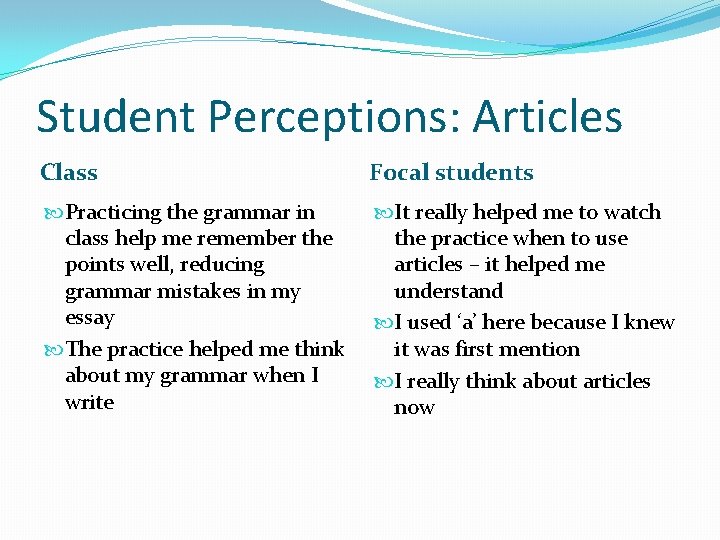
Student Perceptions: Articles Class Focal students Practicing the grammar in class help me remember the points well, reducing grammar mistakes in my essay The practice helped me think about my grammar when I write It really helped me to watch the practice when to use articles – it helped me understand I used ‘a’ here because I knew it was first mention I really think about articles now
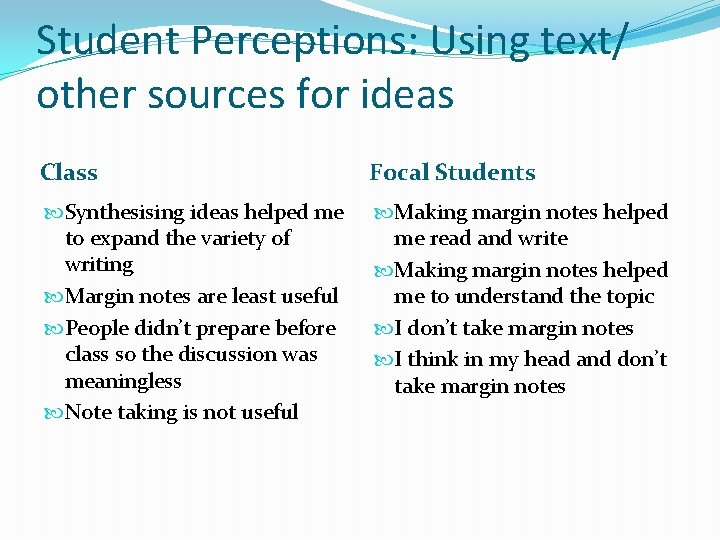
Student Perceptions: Using text/ other sources for ideas Class Focal Students Synthesising ideas helped me to expand the variety of writing Margin notes are least useful People didn’t prepare before class so the discussion was meaningless Note taking is not useful Making margin notes helped me read and write Making margin notes helped me to understand the topic I don’t take margin notes I think in my head and don’t take margin notes
Student perceptions of linking reading and writing to writing development �Writing is the process when we express our thoughts and by reading we accumulate someone’s thoughts �I use plenty of the content from reading and use it in writing �Writing is almost the same as reading. You need to learn things from reading, then you have the ability to write �Reading and writing are connected. The more I understand the article, the more clear I write an essay �They are similar because I can improve my writing skill while I am reading
Preliminary Conclusions The teaching of reading and writing are connected Students should be reminded of this relationship in order to raise awareness of how one skill informs the other Explicit teacher modeling including thinking aloud the process seems to have an impact on students’ metacognitive processes when they engage in a task Reading and writing metacognition does seem to influence writing development
Our turn to model, and your turn to practice: We will now model the think-aloud strategies used in the class that helped the learners gain and employ metacognitive experience in the reading-writing process Using a reading , we will model and practice Paraphrasing Vocabulary development Article use
References Anderson, J. (1983). The architecture of cognition. Cambridge, MA: Harvard University Press. Carson, J. (1993). Reading for writing. In J. Carson, & I. Leki (Eds. ), Reading in the composition classroom: Second language perspectives (pp. 85 -104). Boston: Heinle & Heinle. Cumming, A. (1989). Writing expertise and second language proficiency. Language Learning, 39 , 81 -141. Eisterhold, J. (1990). Reading-writing connections: Toward a description for second language learners. In B. Kroll (Ed. ), Second language writing: Research insights for the classroom (pp. 88 -101). New York: NY: Cambridge University Press. Flavell, J. H. (1981). Cognitive monitoring. In W. P. Dickson (Ed. ), Children's oral communication skills (pp. 35 -60). New York: Academic Press Garner, R. (1987). Metacognition and reading instruction. United States: Ablex Publishing. Grabe, W. , & Kaplan, R. (1996). Theory and practice of writing. Harlow, U. K. : Addison Wesley Longman. Hirvela, A. (2004). Connecting reading and writing in second language writing instruction. Ann Arbor: University of Michigan Press. Leki, I. (1992). Understanding ESL writers: A guide for teachers. Portsmouth, N. H. : Boynton/Cook. Pressley, M. & Afflerbach, P. (1995). Verbal protocols of reading: The nature of constructively responsive reading. New Jersey: Lawrence Erlbaum Associates. Wenden, A. (1991). Learner strategies for learner autonomy. New York: Prentice Hall. Wenden, A. (1998). Metacognitive knowledge and language learning. Applied Linguistics, 19(4), 515 -537. Zamel. V. (1992). Writing one's way into reading. TESOL Quarterly 17 , 165 -187.
Thank you mheeney@artsmail. uwaterloo. ca pskinner@artsmail. uwaterloo. ca
- Slides: 21