
Your Negotiation Style Aim To learn about negotiation
Your Negotiation Style Aim: To learn about negotiation styles , recognize situations and make a choice.
Every day we interact with people and are part of a situation. Did you realize the interaction was a negotiation or was it one of those situations which seemed , at the time, to be something else / a conversation, an argument, a debate, a fight/?
Let’s watch a movie about Tom’s story. • • • Some new expressions from the video cajole the kids to get up, eat breakfast and leave for school; hop in a taxi; a scheduled meeting with the boss; kick up a fuss; bite one’s tongue;
While watching the movie, try to remember or write down every interaction in it. Movie
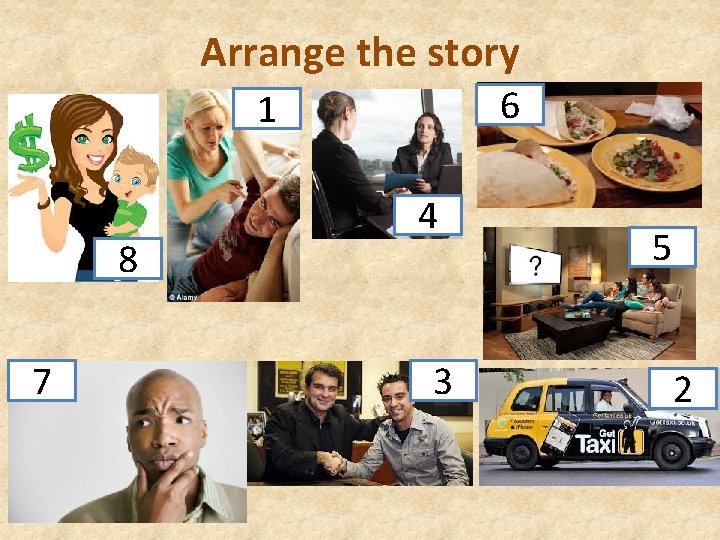
Arrange the story 6 1 8 7 4 3 5 2
Interactions shown in the video Find the verbs that express • Tom cajoled the kids to get up, eat breakfast interactions. • • and leave for school; Tom persuaded the taxi driver to take him down Main street instead the Second Avenue; Tom persuaded the boss to give him a small raise; The boss convinced him to work over the weekend until the end of the year; Tom persuaded the cable TV provider to give him a cheaper cable package;
Interactions shown in the video • They discussed where to eat; • He decided to avoid mentioning his new work schedule; • The babysitter wanted $15 per hour, Tom was about to suggest $12 but Lisa paid $20.
Can you give a definition of negotiation? However, when our interactions involve elements of trying to obtain something from the other; when we are trying to convince or persuade the other; when we are trying to engage in an exchange of something other than conversation with the other – there is, indeed, an element of negotiation in the interaction. The more central these elements are to the interaction, the simpler it is to say “Yes - this is a negotiation. ”
How could we identify interactions with parents, brothers or sisters / siblings/, classmates, teachers, friends? Are they negotiations?
One reason we don’t readily identify many situations as negotiation interactions is because we have different names for them. Here a few examples: ØWe don’t negotiate with our spouse; we “get along”, or “work things out” with them Ø We don’t negotiate with our kids; we “parent” or “educate” or “raise” or even “discipline” them.
ØWe don’t negotiate with our co-workers, we “collaborate” with them when things go well; or, we need to “smooth-things over” with them when they don’t. Ø We don’t negotiate with our friends, we “decide” or “argue” or “discuss” or “disagree” with them. ØWe don’t negotiate with our students, we “teach” or “educate” them. Ø We don’t negotiate with our employees, we “manage” them.
What does it mean? When we act in a There are situations when we reactive mode , this üact from theisgut your instinct! Act – React! ügo with the flow Give examples! üshoot from the hip Is it the instinct or choice we’ve made? Explain!
Sentences to consider • I don’t like to confront others. • While negotiating - I tend to focus on my own views and needs. • It’s important to gain more than the other party in a negotiation. • I like to feel that me and the other party are working together on something shared. • I don’t want the other side to think I’m a sucker. • I’m willing to make concessions in order to save • my relationship with another party.
• I want the other party to feel satisfied with the negotiation’s outcome. • I try to negotiate without giving in on anything. • I often feel that I make concessions in negotiations, while the other party makes none. • When money is on the table, I try to find a quick way to split it with the other. • I enjoy turning opponents into partners • Whenever I can, I ask someone else – a spouse, a friend, a family member, an employee - to negotiate on my behalf.
Negotiation styles The ways in which people manage situations of different points conflict can reflect how they negotiate. In general terms there are five different styles of managing disagreement conflict: be contradictory • avoidance What is • competition be opposition conflict? • accommodation clash • compromise fight • collaboration. do battle • Most people use two different styles, but tend to favour one. Are you able to identify the style of negotiation you tend to use?
Avoidance • Can be useful when there is an imbalance of power. • Used by some people to provide time to consider their position. • Others use it to defuse further conflict. • In most situations little or nothing is achieved.
Competition • Sometimes called ‘hard positional bargaining’ because one person takes a stand on the outcome. • Can often result in one or both people focusing on what they want, rather than preserving a relationship or considering the needs of the other. • If one person begins with an extreme position, it can result in only giving small concessions within the negotiation.
Accommodation • The opposite of the competitive style, sometimes called ‘soft positional bargaining’. • Main interest for this person is that they can see the other party finds a solution that is satisfactory. • The negotiator using this style tends to hope their position will lead to a better relationship. • Can reinforce the power imbalance in the relationship and means it is more difficult in the long term to change the status quo.
Compromise • Often used to resolve a stalemate, so both people can move ahead. • People using this style may say “Let’s just split the difference”. • This style may still result in mistrust and doubt. • Relies on both parties keeping their side of the bargain. • In this style, somebody has to give up something of value in order to get something of value. Usually this means each side tries to get as much as possible while giving up as little as possible.
Collaboration • Often thought of as ‘the sum is greater than its parts’ by people using a collaborative approach. • Also called interest-based negotiation, resulting from human needs, and often based on values and beliefs. • This approach allows each person to look for a solution which is the best for all concerned. • Can only work if both parties are willing to examine each possible option and choose one that gives what they need rather than what they want.
Let’s go back to Tom’s story!
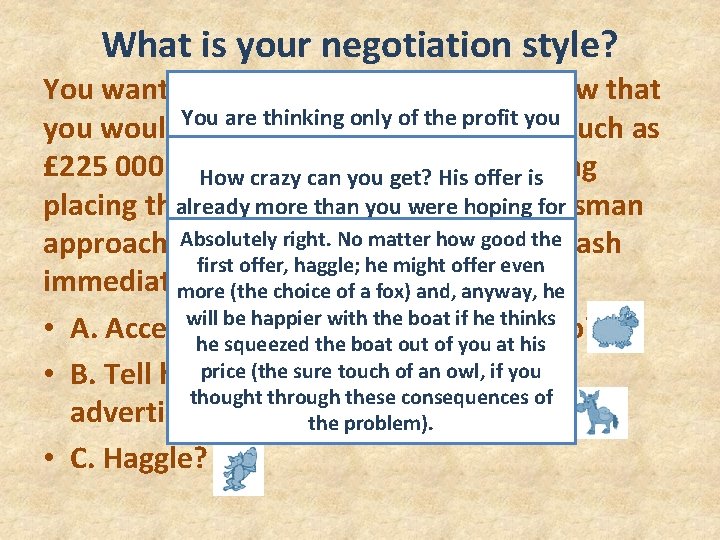
What is your negotiation style? You want to sell your yacht and you know that are thinking only of the profit you would. You bemight verymake fortunate to get as much as and not about the £ 225 000 for it. crazy While you are His considering problems you might These How can you create. get? offer are is the characteristics of aa sheep. Always more than you were hoping for placing thealready advertisement, keen yachtsman challenge amatter firstby offer! and to delay a decision sending Absolutely right. No how goodhim the cash approaches you and offers £ 250 000 in out offer, of your sighthe is might foolhardy he first haggle; offer –even immediately for your boat. Do more (thesee choice of a fox) and, anyway, might another boat onyou: the wayhe be to happier with theisboat if he thinks back his car. This the stubborn • A. Acceptwill his offer without further ado? he squeezed the boat out of you at his characteristic of a donkey. sure touchthe of anboat owl, if is you • B. Tell himprice to (the wait until thought through these consequences of advertised? the problem). • C. Haggle?
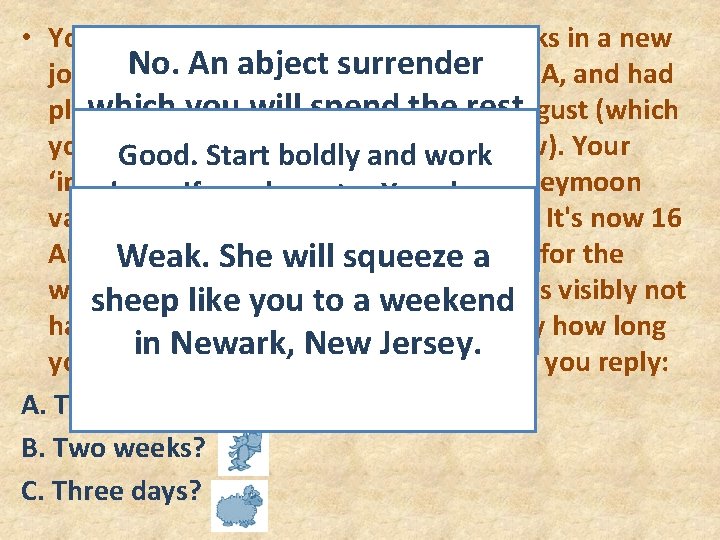
• You have been working only three weeks in a new An abject job as No. a shipping agent surrender in Baltimore, USA, and had which will spend the 18 rest planned to you get married on Friday August (which you did not at theand job interview). Your of disclose your life Good. Start married boldly work ‘intended’ expects proper honeymoon sheepishly toa. Your justify to down spouse if youtrying have to. boss vacation of at least a week in Bermuda. It's now 16 will respect your courageous your partner. August and you askwill yoursqueeze boss for leave for the Weak. She a assertiveness eventually. A move wedding andyou for the vacation. She is visibly not sheepday like to a weekend for clever foxes. happy with your request and asks stiffly how long in Newark, New Jersey. you were ‘thinking of being absent’. Do you reply: A. The wedding day only? B. Two weeks? C. Three days?
Reflection Share one negotiation situation you’ve experienced, and discuss it using some of the terminology and concepts discussed in this presentation material. Thank you!
Materials • The materials have been taken from the course ‘Negotiation’ by Noam Ebner. • The images have been taken from Internet.
- Slides: 25