
Your Health Matters Growing Active Communities Community Assessments
- Slides: 31
Your Health Matters: Growing Active Communities Community Assessments 1
Community Assessments: Learning Objectives • Identify ways to determine gaps and assets which influence physical activity in your community. 2
Power of a Community Assessment • Assessments provide evidence to: – Improve a policy – Change a system – Enhance the environment • Multiple assessments can better examine an issue and involve the community in: – Helping to collect data – Helping to generate meaning – Helping to share findings and create action plans • Assessments can be targeted to specific “problem areas. ” 3
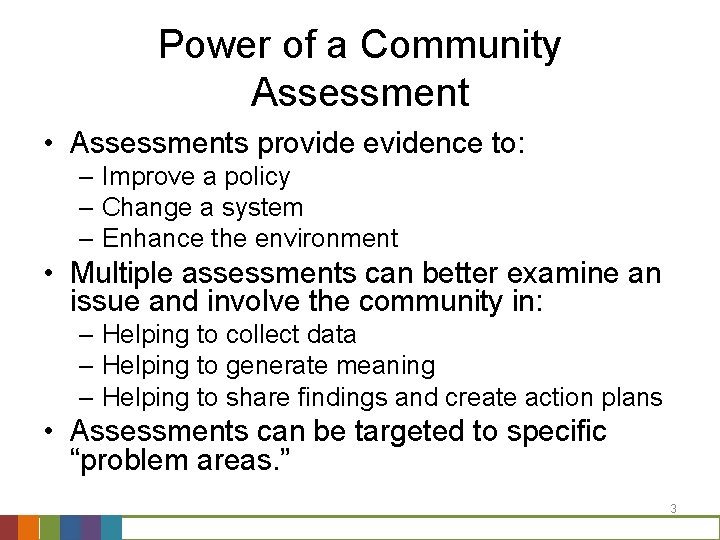
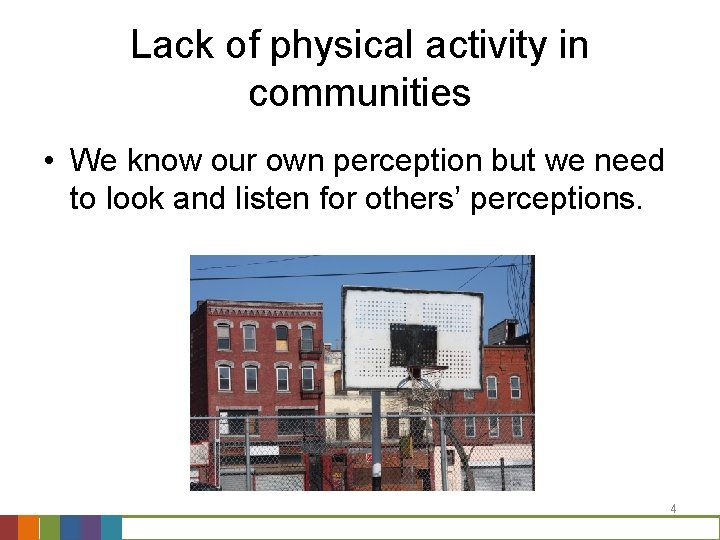
Lack of physical activity in communities • We know our own perception but we need to look and listen for others’ perceptions. 4
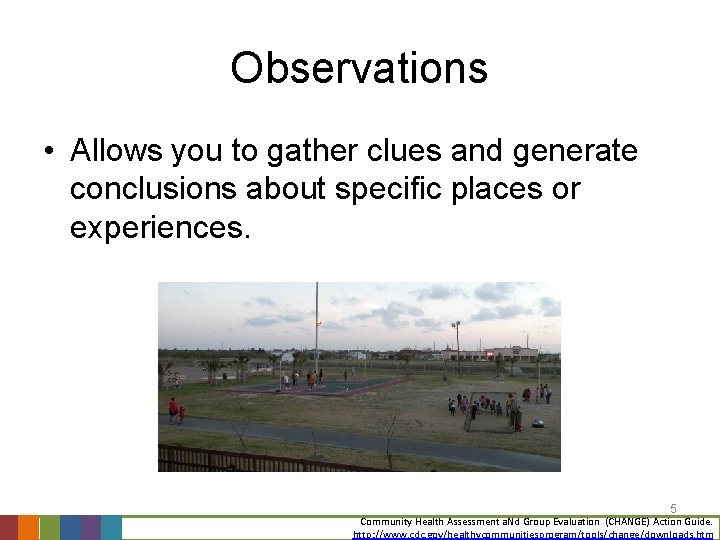
Observations • Allows you to gather clues and generate conclusions about specific places or experiences. 5 Community Health Assessment a. Nd Group Evaluation (CHANGE) Action Guide. http: //www. cdc. gov/healthycommunitiesprogram/tools/change/downloads. htm
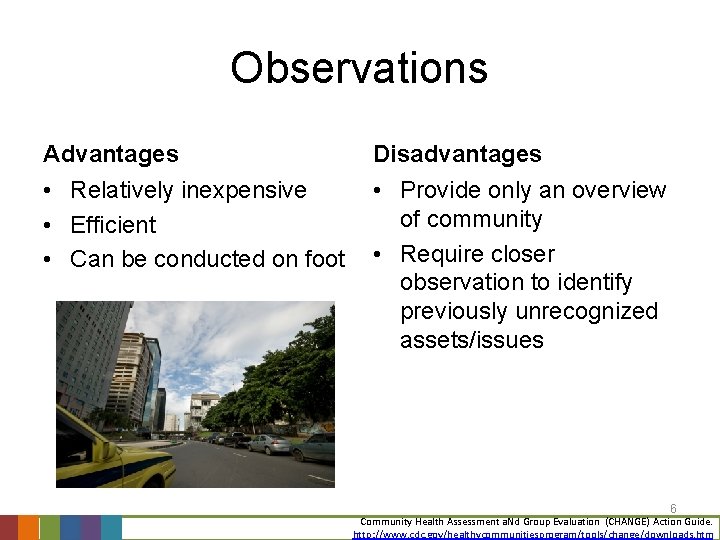
Observations Advantages Disadvantages • Relatively inexpensive • Efficient • Can be conducted on foot • Provide only an overview of community • Require closer observation to identify previously unrecognized assets/issues 6 Community Health Assessment a. Nd Group Evaluation (CHANGE) Action Guide. http: //www. cdc. gov/healthycommunitiesprogram/tools/change/downloads. htm
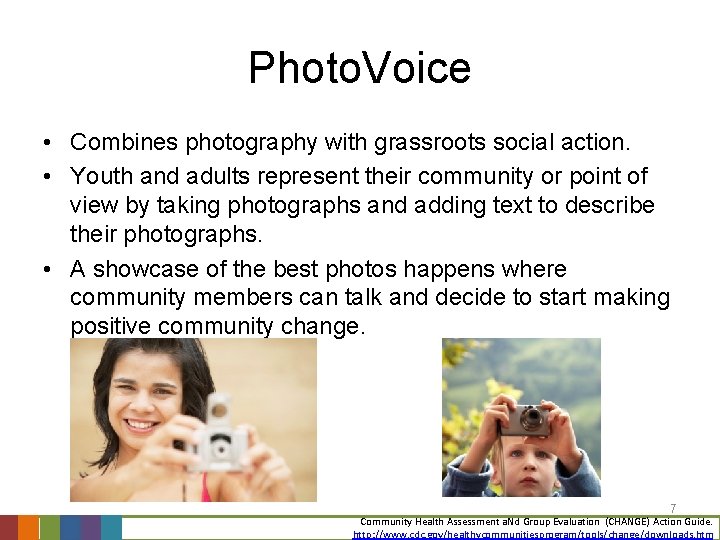
Photo. Voice • Combines photography with grassroots social action. • Youth and adults represent their community or point of view by taking photographs and adding text to describe their photographs. • A showcase of the best photos happens where community members can talk and decide to start making positive community change. 7 Community Health Assessment a. Nd Group Evaluation (CHANGE) Action Guide. http: //www. cdc. gov/healthycommunitiesprogram/tools/change/downloads. htm
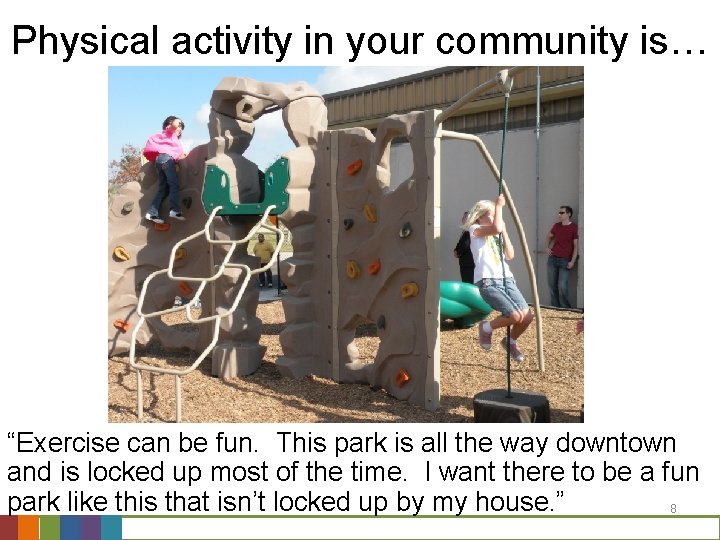
Physical activity in your community is… “Exercise can be fun. This park is all the way downtown and is locked up most of the time. I want there to be a fun park like this that isn’t locked up by my house. ” 8
Photo. Voice Advantages Disadvantages • Describes the community from the viewpoint of those who live there • Records their community’s strengths and concerns • Promotes dialogue and knowledge about community issues • Can be complex due to the volume of information • Requires photo release form • Can be expensive to print photos 9 Community Health Assessment a. Nd Group Evaluation (CHANGE) Action Guide. http: //www. cdc. gov/healthycommunitiesprogram/tools/change/downloads. htm
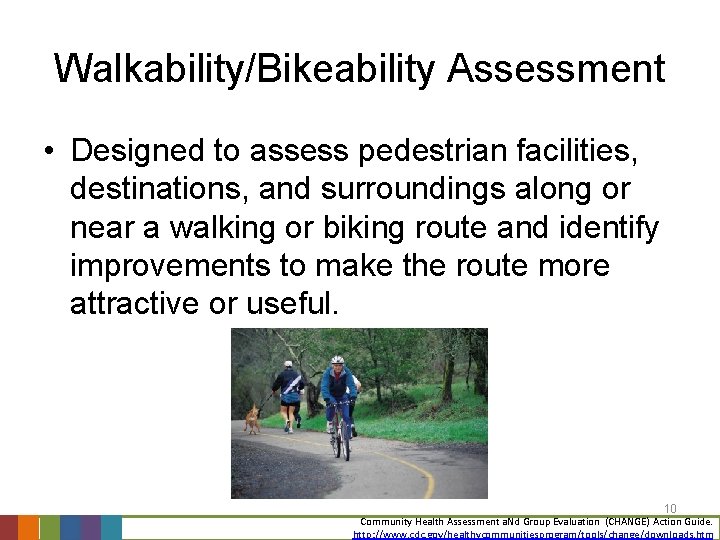
Walkability/Bikeability Assessment • Designed to assess pedestrian facilities, destinations, and surroundings along or near a walking or biking route and identify improvements to make the route more attractive or useful. 10 Community Health Assessment a. Nd Group Evaluation (CHANGE) Action Guide. http: //www. cdc. gov/healthycommunitiesprogram/tools/change/downloads. htm
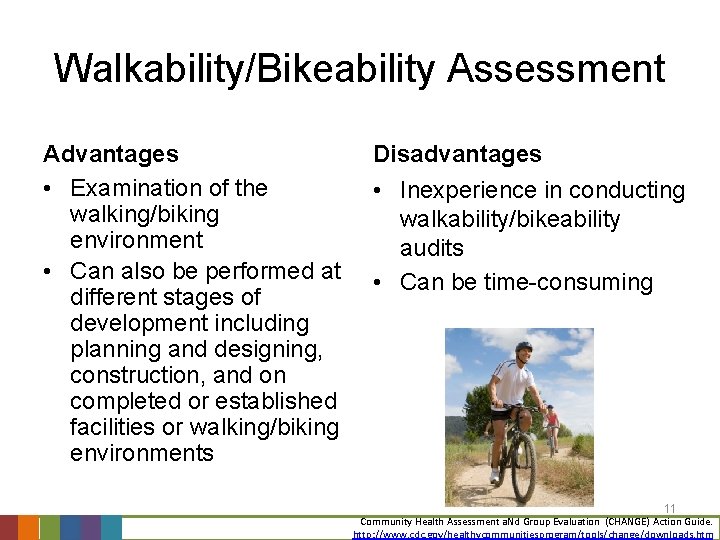
Walkability/Bikeability Assessment Advantages • Examination of the walking/biking environment • Can also be performed at different stages of development including planning and designing, construction, and on completed or established facilities or walking/biking environments Disadvantages • Inexperience in conducting walkability/bikeability audits • Can be time-consuming 11 Community Health Assessment a. Nd Group Evaluation (CHANGE) Action Guide. http: //www. cdc. gov/healthycommunitiesprogram/tools/change/downloads. htm
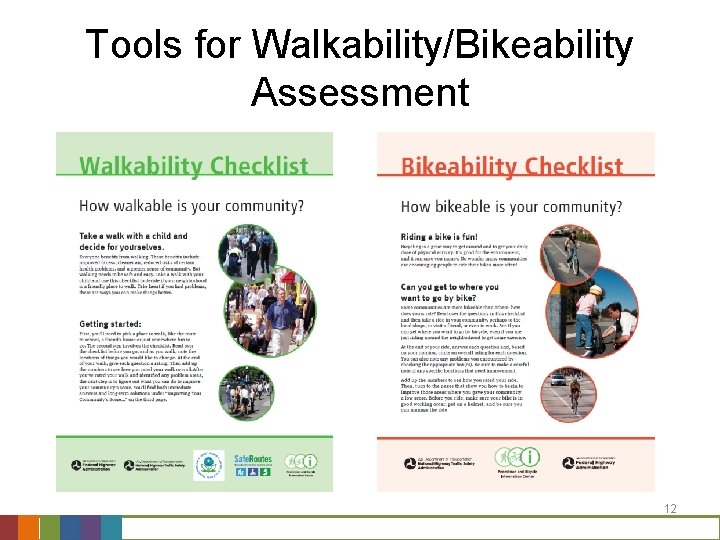
Tools for Walkability/Bikeability Assessment 12
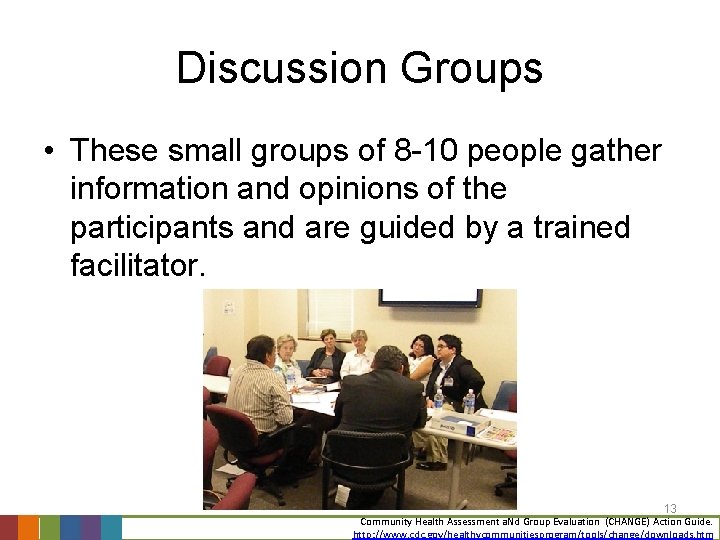
Discussion Groups • These small groups of 8 -10 people gather information and opinions of the participants and are guided by a trained facilitator. 13 Community Health Assessment a. Nd Group Evaluation (CHANGE) Action Guide. http: //www. cdc. gov/healthycommunitiesprogram/tools/change/downloads. htm
Discussion Groups Advantages • Can assess body language • Observers can be present without distracting participants • Can be recorded to share with others who couldn’t attend through quotes • Can be done at natural gathering places for example churches and schools Disadvantages • Responders are not anonymous • Logistical challenge in rural areas or small towns 14 Community Health Assessment a. Nd Group Evaluation (CHANGE) Action Guide. http: //www. cdc. gov/healthycommunitiesprogram/tools/change/downloads. htm
Postal Survey • Mailing self-completion questionnaires to a selected group of people. 15 Community Health Assessment a. Nd Group Evaluation (CHANGE) Action Guide. http: //www. cdc. gov/healthycommunitiesprogram/tools/change/downloads. htm
Postal Survey Advantages Disadvantages • Relatively inexpensive • No interviewer training required • Suitable for short and straightforward questions • Data collection takes a long time • Relatively low response rates • Moderate literacy level required 16 Community Health Assessment a. Nd Group Evaluation (CHANGE) Action Guide. http: //www. cdc. gov/healthycommunitiesprogram/tools/change/downloads. htm
Telephone Survey • Collecting information from a group of the community with a standardized questionnaire by telephone. 17 Community Health Assessment a. Nd Group Evaluation (CHANGE) Action Guide. http: //www. cdc. gov/healthycommunitiesprogram/tools/change/downloads. htm
Telephone Survey Advantages Disadvantages • Minimizes missing data • Can use open-ended questions and more complex interviewing schedules • Quick and inexpensive • Does not require a high level of literacy • Can be hard to prevent interference from others • Need to keep questions few and short • Unable to ask questions requiring visual cues 18 Community Health Assessment a. Nd Group Evaluation (CHANGE) Action Guide. http: //www. cdc. gov/healthycommunitiesprogram/tools/change/downloads. htm
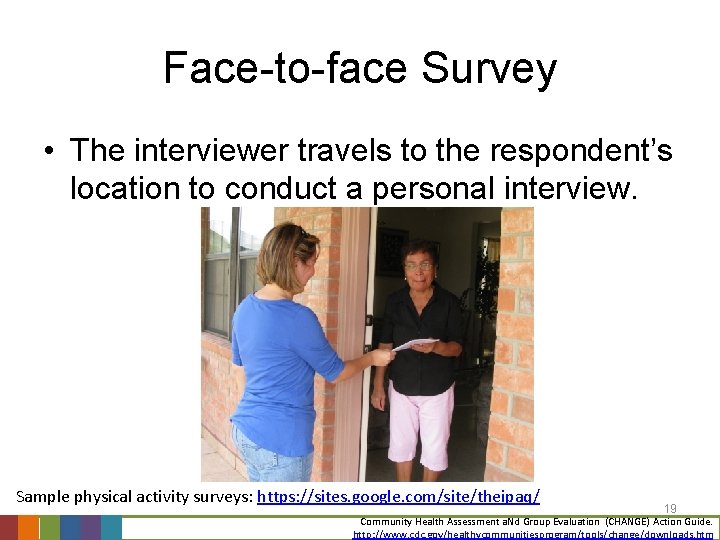
Face-to-face Survey • The interviewer travels to the respondent’s location to conduct a personal interview. Sample physical activity surveys: https: //sites. google. com/site/theipaq/ 19 Community Health Assessment a. Nd Group Evaluation (CHANGE) Action Guide. http: //www. cdc. gov/healthycommunitiesprogram/tools/change/downloads. htm
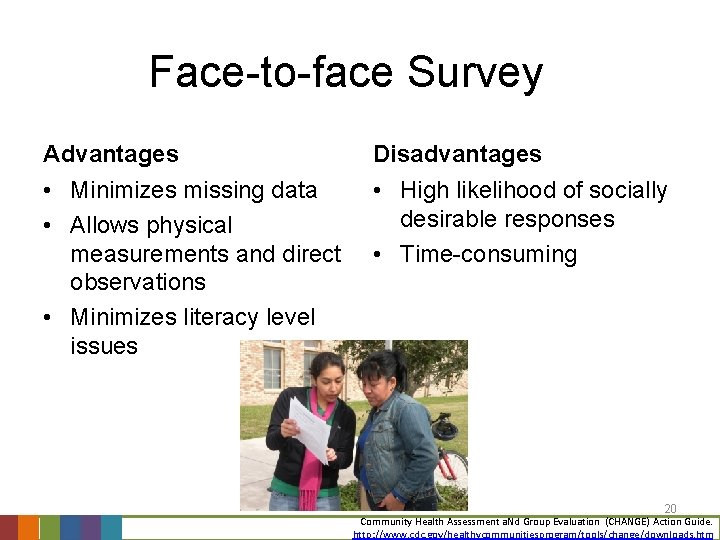
Face-to-face Survey Advantages Disadvantages • Minimizes missing data • Allows physical measurements and direct observations • Minimizes literacy level issues • High likelihood of socially desirable responses • Time-consuming 20 Community Health Assessment a. Nd Group Evaluation (CHANGE) Action Guide. http: //www. cdc. gov/healthycommunitiesprogram/tools/change/downloads. htm
Web-based Surveys • A group of individuals are invited to participate in completing an online survey, their responses are submitted and tracked electronically on the Internet. • Social media (Facebook, twitter, blogs, etc. ) can be a great way to get web-based surveys out. 21 Community Health Assessment a. Nd Group Evaluation (CHANGE) Action Guide. http: //www. cdc. gov/healthycommunitiesprogram/tools/change/downloads. htm
Web-based Surveys Advantages Disadvantages • Can be relatively inexpensive • Relatively quick method of data-collection • Lets people participate from where they are on their own time • Basic computer skills required • No information on people who do not participate 22 Community Health Assessment a. Nd Group Evaluation (CHANGE) Action Guide. http: //www. cdc. gov/healthycommunitiesprogram/tools/change/downloads. htm
Tools for Web-based Surveys • www. Survey. Monkey. com allows you to create your own surveys for free and email the link to participants or post them on a webpage or social media site. 23
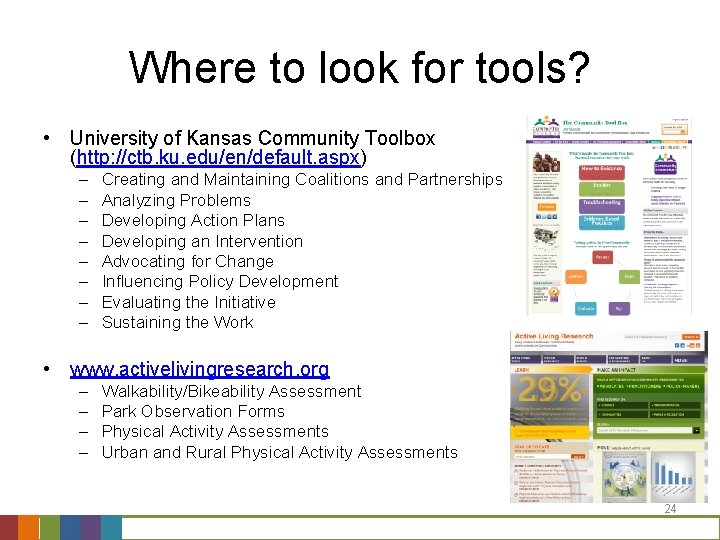
Where to look for tools? • University of Kansas Community Toolbox (http: //ctb. ku. edu/en/default. aspx) – – – – Creating and Maintaining Coalitions and Partnerships Analyzing Problems Developing Action Plans Developing an Intervention Advocating for Change Influencing Policy Development Evaluating the Initiative Sustaining the Work • www. activelivingresearch. org – – Walkability/Bikeability Assessment Park Observation Forms Physical Activity Assessments Urban and Rural Physical Activity Assessments 24
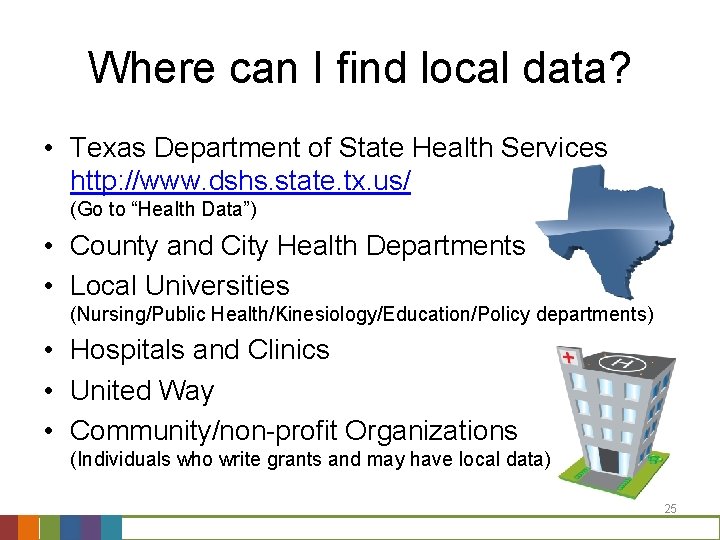
Where can I find local data? • Texas Department of State Health Services http: //www. dshs. state. tx. us/ (Go to “Health Data”) • County and City Health Departments • Local Universities (Nursing/Public Health/Kinesiology/Education/Policy departments) • Hospitals and Clinics • United Way • Community/non-profit Organizations (Individuals who write grants and may have local data) 25
Statistics and Stories • Results can be presented simply. • Highlight comparisons to national and state findings, ask these questions when looking at the data: – What is the obesity level in my community compared to the rest of the state or nation? – What percentage of my community are meeting the physical activity recommendations? • Combine the data with your own stories. – Your personal stories are very important. – They have a huge impact on their own, but with a few simple statistics they can have an even larger impact. 26
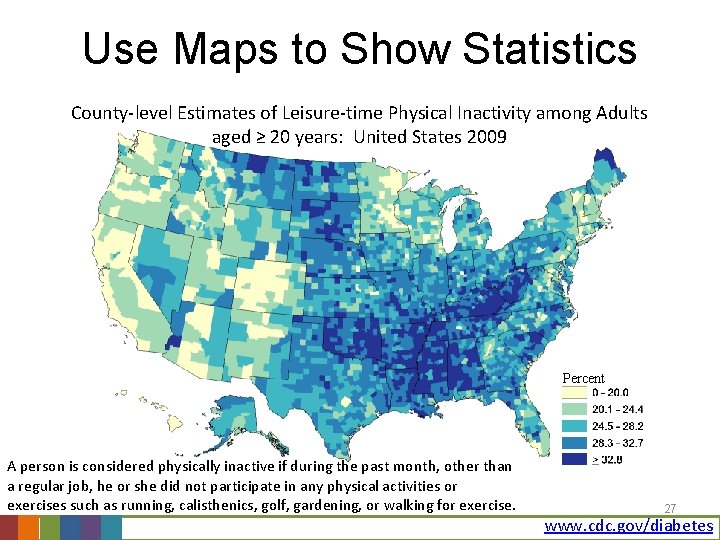
Use Maps to Show Statistics County-level Estimates of Leisure-time Physical Inactivity among Adults aged ≥ 20 years: United States 2009 Percent A person is considered physically inactive if during the past month, other than a regular job, he or she did not participate in any physical activities or exercises such as running, calisthenics, golf, gardening, or walking for exercise. 27 www. cdc. gov/diabetes
Draw Maps of Your Community ACTIV ITY • Now that you’ve seen an example of a fictitious community, think about your own community, whether it is the city as a whole or a smaller neighborhood and draw it to the best of your knowledge. • Think about the following: – – – – Schools, parks, playgrounds Sidewalks, crosswalks, street lights Bus stops Grocery stores Churches Major roads Housing (apartments, condos, houses on larger lots, vacant lots) 28
Community Assessments: Key Point Recap • Use any or all of the previous ways to look at your community. • Think about what methods will work best for your community, all methods have positives and negatives. • Don’t forget to ask your community what they want! • Have community members help lead the assessment. • Specific, local stories and evidence can help to make the case. 29
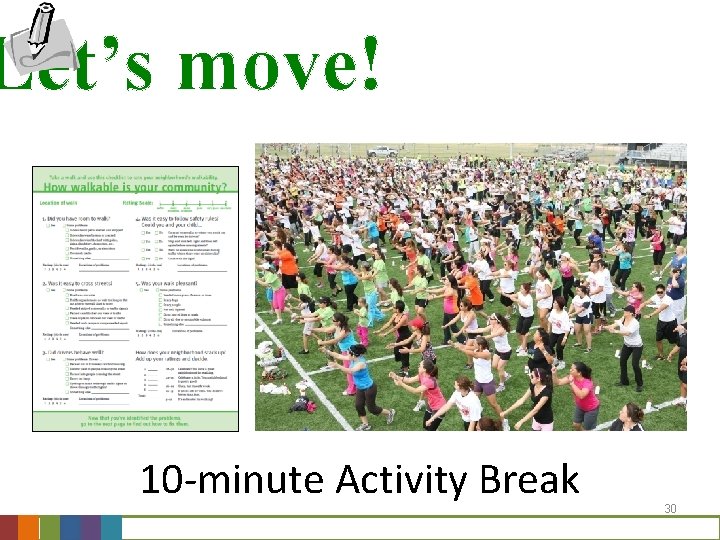
Let’s move! 10 -minute Activity Break 30
Switch to Partners Power. Point 31