
Your Brain is in Your Hand Action Research
Your Brain is in Your Hand Action Research Report EDUB 669 Kelly Way, April 2011
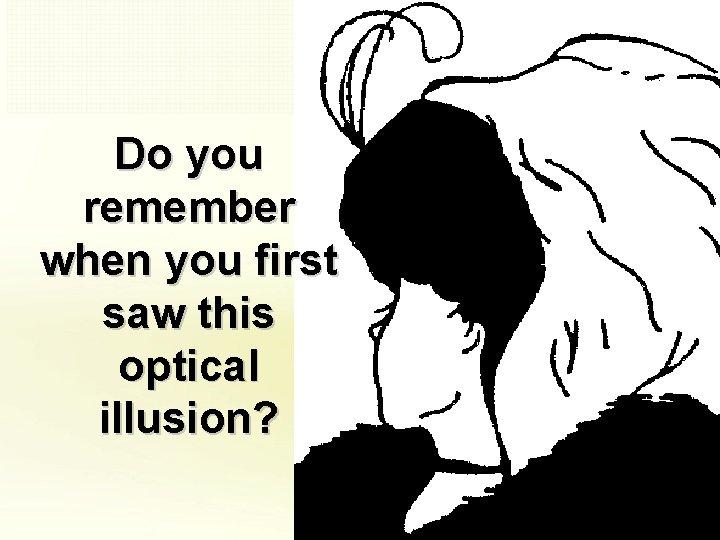
Do you remember when you first saw this optical illusion?

Did you see an old hag in profile? Or a young lady looking over her shoulder?
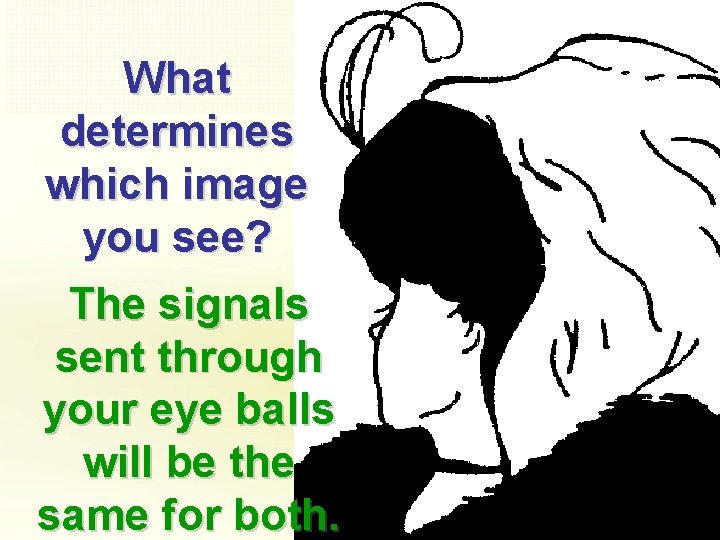
What determines which image you see? The signals sent through your eye balls will be the same for both.
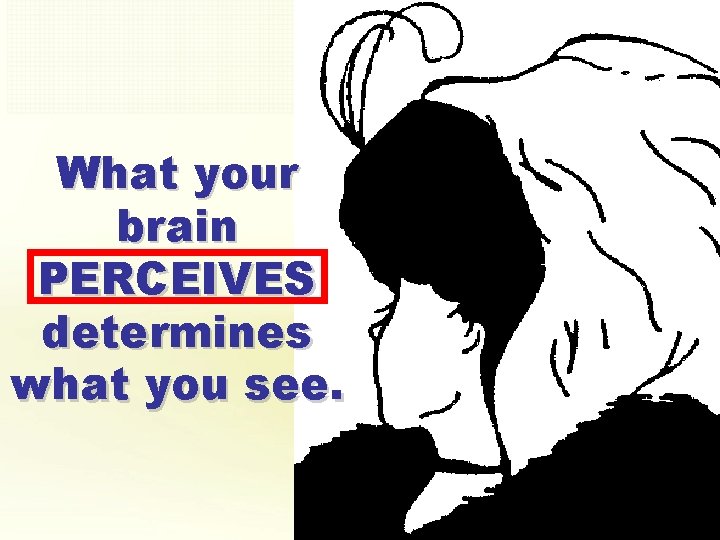
What your brain PERCEIVES determines what you see.
Does it seem like many of the cognitive skills of your students have drastically changed over the past 5 -6 years?
It’s not your imagination. You are teaching the first generation of Digital Natives. They both perceive and process information dramatically different than us Digital Immigrants.
“Because of the current technological revolution, our brains are evolving right nowat a speed like never before. Besides influencing how we think, digital technology is altering how we feel, how we behave, and the way in which our brains function. ” (Small, G. , & Vorgan, G, 2009)
The flooding of digital technology has dramatically altered key cognitive abilities: • Focused attention • Reading • The Hand-Brain Connection
ATTENTION The author of Distracted: The Erosion of Attention and the Coming Dark Age noted: To breed children for a world of split focus is to raise generations who will have ceded cognitive control of their days. (Jackson, 2009, p. 92)
READING Mark Bauerlein observed regarding reading: Screen reading isn’t a supplement anymore, is not longer an “extension” of thinking skills beyond the “linear-sequential model. ” It is the primary activity, and the cultivation of nonlinear, nonhierarchical, nonsequential thought patters through Web reading now transpires on top of a thin and cracking foundation of print reading …as teens and young adults read linear texts in linear fashion less and less, the less they engage in sustained linear thinking. (2008, p. 141)
THE HAND-BRAIN CONNECTION Due to the very nature of a digitally -saturated childhood, children now keyboard more than they write cursive, animate images with a click of a mouse rather than sketch and color, and construct 3 -D images with command strokes rather than build with Lego blocks.
THE HAND-BRAIN CONNECTION Why would that be a problem?
THE HAND-BRAIN CONNECTION Todd Oppenheimer wrote The Flickering Mind. Saving Education from the False Promise of Technology. He cited the works of neurologist, Frank Wilson, in connecting hand usage to brain development. In summarizing the neurologist’s work he stated:
THE HAND-BRAIN CONNECTION “The overall picture suggests that the sensory capacities of the human hand send powerful signals to the brain, helping it learn and develop. ” (2004, p. 199)

What does this mean for my classroom?
A few years after the Millennium, I started noticing a trend among my geometry students while tutoring.
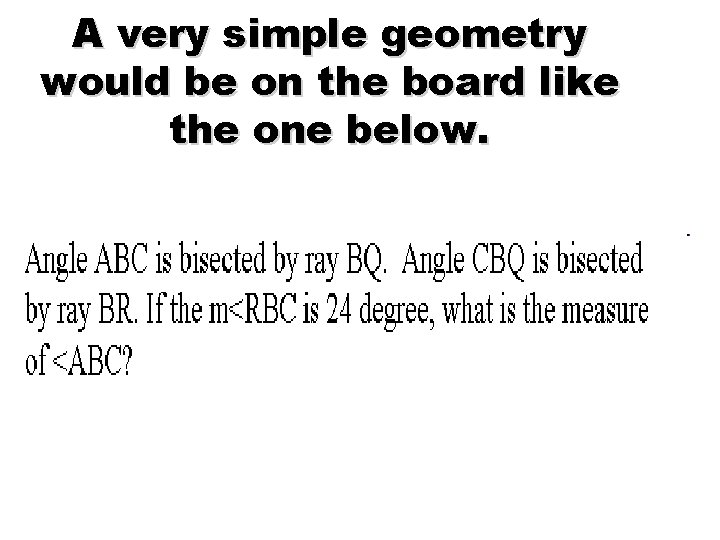
A very simple geometry would be on the board like the one below.
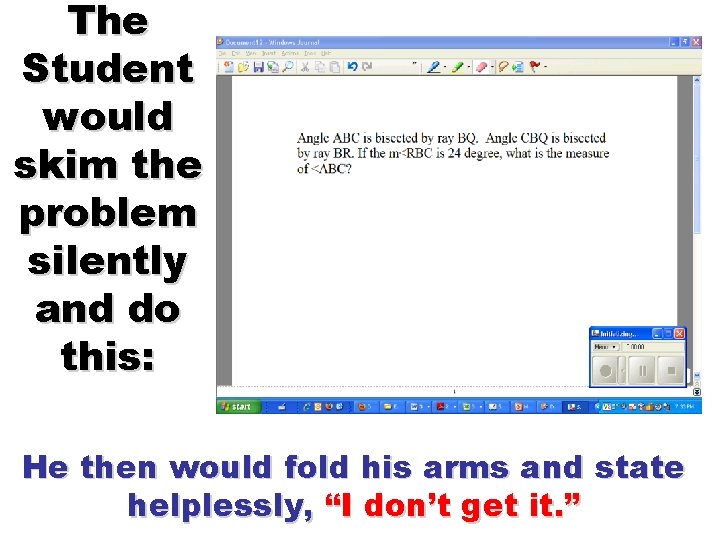
The Student would skim the problem silently and do this: He then would fold his arms and state helplessly, “I don’t get it. ”
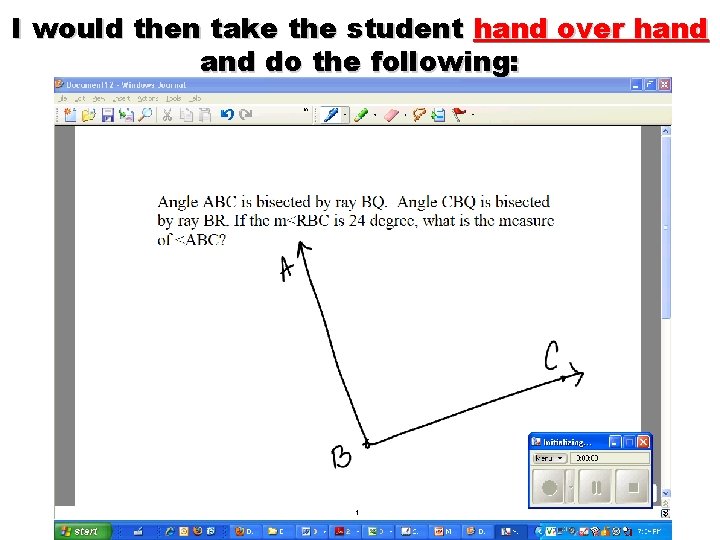
I would then take the student hand over hand do the following:
The student would suddenly “perceive” the proper diagram and exclaim, “Oh, I get it! This is easy. ”
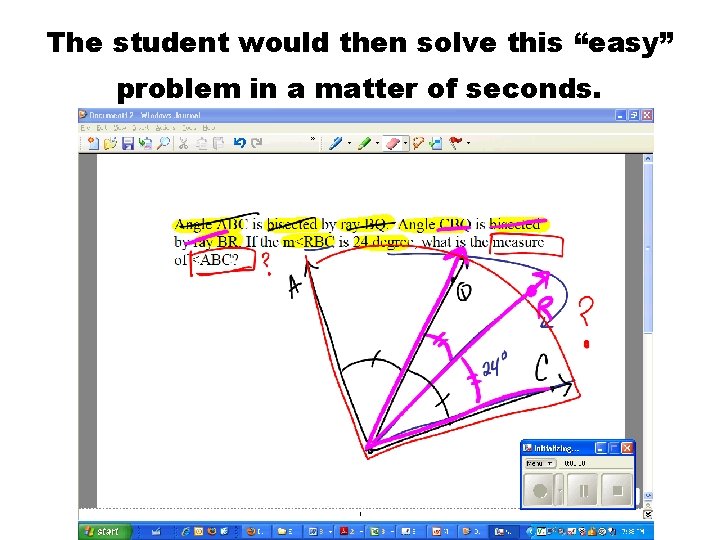
The student would then solve this “easy” problem in a matter of seconds.
Through hundreds of similar interactions I noticed that my students were increasingly deficient in their visual-perception skills.
Many tactile skills I used instinctually as a DIGITAL IMMIGRANT I now had to train my DIGITAL NATIVES students to intentionally incorporate in their problem solving repertoire.
These tactile interactive strategies I summarize with the phrase: Your BRAIN is in Your HAND.
• • • Tactile Interactive Strategies include: Physically filtering word problems by highlighting or underlining key words & numbers. Drawing a diagram. Labeling a diagram. Listing given information. Tracing and sweeping angles for proper positioning.
• • Tactile Interactive Strategies continued: Marking the diagram with proper notations for cue words like bisect, parallel, and perpendicular. Writing out all formulas and equations. Showing all work for algebra and math computations on paper. Boxing all sub answers and properly labeling the final answer.

An additional Digital Native distinction was noted when we introduced an online tutoring system called ALEKS to our math classes. (See www. aleks. com )
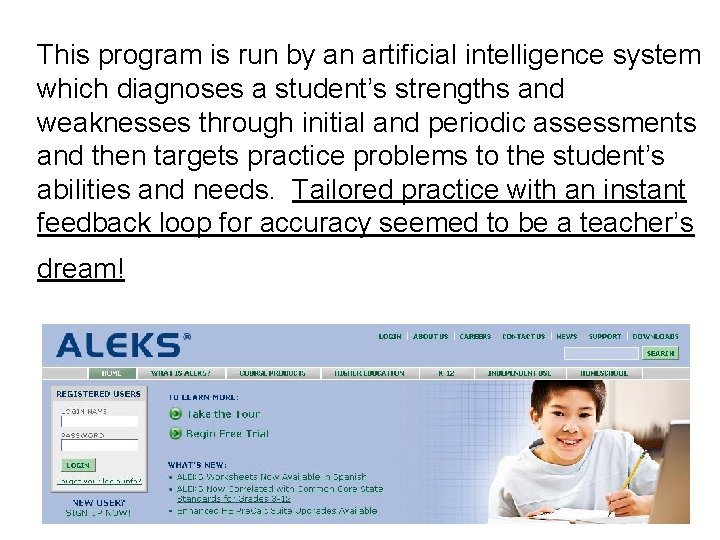
This program is run by an artificial intelligence system which diagnoses a student’s strengths and weaknesses through initial and periodic assessments and then targets practice problems to the student’s abilities and needs. Tailored practice with an instant feedback loop for accuracy seemed to be a teacher’s dream!
Most of the work on ALEKS was done at home. When students took quizzes on this system at home, their scores plummeted! Students who normally scored A’s on my in-class paper tests, were scoring C’s or below on the ALEKS quizzes.
After a few months of this trend, I finally rotated all seven classes through the school’s computer lab to observe how students were completing these ALEKS quizzes.
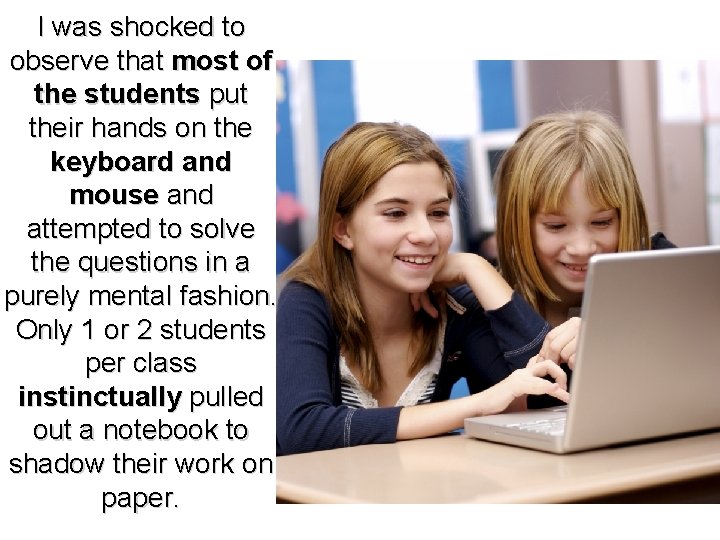
I was shocked to observe that most of the students put their hands on the keyboard and mouse and attempted to solve the questions in a purely mental fashion. Only 1 or 2 students per class instinctually pulled out a notebook to shadow their work on paper.
The epiphany was that to my Digital Native students the use of a keyboard and mouse were part of their native environment. Pencil and paper usage was foreign.
This lack of drawing, writing, tracing, sweeping, shading, and showing work for computations and algebra on PAPER contributed to decreased accuracy.
The hypothesis for my action research was: “Tactile/kinesthetic interactive training benefits Digital Natives and empowers them to solve math problems more effectively as demonstrated using both pencil/paper and digital tests. ”
The two target questions: • Does writing out work via pencil/paper while taking an online quiz improve accuracy? • Does the incorporation of tactile interactive techniques enhance word problem solution accuracy?
On March 13 th and 14 th my seven classes rotated through the our school’s computer lab to take two online math quizzes. For one quiz they were required to have a “paper shadow” and write out all the problems and show work. For the other quiz, they worked purely via the key board and mouse.
4 of my classes took the paper shadow first, and then the electronic only quiz. 3 of my classes took the paper shadow second.
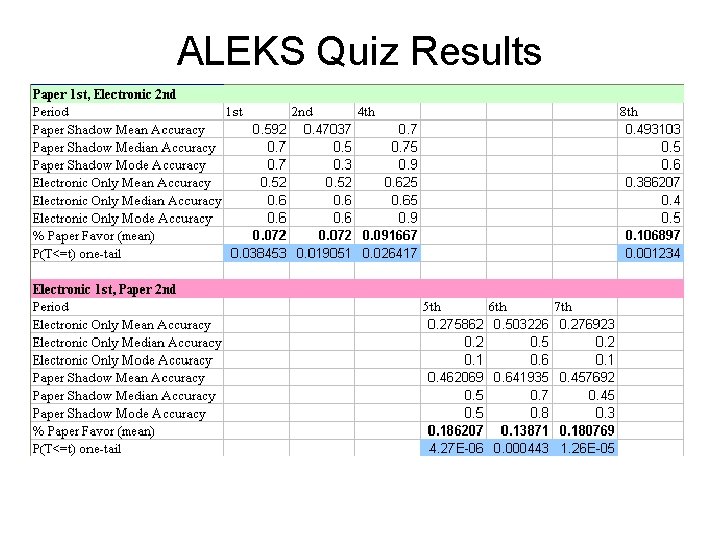
ALEKS Quiz Results
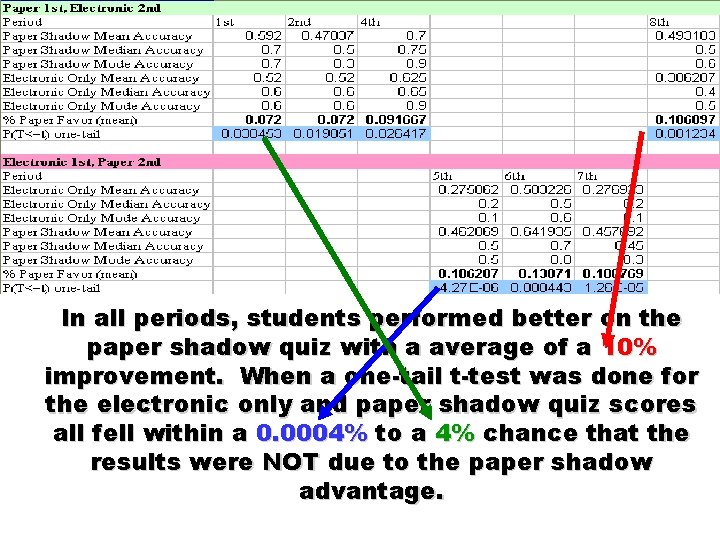
In all periods, students performed better on the paper shadow quiz with a average of a 10% improvement. When a one-tail t-test was done for the electronic only and paper shadow quiz scores all fell within a 0. 0004% to a 4% chance that the results were NOT due to the paper shadow advantage.
Target question #1: Does writing out work via pencil/paper while taking an online quiz improve accuracy? The results show that the use of a pencil/paper shadow enhances accuracy when taking online math quizzes.
Students were given a single word problem quiz on March 23 rd. Both the students’ parents and our principal were notified of this testing process prior the quiz. All student solutions were completed anonymously to prevent grading bias.
Students were at liberty to solve the problem in any fashion.
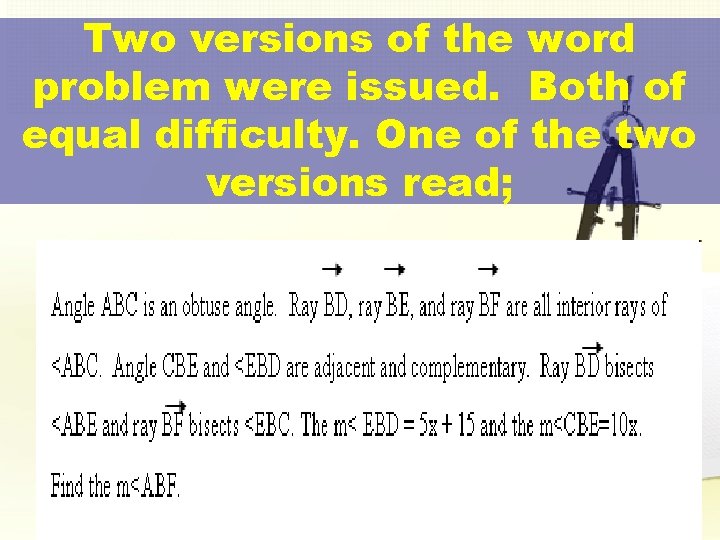
Two versions of the word problem were issued. Both of equal difficulty. One of the two versions read;
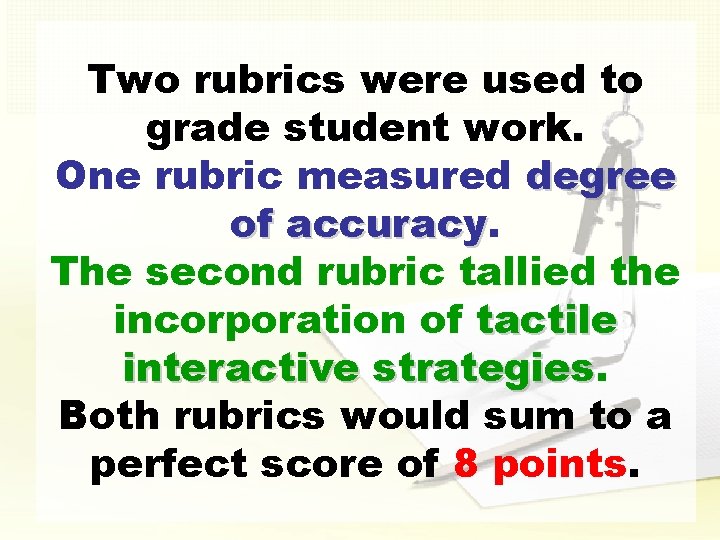
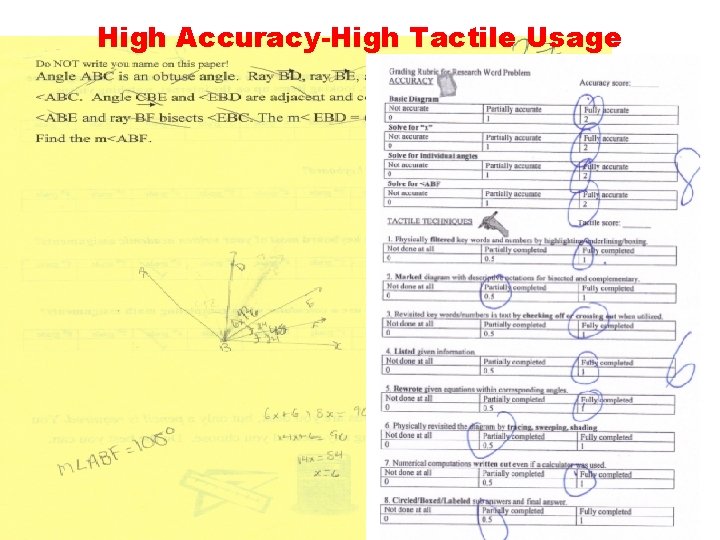
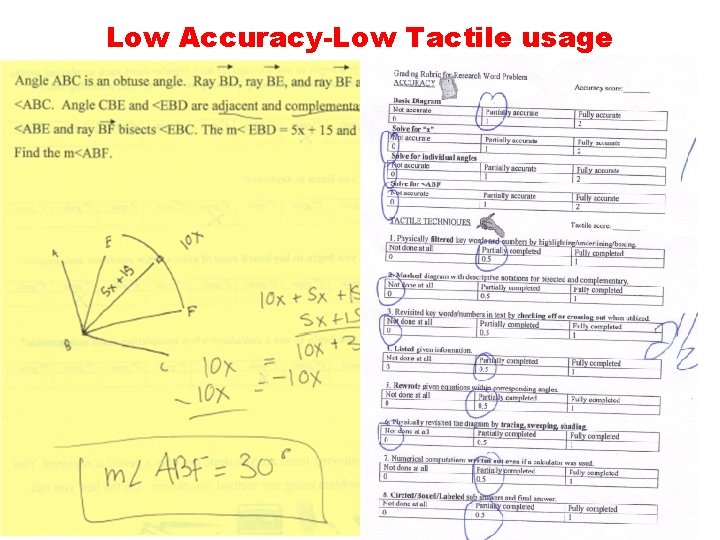
Two rubrics were used to grade student work. One rubric measured degree of accuracy The second rubric tallied the incorporation of tactile interactive strategies Both rubrics would sum to a perfect score of 8 points.
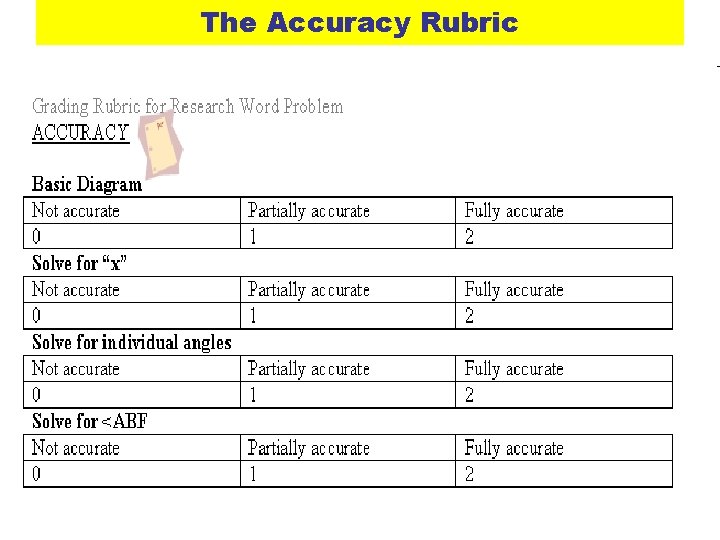
The Accuracy Rubric
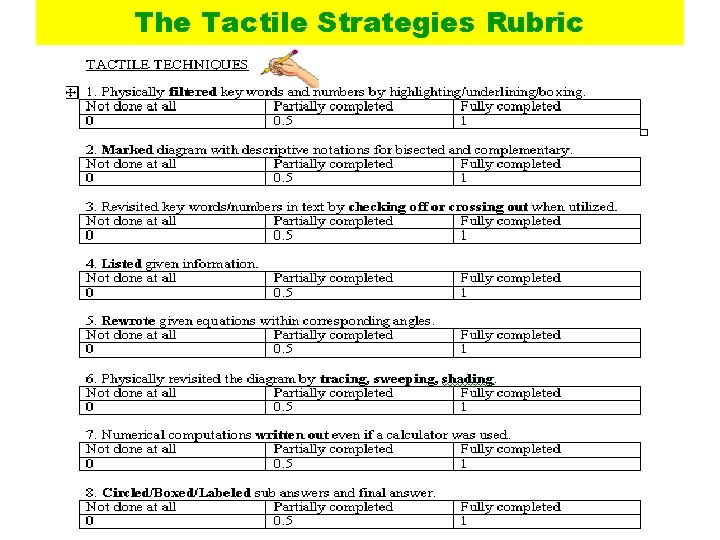
The Tactile Strategies Rubric
The hypothesis would anticipate that the degree of solution accuracy would shadow the degree of tactile interactive techniques integration.
Following are two student samples.
High Accuracy-High Tactile Usage
Low Accuracy-Low Tactile usage
All 198 word problems were graded based on these two rubrics.
The results were tallied both by individual periods as well as all samples as a whole. Trends are noted in the following graph and excel spreadsheet.
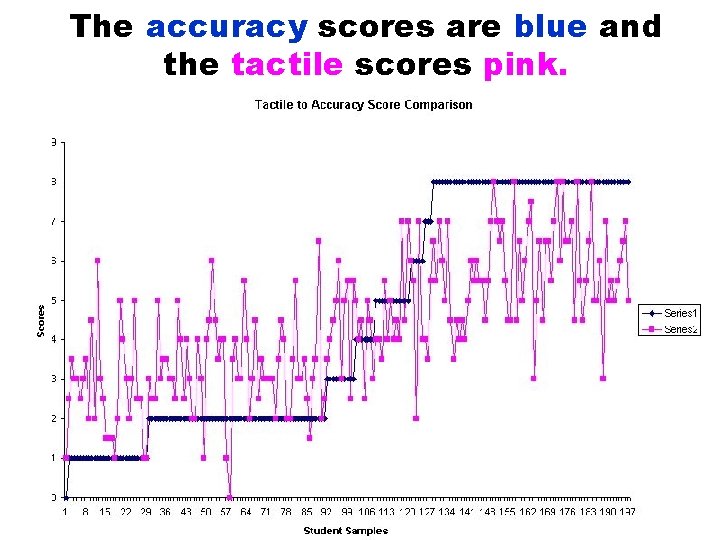
The accuracy scores are blue and the tactile scores pink.
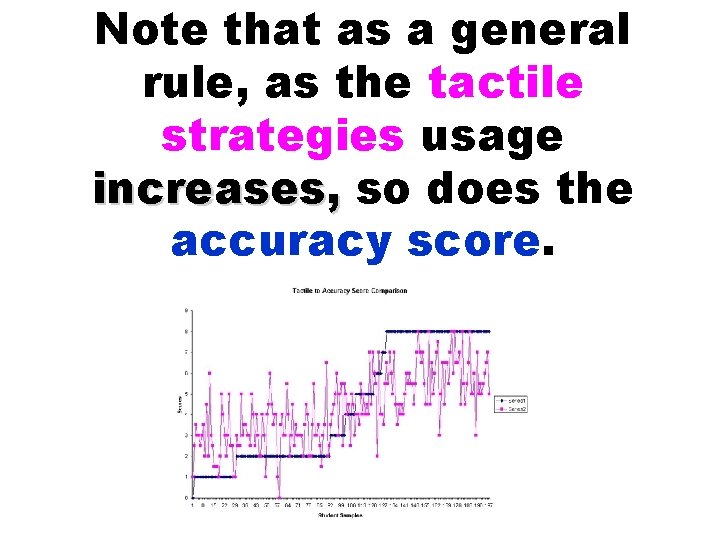
Note that as a general rule, as the tactile strategies usage increases, so does the accuracy score.
The accuracy and tactile scores were further analyzed using: • Measures of central tendencies such as mean and mode. • Pearson correlations. • Paired t-test for means and significance.
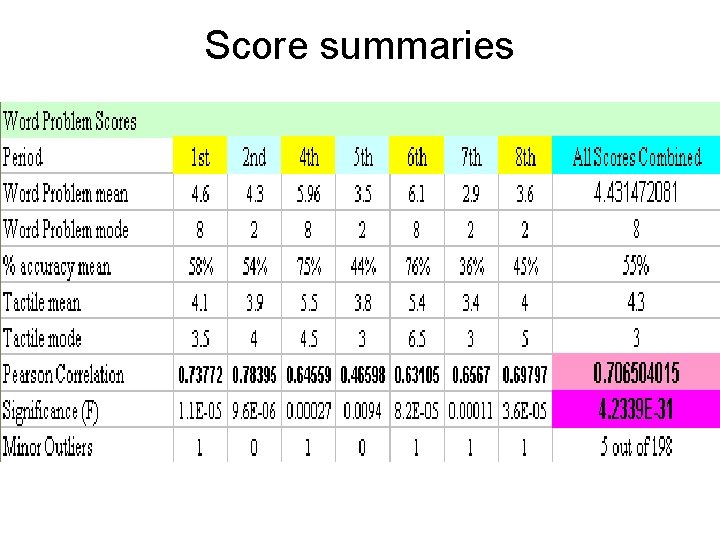
Score summaries
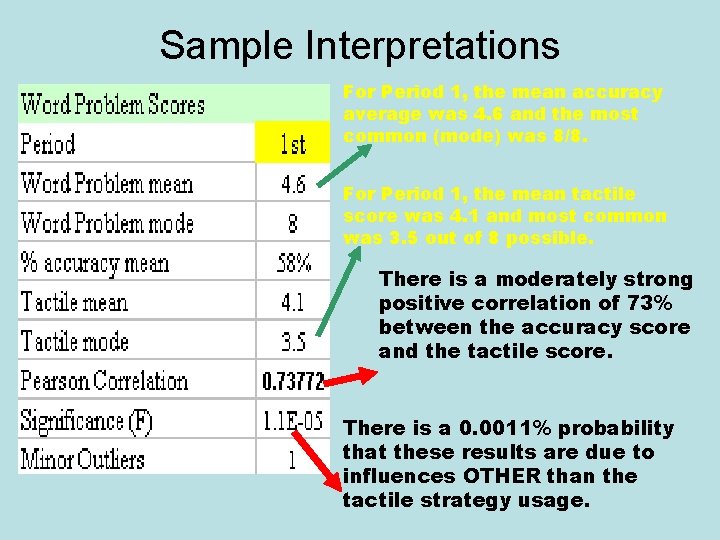
Sample Interpretations For Period 1, the mean accuracy average was 4. 6 and the most common (mode) was 8/8. For Period 1, the mean tactile score was 4. 1 and most common was 3. 5 out of 8 possible. There is a moderately strong positive correlation of 73% between the accuracy score and the tactile score. There is a 0. 0011% probability that these results are due to influences OTHER than the tactile strategy usage.
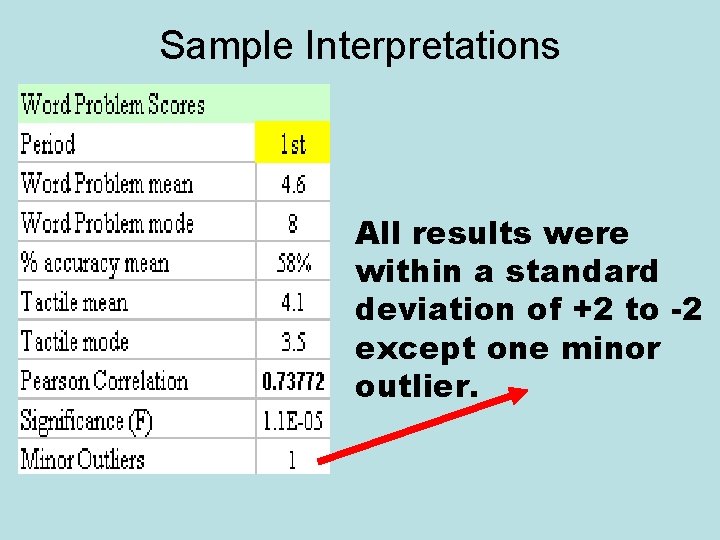
Sample Interpretations All results were within a standard deviation of +2 to -2 except one minor outlier.
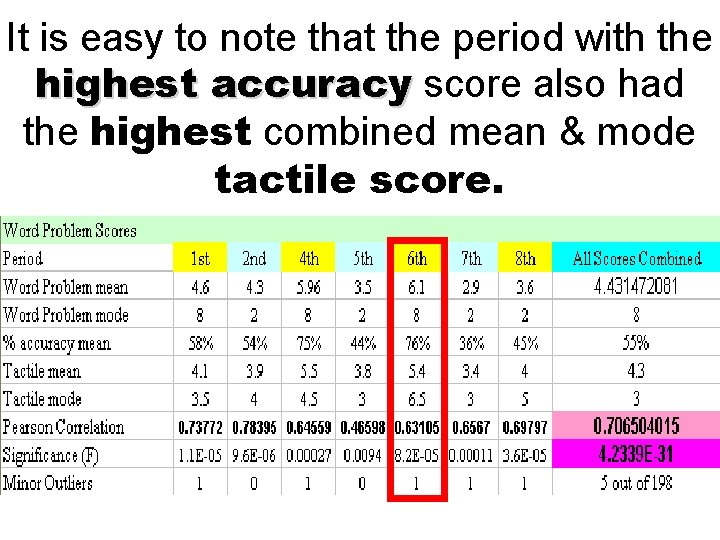
It is easy to note that the period with the highest accuracy score also had the highest combined mean & mode tactile score.
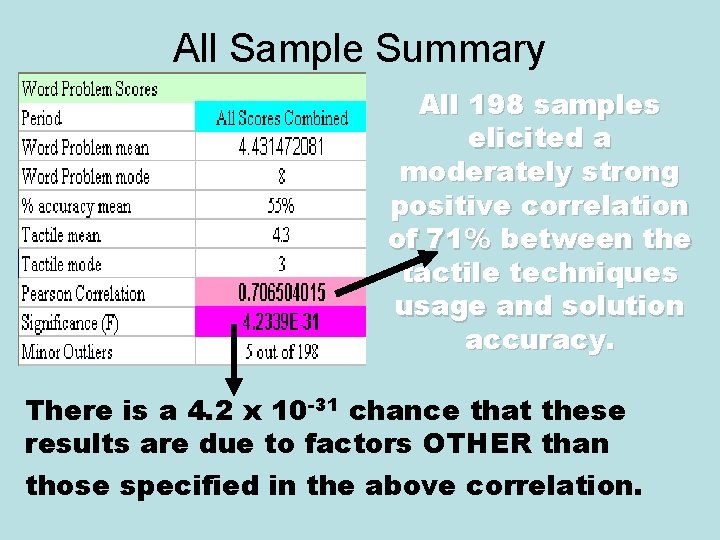
All Sample Summary All 198 samples elicited a moderately strong positive correlation of 71% between the tactile techniques usage and solution accuracy. There is a 4. 2 x 10 -31 chance that these results are due to factors OTHER than those specified in the above correlation.
Target question #2: Does the incorporation of tactile interactive techniques enhance word problem solution accuracy?
CONCLUSION? The results seem to demonstrate that my Digital Native students improve their math word problem solution accuracy to the degree that they incorporate the “brain-is in-your-hand” in-your-hand tactile interactive strategies.

Special thanks to my math department coworkers of Valley Christian High School for their patience in listening to my ruminations about this topic over the past several months and their insightful feedback. Without the valuable assistance of our AP statistics teacher, Claudia Smith, Smith this research analysis would be possible.
References • Bauerlein, M. (2008) The Dumbest Generation. How the Digital Age Stupefies Young Americans and Jeopardizes Our Future New York, NY: Penguin Group. • Jackson, M. (2009) Distracted: The Erosion of Attention and the Coming Dark Age Amherst, NY: Prometheus Books. • Oppenheimer, T. (2004) The Flickering Mind. Saving Education from the False Promise of Technology New York, NY: Random House Trade Paperbacks. • Small, G. , & Vorgan, G. (2009) I-Brain. Surviving the Technological Alteration of the Modern Mind New York, NY: Harper Collins.
- Slides: 65