
Your body Responding and adapting to exercise The
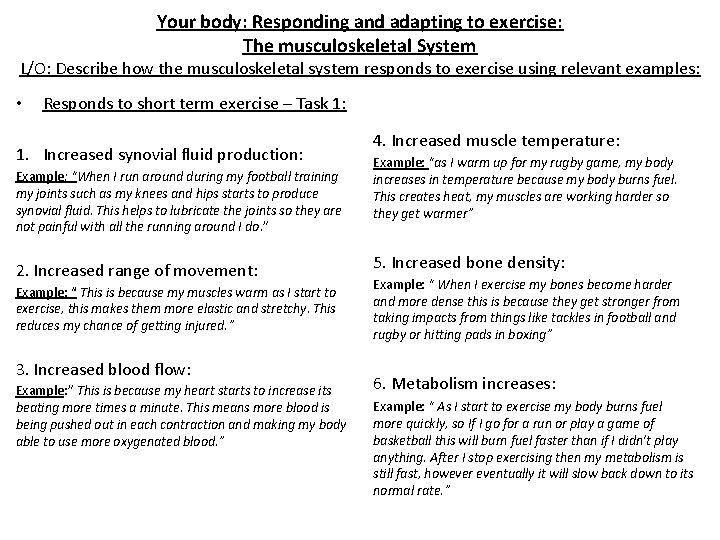
Your body: Responding and adapting to exercise: The musculoskeletal System L/O: Describe how the musculoskeletal system responds to exercise using relevant examples: • Responds to short term exercise – Task 1: 1. Increased synovial fluid production: Example: “When I run around during my football training my joints such as my knees and hips starts to produce synovial fluid. This helps to lubricate the joints so they are not painful with all the running around I do. ” 2. Increased range of movement: Example: “ This is because my muscles warm as I start to exercise, this makes them more elastic and stretchy. This reduces my chance of getting injured. ” 3. Increased blood flow: Example: ” This is because my heart starts to increase its beating more times a minute. This means more blood is being pushed out in each contraction and making my body able to use more oxygenated blood. ” 4. Increased muscle temperature: Example: “as I warm up for my rugby game, my body increases in temperature because my body burns fuel. This creates heat, my muscles are working harder so they get warmer” 5. Increased bone density: Example: “ When I exercise my bones become harder and more dense this is because they get stronger from taking impacts from things like tackles in football and rugby or hitting pads in boxing” 6. Metabolism increases: Example: “ As I start to exercise my body burns fuel more quickly, so If I go for a run or play a game of basketball this will burn fuel faster than if I didn’t play anything. After I stop exercising then my metabolism is still fast, however eventually it will slow back down to its normal rate. ”
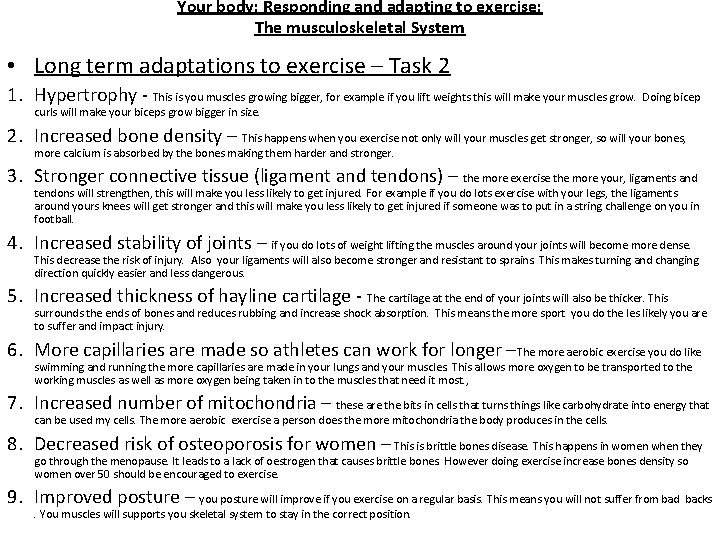
Your body: Responding and adapting to exercise: The musculoskeletal System • Long term adaptations to exercise – Task 2 1. Hypertrophy - This is you muscles growing bigger, for example if you lift weights this will make your muscles grow. Doing bicep curls will make your biceps grow bigger in size. 2. Increased bone density – This happens when you exercise not only will your muscles get stronger, so will your bones, more calcium is absorbed by the bones making them harder and stronger. 3. Stronger connective tissue (ligament and tendons) – the more exercise the more your, ligaments and tendons will strengthen, this will make you less likely to get injured. For example if you do lots exercise with your legs, the ligaments around yours knees will get stronger and this will make you less likely to get injured if someone was to put in a string challenge on you in football. 4. Increased stability of joints – if you do lots of weight lifting the muscles around your joints will become more dense. This decrease the risk of injury. Also your ligaments will also become stronger and resistant to sprains. This makes turning and changing direction quickly easier and less dangerous. 5. Increased thickness of hayline cartilage - The cartilage at the end of your joints will also be thicker. This surrounds the ends of bones and reduces rubbing and increase shock absorption. This means the more sport you do the les likely you are to suffer and impact injury. 6. More capillaries are made so athletes can work for longer –The more aerobic exercise you do like swimming and running the more capillaries are made in your lungs and your muscles. This allows more oxygen to be transported to the working muscles as well as more oxygen being taken in to the muscles that need it most. , 7. Increased number of mitochondria – these are the bits in cells that turns things like carbohydrate into energy that can be used my cells. The more aerobic exercise a person does the more mitochondria the body produces in the cells. 8. Decreased risk of osteoporosis for women – This is brittle bones disease. This happens in women when they go through the menopause. It leads to a lack of oestrogen that causes brittle bones. However doing exercise increase bones density so women over 50 should be encouraged to exercise. 9. Improved posture – you posture will improve if you exercise on a regular basis. This means you will not suffer from bad backs. You muscles will supports you skeletal system to stay in the correct position.
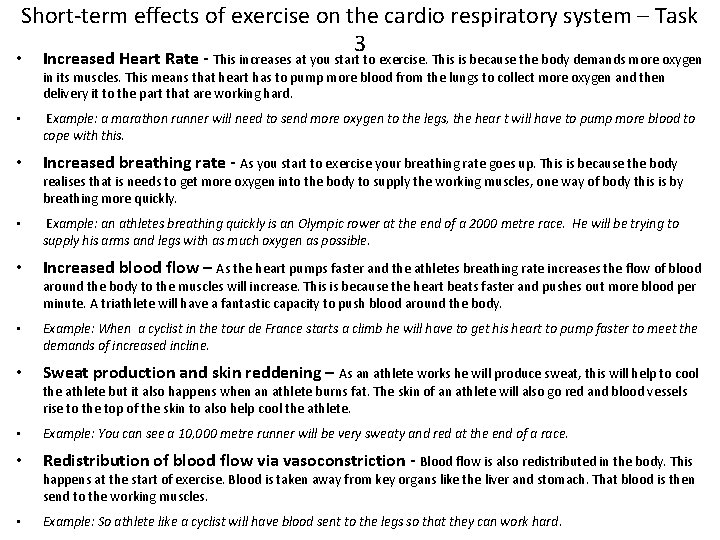
Short-term effects of exercise on the cardio respiratory system – Task 3 • Increased Heart Rate - This increases at you start to exercise. This is because the body demands more oxygen in its muscles. This means that heart has to pump more blood from the lungs to collect more oxygen and then delivery it to the part that are working hard. • Example: a marathon runner will need to send more oxygen to the legs, the hear t will have to pump more blood to cope with this. • Increased breathing rate - As you start to exercise your breathing rate goes up. This is because the body realises that is needs to get more oxygen into the body to supply the working muscles, one way of body this is by breathing more quickly. • Example: an athletes breathing quickly is an Olympic rower at the end of a 2000 metre race. He will be trying to supply his arms and legs with as much oxygen as possible. • Increased blood flow – As the heart pumps faster and the athletes breathing rate increases the flow of blood around the body to the muscles will increase. This is because the heart beats faster and pushes out more blood per minute. A triathlete will have a fantastic capacity to push blood around the body. • Example: When a cyclist in the tour de France starts a climb he will have to get his heart to pump faster to meet the demands of increased incline. • Sweat production and skin reddening – As an athlete works he will produce sweat, this will help to cool the athlete but it also happens when an athlete burns fat. The skin of an athlete will also go red and blood vessels rise to the top of the skin to also help cool the athlete. • Example: You can see a 10, 000 metre runner will be very sweaty and red at the end of a race. • Redistribution of blood flow via vasoconstriction - Blood flow is also redistributed in the body. This happens at the start of exercise. Blood is taken away from key organs like the liver and stomach. That blood is then send to the working muscles. • Example: So athlete like a cyclist will have blood sent to the legs so that they can work hard.
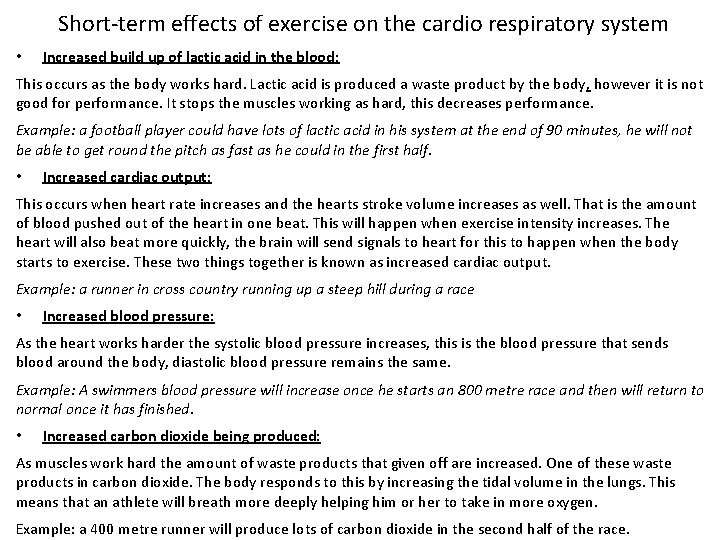
Short-term effects of exercise on the cardio respiratory system • Increased build up of lactic acid in the blood: This occurs as the body works hard. Lactic acid is produced a waste product by the body, however it is not good for performance. It stops the muscles working as hard, this decreases performance. Example: a football player could have lots of lactic acid in his system at the end of 90 minutes, he will not be able to get round the pitch as fast as he could in the first half. • Increased cardiac output: This occurs when heart rate increases and the hearts stroke volume increases as well. That is the amount of blood pushed out of the heart in one beat. This will happen when exercise intensity increases. The heart will also beat more quickly, the brain will send signals to heart for this to happen when the body starts to exercise. These two things together is known as increased cardiac output. Example: a runner in cross country running up a steep hill during a race • Increased blood pressure: As the heart works harder the systolic blood pressure increases, this is the blood pressure that sends blood around the body, diastolic blood pressure remains the same. Example: A swimmers blood pressure will increase once he starts an 800 metre race and then will return to normal once it has finished. • Increased carbon dioxide being produced: As muscles work hard the amount of waste products that given off are increased. One of these waste products in carbon dioxide. The body responds to this by increasing the tidal volume in the lungs. This means that an athlete will breath more deeply helping him or her to take in more oxygen. Example: a 400 metre runner will produce lots of carbon dioxide in the second half of the race.
Long term Adaptations of the cardio respiratory system • Decrease in Resting Heart Rate: The heart gets bigger and can push out more blood in one contraction. This means that the heart can push blood out at a slower rate. Example: Mo Farah will have a very low resting heart rate as he is highly trained and he will have a large heart. • Increase in heart size and strength: When training on a regular basis especially in a aerobic capacity an athletes heart will get bigger and cardiac muscle will also get stronger. Example: Bradley Wiggins will have had a very large heart when he won the tour de France, now that he is focusing on shorter track distances it will still be strong but a little bit smaller • Increase in stroke volume: This is when the blood is pushed out of the left side of the heart in one contraction. Stroke volume increases as the heart gets fitter and bigger. Example: an endurance athlete will have a large stroke volume as they ned to get lots of blood with oxygen in to the working muscles. • The heart rate and pump more blood per beat – resting heart rate decreases the medical term of this is known as Bradycardia. Example: Steven Davis the Saints midfielder will a decreased heart rate as he has trained it to become more efficient by playing lots of football games and at rest he will not longer have to work as hard.
Long term Adaptations of the cardio respiratory system • Decreased risk of Hypertension: Hypertension is the medical term to describe high blood pressure, this can be very serious and lead to heart attacks. If you exercise on a regular basis then the blood pressure in your heart will naturally decrease. Example: A fat or overweight person will suffer from hypertension as they have increased pressure on the heart to deliver blood around the body. • Increased Vital Capacity: Vital capacity is the amount of air the can be exhaled out of the lungs in one breath. This scan be increased by making the diaphragm stronger and therefore able to contract harder and quicker. This gets rid of air out of the lungs faster. Example: An endurance athlete will have a strong diaphragm and have a better ling function than sprinters who does not need to use their lungs as much and rely more on muscular strength. • Increased efficiency in delivering oxygen and removal of waste products: The body is able to get rid waste products in a faster manner. This is because blood is being pumped around the body faster and therefore as it delivers oxygen quicker it also gets rid of waste products like carbon dioxide and lactic acid quicker. Example: as marathon runner will be able to remove waste products throughout the race very quickly, but also they will have a very quickly recovery time after the race as well. • Increased lung efficiency and gaseous exchange - leading to increased VO 2 Max Lung efficiency is increase and more oxygen is able to be taken in by the lungs alveoli in each breath this leads to an increased VO 2 max. This a athletes maximum aerobic capacity to take in an use the oxygen in their body. Example: Many athletes such as cyclists footballers and runner will have their VO 2 max tested in pre season so that coaches know how much training they need to do with them. Endurance athletes will generally have a higher VO 2 max than athletes who rely on skill or strength like golfers of weight lifters.
- Slides: 6