
Youngs Modulus Decrease After Cold Forming in High
![Introduction to the Problem Theory Experimental Procedure Results Conclusions Prediction of Springback Source: Burchitz[2008]](https://slidetodoc.com/presentation_image/4aa238eff1bf9472491cfb597795d2bd/image-16.jpg "Introduction to the Problem Theory Experimental Procedure Results Conclusions Prediction of Springback Source: Burchitz[2008]")
![Introduction to the Problem Theory Experimental Procedure Results Conclusions No Heat Treated(HT) Samples[2] •](https://slidetodoc.com/presentation_image/4aa238eff1bf9472491cfb597795d2bd/image-32.jpg "Introduction to the Problem Theory Experimental Procedure Results Conclusions No Heat Treated(HT) Samples[2] •")
- Slides: 45
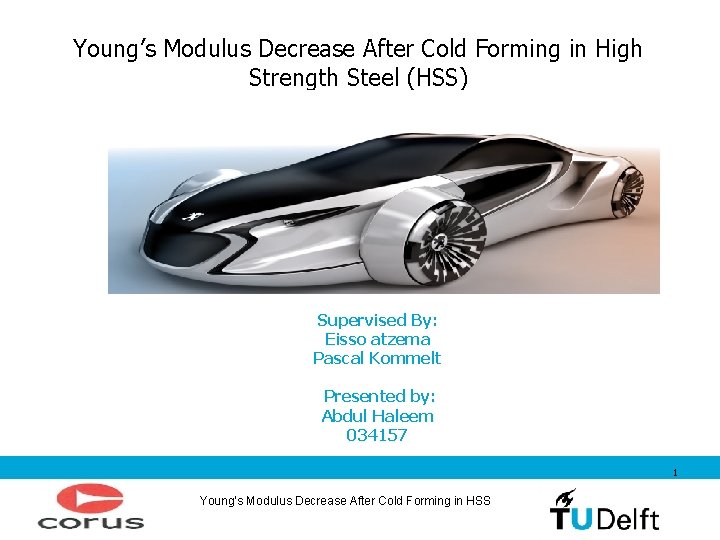
Young’s Modulus Decrease After Cold Forming in High Strength Steel (HSS) Supervised By: Eisso atzema Pascal Kommelt Presented by: Abdul Haleem 034157 1 Young’s Modulus Decrease After Cold Forming in HSS
Introduction to the Problem Theory Experimental Procedure Results Conclusions Contents 1. 2. 3. 4. 5. Introduction to the Problem Theory Experimental Procedure Results Conclusions 2 Young’s Modulus Decrease After Cold Forming in HSS
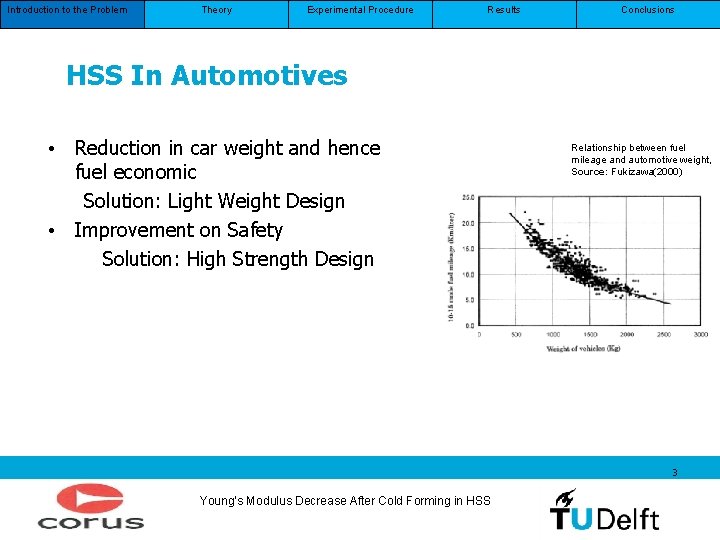
Introduction to the Problem Theory Experimental Procedure Results Conclusions HSS In Automotives • Reduction in car weight and hence fuel economic Solution: Light Weight Design • Improvement on Safety Solution: High Strength Design Relationship between fuel mileage and automotive weight, Source: Fukizawa(2000) 3 Young’s Modulus Decrease After Cold Forming in HSS
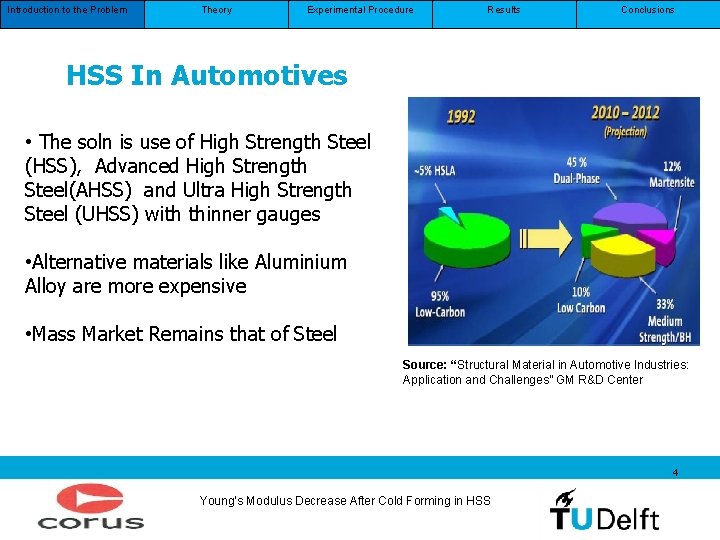
Introduction to the Problem Theory Experimental Procedure Results Conclusions HSS In Automotives • The soln is use of High Strength Steel (HSS), Advanced High Strength Steel(AHSS) and Ultra High Strength Steel (UHSS) with thinner gauges • Alternative materials like Aluminium Alloy are more expensive • Mass Market Remains that of Steel Source: “Structural Material in Automotive Industries: Application and Challenges” GM R&D Center 4 Young’s Modulus Decrease After Cold Forming in HSS
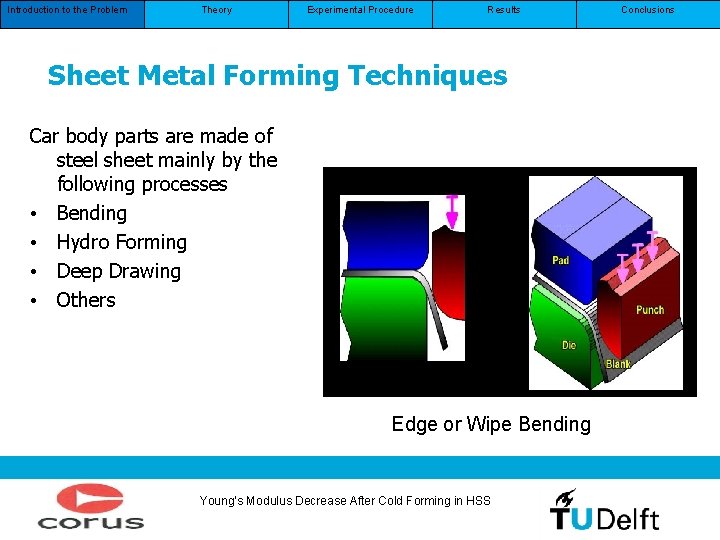
Introduction to the Problem Theory Experimental Procedure Results Sheet Metal Forming Techniques Car body parts are made of steel sheet mainly by the following processes • Bending • Hydro Forming • Deep Drawing • Others Edge or Wipe Bending Young’s Modulus Decrease After Cold Forming in HSS Conclusions
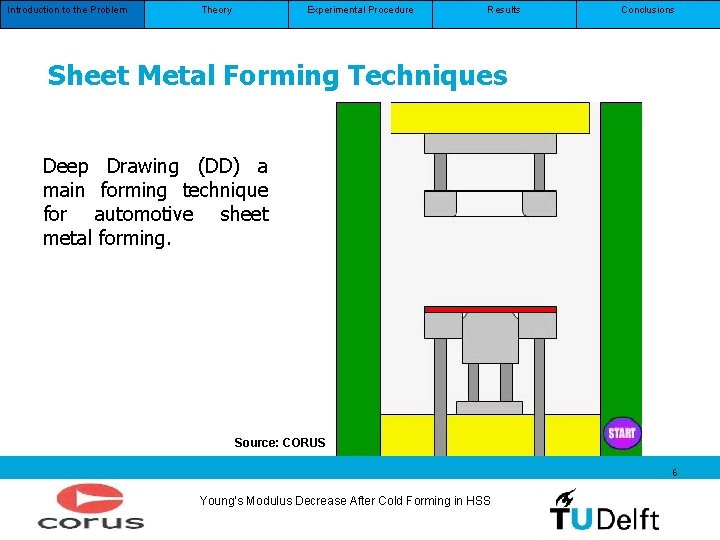
Introduction to the Problem Theory Experimental Procedure Results Conclusions Sheet Metal Forming Techniques Deep Drawing (DD) a main forming technique for automotive sheet metal forming. Source: CORUS 6 Young’s Modulus Decrease After Cold Forming in HSS
Introduction to the Problem Theory Experimental Procedure Results Conclusions Springback • • Weight Saving Achieved But at the expense of higher springback. An elastic driven change of shape during load removal Governed by the stress state obtained at the end of deformation 2 nd Feb 2009 7 Young’s Modulus Decrease After Cold Forming in HSS
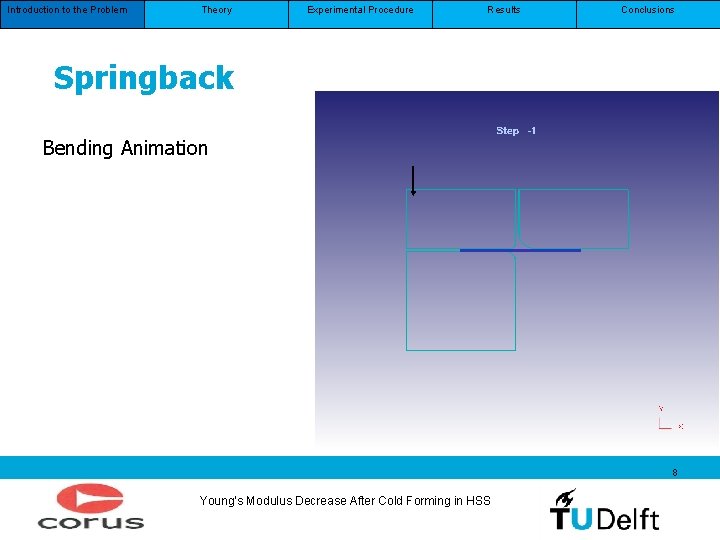
Introduction to the Problem Theory Experimental Procedure Results Conclusions Springback Bending Animation 8 Young’s Modulus Decrease After Cold Forming in HSS
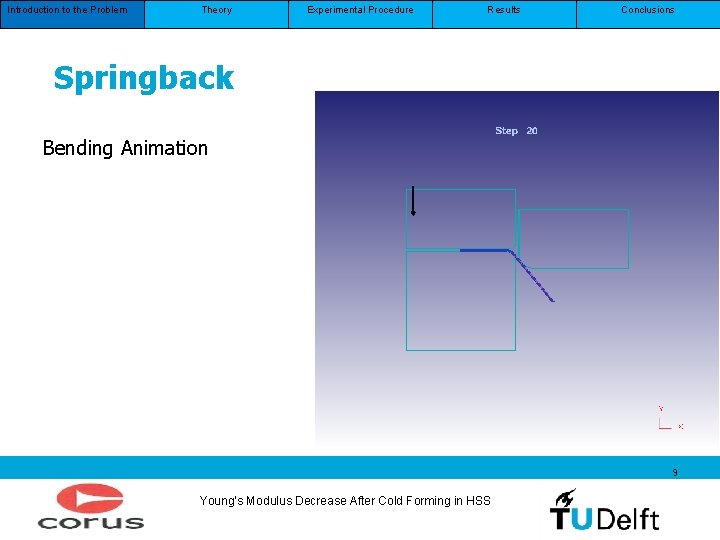
Introduction to the Problem Theory Experimental Procedure Results Conclusions Springback Bending Animation 9 Young’s Modulus Decrease After Cold Forming in HSS
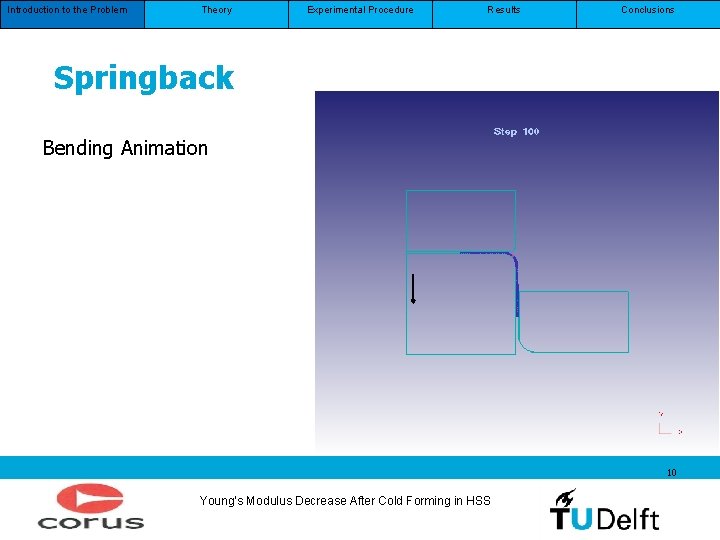
Introduction to the Problem Theory Experimental Procedure Results Conclusions Springback Bending Animation 10 Young’s Modulus Decrease After Cold Forming in HSS
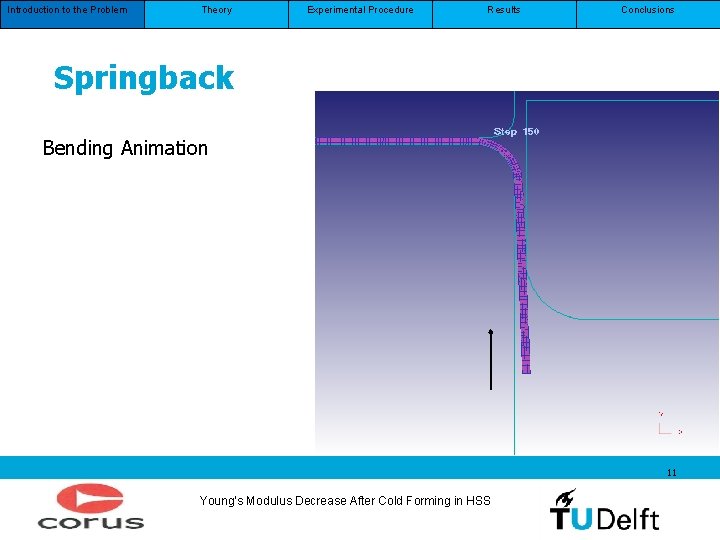
Introduction to the Problem Theory Experimental Procedure Results Conclusions Springback Bending Animation 11 Young’s Modulus Decrease After Cold Forming in HSS
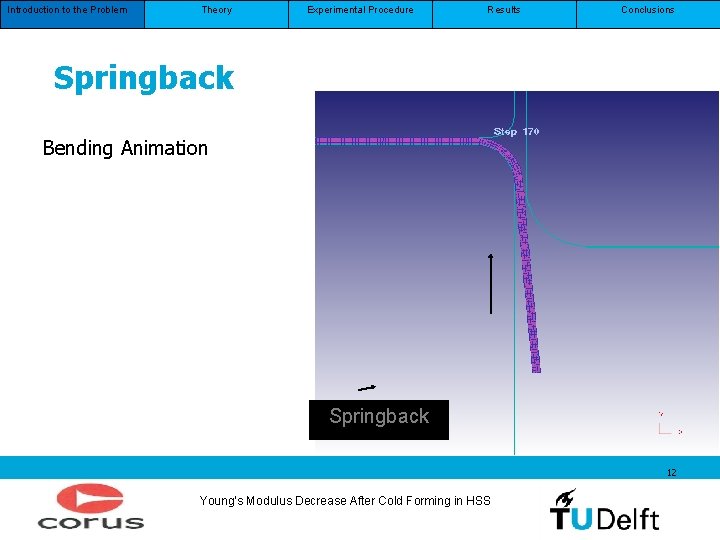
Introduction to the Problem Theory Experimental Procedure Results Conclusions Springback Bending Animation Springback 12 Young’s Modulus Decrease After Cold Forming in HSS
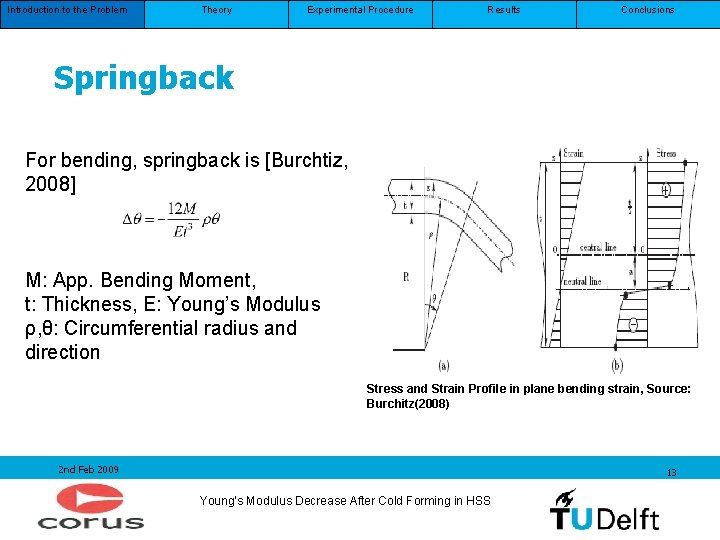
Introduction to the Problem Theory Experimental Procedure Results Conclusions Springback For bending, springback is [Burchtiz, 2008] M: App. Bending Moment, t: Thickness, E: Young’s Modulus ρ, θ: Circumferential radius and direction Stress and Strain Profile in plane bending strain, Source: Burchitz(2008) 2 nd Feb 2009 13 Young’s Modulus Decrease After Cold Forming in HSS
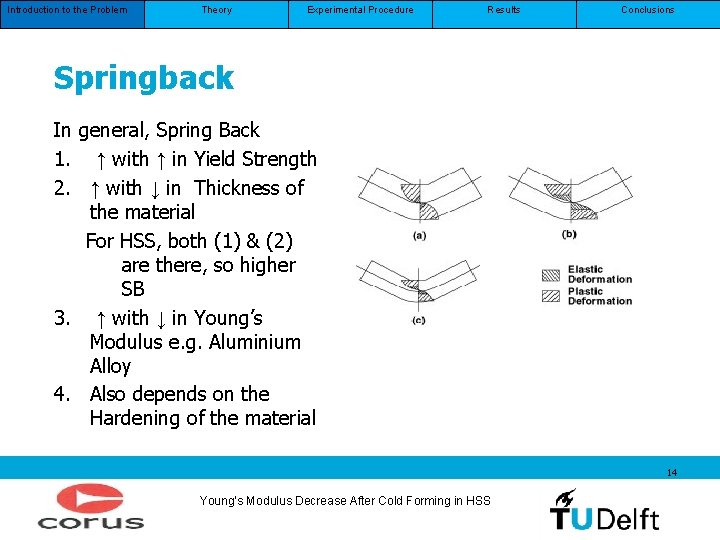
Introduction to the Problem Theory Experimental Procedure Results Conclusions Springback In general, Spring Back 1. ↑ with ↑ in Yield Strength 2. ↑ with ↓ in Thickness of the material For HSS, both (1) & (2) are there, so higher SB 3. ↑ with ↓ in Young’s Modulus e. g. Aluminium Alloy 4. Also depends on the Hardening of the material 14 Young’s Modulus Decrease After Cold Forming in HSS
Introduction to the Problem Theory Experimental Procedure Results Conclusions Prediction of Springback • Living with SB is acceptable as long as it can be predicted correctly • Prediction is possible by the use of CAE and FE • Prediction is important because we can -compensate springback in the tooling design -save labour of reworking -Reduce design to production time • Implimentation of CAE helps in producing the “first time right” product. ` • Unfortunately, the prediction with FE at the moment is not very accurate 15 Young’s Modulus Decrease After Cold Forming in HSS
Introduction to the Problem Theory Experimental Procedure Results Conclusions Prediction of Springback Source: Burchitz[2008] 16 Young’s Modulus Decrease After Cold Forming in HSS
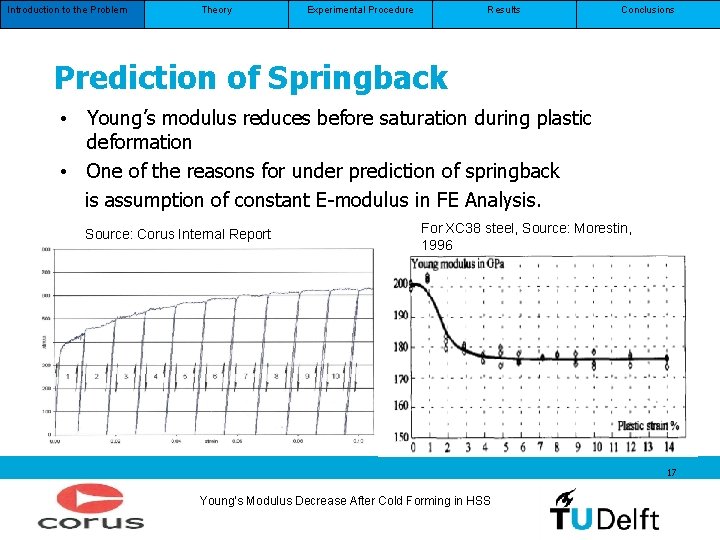
Introduction to the Problem Theory Experimental Procedure Results Conclusions Prediction of Springback • Young’s modulus reduces before saturation during plastic deformation • One of the reasons for under prediction of springback is assumption of constant E-modulus in FE Analysis. Source: Corus Internal Report For XC 38 steel, Source: Morestin, 1996 17 Young’s Modulus Decrease After Cold Forming in HSS
Introduction to the Problem Theory Experimental Procedure Results Conclusions Contents 1. 2. 3. 4. 5. Introduction to the Problem Theory Experimental Procedure Results Conclusions 18 Young’s Modulus Decrease After Cold Forming in HSS
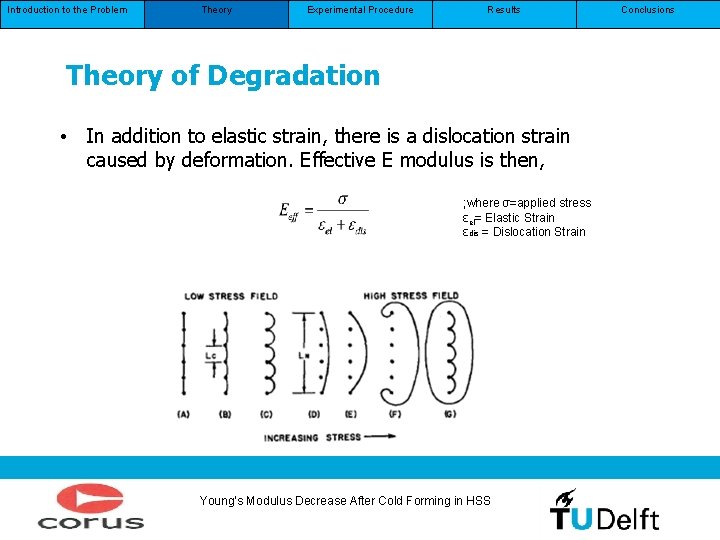
Introduction to the Problem Theory Experimental Procedure Results Theory of Degradation • In addition to elastic strain, there is a dislocation strain caused by deformation. Effective E modulus is then, ; where σ=applied stress εel= Elastic Strain εdis = Dislocation Strain Young’s Modulus Decrease After Cold Forming in HSS Conclusions
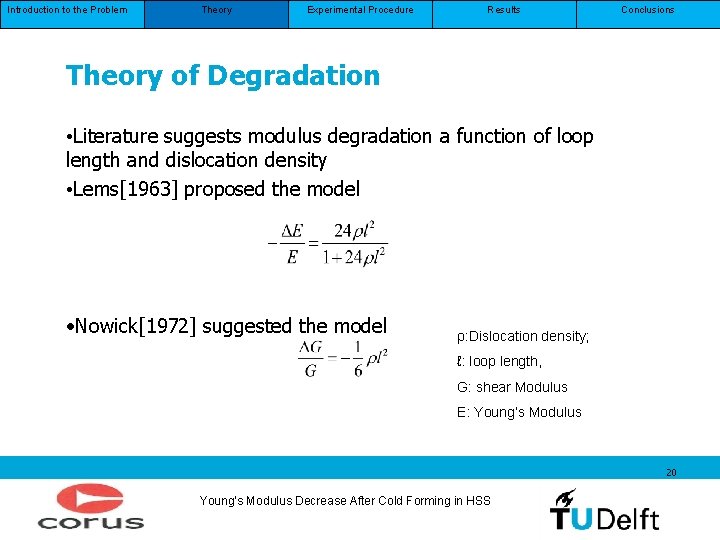
Introduction to the Problem Theory Experimental Procedure Results Conclusions Theory of Degradation • Literature suggests modulus degradation a function of loop length and dislocation density • Lems[1963] proposed the model • Nowick[1972] suggested the model ρ: Dislocation density; ℓ: loop length, G: shear Modulus E: Young’s Modulus 20 Young’s Modulus Decrease After Cold Forming in HSS
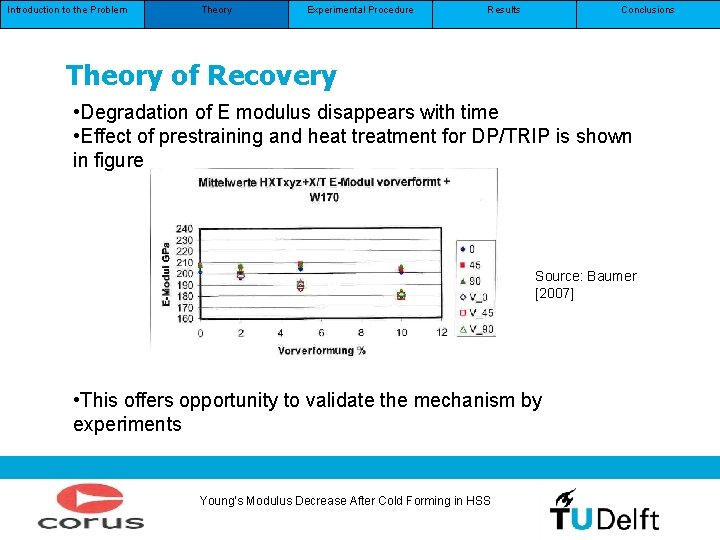
Introduction to the Problem Theory Experimental Procedure Results Conclusions Theory of Recovery • Degradation of E modulus disappears with time • Effect of prestraining and heat treatment for DP/TRIP is shown in figure Source: Baumer [2007] • This offers opportunity to validate the mechanism by experiments Young’s Modulus Decrease After Cold Forming in HSS
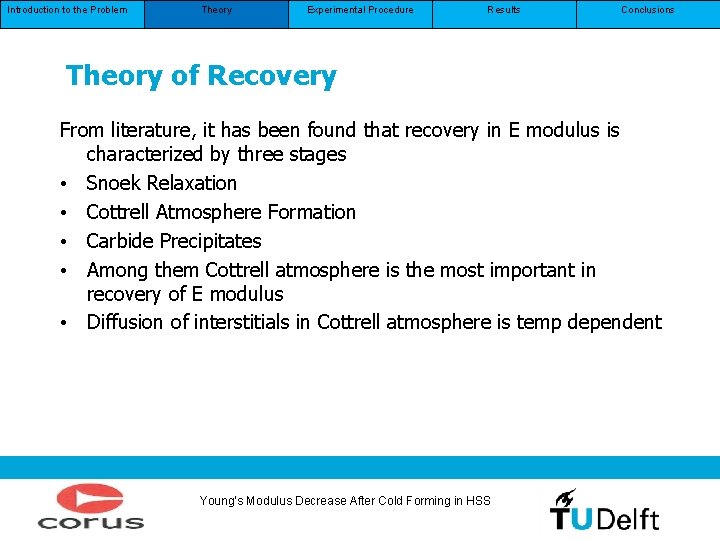
Introduction to the Problem Theory Experimental Procedure Results Conclusions Theory of Recovery From literature, it has been found that recovery in E modulus is characterized by three stages • Snoek Relaxation • Cottrell Atmosphere Formation • Carbide Precipitates • Among them Cottrell atmosphere is the most important in recovery of E modulus • Diffusion of interstitials in Cottrell atmosphere is temp dependent Young’s Modulus Decrease After Cold Forming in HSS
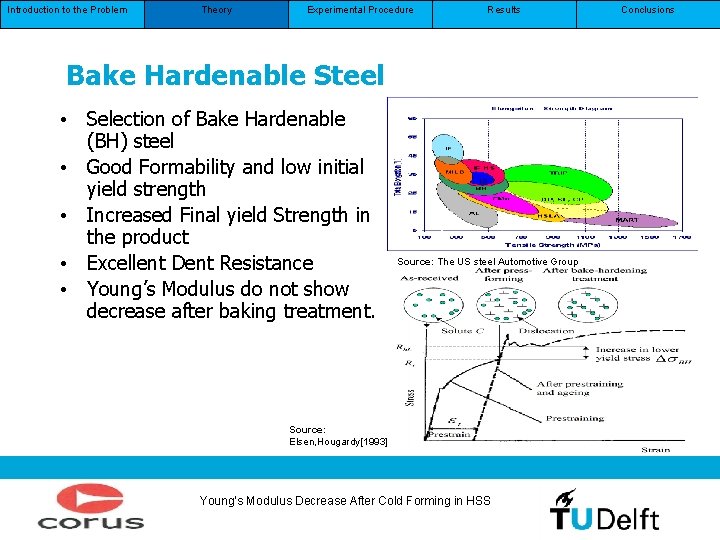
Introduction to the Problem Theory Experimental Procedure Results Bake Hardenable Steel • Selection of Bake Hardenable (BH) steel • Good Formability and low initial yield strength • Increased Final yield Strength in the product • Excellent Dent Resistance • Young’s Modulus do not show decrease after baking treatment. Source: The US steel Automotive Group Source: Elsen, Hougardy[1993] Young’s Modulus Decrease After Cold Forming in HSS Conclusions
Introduction to the Problem Theory Experimental Procedure Results Conclusions Contents 1. 2. 3. 4. 5. Introduction to the Problem Theory Experimental Procedure Results Conclusions 24 Young’s Modulus Decrease After Cold Forming in HSS
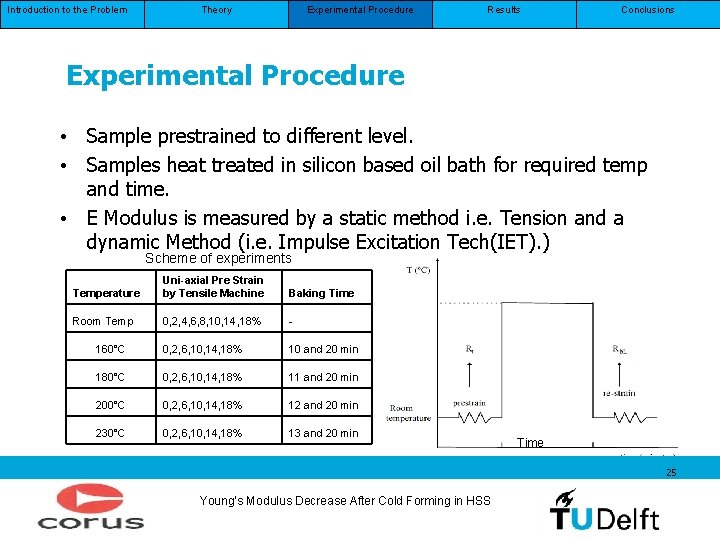
Introduction to the Problem Theory Experimental Procedure Results Conclusions Experimental Procedure • Sample prestrained to different level. • Samples heat treated in silicon based oil bath for required temp and time. • E Modulus is measured by a static method i. e. Tension and a dynamic Method (i. e. Impulse Excitation Tech(IET). ) Scheme of experiments Temperature Uni-axial Pre Strain by Tensile Machine Baking Time Room Temp 0, 2, 4, 6, 8, 10, 14, 18% - 160°C 0, 2, 6, 10, 14, 18% 10 and 20 min 180°C 0, 2, 6, 10, 14, 18% 11 and 20 min 200°C 0, 2, 6, 10, 14, 18% 12 and 20 min 230°C 0, 2, 6, 10, 14, 18% 13 and 20 min Time 25 Young’s Modulus Decrease After Cold Forming in HSS
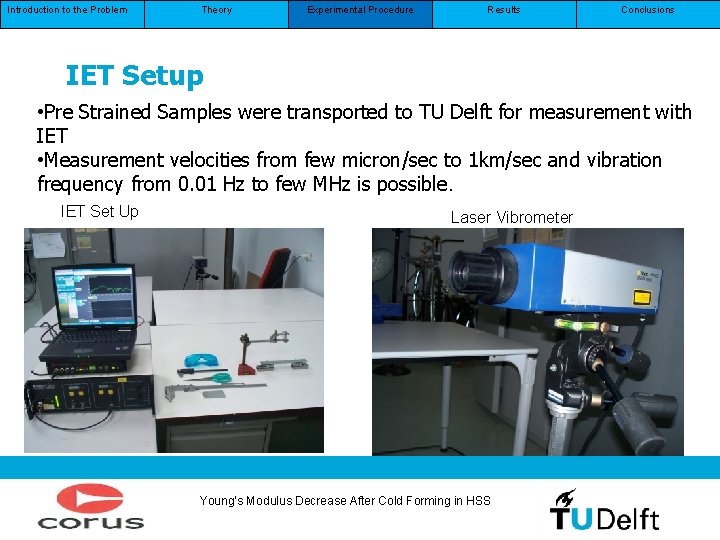
Introduction to the Problem Theory Experimental Procedure Results Conclusions IET Setup • Pre Strained Samples were transported to TU Delft for measurement with IET • Measurement velocities from few micron/sec to 1 km/sec and vibration frequency from 0. 01 Hz to few MHz is possible. IET Set Up Laser Vibrometer Young’s Modulus Decrease After Cold Forming in HSS
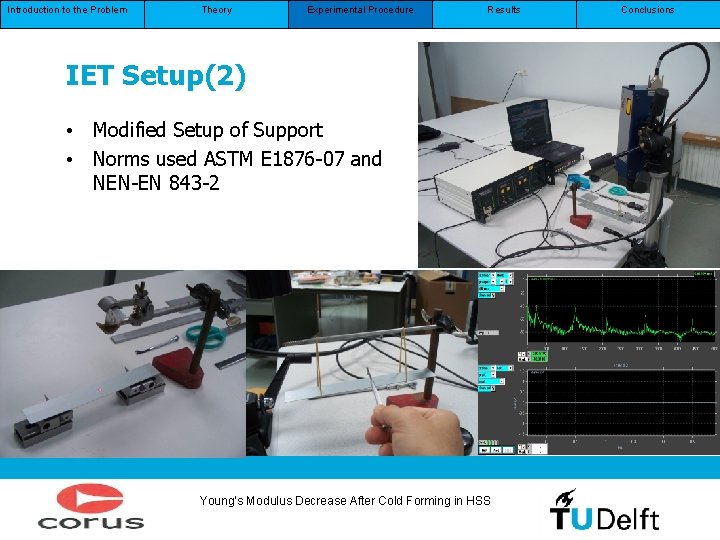
Introduction to the Problem Theory Experimental Procedure Results IET Setup(2) • Modified Setup of Support • Norms used ASTM E 1876 -07 and NEN-EN 843 -2 Young’s Modulus Decrease After Cold Forming in HSS Conclusions
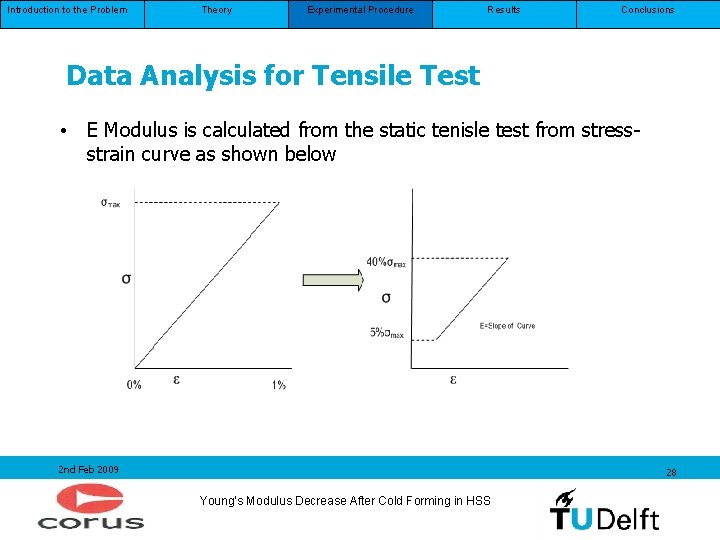
Introduction to the Problem Theory Experimental Procedure Results Conclusions Data Analysis for Tensile Test • E Modulus is calculated from the static tenisle test from stressstrain curve as shown below 2 nd Feb 2009 28 Young’s Modulus Decrease After Cold Forming in HSS
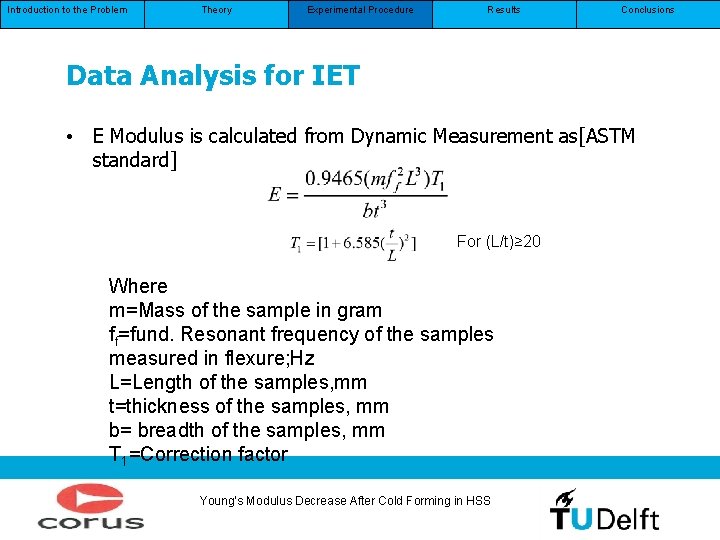
Introduction to the Problem Theory Experimental Procedure Results Conclusions Data Analysis for IET • E Modulus is calculated from Dynamic Measurement as[ASTM standard] For (L/t)≥ 20 Where m=Mass of the sample in gram ff=fund. Resonant frequency of the samples measured in flexure; Hz L=Length of the samples, mm t=thickness of the samples, mm b= breadth of the samples, mm T 1=Correction factor Young’s Modulus Decrease After Cold Forming in HSS
Introduction to the Problem Theory Experimental Procedure Results Conclusions Contents 1. 2. 3. 4. 5. Introduction to the Problem Theory Experimental Procedure Results Conclusions 30 Young’s Modulus Decrease After Cold Forming in HSS
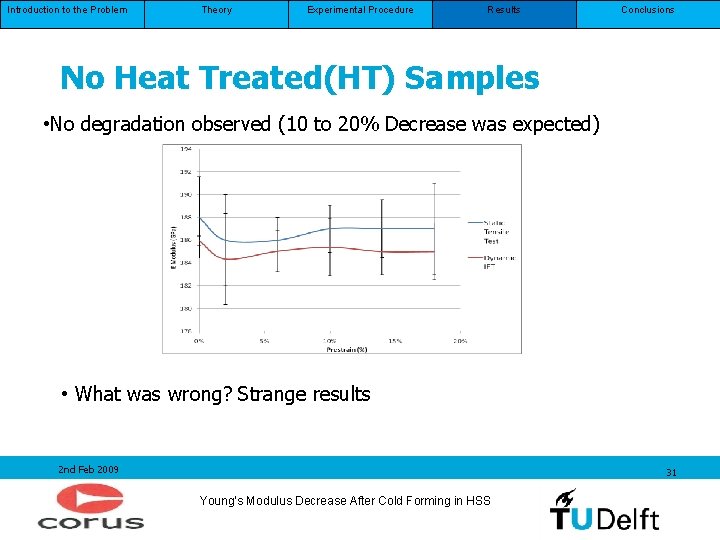
Introduction to the Problem Theory Experimental Procedure Results Conclusions No Heat Treated(HT) Samples • No degradation observed (10 to 20% Decrease was expected) • What was wrong? Strange results 2 nd Feb 2009 31 Young’s Modulus Decrease After Cold Forming in HSS
Introduction to the Problem Theory Experimental Procedure Results Conclusions No Heat Treated(HT) Samples[2] • True stress true strain data revealed existence of strain ageing phenomenon beyond 2% prestrain level. • Even with care for not ageing during transportation, strain ageing took place. • Retesting needed for Non Heat treated samples 2 nd Feb 2009 32 Young’s Modulus Decrease After Cold Forming in HSS
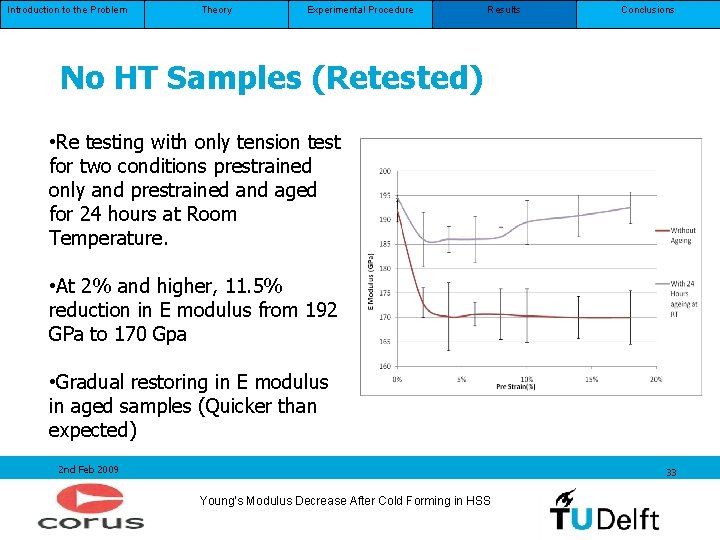
Introduction to the Problem Theory Experimental Procedure Results Conclusions No HT Samples (Retested) • Re testing with only tension test for two conditions prestrained only and prestrained and aged for 24 hours at Room Temperature. • At 2% and higher, 11. 5% reduction in E modulus from 192 GPa to 170 Gpa • Gradual restoring in E modulus in aged samples (Quicker than expected) 2 nd Feb 2009 33 Young’s Modulus Decrease After Cold Forming in HSS
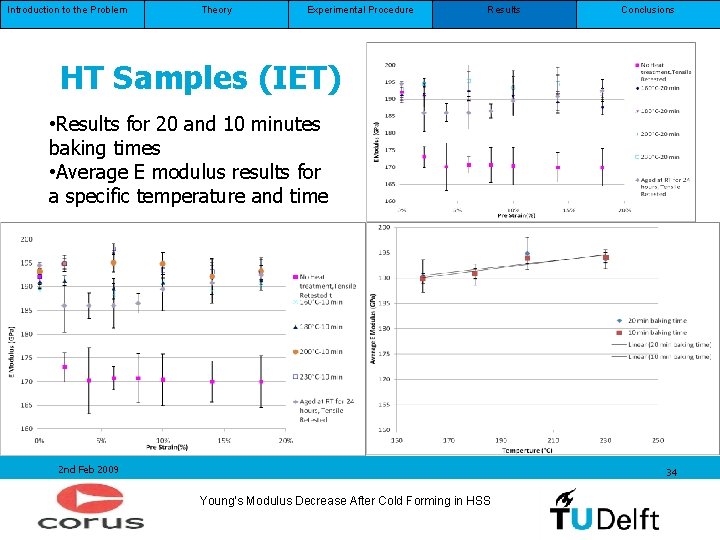
Introduction to the Problem Theory Experimental Procedure Results Conclusions HT Samples (IET) • Results for 20 and 10 minutes baking times • Average E modulus results for a specific temperature and time 2 nd Feb 2009 34 Young’s Modulus Decrease After Cold Forming in HSS
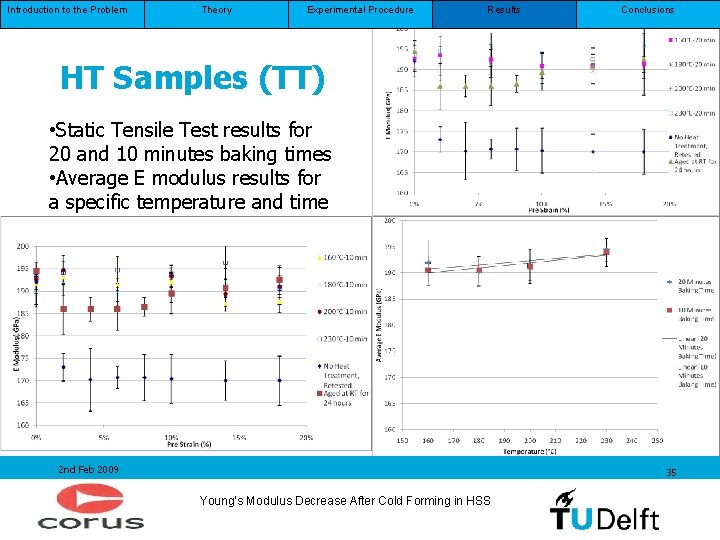
Introduction to the Problem Theory Experimental Procedure Results Conclusions HT Samples (TT) • Static Tensile Test results for 20 and 10 minutes baking times • Average E modulus results for a specific temperature and time 2 nd Feb 2009 35 Young’s Modulus Decrease After Cold Forming in HSS
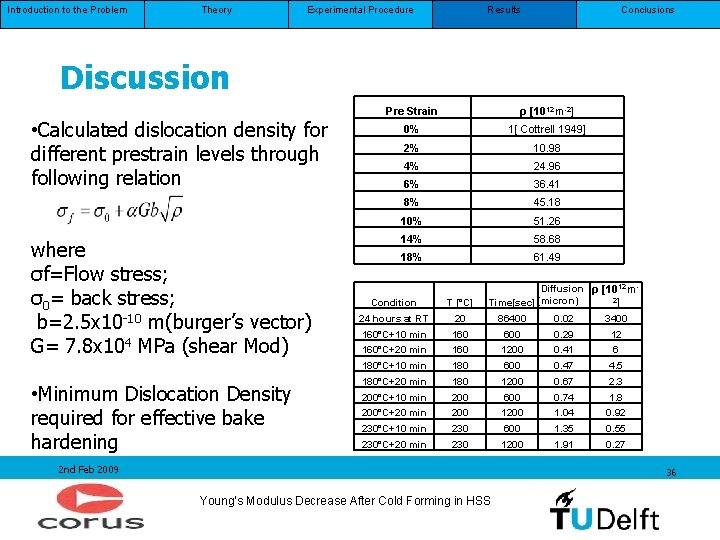
Introduction to the Problem Theory Experimental Procedure Results Conclusions Discussion • Calculated dislocation density for different prestrain levels through following relation where σf=Flow stress; σ0= back stress; b=2. 5 x 10 -10 m(burger’s vector) G= 7. 8 x 10⁴ MPa (shear Mod) • Minimum Dislocation Density required for effective bake hardening Pre Strain ρ [1012 m-2] 0% 1[ Cottrell 1949] 2% 10. 98 4% 24. 96 6% 36. 41 8% 45. 18 10% 51. 26 14% 58. 68 18% 61. 49 Diffusion ρ [1012 m 2] Time[sec] (micron) Condition T [°C] 24 hours at RT 20 86400 0. 02 3400 160°C+10 min 160 600 0. 29 12 160°C+20 min 160 1200 0. 41 6 180°C+10 min 180 600 0. 47 4. 5 180°C+20 min 180 1200 0. 67 2. 3 200°C+10 min 200 600 0. 74 1. 8 200°C+20 min 200 1. 04 0. 92 230°C+10 min 230 600 1. 35 0. 55 230°C+20 min 230 1200 1. 91 0. 27 2 nd Feb 2009 36 Young’s Modulus Decrease After Cold Forming in HSS
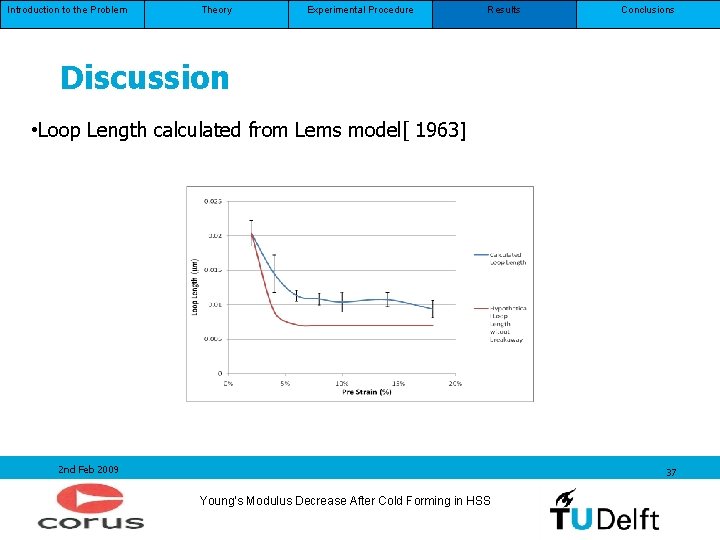
Introduction to the Problem Theory Experimental Procedure Results Conclusions Discussion • Loop Length calculated from Lems model[ 1963] 2 nd Feb 2009 37 Young’s Modulus Decrease After Cold Forming in HSS
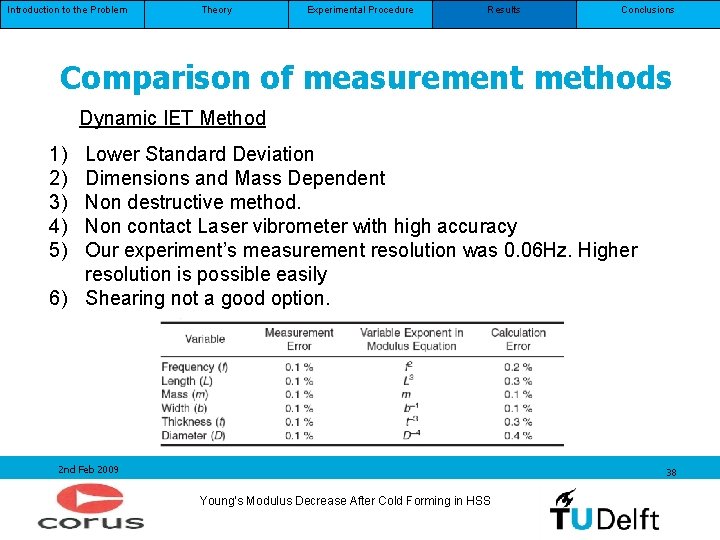
Introduction to the Problem Theory Experimental Procedure Results Conclusions Comparison of measurement methods Dynamic IET Method 1) 2) 3) 4) 5) Lower Standard Deviation Dimensions and Mass Dependent Non destructive method. Non contact Laser vibrometer with high accuracy Our experiment’s measurement resolution was 0. 06 Hz. Higher resolution is possible easily 6) Shearing not a good option. 2 nd Feb 2009 38 Young’s Modulus Decrease After Cold Forming in HSS
Introduction to the Problem Theory Experimental Procedure Results Conclusions Comparison of measurement methods Static Tensile Test Method 1) For lower standard deviation in E modulus, 3 samples are not sufficient. 2) Destructive Method 3) More information per one set of test. 4) More Accuracy emphasized. 5) Lack of standardization( Only ASTM standard, No European Standard exists) 6) Some factors responsible for inaccuracy in E modulus are conditions of clamps, extensometers, test conditions e. g. pre load, temperature, stress rate, way of finding linear regression, material condition etc. 2 nd Feb 2009 39 Young’s Modulus Decrease After Cold Forming in HSS
Introduction to the Problem Theory Experimental Procedure Results Conclusions Contents 1. 2. 3. 4. 5. Introduction to the Problem Theory Experimental Procedure Results Conclusions 40 Young’s Modulus Decrease After Cold Forming in HSS
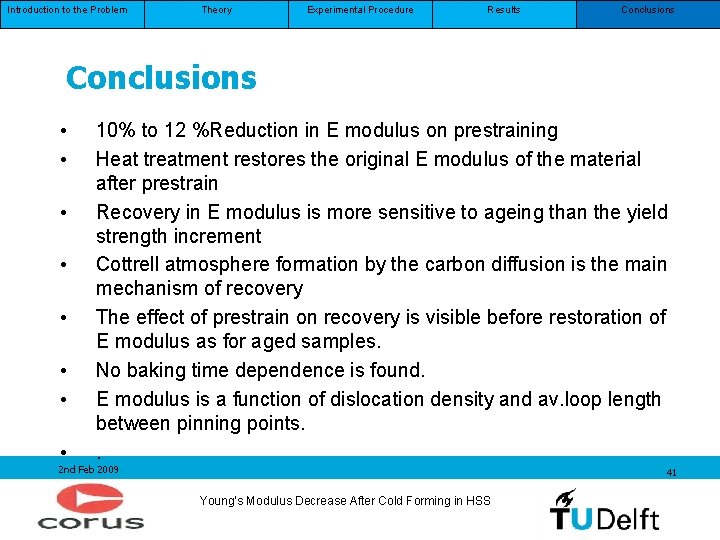
Introduction to the Problem Theory Experimental Procedure Results Conclusions • • 10% to 12 %Reduction in E modulus on prestraining Heat treatment restores the original E modulus of the material after prestrain Recovery in E modulus is more sensitive to ageing than the yield strength increment Cottrell atmosphere formation by the carbon diffusion is the main mechanism of recovery The effect of prestrain on recovery is visible before restoration of E modulus as for aged samples. No baking time dependence is found. E modulus is a function of dislocation density and av. loop length between pinning points. . 2 nd Feb 2009 41 Young’s Modulus Decrease After Cold Forming in HSS
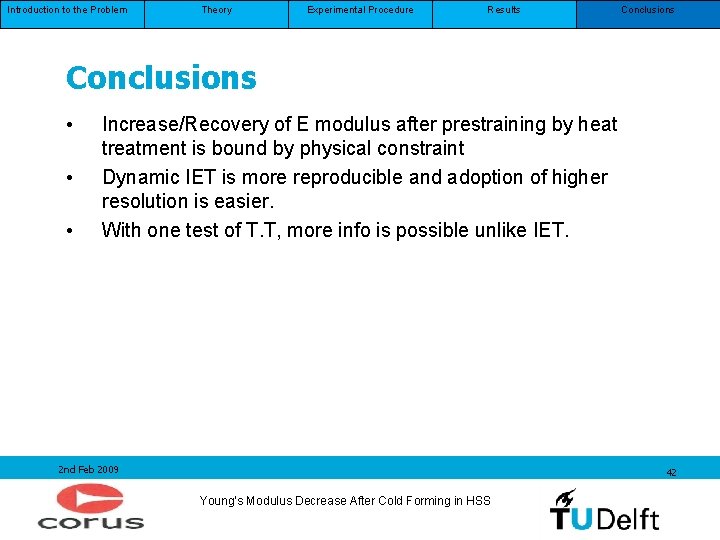
Introduction to the Problem Theory Experimental Procedure Results Conclusions • • • Increase/Recovery of E modulus after prestraining by heat treatment is bound by physical constraint Dynamic IET is more reproducible and adoption of higher resolution is easier. With one test of T. T, more info is possible unlike IET. 2 nd Feb 2009 42 Young’s Modulus Decrease After Cold Forming in HSS
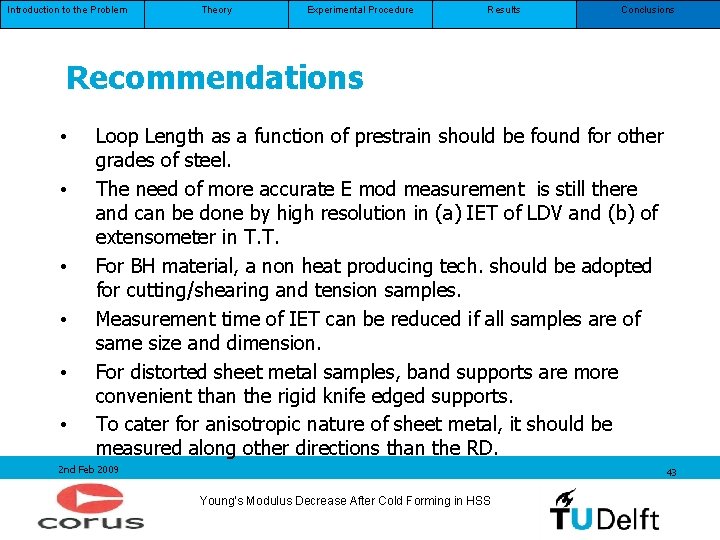
Introduction to the Problem Theory Experimental Procedure Results Conclusions Recommendations • • • Loop Length as a function of prestrain should be found for other grades of steel. The need of more accurate E mod measurement is still there and can be done by high resolution in (a) IET of LDV and (b) of extensometer in T. T. For BH material, a non heat producing tech. should be adopted for cutting/shearing and tension samples. Measurement time of IET can be reduced if all samples are of same size and dimension. For distorted sheet metal samples, band supports are more convenient than the rigid knife edged supports. To cater for anisotropic nature of sheet metal, it should be measured along other directions than the RD. 2 nd Feb 2009 43 Young’s Modulus Decrease After Cold Forming in HSS
Introduction to the Problem Theory Experimental Procedure Results Conclusions Ultimate Goals of the Research • Better Springback Prediction • • First Time Accurate Production of stamping dies and tooling Labour of Reworking reduced Design to Production Time Reduced All of above, results in reduction of production costs 44 Young’s Modulus Decrease After Cold Forming in HSS
Introduction to the Problem Theory Experimental Procedure Results Conclusions Thank You for Your Attention Questions/Comments? 45 Young’s Modulus Decrease After Cold Forming in HSS