
Youngs Interference Experiment In 1801 Thomas Young demonstrated
- Slides: 14
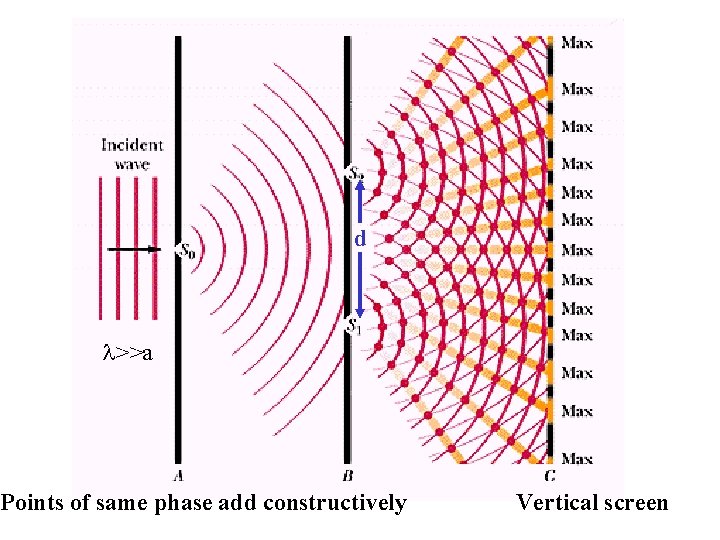
Young’s Interference Experiment • In 1801, Thomas Young demonstrated the wave nature of light by showing that it produced interference effects • he measured the average of sunlight to be 570 nm • a single slit causes diffraction of sunlight to illuminate two slits S 1 and S 2 • each of these sends out circular waves which overlap and interfere
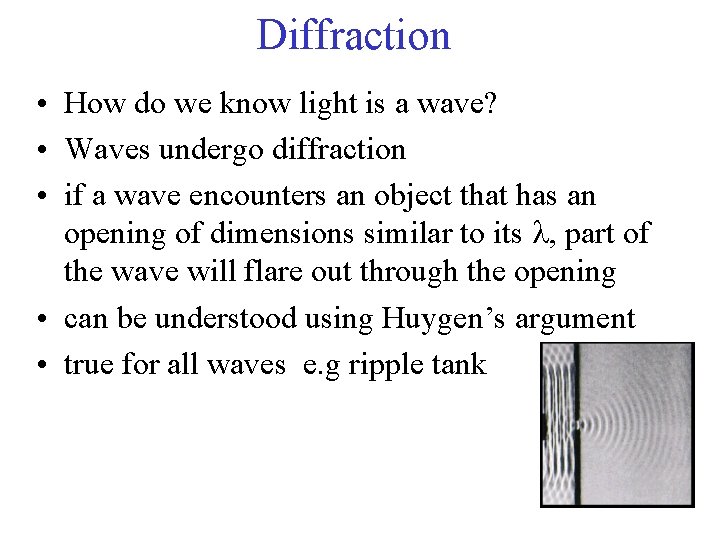
Diffraction • How do we know light is a wave? • Waves undergo diffraction • if a wave encounters an object that has an opening of dimensions similar to its , part of the wave will flare out through the opening • can be understood using Huygen’s argument • true for all waves e. g ripple tank
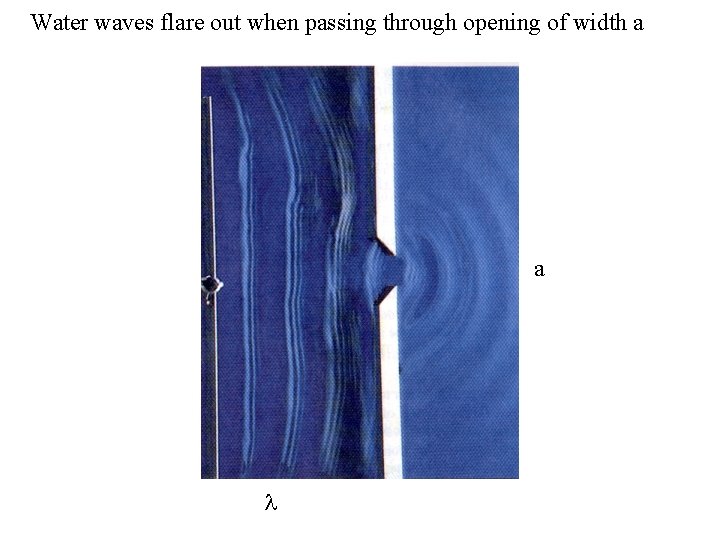
Water waves flare out when passing through opening of width a a
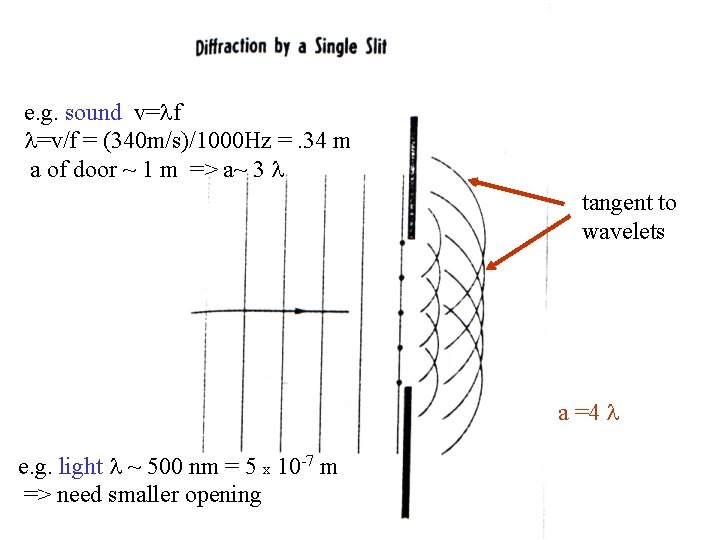
e. g. sound v= f =v/f = (340 m/s)/1000 Hz =. 34 m a of door ~ 1 m => a~ 3 tangent to wavelets a =4 e. g. light ~ 500 nm = 5 x 10 -7 m => need smaller opening
d >>a Points of same phase add constructively Vertical screen
Coherence • For interference to occur, the phase difference between the two waves arriving at any point P must not depend on time. • The waves passing through slits 1 and 2 are parts of the same wave and are said to be coherent • light from different parts of the sun is not coherent • the first slit in Young’s expt produces a coherent source of waves for the slits S 1 and S 2
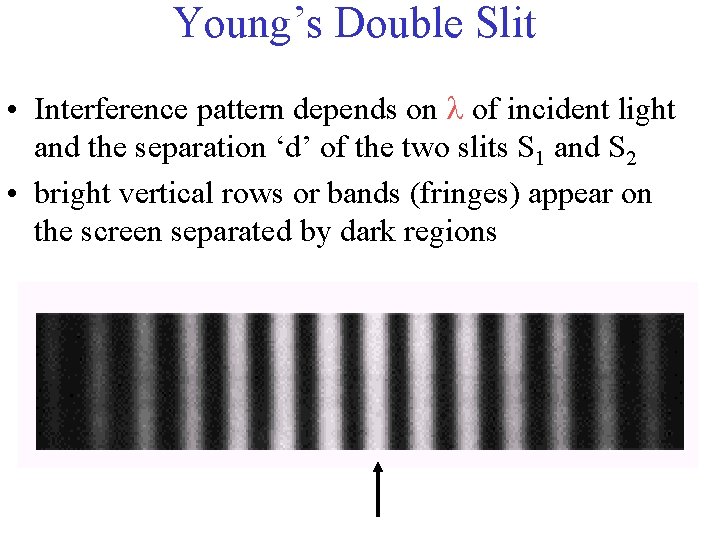
Young’s Double Slit • Interference pattern depends on of incident light and the separation ‘d’ of the two slits S 1 and S 2 • bright vertical rows or bands (fringes) appear on the screen separated by dark regions
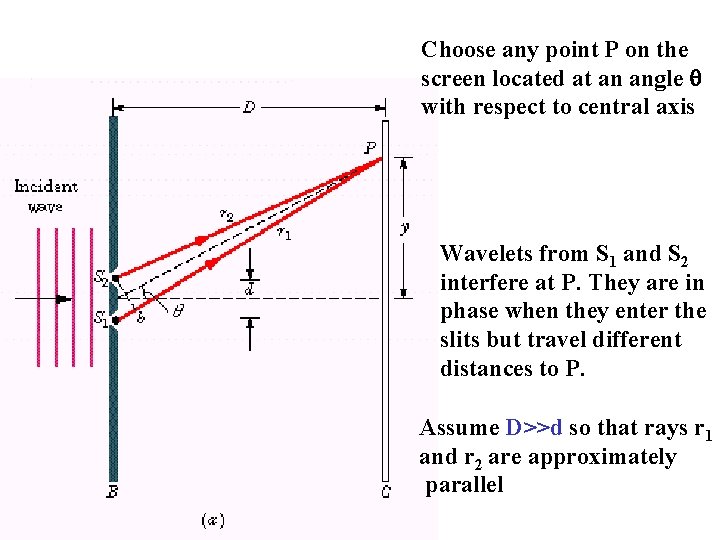
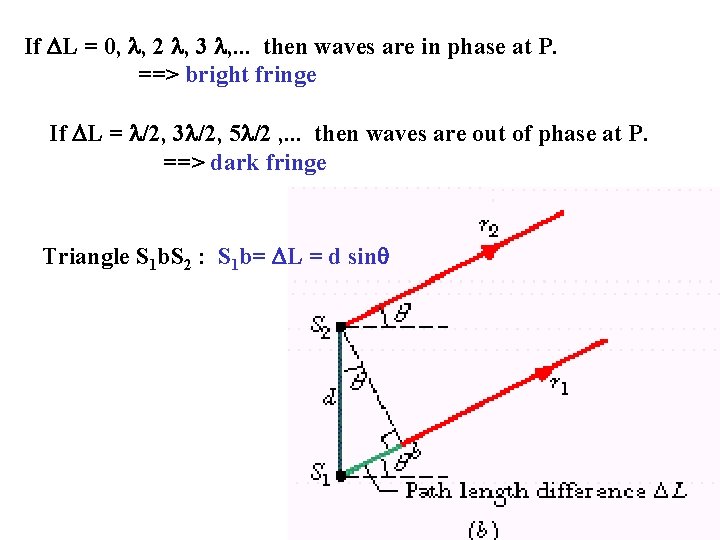
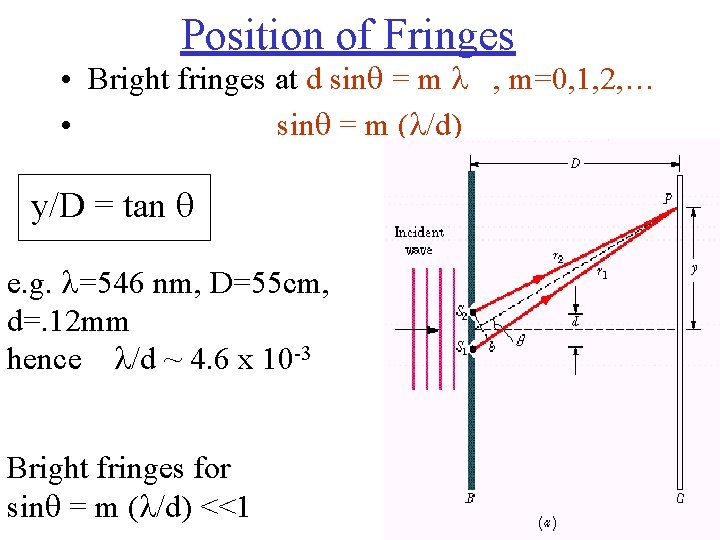
Choose any point P on the screen located at an angle with respect to central axis Wavelets from S 1 and S 2 interfere at P. They are in phase when they enter the slits but travel different distances to P. Assume D>>d so that rays r 1 and r 2 are approximately parallel
If L = 0, , 2 , 3 , . . . then waves are in phase at P. ==> bright fringe If L = /2, 3 /2, 5 /2 , . . . then waves are out of phase at P. ==> dark fringe Triangle S 1 b. S 2 : S 1 b= L = d sin
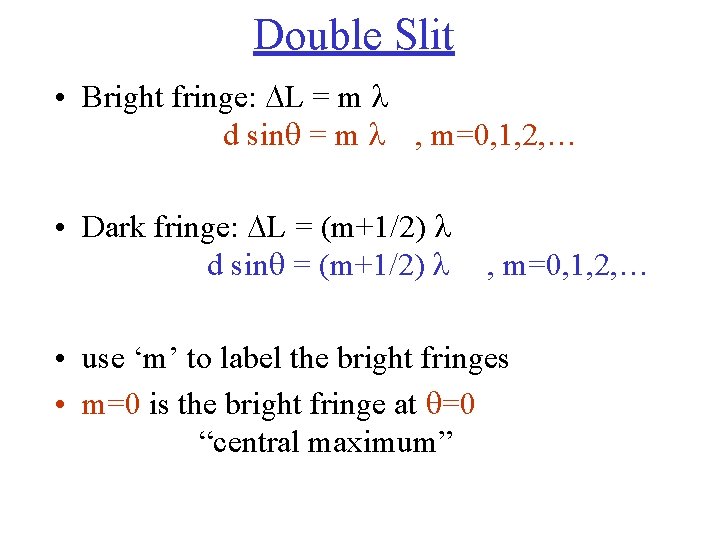
Double Slit • Bright fringe: L = m d sin = m , m=0, 1, 2, … • Dark fringe: L = (m+1/2) d sin = (m+1/2) , m=0, 1, 2, … • use ‘m’ to label the bright fringes • m=0 is the bright fringe at =0 “central maximum”
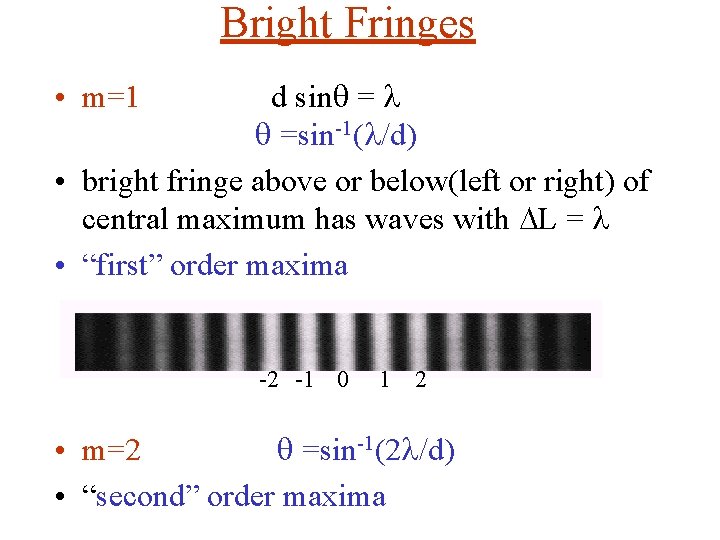
Bright Fringes d sin = =sin-1( /d) • bright fringe above or below(left or right) of central maximum has waves with L = • “first” order maxima • m=1 -2 -1 0 1 2 • m=2 =sin-1(2 /d) • “second” order maxima
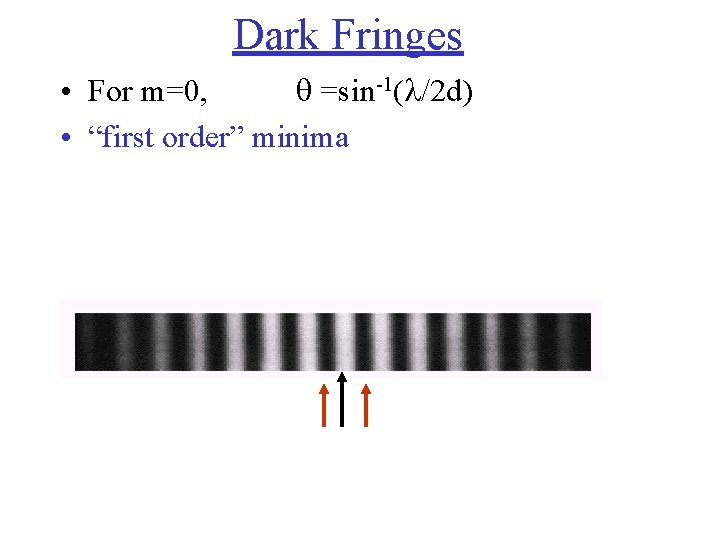
Dark Fringes • For m=0, =sin-1( /2 d) • “first order” minima
Position of Fringes • Bright fringes at d sin = m , m=0, 1, 2, … • sin = m ( /d) y/D = tan e. g. =546 nm, D=55 cm, d=. 12 mm hence /d ~ 4. 6 x 10 -3 Bright fringes for sin = m ( /d) <<1
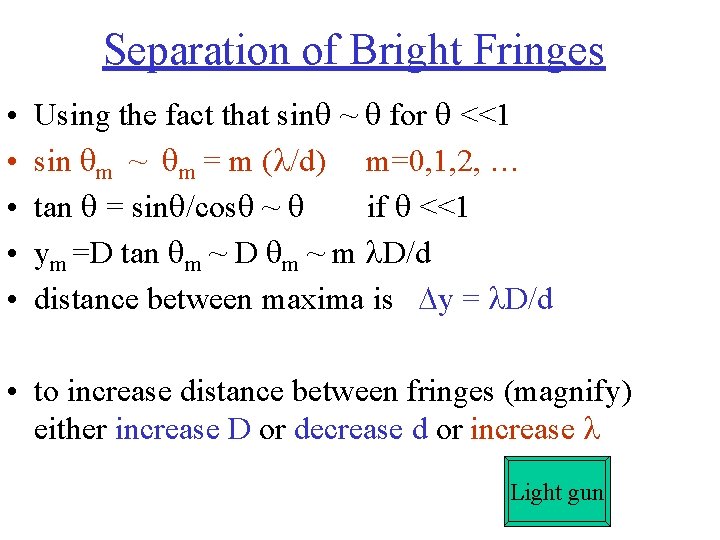
Separation of Bright Fringes • • • Using the fact that sin ~ for <<1 sin m ~ m = m ( /d) m=0, 1, 2, … tan = sin /cos ~ if <<1 ym =D tan m ~ D m ~ m D/d distance between maxima is y = D/d • to increase distance between fringes (magnify) either increase D or decrease d or increase Light gun