
Young European Research Universities WG on Joint Programmes
- Slides: 29
Young European Research Universities WG on Joint Programmes YERUN General Assembly University of Ulm 26 th of October 2017 Amaya Mendikoetxea Universidad Autónoma de Madrid
Outline 1. The background 2. YERUN Guidelines for Good Practice for Developing and Running Joint Programmes 3. Questionnaire on Joint Programmes 4. What’s next?
PART 1 The background
YERUN Aims: Strategic Action 3 • To promote education collaboration through teaching collaborations, innovation, enhancement activities, academic exchange between staff, and students and the development of dual, multiple or joint international degrees within the framework of the EU’s academic partnerships and mobility programmes ØSA 3 group: Øcreated in Lisbon, February 2016 ØReported to GA on mobility within YERUN, Joint Programmes and Erasmus+ KA 2 -KA 3 projects Konstanz, October 2016. ØWG on Joint Programmes: created in Konstanz, October 2016
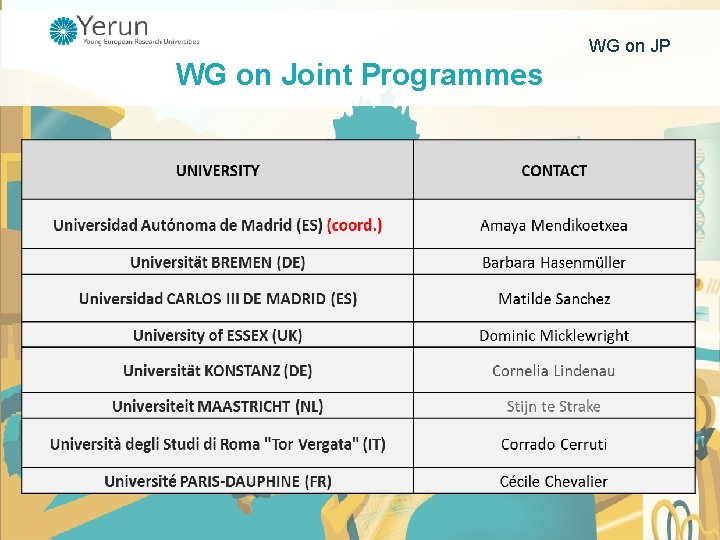
WG on JP WG on Joint Programmes
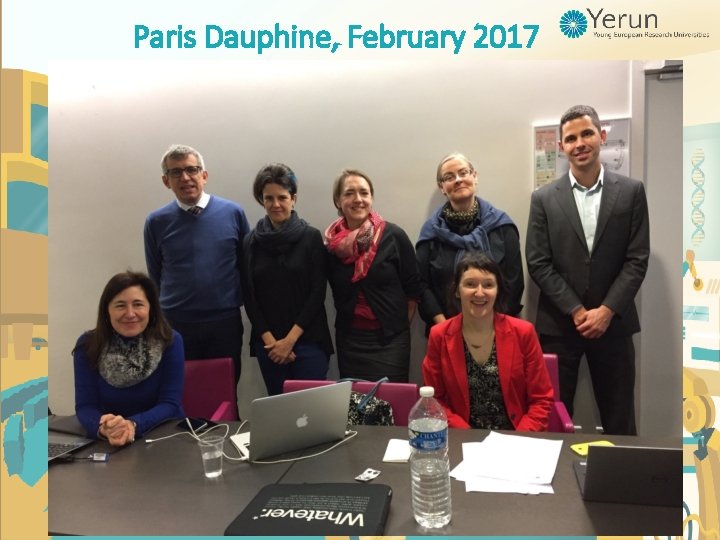
Paris Dauphine, February 2017
WG on JP Aims of the WG on JP Ø To contribute to the YERUN network, for the benefit of all member universities, in order to enhance the quality of the education, increase student mobility, make YERUN (more) visible and create stronger partnerships, by • Raising awareness of the opportunities that lie in joint programmes • Promoting and encouraging the setting up of such programmes • Defining guidelines for double degrees and other joint programmes • Elaborating a set of tools to develop, monitor and ensure quality standards of such programmes
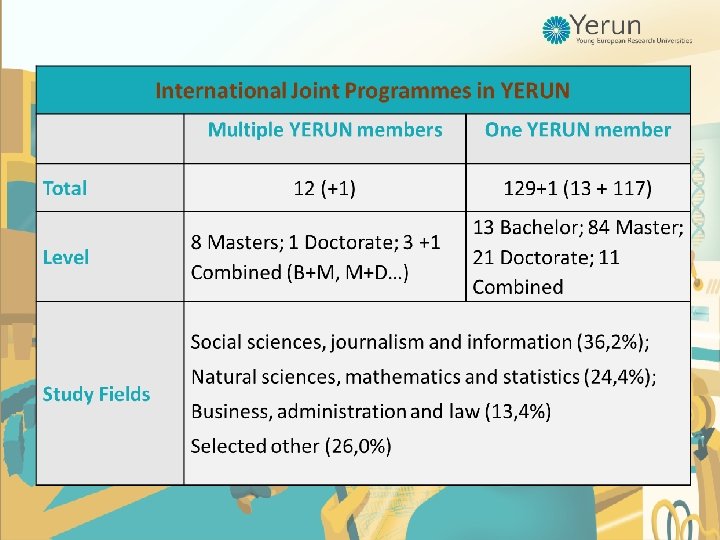
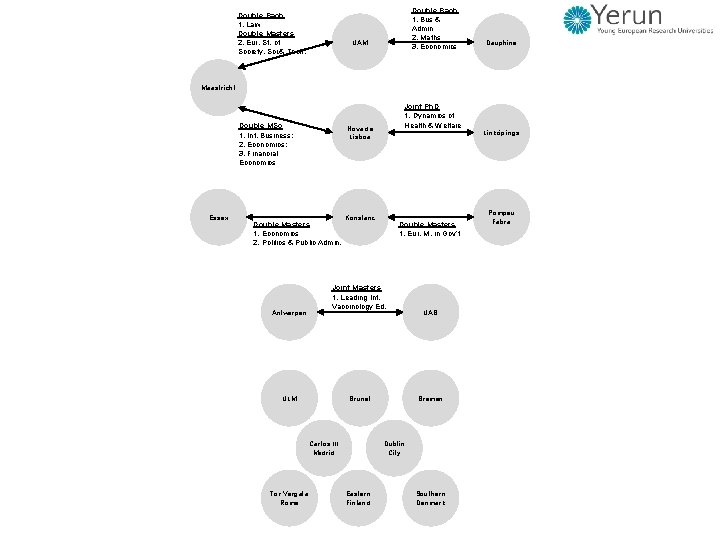
Double Bach 1. Law Double Masters 2. Eur. St. of Society, Sci. & Tech. Double Bach 1. Bus & Admin 2. Maths 3. Economics UAM Dauphine Maastricht Double MSc 1. Int. Business; 2. Economics; 3. Financial Economics Essex Nova de Lisboa Double Masters 1. Economics 2. Politics & Public Admin. Antwerpen Konstanz Double Masters 1. Eur. M. in Gov’t Joint Masters 1. Leading Int. Vaccinology Ed. ULM Brunel Carlos III Madrid Tor Vergata Rome Joint Ph. D 1. Dynamics of Health & Welfare UAB Bremen Dublin City Eastern Finland Southern Denmark Linköpings Pompeu Fabra
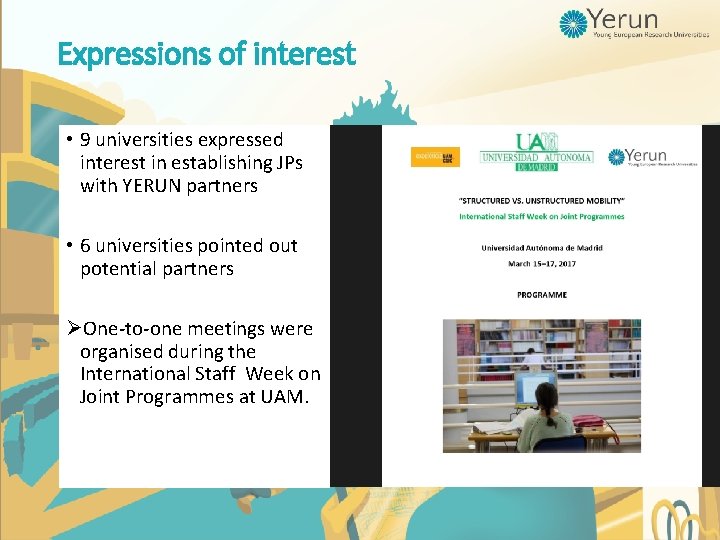
Expressions of interest • 9 universities expressed interest in establishing JPs with YERUN partners • 6 universities pointed out potential partners ØOne-to-one meetings were organised during the International Staff Week on Joint Programmes at UAM.
JOINT PROGRAMMES and the EHEA • Joint programmes an essential instrument for the consolidation of the EHEA. • Joint programmes are the result of two or more institutions joining forces to contribute their academic resources and traditions with the objective of improving the quality of the teaching and research in the particular subject area covered • Joint programmes at the core of YERUN strategic action plan A joint programme should be a programme of a higher academic standard than each of the participating institutions would achieve separately
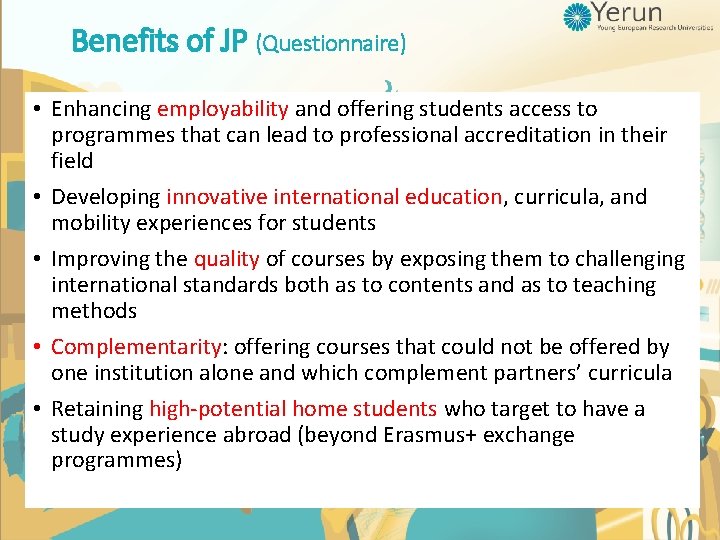
Benefits of JP (Questionnaire) • Enhancing employability and offering students access to programmes that can lead to professional accreditation in their field • Developing innovative international education, curricula, and mobility experiences for students • Improving the quality of courses by exposing them to challenging international standards both as to contents and as to teaching methods • Complementarity: offering courses that could not be offered by one institution alone and which complement partners’ curricula • Retaining high-potential home students who target to have a study experience abroad (beyond Erasmus+ exchange programmes)
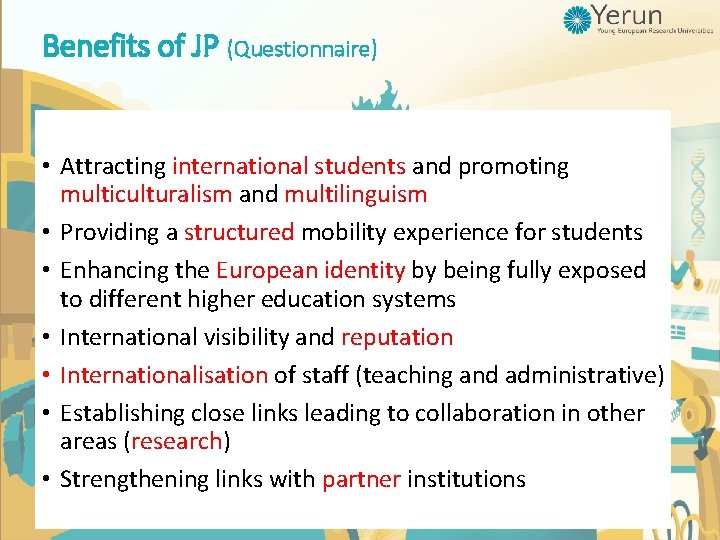
Benefits of JP (Questionnaire) • Attracting international students and promoting multiculturalism and multilinguism • Providing a structured mobility experience for students • Enhancing the European identity by being fully exposed to different higher education systems • International visibility and reputation • Internationalisation of staff (teaching and administrative) • Establishing close links leading to collaboration in other areas (research) • Strengthening links with partner institutions
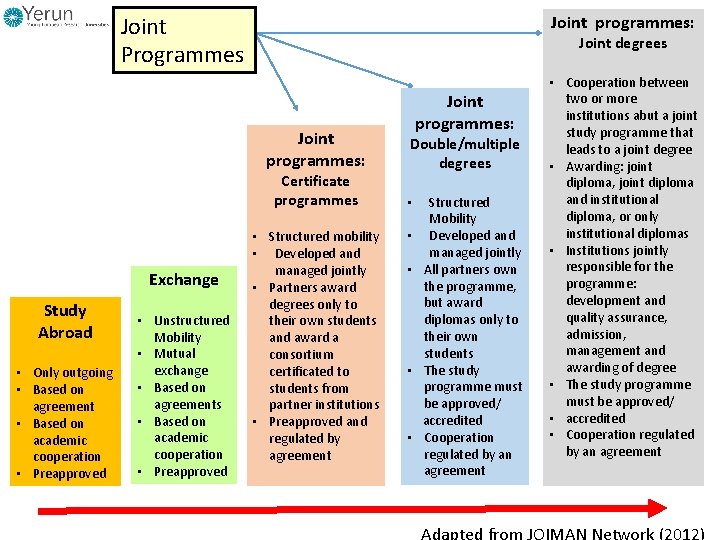
Joint Programmes Joint programmes: Joint degrees Joint programmes: Certificate programmes Exchange Study Abroad • Only outgoing • Based on agreement • Based on academic cooperation • Preapproved • Unstructured Mobility • Mutual exchange • Based on agreements • Based on academic cooperation • Preapproved • Structured mobility • Developed and managed jointly • Partners award degrees only to their own students and award a consortium certificated to students from partner institutions • Preapproved and regulated by agreement Joint programmes: Double/multiple degrees Structured Mobility • Developed and managed jointly • All partners own the programme, but award diplomas only to their own students • The study programme must be approved/ accredited • Cooperation regulated by an agreement • • Cooperation between two or more institutions abut a joint study programme that leads to a joint degree • Awarding: joint diploma, joint diploma and institutional diploma, or only institutional diplomas • Institutions jointly responsible for the programme: development and quality assurance, admission, management and awarding of degree • The study programme must be approved/ • accredited • Cooperation regulated by an agreement Adapted from JOIMAN Network (2012)
PART 2 YERUN Guidelines for Good Practice for Developing and Running Joint Programmes
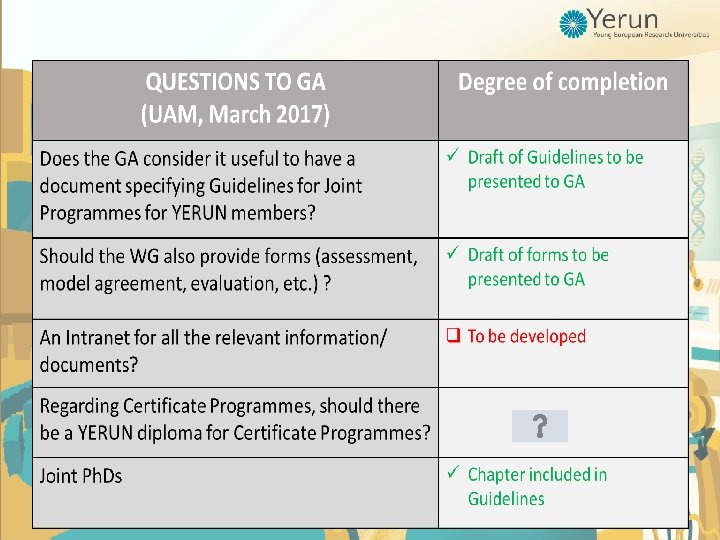
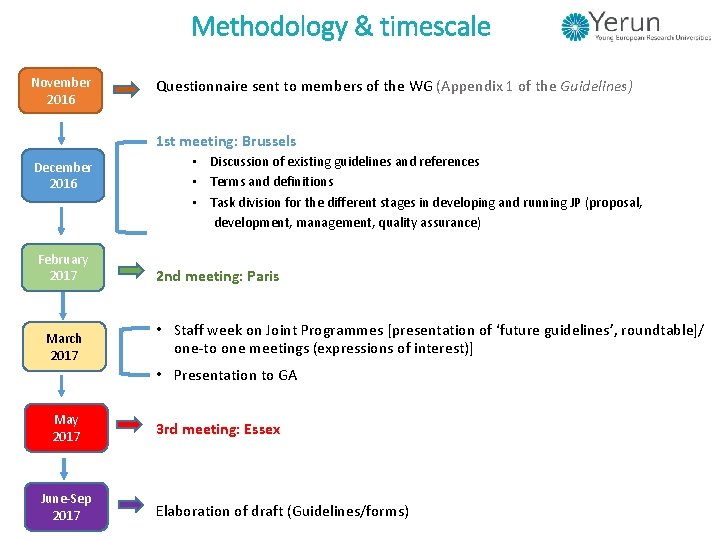
Methodology & timescale November 2016 Questionnaire sent to members of the WG (Appendix 1 of the Guidelines) 1 st meeting: Brussels December 2016 February 2017 March 2017 • Discussion of existing guidelines and references • Terms and definitions • Task division for the different stages in developing and running JP (proposal, development, management, quality assurance) 2 nd meeting: Paris • Staff week on Joint Programmes [presentation of ‘future guidelines’, roundtable]/ one-to one meetings (expressions of interest)] • Presentation to GA May 2017 June-Sep 2017 3 rd meeting: Essex Elaboration of draft (Guidelines/forms)
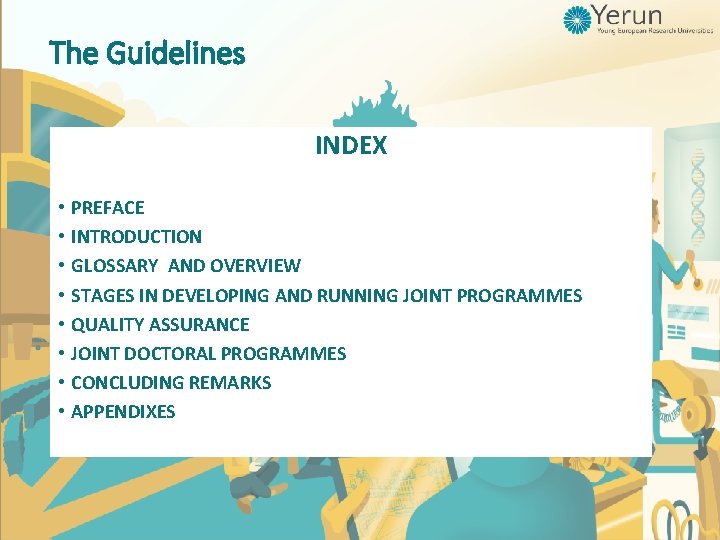
The Guidelines INDEX • • PREFACE INTRODUCTION GLOSSARY AND OVERVIEW STAGES IN DEVELOPING AND RUNNING JOINT PROGRAMMES QUALITY ASSURANCE JOINT DOCTORAL PROGRAMMES CONCLUDING REMARKS APPENDIXES
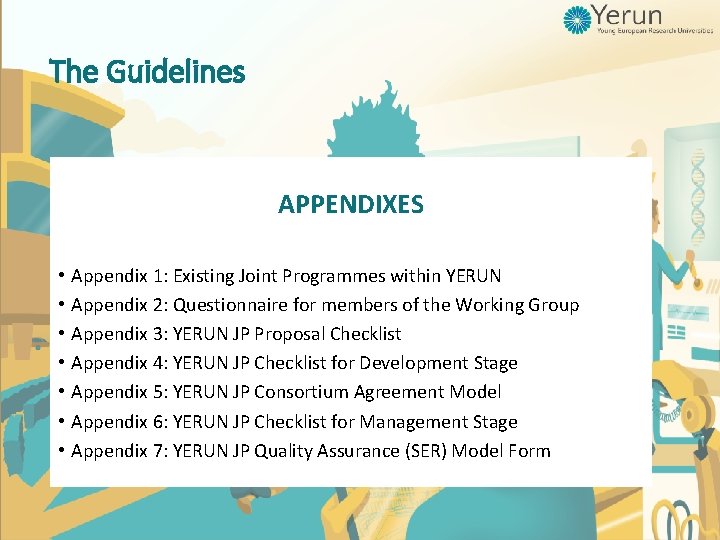
The Guidelines APPENDIXES • • Appendix 1: Existing Joint Programmes within YERUN Appendix 2: Questionnaire for members of the Working Group Appendix 3: YERUN JP Proposal Checklist Appendix 4: YERUN JP Checklist for Development Stage Appendix 5: YERUN JP Consortium Agreement Model Appendix 6: YERUN JP Checklist for Management Stage Appendix 7: YERUN JP Quality Assurance (SER) Model Form
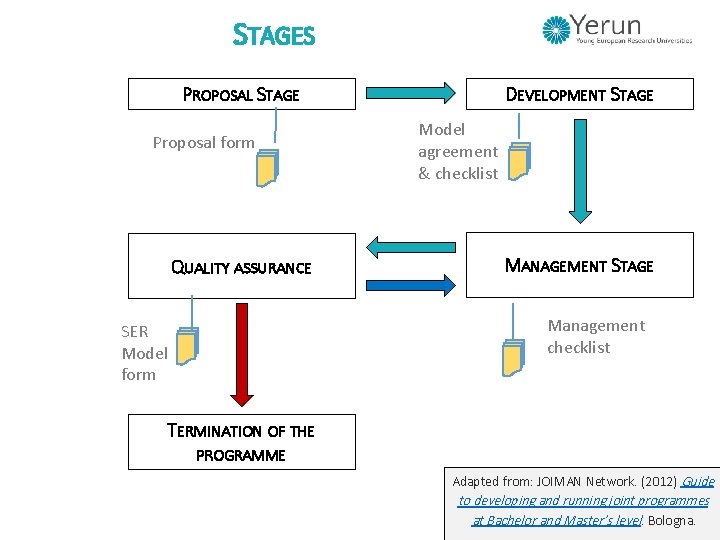
STAGES DEVELOPMENT STAGE PROPOSAL STAGE Proposal form QUALITY ASSURANCE Model agreement & checklist MANAGEMENT STAGE Management checklist SER Model form TERMINATION OF THE PROGRAMME Adapted from: JOIMAN Network. (2012) Guide to developing and running joint programmes at Bachelor and Master’s level. Bologna.
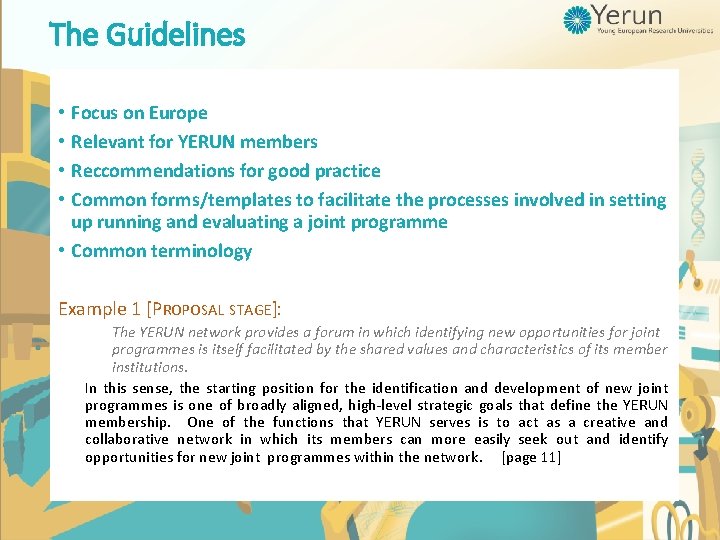
The Guidelines Focus on Europe Relevant for YERUN members Reccommendations for good practice Common forms/templates to facilitate the processes involved in setting up running and evaluating a joint programme • Common terminology • • Example 1 [PROPOSAL STAGE]: The YERUN network provides a forum in which identifying new opportunities for joint programmes is itself facilitated by the shared values and characteristics of its member institutions. In this sense, the starting position for the identification and development of new joint programmes is one of broadly aligned, high-level strategic goals that define the YERUN membership. One of the functions that YERUN serves is to act as a creative and collaborative network in which its members can more easily seek out and identify opportunities for new joint programmes within the network. [page 11]
The Guidelines Example 2 [MANAGEMENT STAGE]: A checklist for management is provided in Appendix 6. The following are good practices to be established at the beginning of the process: • The programme should have a dedicated webpage with all the relevant information for (current or prospective) students, academics, administrators and external evaluators. • There should be a management timetable, establishing all the processes and actions to be taken each academic year throughout the entire running of the programme. [page 16] Example 3 [QUALITY ASSURANCE]: Consortium agreement: The terms and conditions of a joint programme should be clearly laid out in the consortium agreement to ensure the necessary support and commitment from all partners. The consortium agreement should be signed by the competent authorities of each partner institution. The YERUN model for consortium agreement is designed to fulfil this requirement. [page 19 -20]
PART 3 Questionnaire on Joint Programmes
The Questionnaire - Questions v. Is your university currently working on a proposal for a double or joint degree programme with a YERUN partner university? (Please erase as appropriate) a) Yes b) Not yet, but possibilities are being considered and some conversations have started with potential partners c) No v. Additional comments for the WG on JP
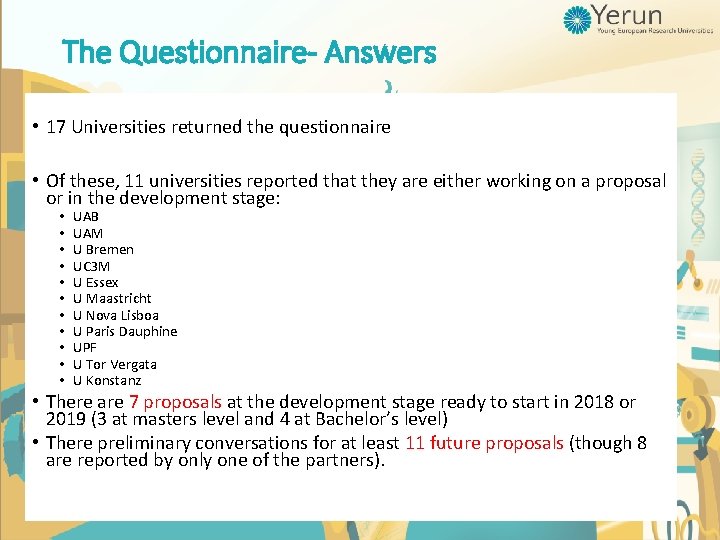
The Questionnaire- Answers • 17 Universities returned the questionnaire • Of these, 11 universities reported that they are either working on a proposal or in the development stage: • • • UAB UAM U Bremen UC 3 M U Essex U Maastricht U Nova Lisboa U Paris Dauphine UPF U Tor Vergata U Konstanz • There are 7 proposals at the development stage ready to start in 2018 or 2019 (3 at masters level and 4 at Bachelor’s level) • There preliminary conversations for at least 11 future proposals (though 8 are reported by only one of the partners).
Proposals at the Development Stage
PART 4 What’s next?
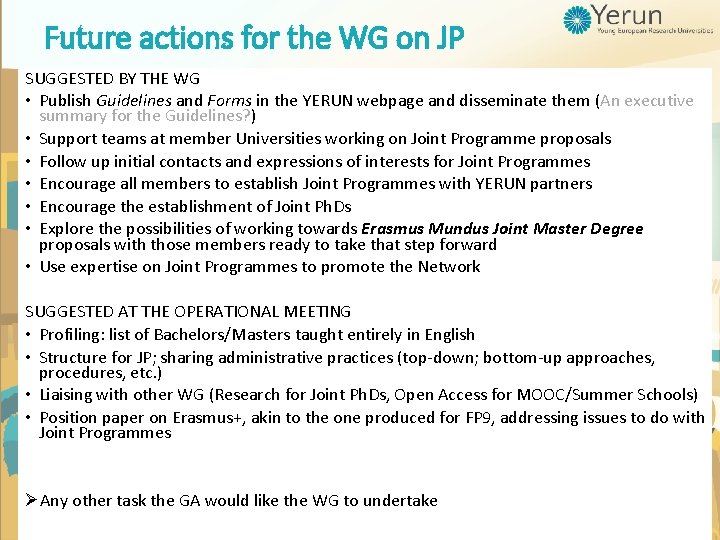
Future actions for the WG on JP SUGGESTED BY THE WG • Publish Guidelines and Forms in the YERUN webpage and disseminate them (An executive summary for the Guidelines? ) • Support teams at member Universities working on Joint Programme proposals • Follow up initial contacts and expressions of interests for Joint Programmes • Encourage all members to establish Joint Programmes with YERUN partners • Encourage the establishment of Joint Ph. Ds • Explore the possibilities of working towards Erasmus Mundus Joint Master Degree proposals with those members ready to take that step forward • Use expertise on Joint Programmes to promote the Network SUGGESTED AT THE OPERATIONAL MEETING • Profiling: list of Bachelors/Masters taught entirely in English • Structure for JP; sharing administrative practices (top-down; bottom-up approaches, procedures, etc. ) • Liaising with other WG (Research for Joint Ph. Ds, Open Access for MOOC/Summer Schools) • Position paper on Erasmus+, akin to the one produced for FP 9, addressing issues to do with Joint Programmes ØAny other task the GA would like the WG to undertake
THANK YOU On behalf of YERUN WG on JOINT PROGRAMMES