
Young Children with Movement and Positioning Needs CHARACTERISTICS
- Slides: 30
Young Children with Movement and Positioning Needs CHARACTERISTICS HANDLING TECHNIQUES ADAPTIVE POSITIONING EQUIPMENT SAFE TRANSFER TECHNIQUES JESSICA WARD, PT APRIL 5, 2016 VCU - ECSE
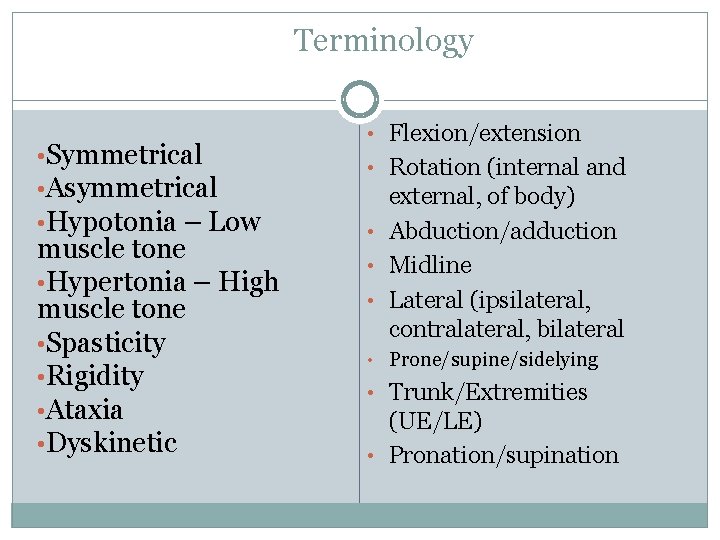
Terminology • Symmetrical • Asymmetrical • Hypotonia – Low muscle tone • Hypertonia – High muscle tone • Spasticity • Rigidity • Ataxia • Dyskinetic • Flexion/extension • Rotation (internal and external, of body) • Abduction/adduction • Midline • Lateral (ipsilateral, contralateral, bilateral • Prone/supine/sidelying • Trunk/Extremities (UE/LE) • Pronation/supination
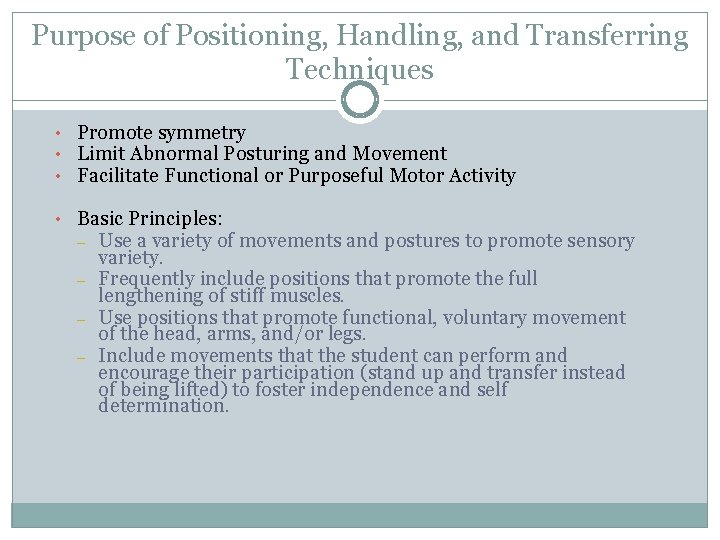
Purpose of Positioning, Handling, and Transferring Techniques • Promote symmetry • Limit Abnormal Posturing and Movement • Facilitate Functional or Purposeful Motor Activity • Basic Principles: – – Use a variety of movements and postures to promote sensory variety. Frequently include positions that promote the full lengthening of stiff muscles. Use positions that promote functional, voluntary movement of the head, arms, and/or legs. Include movements that the student can perform and encourage their participation (stand up and transfer instead of being lifted) to foster independence and self determination.
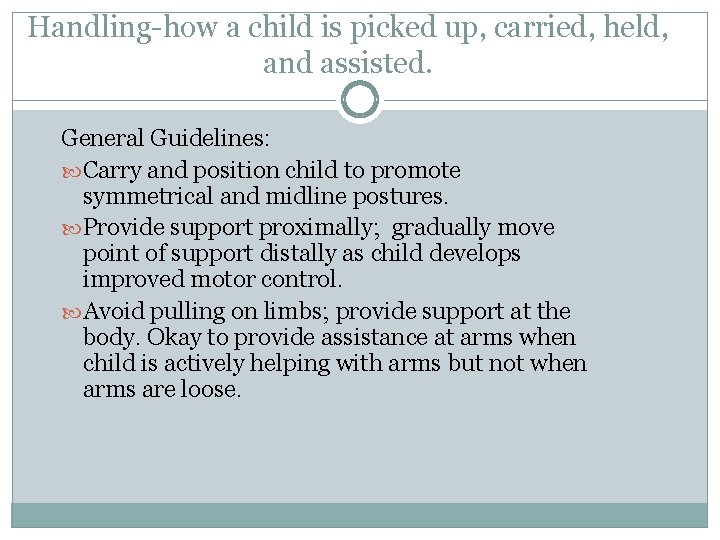
Handling-how a child is picked up, carried, held, and assisted. General Guidelines: Carry and position child to promote symmetrical and midline postures. Provide support proximally; gradually move point of support distally as child develops improved motor control. Avoid pulling on limbs; provide support at the body. Okay to provide assistance at arms when child is actively helping with arms but not when arms are loose.
Positioning Who benefits from a positioning program? Children born prematurely. Children with mild or no obvious physical disability when performing fine motor tasks. Children with poor head and/or trunk control because of weakness or hypotonia stiff muscles or hypertonia atypical movement patterns bony deformity. Children who lack protective reactions or are unstable in certain positions.
Effect of seating on fine motor skills of typically developing 6 and 7 year olds Smith-Zuzovsky, N. , & Exner, C. E. (2004). The effect of seated positioning quality on typical 6 - and 7 -year-old children’s object manipulation skills. American Journal of Occupational Therapy, 58, 380– 388. “The study’s results suggest that the fit of furniture relative to the child’s size may have a significant impact on a young, typical child’s object manipulation skills. Complex hand skills, such as those involving in-hand manipulation with stabilization, appear to be more affected by the quality of the child’s seated position than are simpler, more well-established skills. Findings suggest that test administrators should strive to test young children in the most optimal seated position possible, particularly when the test involves complex hand skills. ”
Positioning for Children with Special Physical Needs LOW MUSCLE TONE (HYPOTONIA) HIGH MUSCLE TONE (HYPERTONIA) LOW POSTURAL TONE AND HIGH EXTREMITY TONE BODY STRUCTURE/BONY DEFORMITY
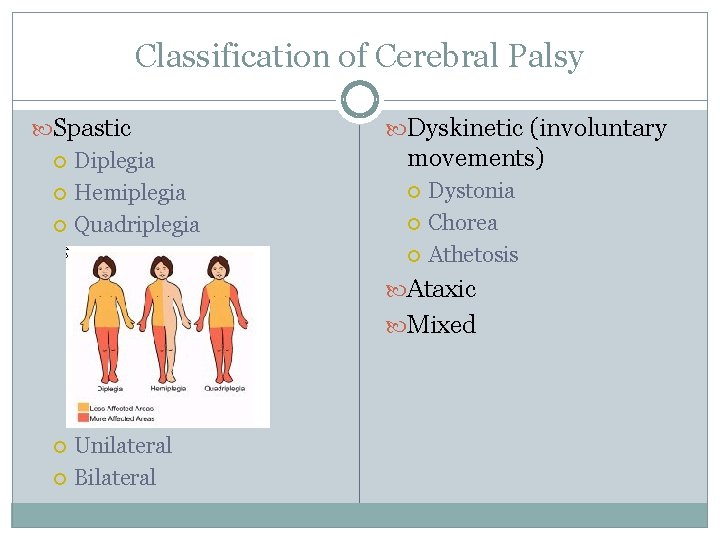
Classification of Cerebral Palsy Based on Movement Abnormality Spastic- muscles are stiff and taut, especially when movement is attempted by the child. (Motor Cortex and/or white fibers) Dyskinetic- Abnormal involuntary movements that affect the entire body and that occur with movement or at rest. (Basal ganglia) Ataxic- General instability of movement. Uncontrolled rate, range, force and direction of movement. (Cerebellum) Mixed – two or more types occur together
Classification of Cerebral Palsy Spastic Diplegia Hemiplegia Quadriplegia Dyskinetic (involuntary movements) Dystonia Chorea Athetosis Ataxic Mixed Unilateral Bilateral
Gross Motor Function Classification System GMFCS Developed in 1997 by Palisano and associates. Developed for children with CP who are 12 years of age and younger. 4 groupings based on age 5 classification levels are based on child’s selfinitiated movement with emphasis on sitting and walking. Promotes consistent communication between professionals.
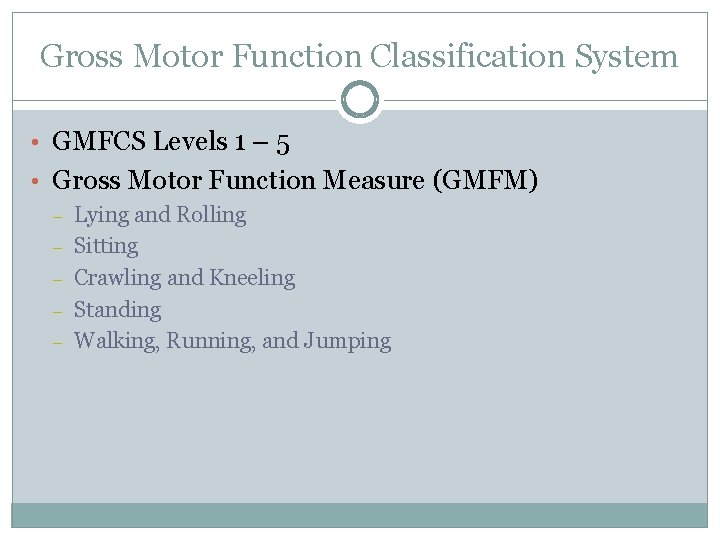
Gross Motor Function Classification System • GMFCS Levels 1 – 5 • Gross Motor Function Measure (GMFM) – – – Lying and Rolling Sitting Crawling and Kneeling Standing Walking, Running, and Jumping
Gross Motor Development in Children with Cerebral Palsy Children with cerebral palsy demonstrate their greatest increase in gross motor development during the preschool years (1 ½ - 5 years of age). Jefferies et al (2016). Description of Primary and Secondary Impairments in Young Children with Cerebral Palsy. Pediatric Physical Therapy 28; 1
Positioning for Children with Special Physical Needs • Muscle tone, movement characteristics, and musculoskeletal issues determine the amount of support needed for – – – Positioning (sitting, standing) Transfers and Transitions (changing positions) Mobility (wheelchair, walker)
Positioning Research and Positioning/Postural Management Link between positioning and cardiopulmonary function. Special seating systems improve sitting posture, head control and comfort of children with CP. Also reduces feeding problems. Supported sitting posture linked to improved UE function, increased handeye coordination, improved cognitive performance and increased vocalizations. Research addressing positioning programs lack rigorous design and have small numbers of participants. Expert consensus still concludes that postural management programs are necessary for children with moderate to severe cerebral palsy.
Purpose of Positioning Equipment ACCESS! PARTICIPATION! BETTER BODY ALIGNMENT FOR SPECIFIC ACTIVITIES SUPPORT/ENCOURAGE COGNITIVE DEVELOPMENT SUPPORT/ENCOURAGE PHYSICAL DEVELOPMENT ADDRESS BODY FUNCTION/STRUCTURE AND IMPAIRMENTS
Positioning Equipment • Orthoses • Supine/Prone/Sidelying Positions • Adapted Seating • Floor seats • Table • Supported Standing • Upright • Supine • Prone • Seated Mobility • Strollers • Wheelchairs • Walkers/Gait Trainers
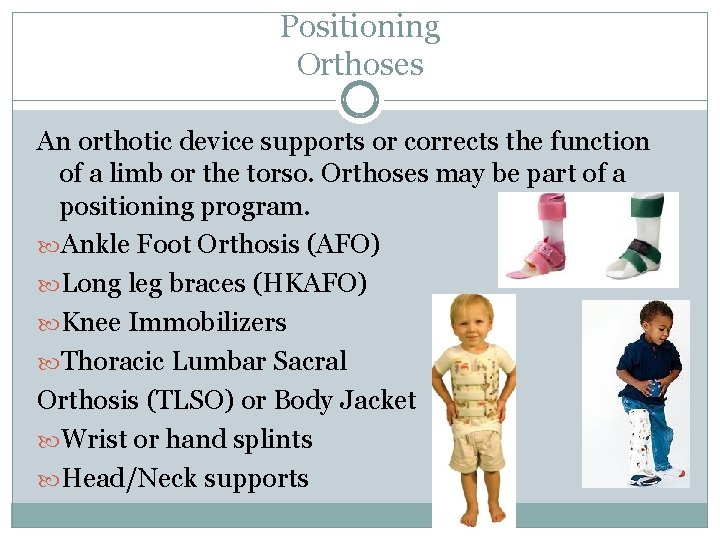
Positioning Orthoses An orthotic device supports or corrects the function of a limb or the torso. Orthoses may be part of a positioning program. Ankle Foot Orthosis (AFO) Long leg braces (HKAFO) Knee Immobilizers Thoracic Lumbar Sacral Orthosis (TLSO) or Body Jacket Wrist or hand splints Head/Neck supports
Supine and Prone Positions When children are active in these positions it helps develop anti-gravity muscles that support the head and trunk and possibly the arms and legs. Prone promotes weight bearing through the arms. Watch for symmetry in these positions. Children may become “stuck” in certain postures.
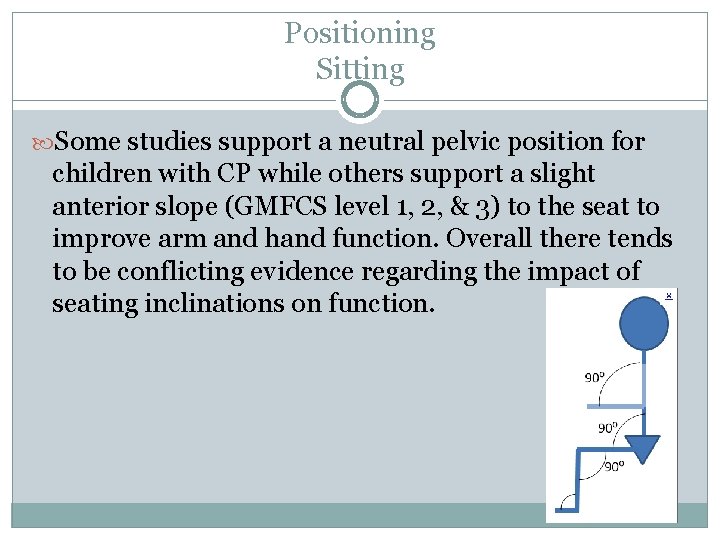
Positioning Sitting Some studies support a neutral pelvic position for children with CP while others support a slight anterior slope (GMFCS level 1, 2, & 3) to the seat to improve arm and hand function. Overall there tends to be conflicting evidence regarding the impact of seating inclinations on function.
Positioning - Standing Programs Reasons PT’s may prescribe a standing program (supported by evidence): To increase bone mineral density of femur and spine To temporarily lessen spasticity of leg muscles Other reasons (not fully supported by evidence): To improve self esteem To improve breathing To improve bowel and bladder function
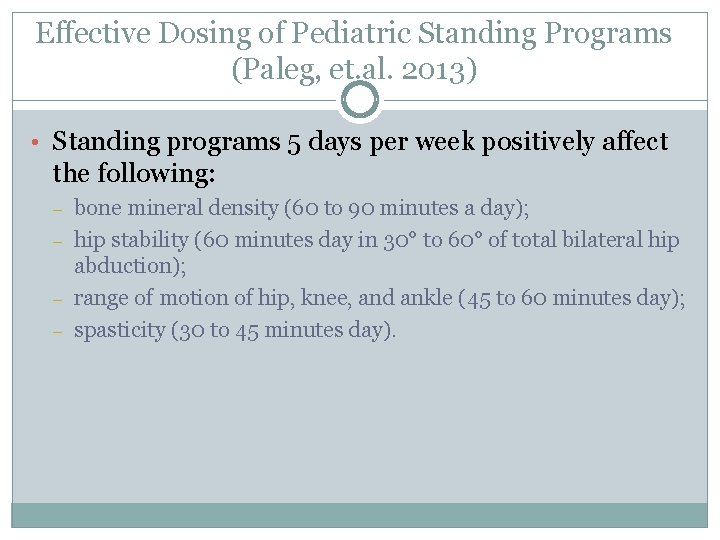
Effective Dosing of Pediatric Standing Programs (Paleg, et. al. 2013) • Standing programs 5 days per week positively affect the following: – – bone mineral density (60 to 90 minutes a day); hip stability (60 minutes day in 30° to 60° of total bilateral hip abduction); range of motion of hip, knee, and ankle (45 to 60 minutes day); spasticity (30 to 45 minutes day).
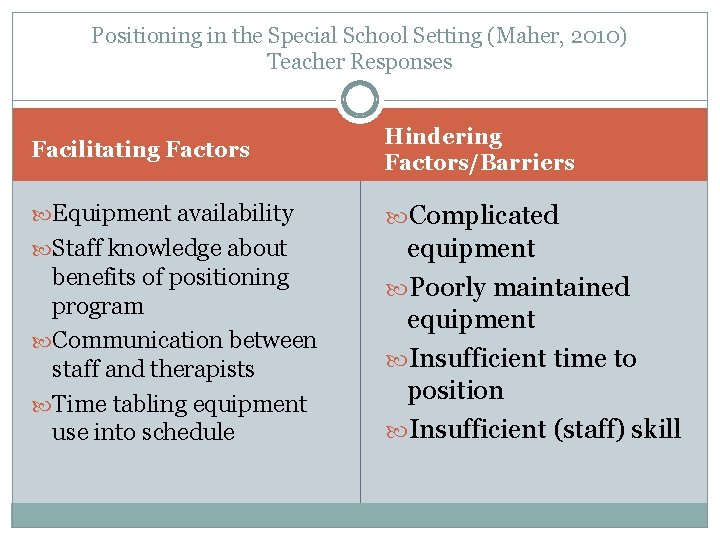
Positioning in the Special School Setting (Maher, 2010) Teacher Responses Facilitating Factors Hindering Factors/Barriers Equipment availability Complicated Staff knowledge about equipment Poorly maintained equipment Insufficient time to position Insufficient (staff) skill benefits of positioning program Communication between staff and therapists Time tabling equipment use into schedule
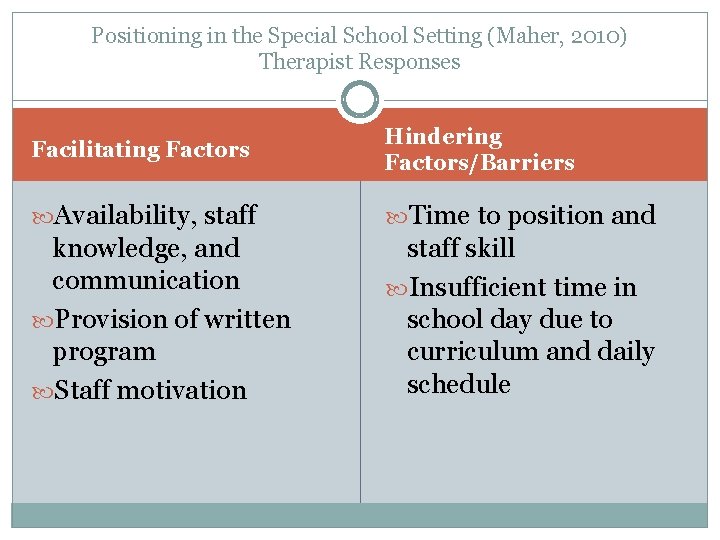
Positioning in the Special School Setting (Maher, 2010) Therapist Responses Facilitating Factors Hindering Factors/Barriers Availability, staff Time to position and knowledge, and communication Provision of written program Staff motivation staff skill Insufficient time in school day due to curriculum and daily schedule
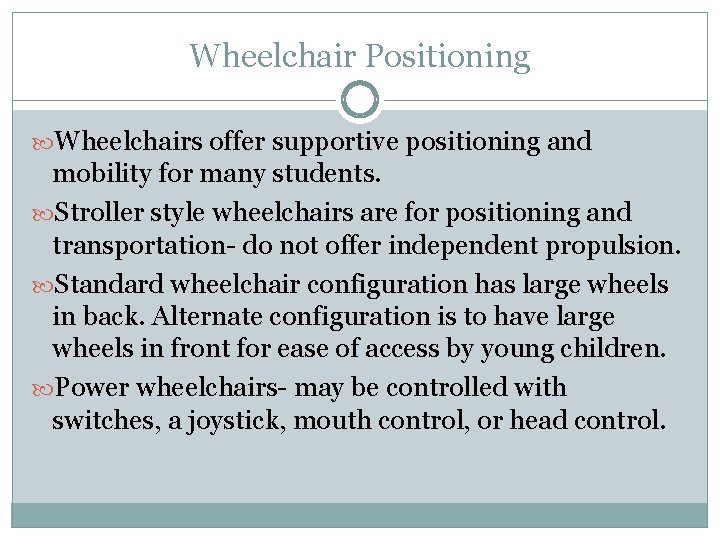
Wheelchair Positioning Wheelchairs offer supportive positioning and mobility for many students. Stroller style wheelchairs are for positioning and transportation- do not offer independent propulsion. Standard wheelchair configuration has large wheels in back. Alternate configuration is to have large wheels in front for ease of access by young children. Power wheelchairs- may be controlled with switches, a joystick, mouth control, or head control.
Wheelchair Safety Always do these two things when assisting students into a wheelchair! 1. Always lock the brakes. 2. Always fasten the seat belt.
Power Mobility Children with limited manual wheelchair or walking mobility. Children with progressive disorders who lose mobility over time (SMA and MD). Children 2 years, and some younger, can learn to use power mobility and those whose cognitive skills do not support independent power mobility benefit from exposure to power mobility devices. Does not result in motor skill regression Hansen, L. (2008). Evidence and outcomes for power mobility intervention with young children. CASEmakers 4(1). Found at: http: //www. fipp. org/Collateral/casemakers_vol 4_no 1. pdf
Mobility-Walkers and Gait Trainers Anterior (positioned in front of the body) Posterior (positioned behind the body) Hands required or hands free May have no additional body supports or have extensive supports
Summary Handling and Positioning Programs are designed to promote: body symmetry functional, purposeful movement sensory variety access of and participation in school activities Positioning programs in school are designed for access and participation and often include: Prone Sidelying Seating – wheelchair and alternatives Standing
Additional References Maher, C. , Evans, K. , Sprod, J. , & Bostock, S. (2010). Factors influencing postural management for children with cerebral in the special school setting. Disability and Rehabilitation, Early online, 1 -13 Massaro, M. , Pastore, S. , Ventura, A. , & Barbi, E. (2013). Pain in cognitively impaired children: a focus for general pediatricians. European Journal of Pediatrics, 179: 9 -14. doi: 10. 1007/s 00431 -012 -1720 -x Mc. Kearnan, K. A. , Kieckhefer, G. M. , Engel, J. M. , Jensen, & M. P. , Labyak, S. (2004). Pain in children with cerebral palsy: A review. Journal of Neuroscience Nursing, 36: 5, 252 -259. Mc. Namara L. & Casey, J. (2007). Seat inclinations affect the function of children with cerebral palsy: A review of the effect of different seat inclines. Disability and Rehabilitation: Assistive Technology, 2: 6, 309 -318. • Paleg, G. S. , Smith, B. A. , Glickman, L. B. (2013). Systematic review and evidence-based clinical recommendations for dosing of pediatric supported standing programs. Journal of Pediatric Physical Therapy, 25(3): 232 -47. doi: 10. 1097/PEP. 0 b 013 e 318299 d 5 e 7. • Smith-Zuzovsky, N. & Exner, C. E. (2004). The effect of seated positioning quality on typical 6 - and 7 year-old children’s object manipulation skills. American Journal of Occupational Therapy, 58, 380– 388. • Stavness, Carrie(2006). The effect of positioning for children with cerebral palsy on upper-extremity function. Physical & Occupational Therapy In Pediatrics, 26: 3, 39 -53. • Tamis Wai-mun (2007). Effectiveness of static weight bearing exercises in children with cerebral palsy. Pediatric Physical Therapy, 19, 62 -73.
Additional References Yung-Shen, T. , Yi-Chen, Y. , Huang, P. &Cheng, H. K. (2014). Seat surface inclination may affect postural stability during Boccia ball throwing in children with cerebral palsy. Research in Developmental Disabilities, 3568 -3573.