
You will see growth in a positive direction
- Slides: 2
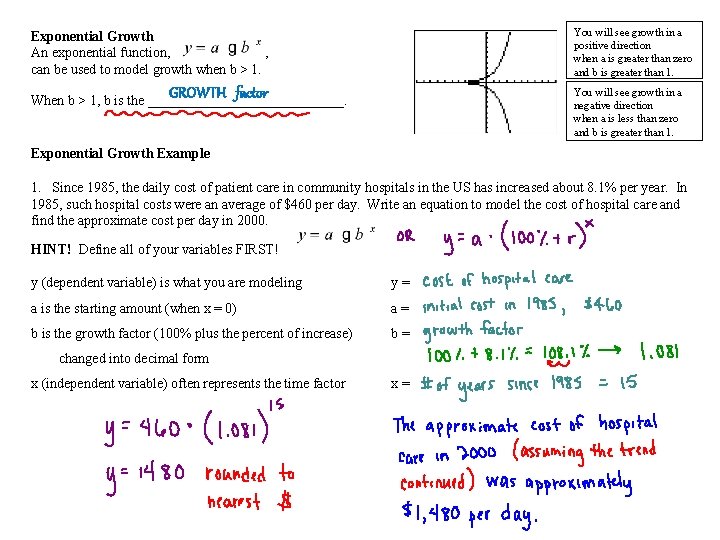
You will see growth in a positive direction when a is greater than zero and b is greater than 1. Exponential Growth An exponential function, , can be used to model growth when b > 1. GROWTH factor You will see growth in a negative direction when a is less than zero and b is greater than 1. When b > 1, b is the ______________. Exponential Growth Example 1. Since 1985, the daily cost of patient care in community hospitals in the US has increased about 8. 1% per year. In 1985, such hospital costs were an average of $460 per day. Write an equation to model the cost of hospital care and find the approximate cost per day in 2000. HINT! Define all of your variables FIRST! y (dependent variable) is what you are modeling y= a is the starting amount (when x = 0) a= b is the growth factor (100% plus the percent of increase) b= changed into decimal form x (independent variable) often represents the time factor x=
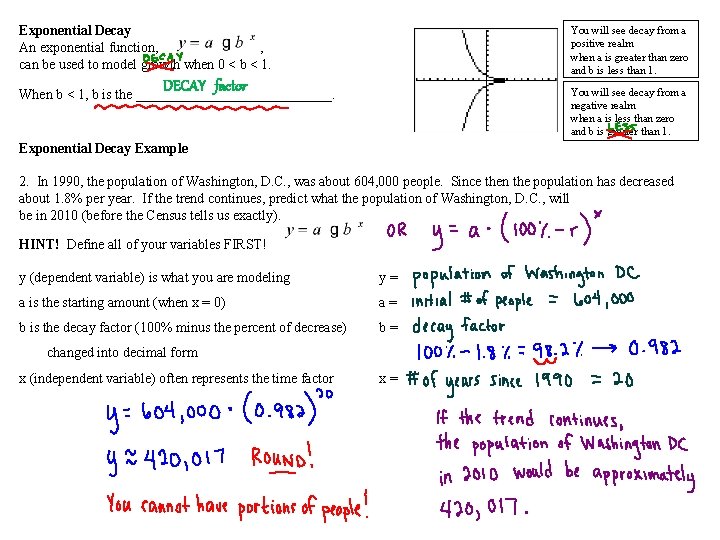
Exponential Decay An exponential function, , can be used to model growth when 0 < b < 1. You will see decay from a positive realm when a is greater than zero and b is less than 1. DECAY factor You will see decay from a negative realm when a is less than zero and b is greater than 1. When b < 1, b is the ______________. Exponential Decay Example 2. In 1990, the population of Washington, D. C. , was about 604, 000 people. Since then the population has decreased about 1. 8% per year. If the trend continues, predict what the population of Washington, D. C. , will be in 2010 (before the Census tells us exactly). HINT! Define all of your variables FIRST! y (dependent variable) is what you are modeling y= a is the starting amount (when x = 0) a= b is the decay factor (100% minus the percent of decrease) b= changed into decimal form x (independent variable) often represents the time factor x=