
You learned that a polynomial function of degree









- Slides: 50
You learned that a polynomial function of degree n can have at most n real zeros. (Lesson 2 -1) • Find real zeros of polynomial functions. • Find complex zeros of polynomial functions.
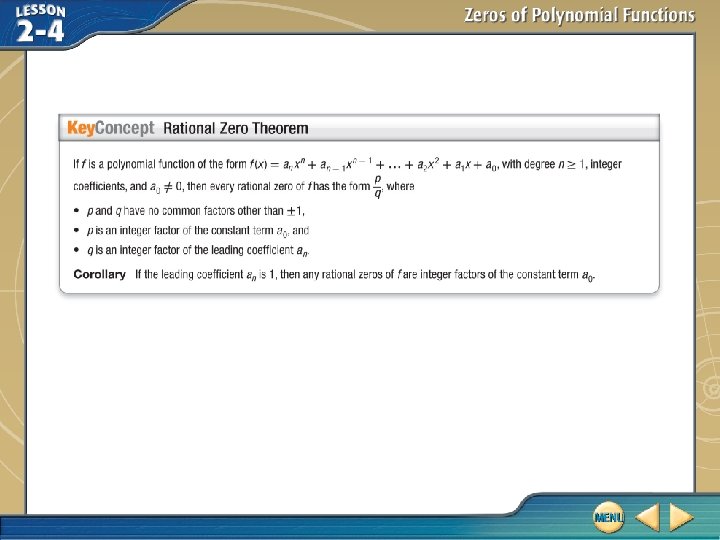
• Rational Zero Theorem • lower bound • upper bound • Descartes’ Rule of Signs • Fundamental Theorem of Algebra • Linear Factorization Theorem • Conjugate Root Theorem • complex conjugates • irreducible over the reals
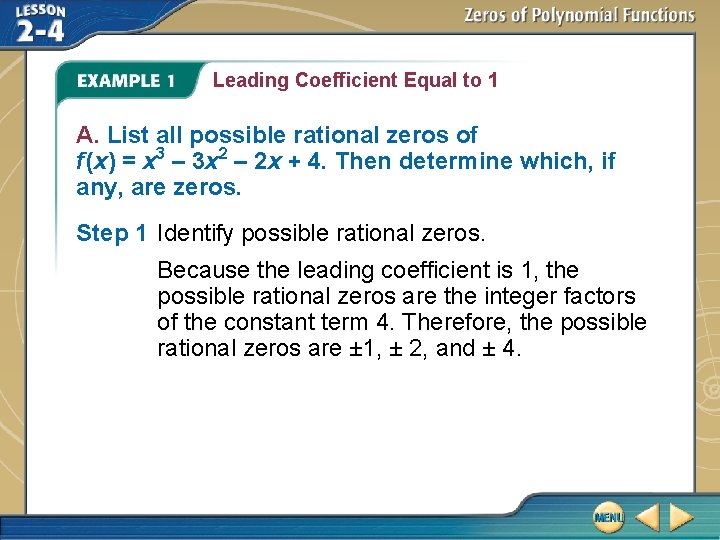
Leading Coefficient Equal to 1 A. List all possible rational zeros of f (x) = x 3 – 3 x 2 – 2 x + 4. Then determine which, if any, are zeros. Step 1 Identify possible rational zeros. Because the leading coefficient is 1, the possible rational zeros are the integer factors of the constant term 4. Therefore, the possible rational zeros are ± 1, ± 2, and ± 4.
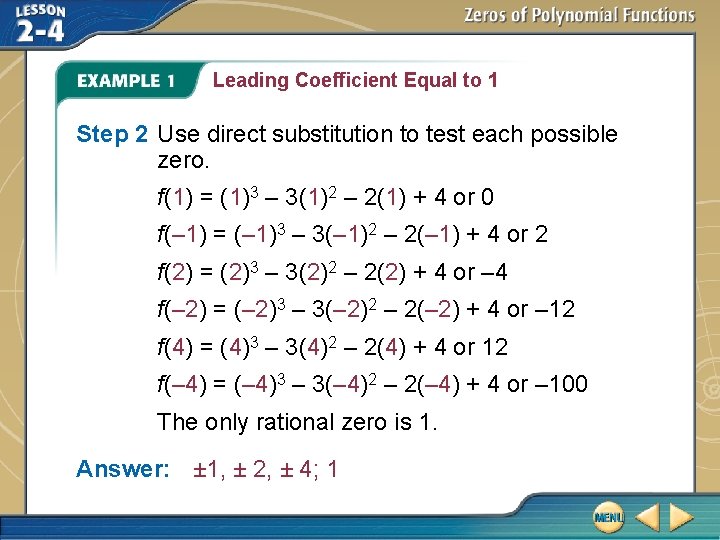
Leading Coefficient Equal to 1 Step 2 Use direct substitution to test each possible zero. f(1) = (1)3 – 3(1)2 – 2(1) + 4 or 0 f(– 1) = (– 1)3 – 3(– 1)2 – 2(– 1) + 4 or 2 f(2) = (2)3 – 3(2)2 – 2(2) + 4 or – 4 f(– 2) = (– 2)3 – 3(– 2)2 – 2(– 2) + 4 or – 12 f(4) = (4)3 – 3(4)2 – 2(4) + 4 or 12 f(– 4) = (– 4)3 – 3(– 4)2 – 2(– 4) + 4 or – 100 The only rational zero is 1. Answer: ± 1, ± 2, ± 4; 1
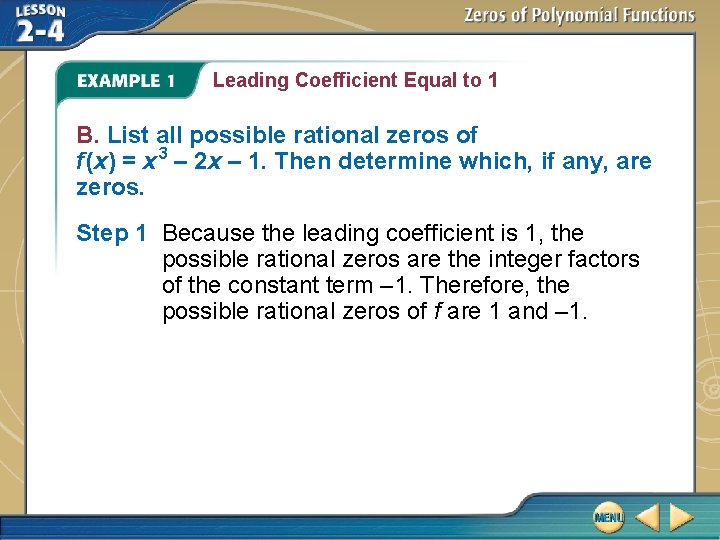
Leading Coefficient Equal to 1 B. List all possible rational zeros of f (x) = x 3 – 2 x – 1. Then determine which, if any, are zeros. Step 1 Because the leading coefficient is 1, the possible rational zeros are the integer factors of the constant term – 1. Therefore, the possible rational zeros of f are 1 and – 1.
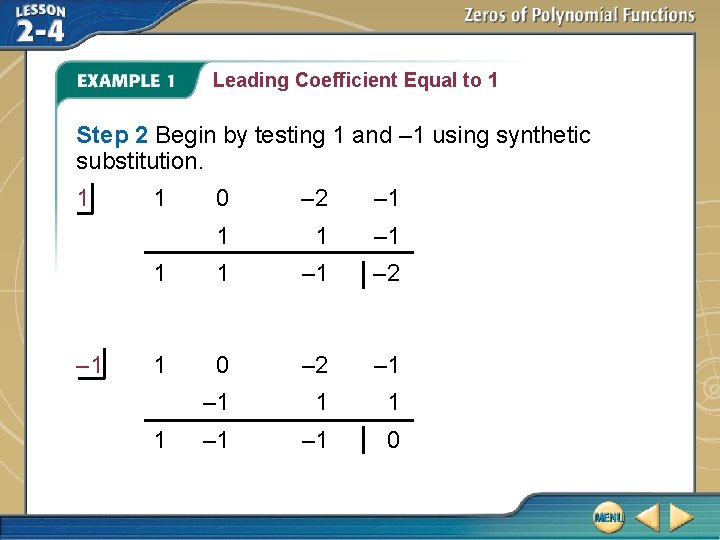
Leading Coefficient Equal to 1 Step 2 Begin by testing 1 and – 1 using synthetic substitution. 1 – 1 1 0 – 2 – 1 1 1 – 1 – 2 1 0 – 2 – 1 1 1 – 1 0 1
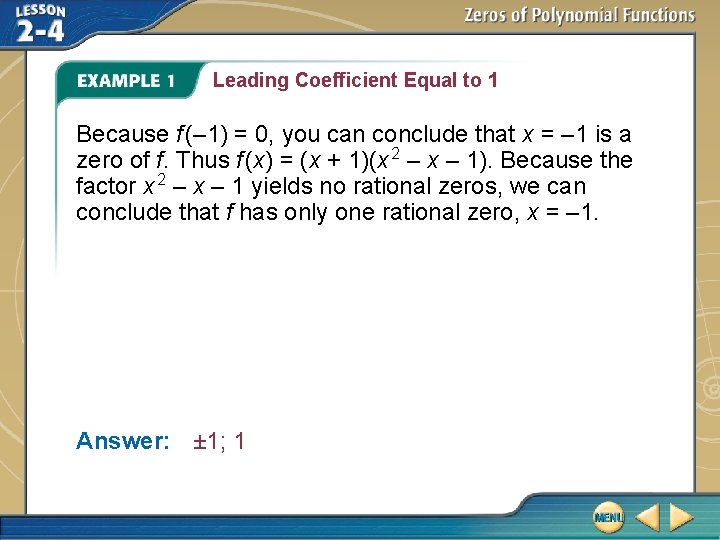
Leading Coefficient Equal to 1 Because f (– 1) = 0, you can conclude that x = – 1 is a zero of f. Thus f (x) = (x + 1)(x 2 – x – 1). Because the factor x 2 – x – 1 yields no rational zeros, we can conclude that f has only one rational zero, x = – 1. Answer: ± 1; 1
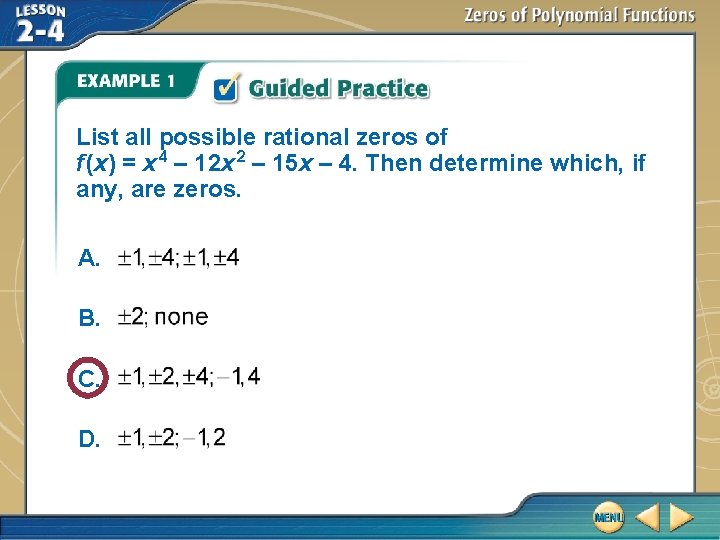
List all possible rational zeros of f (x) = x 4 – 12 x 2 – 15 x – 4. Then determine which, if any, are zeros. A. B. C. D.
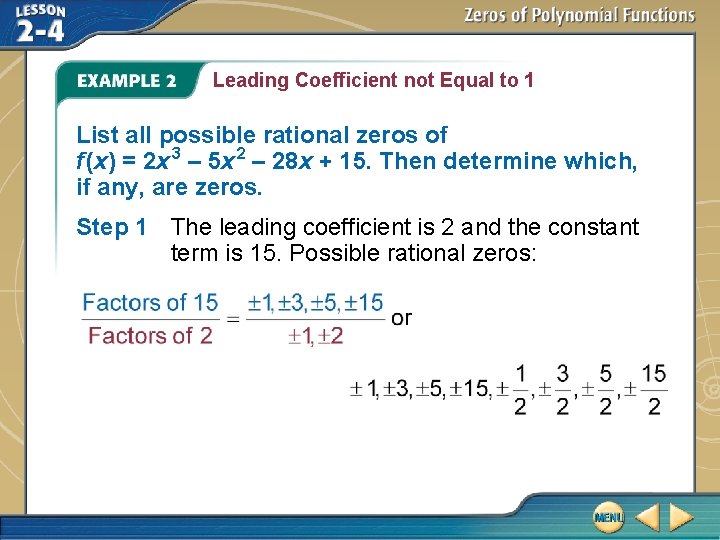
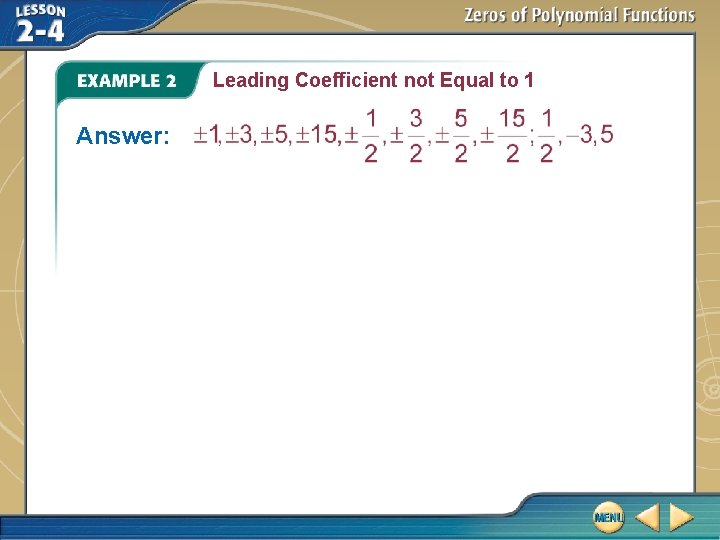
Leading Coefficient not Equal to 1 List all possible rational zeros of f (x) = 2 x 3 – 5 x 2 – 28 x + 15. Then determine which, if any, are zeros. Step 1 The leading coefficient is 2 and the constant term is 15. Possible rational zeros:
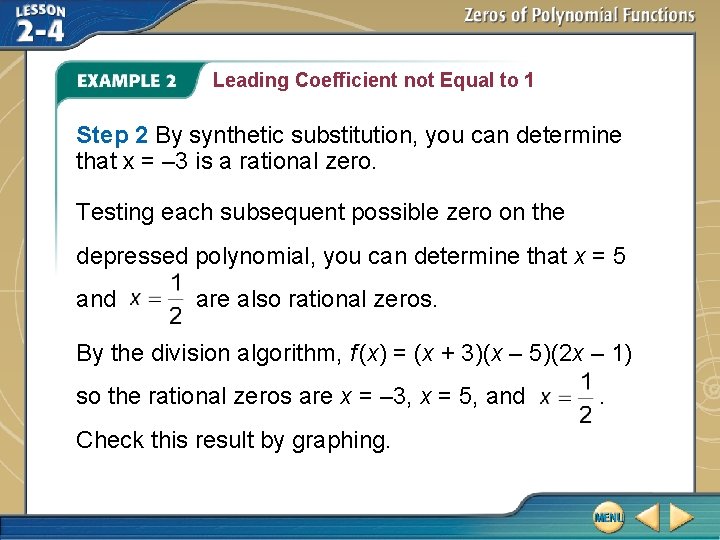
Leading Coefficient not Equal to 1 Step 2 By synthetic substitution, you can determine that x = – 3 is a rational zero. Testing each subsequent possible zero on the depressed polynomial, you can determine that x = 5 and are also rational zeros. By the division algorithm, f (x) = (x + 3)(x – 5)(2 x – 1) so the rational zeros are x = – 3, x = 5, and Check this result by graphing. .
Leading Coefficient not Equal to 1 Answer:
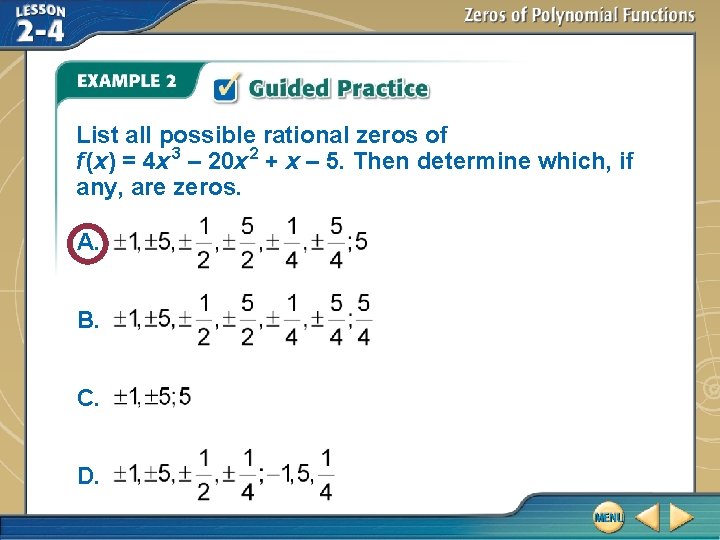
List all possible rational zeros of f (x) = 4 x 3 – 20 x 2 + x – 5. Then determine which, if any, are zeros. A. B. C. D.
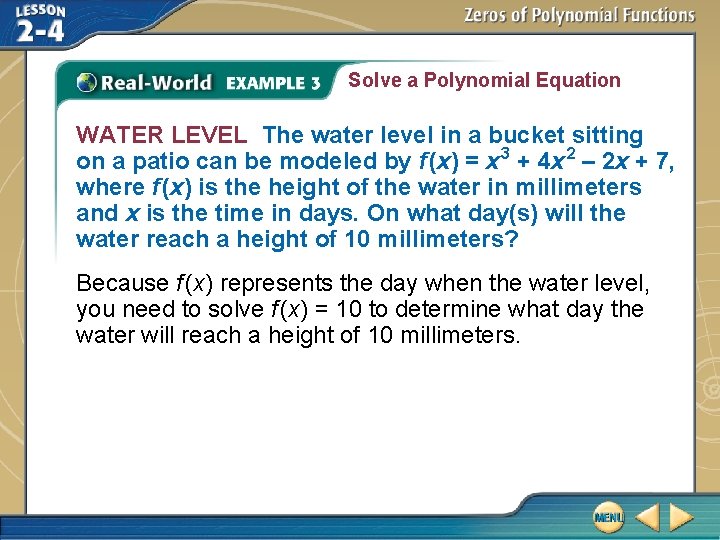
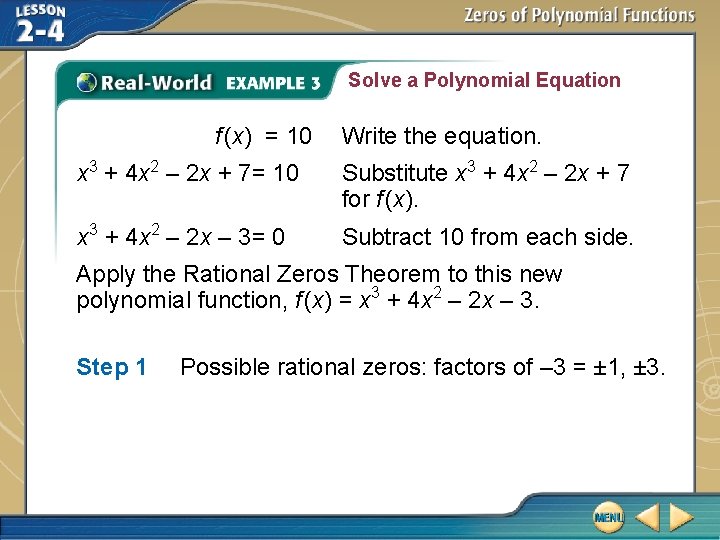
Solve a Polynomial Equation WATER LEVEL The water level in a bucket sitting on a patio can be modeled by f (x) = x 3 + 4 x 2 – 2 x + 7, where f (x) is the height of the water in millimeters and x is the time in days. On what day(s) will the water reach a height of 10 millimeters? Because f (x) represents the day when the water level, you need to solve f (x) = 10 to determine what day the water will reach a height of 10 millimeters.
Solve a Polynomial Equation f (x) = 10 Write the equation. x 3 + 4 x 2 – 2 x + 7= 10 Substitute x 3 + 4 x 2 – 2 x + 7 for f (x). x 3 + 4 x 2 – 2 x – 3= 0 Subtract 10 from each side. Apply the Rational Zeros Theorem to this new polynomial function, f (x) = x 3 + 4 x 2 – 2 x – 3. Step 1 Possible rational zeros: factors of – 3 = ± 1, ± 3.
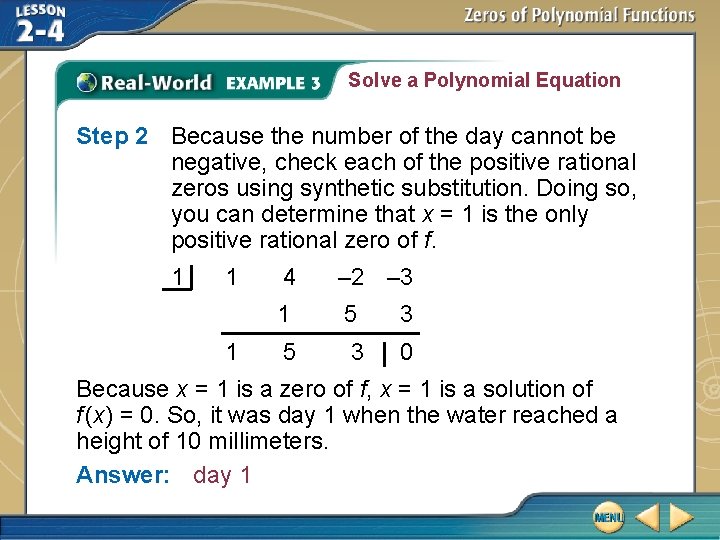
Solve a Polynomial Equation Step 2 Because the number of the day cannot be negative, check each of the positive rational zeros using synthetic substitution. Doing so, you can determine that x = 1 is the only positive rational zero of f. 1 1 1 4 – 2 – 3 1 5 3 0 Because x = 1 is a zero of f, x = 1 is a solution of f (x) = 0. So, it was day 1 when the water reached a height of 10 millimeters. Answer: day 1
PHYSICS The path of a ball is given by the function f (x) = – 4. 9 x 2 + 21. 5 x + 40, where x is the time in seconds and f (x) is the height above the ground in meters. After how many seconds will the ball reach a height of 25 meters? A. 4 seconds, 10 seconds B. 4 seconds C. 5 seconds, D. 5 seconds
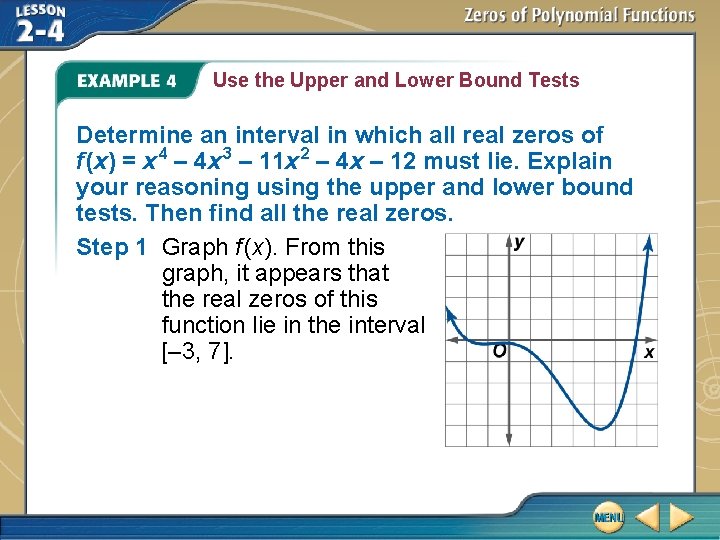
Use the Upper and Lower Bound Tests Determine an interval in which all real zeros of f (x) = x 4 – 4 x 3 – 11 x 2 – 4 x – 12 must lie. Explain your reasoning using the upper and lower bound tests. Then find all the real zeros. Step 1 Graph f (x). From this graph, it appears that the real zeros of this function lie in the interval [– 3, 7].
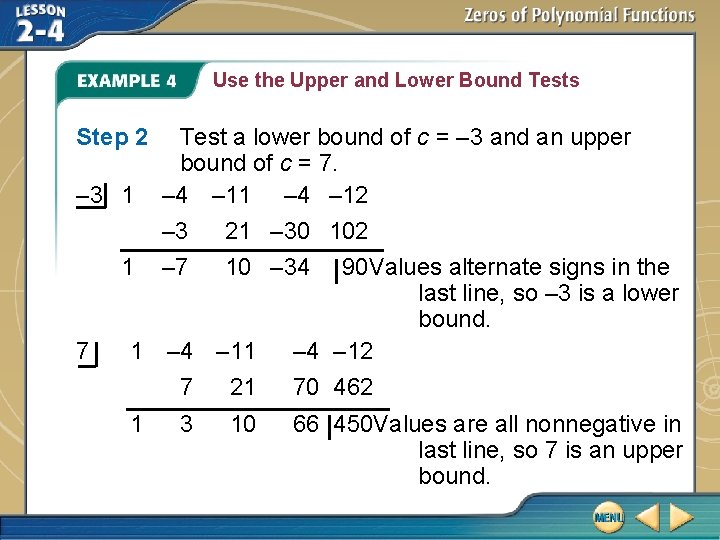
Use the Upper and Lower Bound Tests Step 2 – 3 1 1 7 Test a lower bound of c = – 3 and an upper bound of c = 7. – 4 – 11 – 4 – 12 – 3 21 – 30 102 – 7 10 – 34 1 – 4 – 11 1 90 Values alternate signs in the last line, so – 3 is a lower bound. – 4 – 12 7 21 70 462 3 10 66 450 Values are all nonnegative in last line, so 7 is an upper bound.
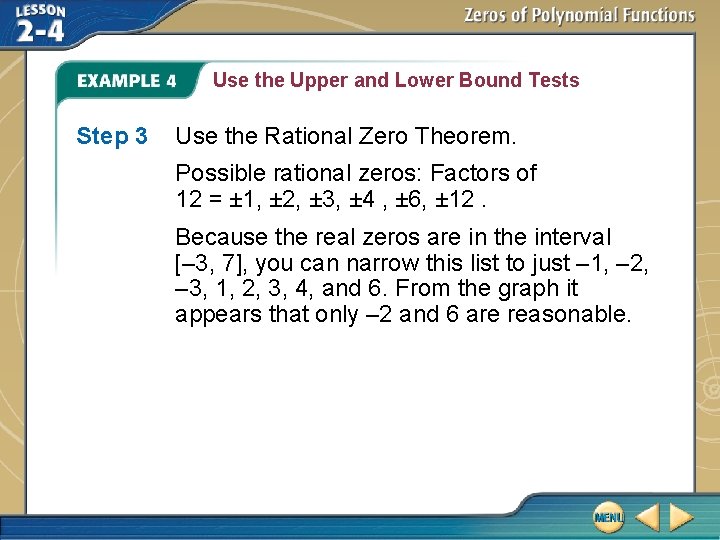
Use the Upper and Lower Bound Tests Step 3 Use the Rational Zero Theorem. Possible rational zeros: Factors of 12 = ± 1, ± 2, ± 3, ± 4 , ± 6, ± 12. Because the real zeros are in the interval [– 3, 7], you can narrow this list to just – 1, – 2, – 3, 1, 2, 3, 4, and 6. From the graph it appears that only – 2 and 6 are reasonable.
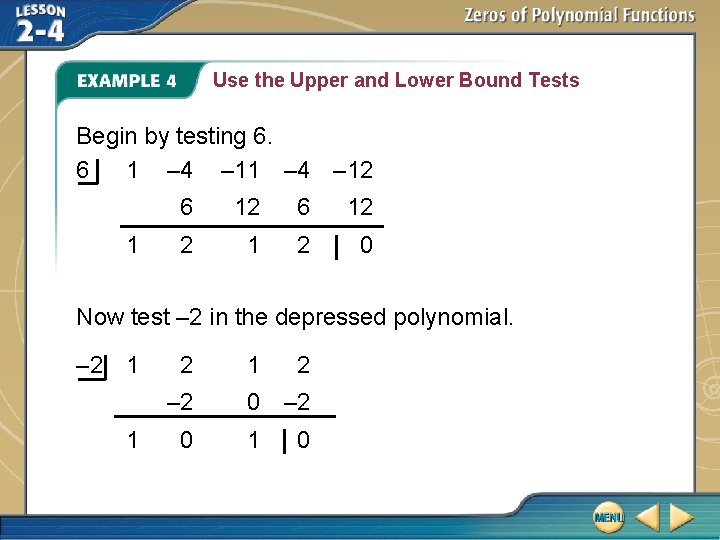
Use the Upper and Lower Bound Tests Begin by testing 6. 6 1 – 4 – 12 1 6 12 2 1 2 0 Now test – 2 in the depressed polynomial. – 2 1 2 – 2 1 0 1 2 0 – 2 1 0
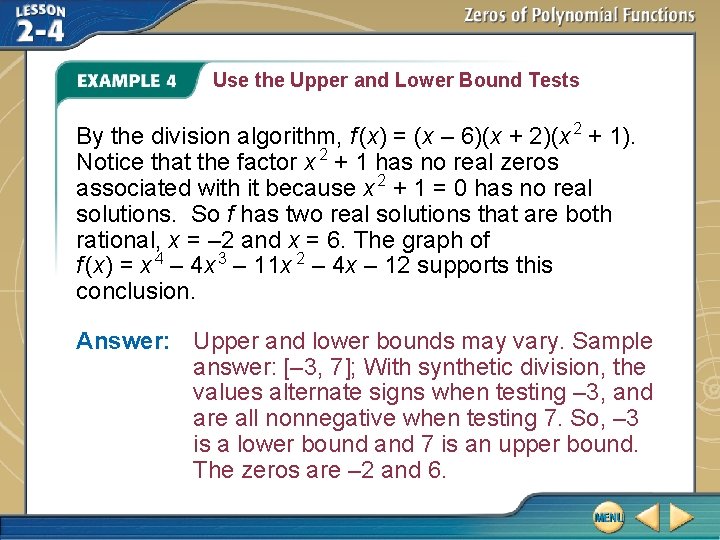
Use the Upper and Lower Bound Tests By the division algorithm, f (x) = (x – 6)(x + 2)(x 2 + 1). Notice that the factor x 2 + 1 has no real zeros associated with it because x 2 + 1 = 0 has no real solutions. So f has two real solutions that are both rational, x = – 2 and x = 6. The graph of f (x) = x 4 – 4 x 3 – 11 x 2 – 4 x – 12 supports this conclusion. Answer: Upper and lower bounds may vary. Sample answer: [– 3, 7]; With synthetic division, the values alternate signs when testing – 3, and are all nonnegative when testing 7. So, – 3 is a lower bound and 7 is an upper bound. The zeros are – 2 and 6.
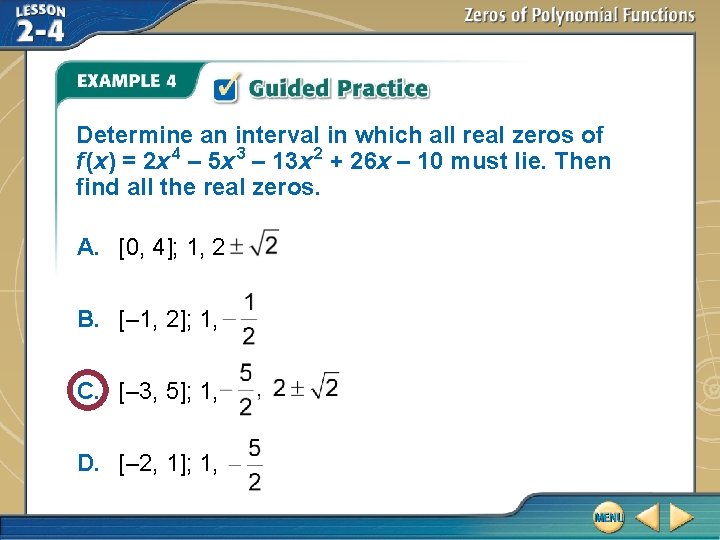
Determine an interval in which all real zeros of f (x) = 2 x 4 – 5 x 3 – 13 x 2 + 26 x – 10 must lie. Then find all the real zeros. A. [0, 4]; 1, 2 B. [– 1, 2]; 1, C. [– 3, 5]; 1, D. [– 2, 1]; 1,
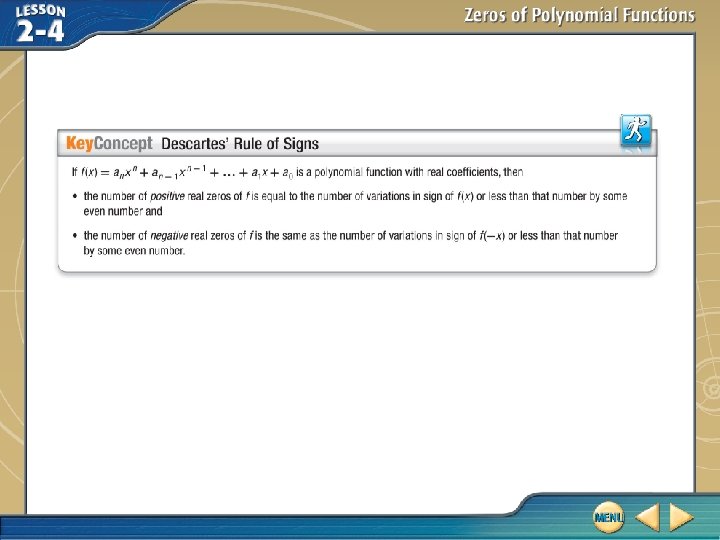
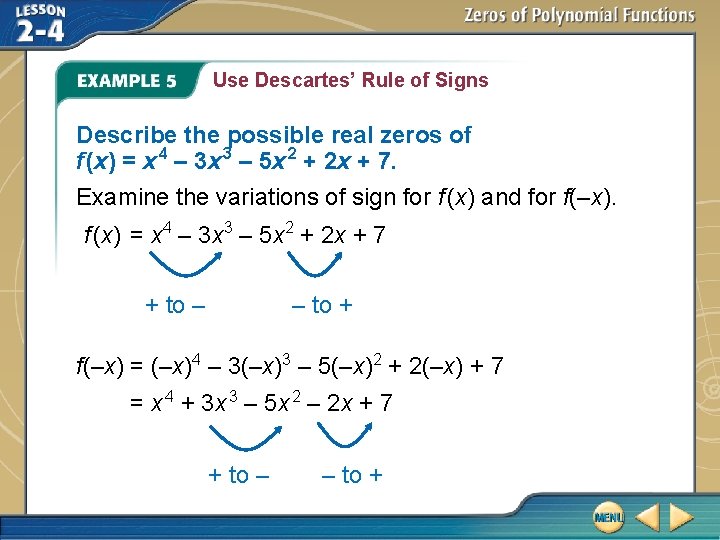
Use Descartes’ Rule of Signs Describe the possible real zeros of f (x) = x 4 – 3 x 3 – 5 x 2 + 2 x + 7. Examine the variations of sign for f (x) and for f(–x). f (x) = x 4 – 3 x 3 – 5 x 2 + 2 x + 7 + to – – to + f(–x) = (–x)4 – 3(–x)3 – 5(–x)2 + 2(–x) + 7 = x 4 + 3 x 3 – 5 x 2 – 2 x + 7 + to – – to +
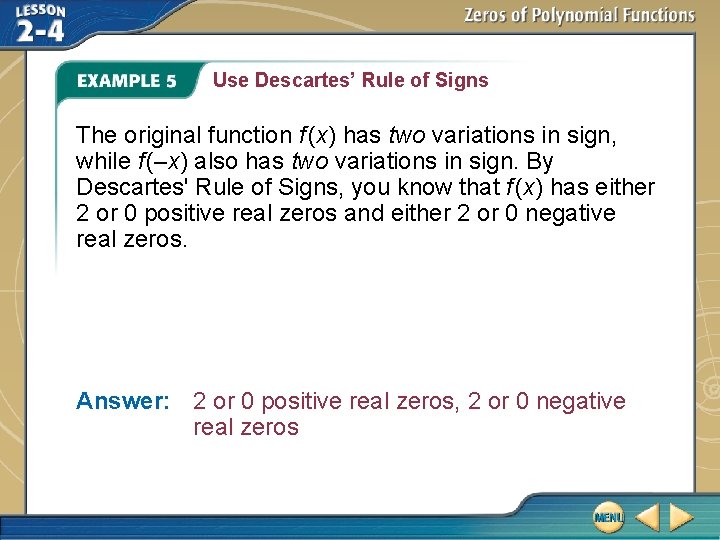
Use Descartes’ Rule of Signs The original function f (x) has two variations in sign, while f (–x) also has two variations in sign. By Descartes' Rule of Signs, you know that f (x) has either 2 or 0 positive real zeros and either 2 or 0 negative real zeros. Answer: 2 or 0 positive real zeros, 2 or 0 negative real zeros
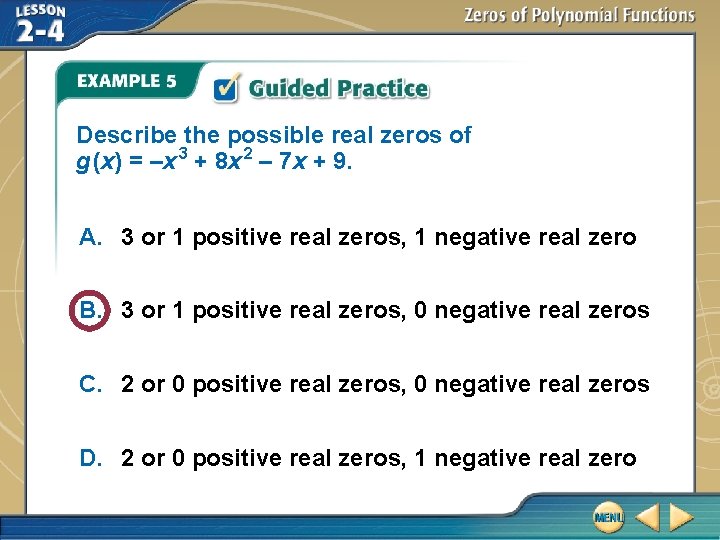
Describe the possible real zeros of g (x) = –x 3 + 8 x 2 – 7 x + 9. A. 3 or 1 positive real zeros, 1 negative real zero B. 3 or 1 positive real zeros, 0 negative real zeros C. 2 or 0 positive real zeros, 0 negative real zeros D. 2 or 0 positive real zeros, 1 negative real zero
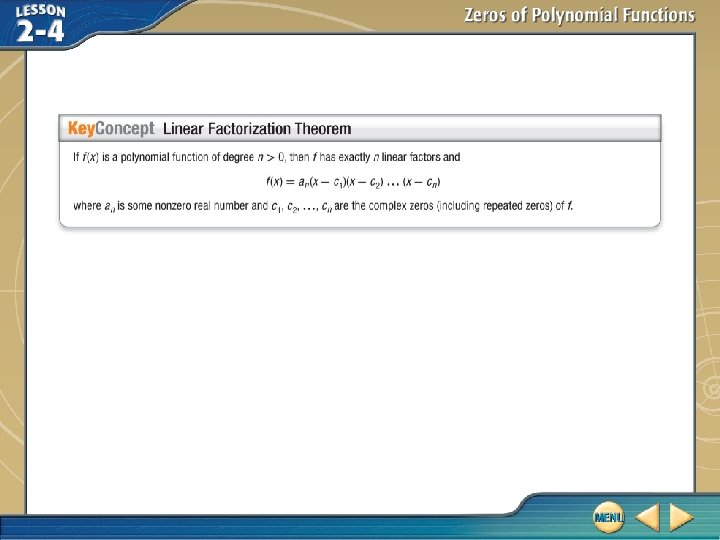
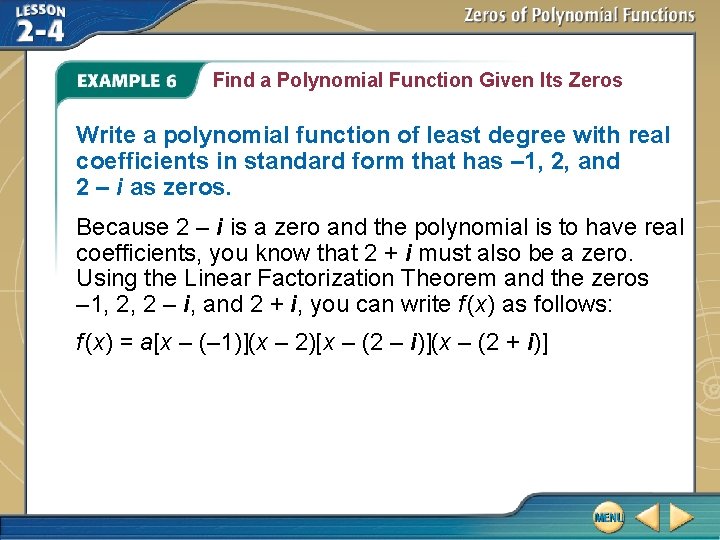
Find a Polynomial Function Given Its Zeros Write a polynomial function of least degree with real coefficients in standard form that has – 1, 2, and 2 – i as zeros. Because 2 – i is a zero and the polynomial is to have real coefficients, you know that 2 + i must also be a zero. Using the Linear Factorization Theorem and the zeros – 1, 2, 2 – i, and 2 + i, you can write f (x) as follows: f (x) = a[x – (– 1)](x – 2)[x – (2 – i)](x – (2 + i)]
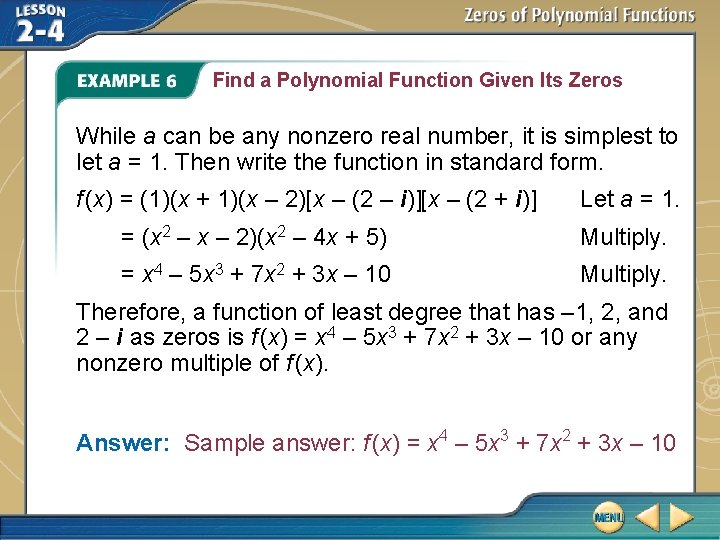
Find a Polynomial Function Given Its Zeros While a can be any nonzero real number, it is simplest to let a = 1. Then write the function in standard form. f (x) = (1)(x + 1)(x – 2)[x – (2 – i)][x – (2 + i)] Let a = 1. = (x 2 – x – 2)(x 2 – 4 x + 5) Multiply. = x 4 – 5 x 3 + 7 x 2 + 3 x – 10 Multiply. Therefore, a function of least degree that has – 1, 2, and 2 – i as zeros is f (x) = x 4 – 5 x 3 + 7 x 2 + 3 x – 10 or any nonzero multiple of f (x). Answer: Sample answer: f (x) = x 4 – 5 x 3 + 7 x 2 + 3 x – 10
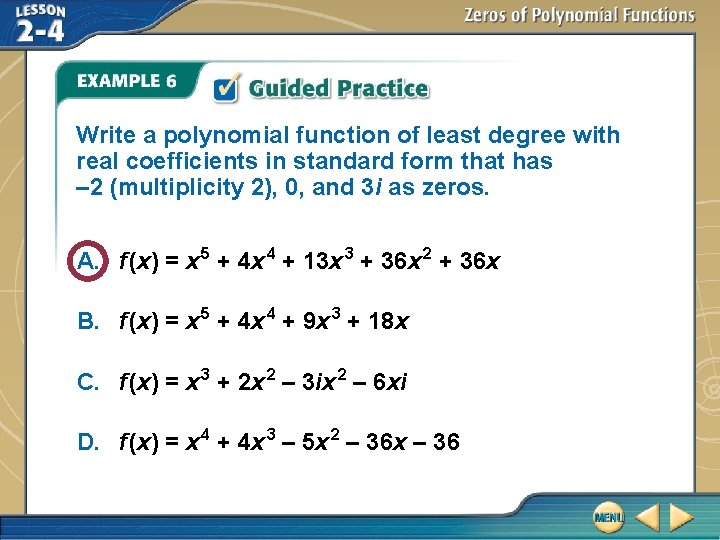
Write a polynomial function of least degree with real coefficients in standard form that has – 2 (multiplicity 2), 0, and 3 i as zeros. A. f (x) = x 5 + 4 x 4 + 13 x 3 + 36 x 2 + 36 x B. f (x) = x 5 + 4 x 4 + 9 x 3 + 18 x C. f (x) = x 3 + 2 x 2 – 3 ix 2 – 6 xi D. f (x) = x 4 + 4 x 3 – 5 x 2 – 36 x – 36
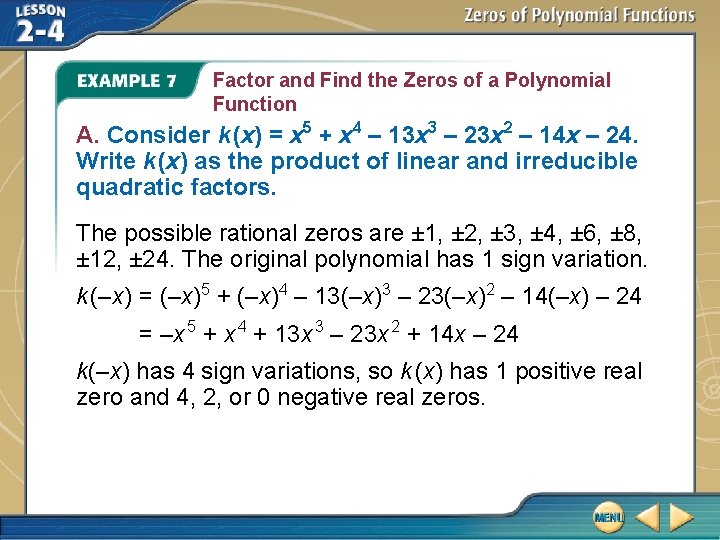
Factor and Find the Zeros of a Polynomial Function A. Consider k (x) = x 5 + x 4 – 13 x 3 – 23 x 2 – 14 x – 24. Write k (x) as the product of linear and irreducible quadratic factors. The possible rational zeros are ± 1, ± 2, ± 3, ± 4, ± 6, ± 8, ± 12, ± 24. The original polynomial has 1 sign variation. k (–x) = (–x)5 + (–x)4 – 13(–x)3 – 23(–x)2 – 14(–x) – 24 = –x 5 + x 4 + 13 x 3 – 23 x 2 + 14 x – 24 k(–x) has 4 sign variations, so k (x) has 1 positive real zero and 4, 2, or 0 negative real zeros.
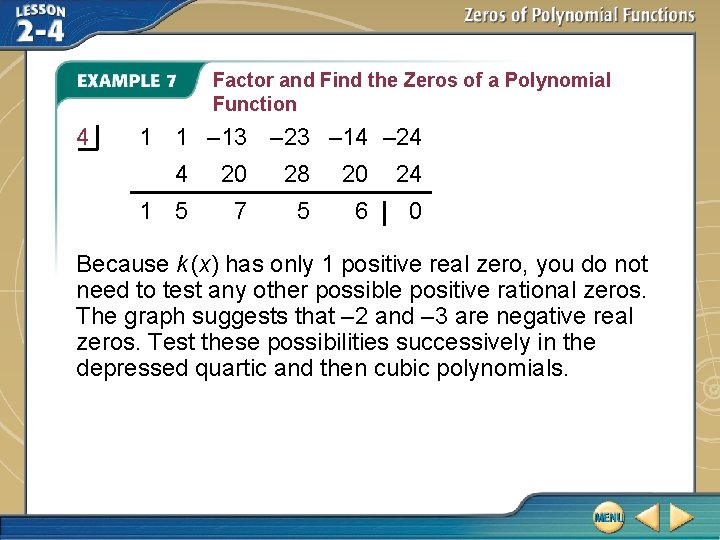
Factor and Find the Zeros of a Polynomial Function The graph shown suggests 4 as one real zero of k (x). Use synthetic substitution to test this possibility.
Factor and Find the Zeros of a Polynomial Function 4 1 1 – 13 – 23 – 14 – 24 4 20 28 20 24 1 5 7 5 6 0 Because k (x) has only 1 positive real zero, you do not need to test any other possible positive rational zeros. The graph suggests that – 2 and – 3 are negative real zeros. Test these possibilities successively in the depressed quartic and then cubic polynomials.
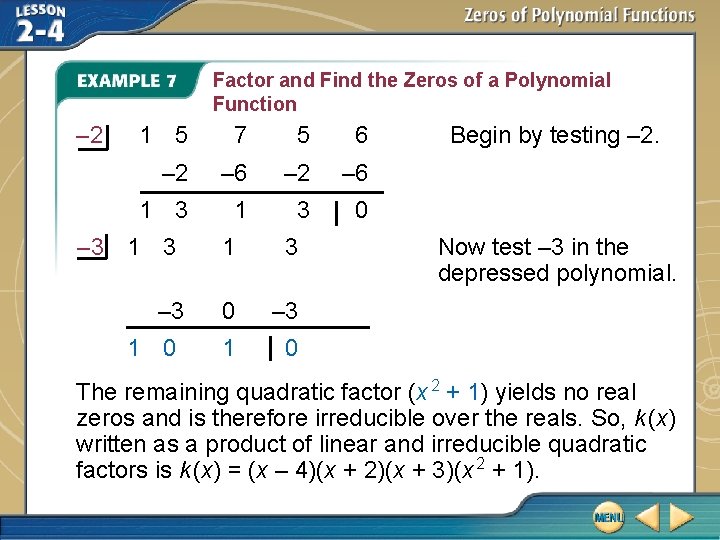
Factor and Find the Zeros of a Polynomial Function – 2 1 5 7 5 6 – 2 – 6 1 3 0 – 3 1 3 – 3 1 0 1 3 0 – 3 1 0 Begin by testing – 2. Now test – 3 in the depressed polynomial. The remaining quadratic factor (x 2 + 1) yields no real zeros and is therefore irreducible over the reals. So, k (x) written as a product of linear and irreducible quadratic factors is k (x) = (x – 4)(x + 2)(x + 3)(x 2 + 1).
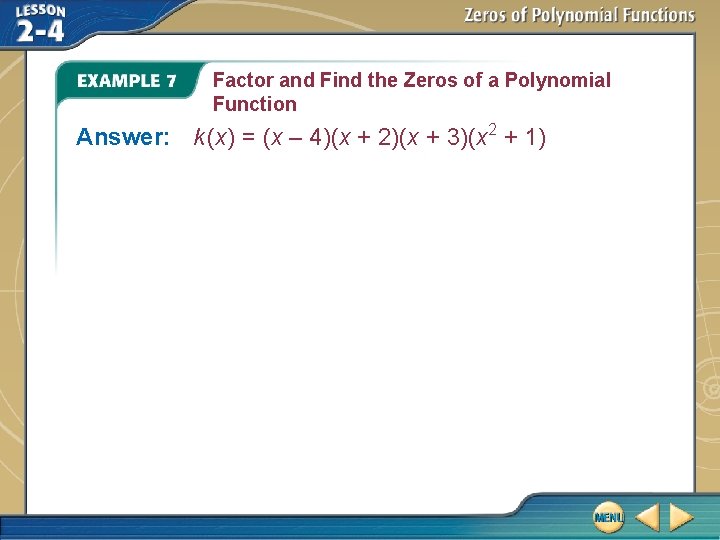
Factor and Find the Zeros of a Polynomial Function Answer: k (x) = (x – 4)(x + 2)(x + 3)(x 2 + 1)
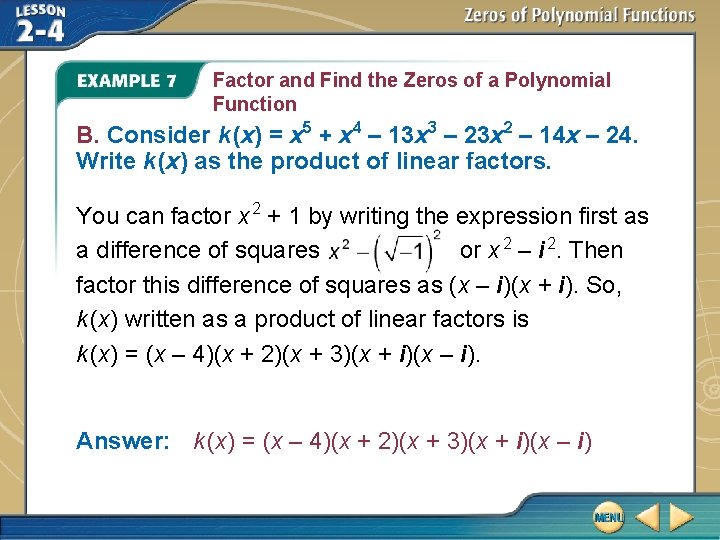
Factor and Find the Zeros of a Polynomial Function B. Consider k (x) = x 5 + x 4 – 13 x 3 – 23 x 2 – 14 x – 24. Write k (x) as the product of linear factors. You can factor x 2 + 1 by writing the expression first as a difference of squares or x 2 – i 2. Then factor this difference of squares as (x – i)(x + i). So, k (x) written as a product of linear factors is k (x) = (x – 4)(x + 2)(x + 3)(x + i)(x – i). Answer: k (x) = (x – 4)(x + 2)(x + 3)(x + i)(x – i)
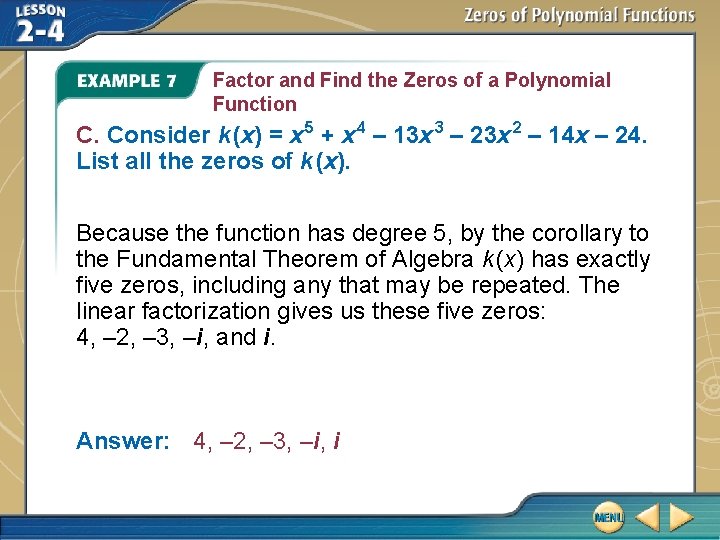
Factor and Find the Zeros of a Polynomial Function C. Consider k (x) = x 5 + x 4 – 13 x 3 – 23 x 2 – 14 x – 24. List all the zeros of k (x). Because the function has degree 5, by the corollary to the Fundamental Theorem of Algebra k (x) has exactly five zeros, including any that may be repeated. The linear factorization gives us these five zeros: 4, – 2, – 3, –i, and i. Answer: 4, – 2, – 3, –i, i
Write k (x) = x 4 – 4 x 3 + 4 x 2 + 4 x – 5 as the product of linear factors. A. (x + 1)(x – 1)(x + (2 – i))(x + (2 + i)) B. (x + 1)(x – 1)(x 2 – 4 x + 5) C. (x + 1)(x – (2 + i))(x – (2 – i)) D. (x + 1)(x – 1)(x + 5)
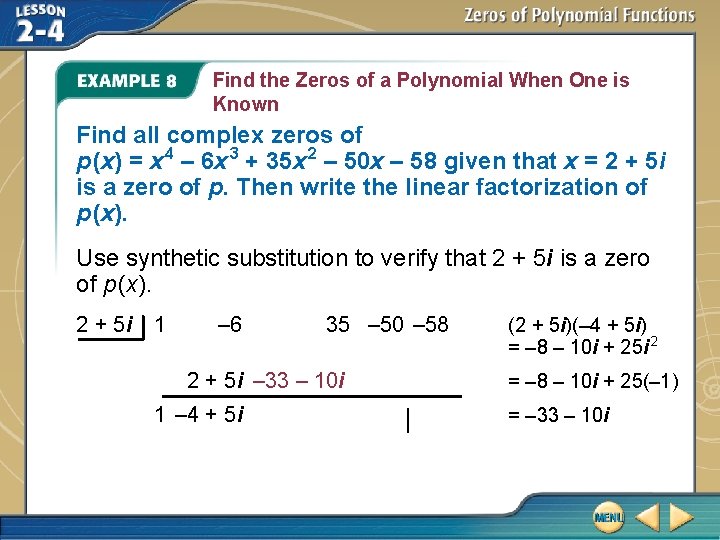
Find the Zeros of a Polynomial When One is Known Find all complex zeros of p (x) = x 4 – 6 x 3 + 35 x 2 – 50 x – 58 given that x = 2 + 5 i is a zero of p. Then write the linear factorization of p (x). Use synthetic substitution to verify that 2 + 5 i is a zero of p (x). 2 + 5 i 1 – 6 35 – 50 – 58 2 + 5 i – 33 – 10 i 1 – 4 + 5 i (2 + 5 i)(– 4 + 5 i) = – 8 – 10 i + 25 i 2 = – 8 – 10 i + 25(– 1) = – 33 – 10 i
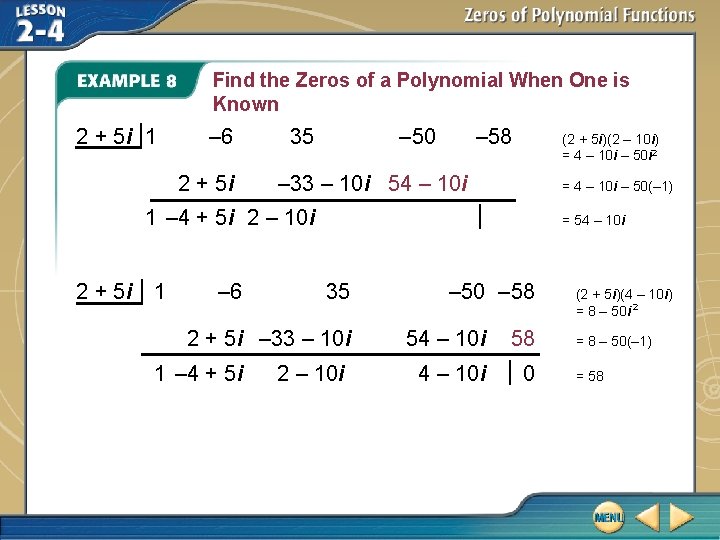
Find the Zeros of a Polynomial When One is Known 2 + 5 i 1 – 6 2 + 5 i 35 – 50 – 58 (2 + 5 i)(2 – 10 i) = 4 – 10 i – 50 i 2 – 33 – 10 i 54 – 10 i = 4 – 10 i – 50(– 1) 1 – 4 + 5 i 2 – 10 i 2 + 5 i 1 – 6 = 54 – 10 i 35 2 + 5 i – 33 – 10 i 1 – 4 + 5 i 2 – 10 i – 50 – 58 54 – 10 i 58 4 – 10 i 0 (2 + 5 i)(4 – 10 i) = 8 – 50 i 2 = 8 – 50(– 1) = 58
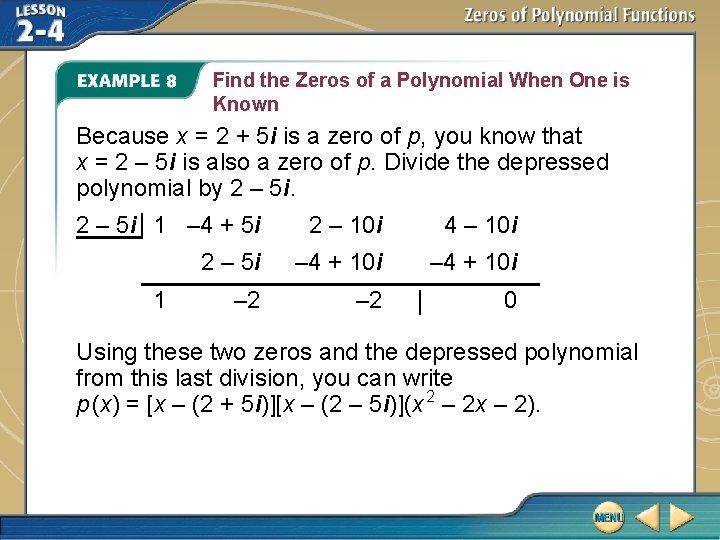
Find the Zeros of a Polynomial When One is Known Because x = 2 + 5 i is a zero of p, you know that x = 2 – 5 i is also a zero of p. Divide the depressed polynomial by 2 – 5 i 1 – 4 + 5 i 2 – 10 i 4 – 10 i 2 – 5 i – 4 + 10 i – 2 0 1 Using these two zeros and the depressed polynomial from this last division, you can write p (x) = [x – (2 + 5 i)][x – (2 – 5 i)](x 2 – 2 x – 2).
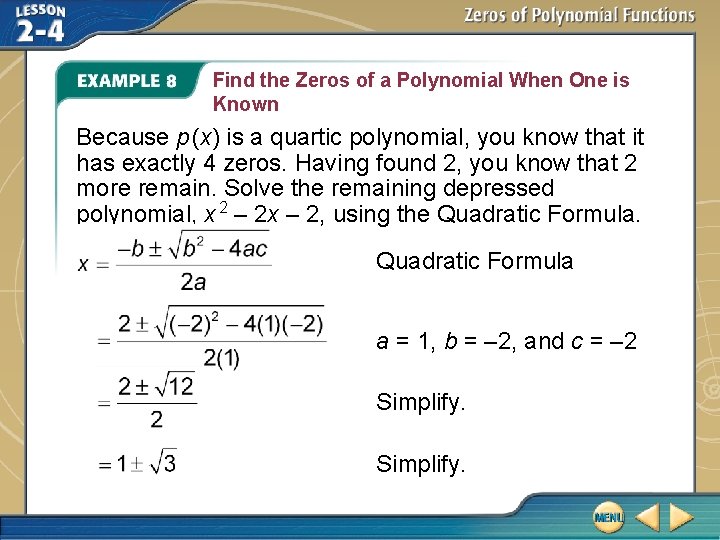
Find the Zeros of a Polynomial When One is Known Because p (x) is a quartic polynomial, you know that it has exactly 4 zeros. Having found 2, you know that 2 more remain. Solve the remaining depressed polynomial, x 2 – 2 x – 2, using the Quadratic Formula a = 1, b = – 2, and c = – 2 Simplify.
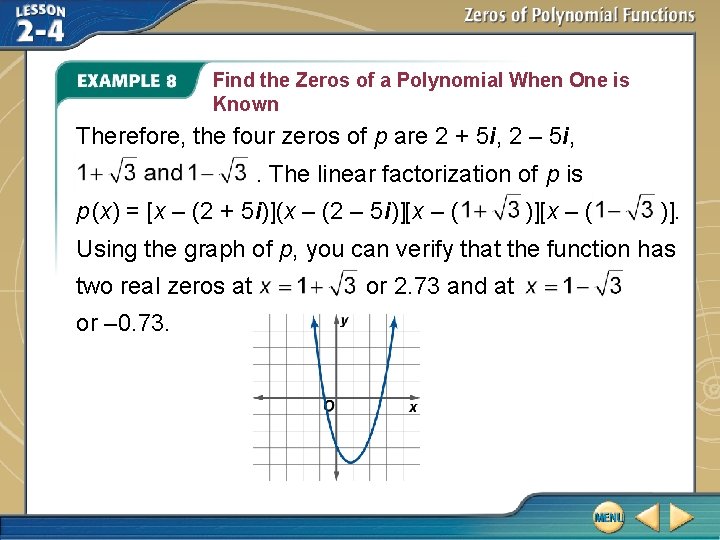
Find the Zeros of a Polynomial When One is Known Therefore, the four zeros of p are 2 + 5 i, 2 – 5 i, . The linear factorization of p is p (x) = [x – (2 + 5 i)](x – (2 – 5 i)][x – ( )]. Using the graph of p, you can verify that the function has two real zeros at or – 0. 73. or 2. 73 and at
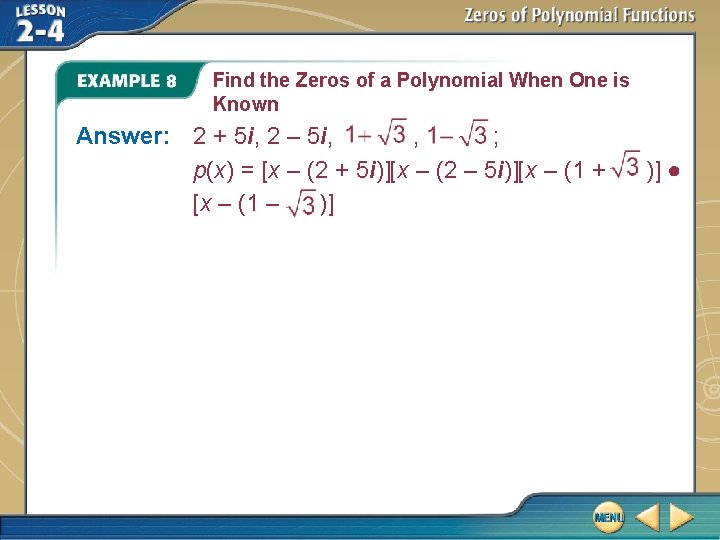
Find the Zeros of a Polynomial When One is Known Answer: 2 + 5 i, 2 – 5 i, , ; p(x) = [x – (2 + 5 i)][x – (2 – 5 i)][x – (1 + [x – (1 – )] )] ●
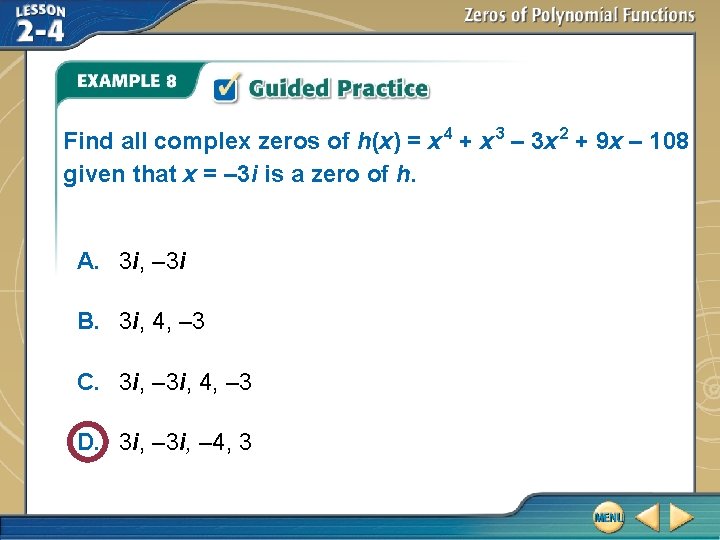
Find all complex zeros of h(x) = x 4 + x 3 – 3 x 2 + 9 x – 108 given that x = – 3 i is a zero of h. A. 3 i, – 3 i B. 3 i, 4, – 3 C. 3 i, – 3 i, 4, – 3 D. 3 i, – 4, 3