
You are taking care of a term newborn
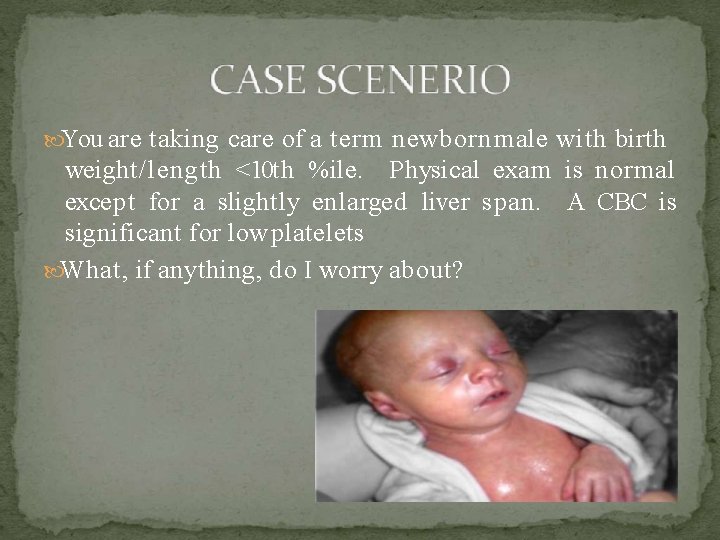
You are taking care of a term newborn m ale with birth weight/length <10 th %ile. Physical exam is normal except for a slightly enlarged liver span. A CBC is significant for low platelets What, if anything, do I worry about?

SARAH AWAISHEH BAU

�The original concept of the TORCH perinatal infections was to group five infections with similar presentations, including rash and ocular findings �These five infections are: � Toxoplasmosis � Other (syphilis) � Rubella � Cytomegalovirus (CMV) � Herpes s implex virus (HSV)

VIRUSES � Varicella, Parvovirus B 19, � Hep B and C, HIV � Enteroviruses (coxackie) �BACTERIA � Listeria, Neisseria � Mycobacterium tuberculosis, salmonella, campylobater �PARASITES � Trepenoma pallidum, plasmodium �FUNGAL � Candida

ASYMPTOMATIC IN MOTHER HAVOC IN OFFSPRING

Fetus may get infected � In utero � During delivery �Severity of manifestation depends on gestational age Less the age more the morbidity �May lead to fetal loss or congenital malformations �Neonate may be even asymptomatic at birth and may manifest symptoms later anytime during infancy or even upto first decade of life �Therefore it is very important to recognize and manage the neonate at the earliest

WRONG CONCEPTS BASIC NOT CLEAR UNNECESSARY TREATMENT IMPROPER MANAGEMENT

COMMON PRESENTATION Premature delivery IUGR or intrauterine d eath Jaundice, petechia or purpura Hepatosplenomegaly, anemia, thrombocytopenia 5. Hydrocephaly, microcephaly, intracranial calcification 6. Chorioretinitis 7. Myocarditis & cardiac abnormalities 1. 2. 3. 4. But each infection have its peculiar presentation and management So, very important to differentiate and identify the particular infection

�SCREENING �MATERNAL HISTORY �NEONATAL PRESENTATION �WHICH CLINICAL INVESTIGATIONS �WHICH MICROBILOGICAL TESTING

HISTORY INFECTION EXPOSURE 1. Handling or ingestion of raw meat 2. Contact with diapered children 3. Travel to certain regions 4. Kitten or cat at home 5. No of sexual partners, illicit drug use 6. Unimmunized Toxoplasmosis Cytomegalovirus Tuberculosis, malaria Toxoplasmosis Syphilis, herpes simplex, Hep. B, HIV Rubella ILLNESS 1. Rash 2. Arthritis Syphilis, rubella, parvovirus B 19 Rubella Mononucleosis like fatigue, lymphadenopathy Toxoplasmosis, HIV Screening in pregnancy or previous history HBV, rubella, syphilis, HIV Fetal ultrasonography Variable

GENERAL FEATURES 1. Premature delivery 2. IUGR or intrauterine d eath 3. Jaundice, petechia or purpura 4. Hepatosplenomegaly, anemia, thrombocytopenia 5. Hydrocephaly, microcephaly, intracranial calcification 6. Chorioretinitis 7. Myocarditis & cardiac abnormalities With suggestive maternal history SUSPECT TORCH

CATARCT, MICROPHTALMIA, GLAUCOMA �CONGENITAL HEART DISEASE �DEAFNESS RUBELLA

BLUEBERRY MUFFIN SPOTS �COTTAGE CHEESE IN KETCHUP CHORIORETINITIS �PERIVENTRICULAR CALCIFICATION CYTOMEGALOVIRUS

HYDROCEPHALUS �OCULAR DEFECTS �CENTRALLY DESTRUCTIVE CHORIORETINITIS �DIFFUSE CEREBRAL CALCIFICATION TOXOPLASMOSIS

SNUFFLES PERIOSTITIS OR OSTEOCHONDRITIS �KERATITIS �MACULOPAPULAR RASH SYPHILLIS

SKIN LESIONS �CONJUCTIVITIS �DISSEMINATED DISEASE HERPES SIMPLEX

Also known as German Measles �Single stranded RNA virus, �Vaccine preventable disease �Effect on fetus � 1 st trimester- 80% infection, 90% malformation � 2 nd trimester- 25% infection, 30% malformation � 3 rd trimester- 100% infection, 10% m alformation �Spontaneous abortions occur in upto 20% of cases if infection occur within 20 wks of gestation.

�MAY BE ASMPTOMATIC �May present as acute viral illness Low grade fever, headache, swollen lymph nodes, joint pain runny nose and rash

Congenital rubella syndrome presents a classic triad � EYE � Cataract � Glaucoma � Chorioretinitis � Microphthalmia � EAR � Sensorineural hearing loss is the most frequent sequelae -80% of infected children � Bilateral and progressive � HEART � Congenital malformation in ~ 50% of children infected in first 8 wks of gestation and consist of PDA, Pulmonary artery stenosis


CHORIORETINITIS – Salt and Pepper type

ANTIBODY TITRE � Ig. G and Ig. M by ELISA � Reliable VIRAL DETECTION Pharyngeal secretions, urine, stool, eye discharge, blood and CSF upto 1 year of age

PRE-PREGNANCY � Childhood vaccination – MMR � Vaccination programs for girls in their teens �PRE-NATAL � Routine checkup of rubella immunity status at first visit � Accidental vaccination indication of termination in early pregnancy not an

�No specific treatment available �Supportive management can be provided �Self limiting disease �Should be nursed i n isolation �Heart defects and cataracts can be corrected surgically, but damage to CNS is permanent �Long term follow up important, as some abnormalities may develop beyond the first decade of life

�Caused by Toxoplasma gondii – an obligate intracellular protozoan parasite �Oocyst, excreted in cat feces – source of infection to h umans �In patients with an existing HIV infection, toxoplasmosis is an opportunistic important infection with considerable morbidity and mortality especially in the pregnant women


�In most immunocompetent individuals, including children and pregnant women, the infection goes u nnoticed � • In approximately 10% of the patients it causes a self- limiting illness, most commonly in the 25 -35 years age group �Painless lymphadenopathy(Local or Generalised) is the most common presenting feature. Cervical lymph nodes are involved in particular. � • Other features include - Malaise, Fever, Fatigue, Muscle pain, Sore throat and headache

�Clinical features vary widely and can manifest at different times before and after birth �Most infected(70 -90%) infants are asymptomatic at birth but up to 80% may develop learning and visual disabilities later �Classic triad is found in < 10% � Chorioretinitis � Intrcranial calcification � Hydrocephalus �OTHERS � nystagmus and visual impairment

Chorioretinitis – Central involvement of macula destructive type with

Hydrocephalus

Diffuse cerebral calcification NORMAL ABNORMAL

SEROLOGY BY ELISA (Enzyme linked immunosorbent essay) or ISAGA (Immunoglobulin M immunosorbent agglutination assay) � Positive toxoplasma Ig. G in infant at 12 months of age – diagnostic (GOLD STANDARD) � Positive Ig. M or Ig. A at 5 -10 days of life � ISAGA more sensitive than ELISA CSF analysis Positive T. Gondii specific Ig. M in CSF fluid d iagnostic Can produce CSF eosinophilia or extremely high proteins level (> 1000 mg/dl) PCR Positive in CSF, blood, or urine is diagnostic

MOTHER � SPIRAMYCIN � 2 gm/day throughout pregnancy � After 20 weeks gestation add sulfadiazine and pyrimethamine INFANT � FIRST 6 MONTHS � Sulfadiazine � Pyrimethamine � NEXT 6 MONTHS � Same therapy for 1 m onth alternated with spiramycin for 1 m onth(100 mg/kg/day in 2 divided doses) Precaution Sulfadiazine not to be used during 1 st week Folinic acid (5 mg twice weekly) to pyrimethamine be given along with

CORTICOSTEROIDS When toxoplasmosis associated with acute inflammatory response ( chorioretinitis, raised CSF proteins etc) Given for 8 -12 weeks �Eyes to be examined every 3 months till the age of 18 months and then yearly �NEITHER MOTHER NOR INFANT IS INFECTIOUS AND CAN BE HANDLED NORMALLY

�Endemic in cat friendly countries unlike INDIA �Cats should be handled with gloves, kept indoors and hand washed after their handling �Meat should be eat after thorough cooking �Hands should be washed before and after eating

�Cause chicken pox – usually a mild disease �If occurs in pregnancy may cause severe disease in mother and baby �Congenital Varicella Syndrome � Skin scarring, malformed extremities, cataracts and brain abnormalities � If disease occurs in mother 5 days before or 2 days after delivery severe fatal neonatal disease may occur �Management � Vaccination of the neonate with varicella vaccine � Varicella IVIG (25 IU/kg) for passive immunity within 96 hours � Inj Acyclovir in affected neonates (doubtful utility)

• Thank you. . • Next with Rina
- Slides: 37