
You are about to witness the strength of
* You are about to witness the strength of space knowledge.
*As we saw last week, the Hertzsprung-Russell (HR) diagram plots stars according to surface temperature (x-axis) and luminosity (y-axis). *Temperature determines a star’s color, and its luminosity tells us its size. *Stars are not randomly spaced on the HR diagram; there are distinct groups. *A star’s life and death are determined by its mass. *
*Stars that didn’t quite make it. *15 -80 Jupiter masses (mjup) *Very faint. *Hot enough to fuse deuterium (106 K), but not regular hydrogen (4 x 10⁶ K). *They fuse their deuterium over a few tens of millions of years, then fade away. *They can only do steps 2 and 3 of the PP chain. *
*Most common type of star. *<0. 4 solar masses (msun). *Hot, but not too hot, fuse H into He slowly and steadily, via the PP chain. *Lifespan may be 1012 to 1013 years. *Every red dwarf ever formed is still going. Like Mista Russell. *
*0. 4 -~2 msun. *These stars slowly heat up as they burn through their supply of hydrogen. *As fusion starts to slow down (after perhaps 1010 years), gravity compresses the star’s core. *This heats the core up enough that it starts to fuse helium. *
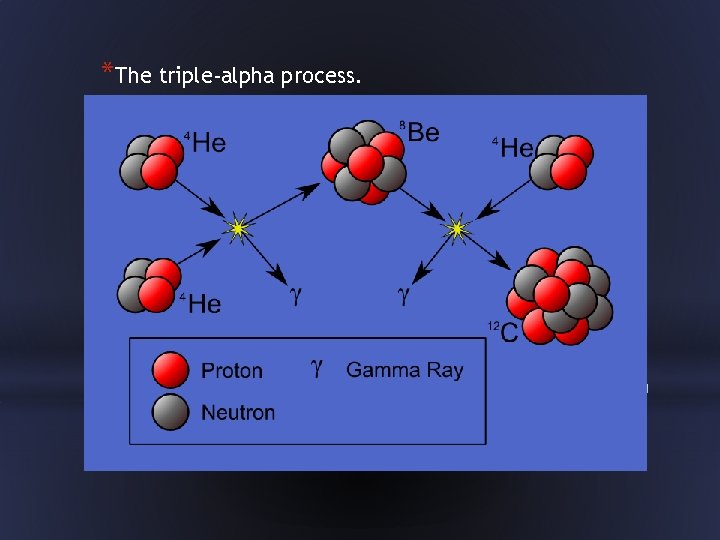
*The triple-alpha process. *
*This hotter core means a more powerful solar wind, so the outer layers of the star are pushed outwards – the star expands. *If you let a gas expand it cools down. This shifts its color towards the red end of the spectrum – the star becomes a red giant. *After ~106 years, the helium has been fused into carbon & the outer layers are long gone, blasted into space as a planetary nebula. *
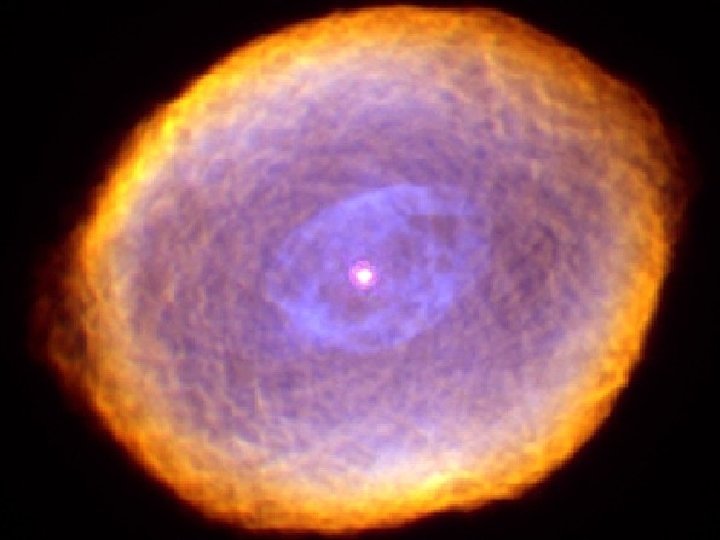
*Image: IC 418
*These stars may just be hot enough to turn a tiny bit of their carbon into oxygen, but no more than that. *What remains is a white dwarf, about the size of Earth, and composed almost entirely of carbon – a giant diamond in the sky. *They take billions of years to cool down. *Would eventually become a theorized object called a black dwarf – but none exist yet. *
*Lifespan ~109 years. *Above ~2 msun, stars are large enough that their cores heat up enough to fuse carbon, oxygen, neon, and silicon into heavier and heavier atoms. *All these reactions are exothermic – they release heat – so the core just gets hotter and hotter. *
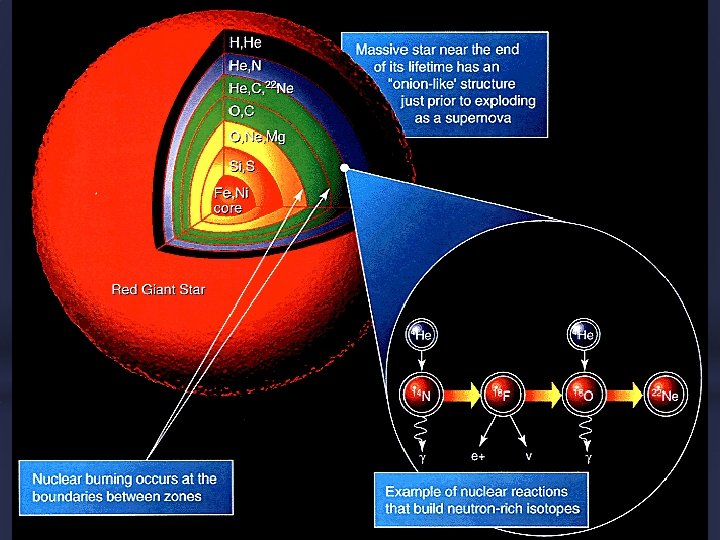
*Image: onion-like shells inside a giant star
*Once they begin to fuse iron-56 (element 26) into nickel-60, the star has a few minutes to live. This reaction is endothermic, so it cools the core off. *Without outward fusion pressure counteracting gravity, the core collapses at about 23% of the speed of light. A star with core radius 300, 000 km would collapse completely in 0. 004 s. Wow. *
*Some of the core survives, but is squashed down by unimaginable gravity. *The electrons (which have a negative charge) of neighboring atoms normally repel one another (electron degeneracy pressure) *Gravity squashes them down so that the core becomes a ball of neutrons ~20 km across, releasing countless neutrinos that blast the star apart as a supernova. *
*The insane temperatures involved in a supernova mean that the nuclei of the metals within the star are bombarded with neutrons, which stick to them in a process called rapid neutron capture (r-process). *Many of these neutrons spontaneously become protons (β- decay), generating the heaviest elements. *Gold and platinum are rare because they only form in supernovae. Yeah. You love this class. *
*The biggest stars do all the things that group 4 did, but the core has so much mass that even neutrons are crushed when such stars collapse. (Neutron degeneracy pressure can’t save it). *This is a black hole. *Escape velocity > speed of light. *We don’t know exactly how large a star has to be to leave behind a black hole. The smallest known black hole is ~5. 5 msun, but the original star would have been bigger. *
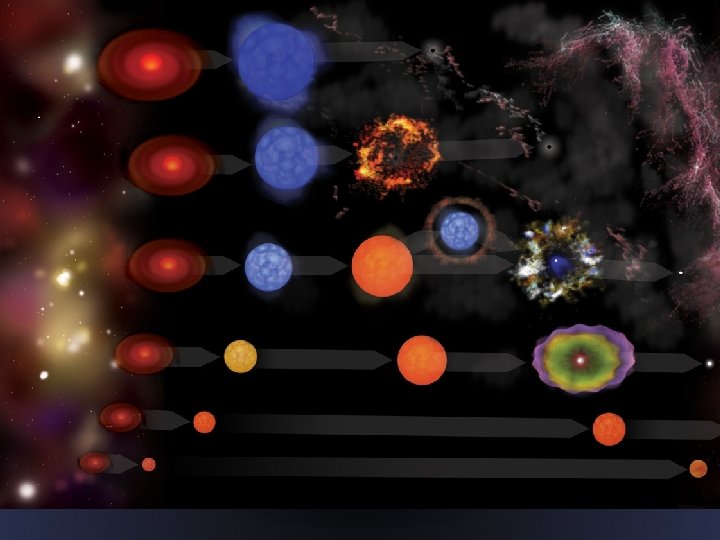
*With so much drama in the galaxy *It’s kinda hard bein’ a red G-I-A-N-T *But I somehow, some way, *Keep fusing helium to carbon like every single day. *
- Slides: 17