
You are a CEO What are your obligations

You are a CEO. What are your obligations to the Club as it’s Company Secretary?

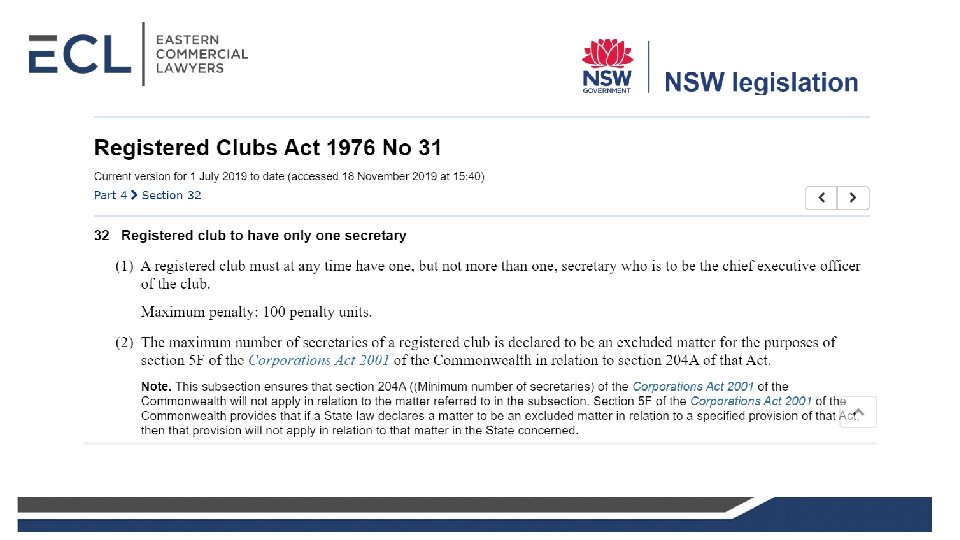
Introduction ‘Secretary’ originates from Latin, meaning “confidential officer” and the corresponding corporate governance role has a long history extending back to the seventeenth century. There is no legal definition of ‘company secretary’, nor any requirement for a company secretary to have any particular qualifications or experience.

Corporations Act 2001
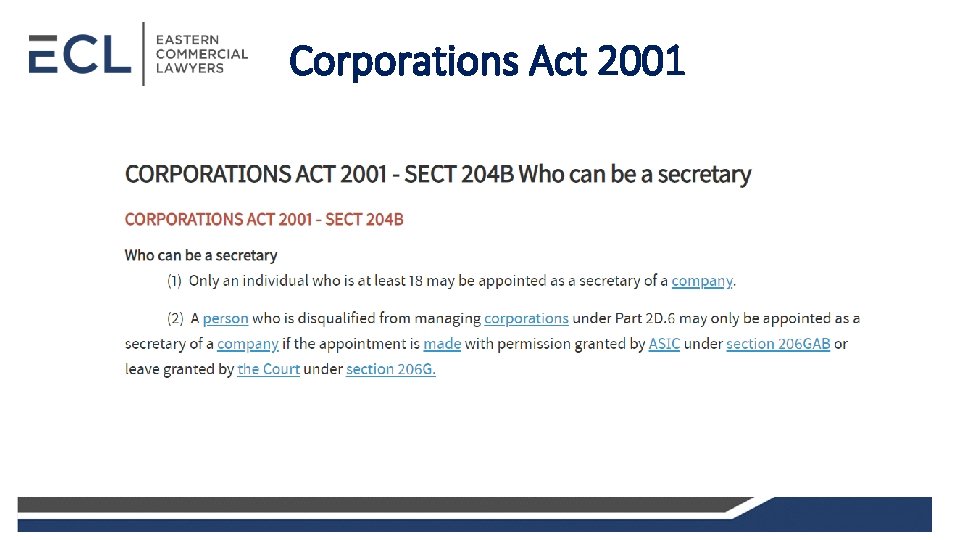
Corporations Act 2001
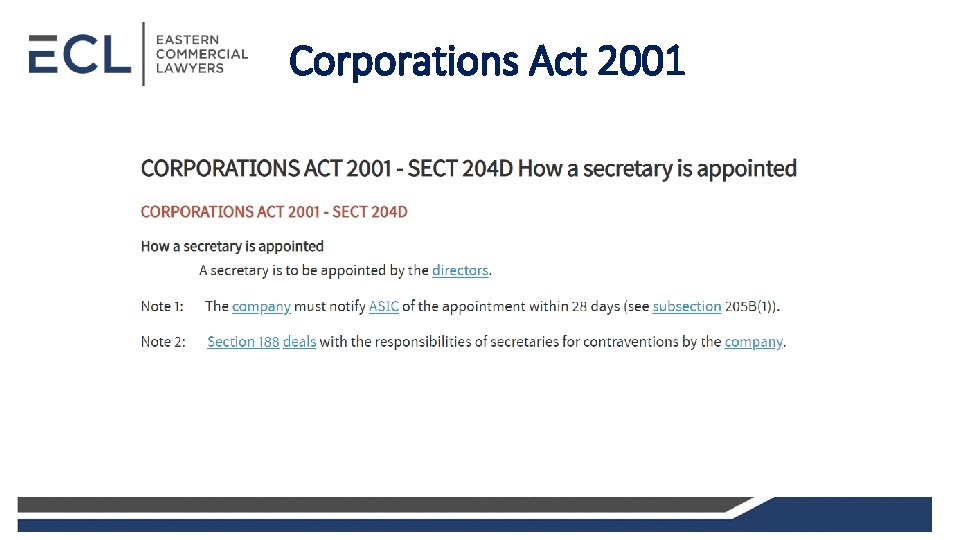
Corporations Act 2001
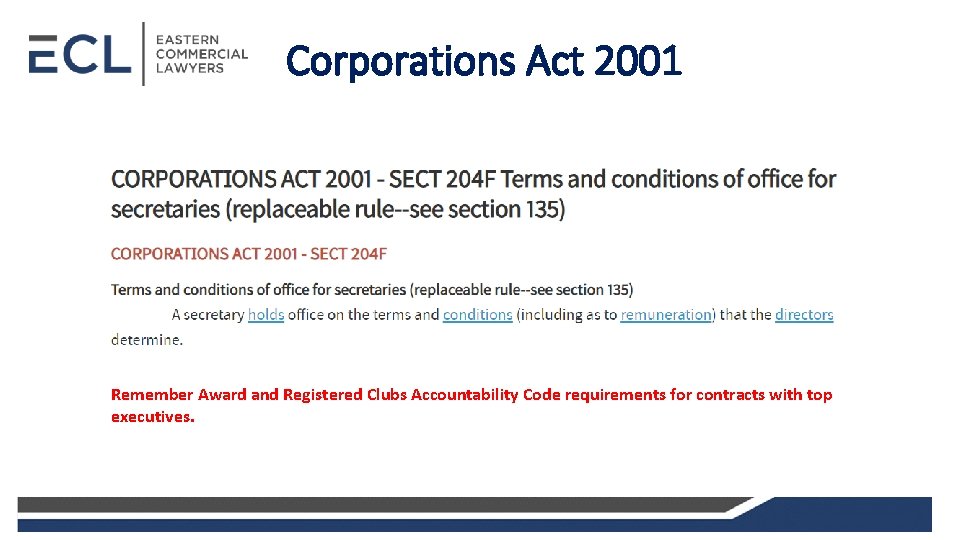
Corporations Act 2001 Remember Award and Registered Clubs Accountability Code requirements for contracts with top executives.
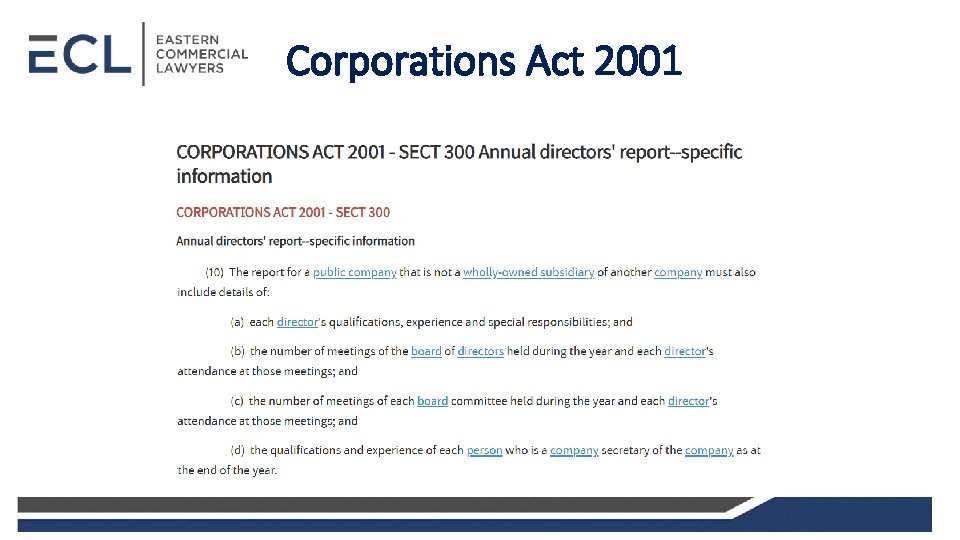
Corporations Act 2001
Registered Clubs Accountability Code Clause 3 - Contract of Employment with Top Executives • Definition of a Top Executive: • The secretary of the club • A manager of the club (approved manager); • Any employee of the club who is nominated by the Club as a top executive, and • Any employee of the club (other than a person referred to above) • who is one of the 5 highest paid employees of the club; and • whose remuneration package exceeds the high income threshold set by the Fair Work Commission ($145, 400. 00); and • who is involved in the general administration of the club or with its liquor and gaming operations.
Registered Clubs Accountability Code Clause 3 - Contract of Employment with Top Executives • All top executives must have a written employment contract that deals with: • • terms of employment; role and responsibilities; remuneration; and termination. • The written employment contract must have been: • reviewed by an independent and qualified adviser; and • approved by the Board.

Your role as the Company Secretary
Your role as the Company Secretary • The company secretary as an employee owes to their employer common law duties of: • Competence; • Care (duplicated in statute); • Obedience; and • Good faith (duplicated in statute).
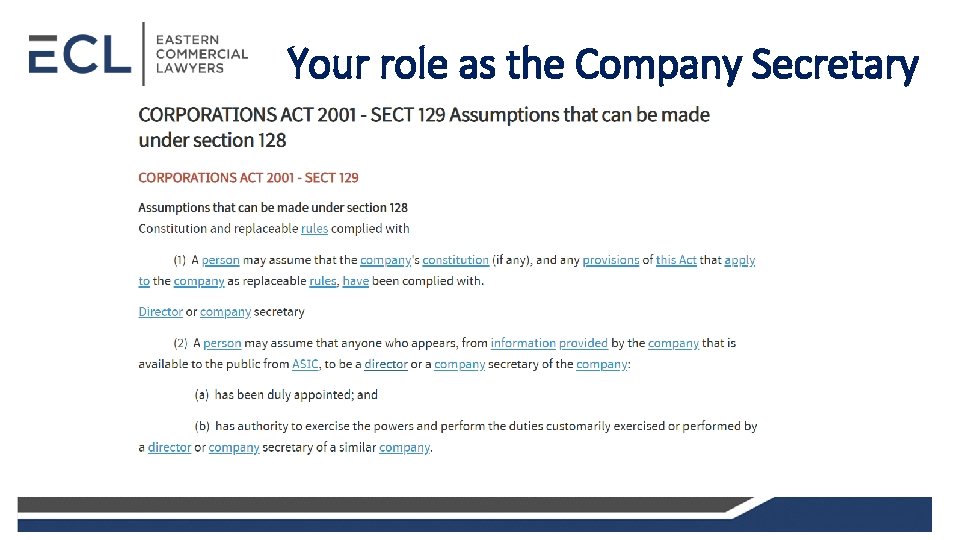
Your role as the Company Secretary
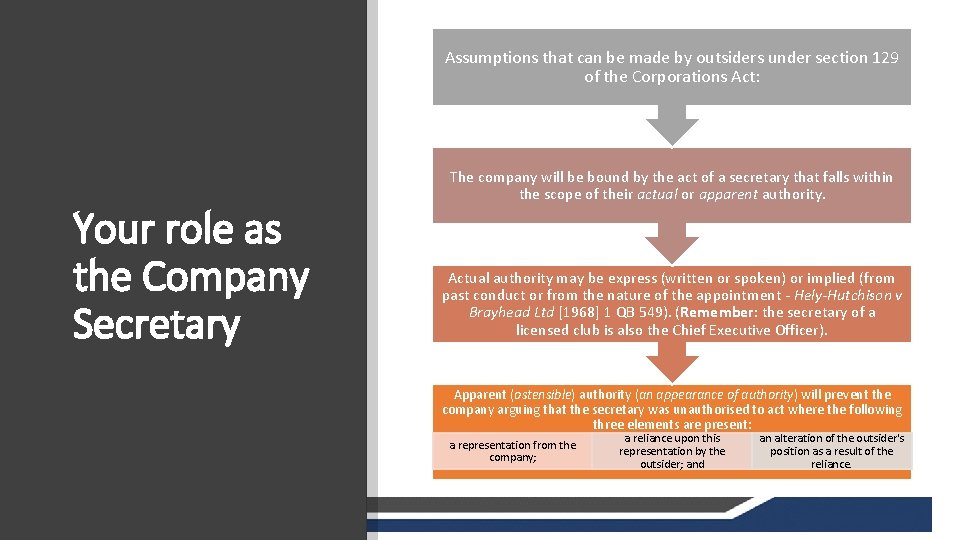
Assumptions that can be made by outsiders under section 129 of the Corporations Act: Your role as the Company Secretary The company will be bound by the act of a secretary that falls within the scope of their actual or apparent authority. Actual authority may be express (written or spoken) or implied (from past conduct or from the nature of the appointment - Hely-Hutchison v Brayhead Ltd [1968] 1 QB 549). (Remember: the secretary of a licensed club is also the Chief Executive Officer). Apparent (ostensible) authority (an appearance of authority) will prevent the company arguing that the secretary was unauthorised to act where the following three elements are present: a representation from the company; a reliance upon this representation by the outsider; and an alteration of the outsider's position as a result of the reliance.
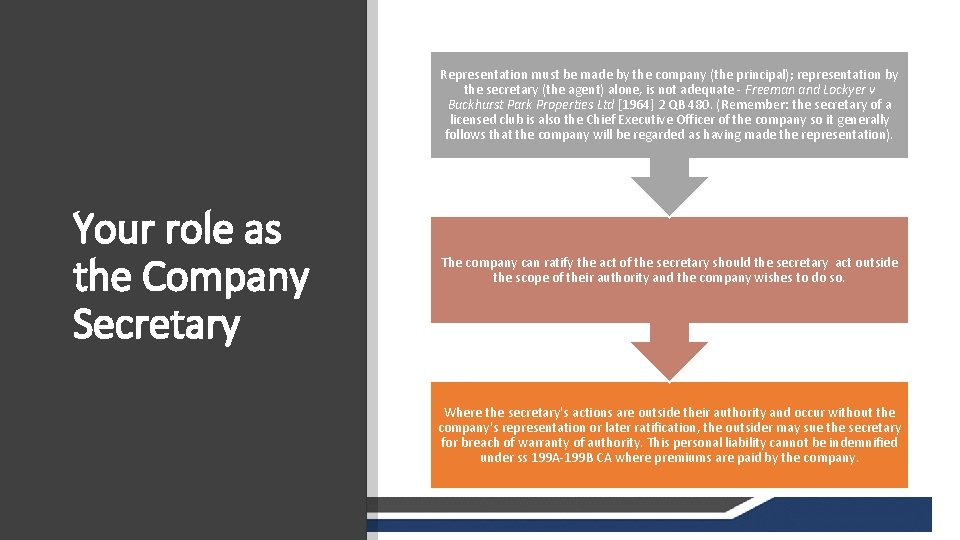
Representation must be made by the company (the principal); representation by the secretary (the agent) alone, is not adequate - Freeman and Lockyer v Buckhurst Park Properties Ltd [1964] 2 QB 480. (Remember: the secretary of a licensed club is also the Chief Executive Officer of the company so it generally follows that the company will be regarded as having made the representation). Your role as the Company Secretary The company can ratify the act of the secretary should the secretary act outside the scope of their authority and the company wishes to do so. Where the secretary's actions are outside their authority and occur without the company's representation or later ratification, the outsider may sue the secretary for breach of warranty of authority. This personal liability cannot be indemnified under ss 199 A-199 B CA where premiums are paid by the company.
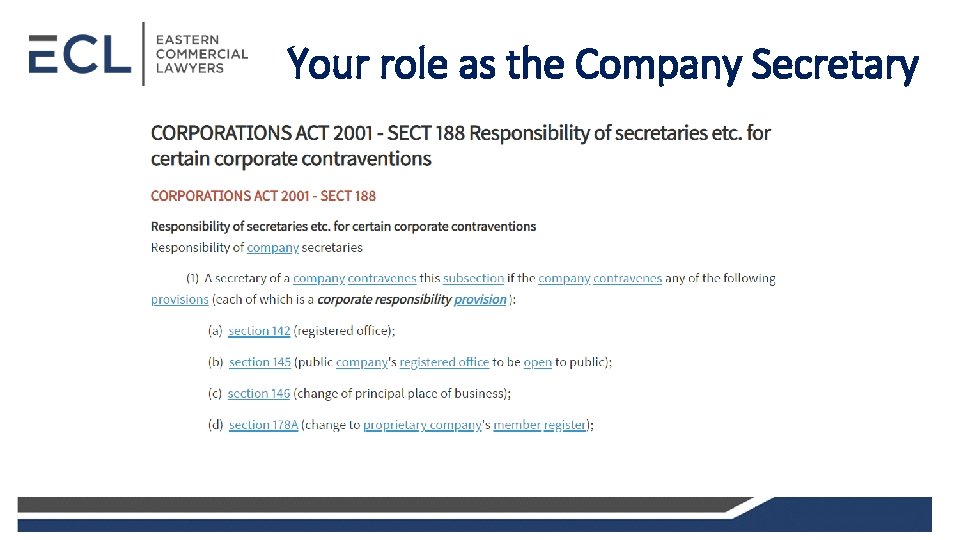
Your role as the Company Secretary
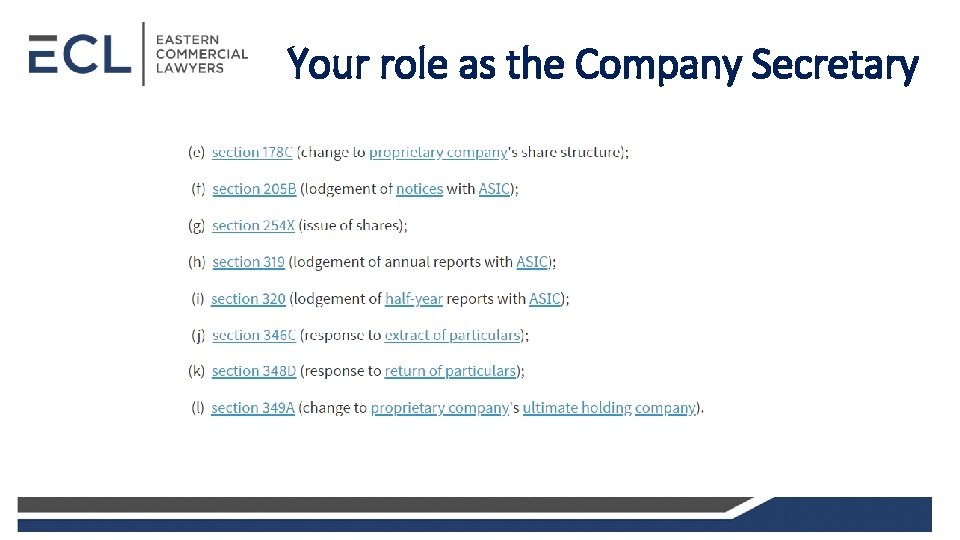
Your role as the Company Secretary
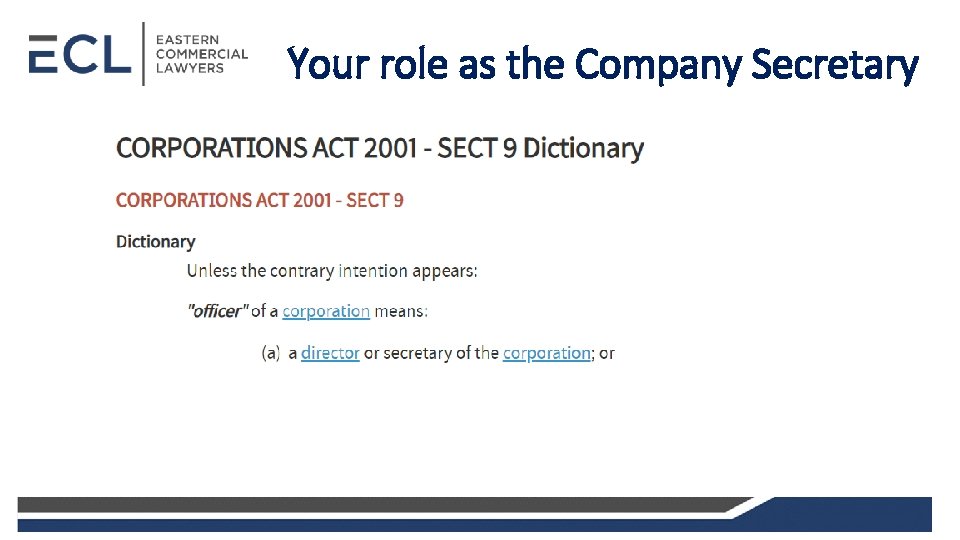
Your role as the Company Secretary
Because company secretaries are considered an ‘officer’ within the meaning of the Corporations Act 2001 they have the same duties of directors, being: Legal Obligations of the Company Secretary • To exercise their powers and discharge their duties with care and diligence (section 180); • To exercise their powers and conduct their duties in good faith and for a proper purpose (section 181); • To ensure they do not improperly use their position to gain an advantage for themselves or someone else or to cause detriment to the company (section 182);
Legal Obligations of the Company Secretary • To ensure they do not improperly use information obtained through their position (section 183); • It is a criminal offence if a company secretary is reckless or intentionally dishonest and fails to exercise their powers and discharge these duties in good faith, for a proper purpose and in the best interest of the company (section 184).
Section 180(1) Corporations Act 2001 Reasonable person standard Directors and officers must exercise their powers and discharge their duties with the degree of care and diligence that a reasonable person would exercise if he or she: Duty of Care and Diligence • Were a director or officer of a company in the company’s circumstances; and • Occupied the office held by, and had the same responsibilities within the company as, the director or officer.
Section 180(2) of the Corporations Act 2001 Directors and officers who make a business judgment are taken to meet the requirements of the statutory duty of care and diligence in respect of the judgment if they: Statutory Business Judgment Rule • Make the judgment in good faith and for a proper purpose • Do not have a material personal interest in the subject matter of the judgment • Inform themselves about the subject matter of the judgment to the extent they reasonably believe to be appropriate; and • Rationally believe that the judgment is in the best interests of the corporation.
Section 180(2) of the Corporations Act 2001 Statutory Business Judgment Rule The director’s or officer’s belief that the judgement is in the best interests of the corporation will be considered a rational belief unless: • the belief is one that no reasonable person in their position would hold. Section 180(3) provides that “business judgment” means any decision to take or not take action in respect of a matter relevant to the business operations of the corporation. IMPORTANT: a decision must be made!!
Section 181(1) of the Corporations Act 2001 Duty to act in Good Faith in the Best Interests of the Company A director or other officer must exercise their power and discharge their duties: • In good faith in the best interests of the corporation; and • For a proper purpose. Malcolm CJ in Chew v R (1991) summarised the first part of the duty as follows: • Directors must exercise their powers in the interests of the company, and must not misuse or abuse their power. • Must avoid conflict between their personal interests and those of the company
Section 181(1) of the Corporations Act 2001 Ipp J (Malcolm CJ and Seaman J agreeing) summarized the second part of the duty as follows: Duty to act in Good Faith in the Best Interests of the Company • Fiduciary powers granted to officers must be exercised for the purpose for which they were given, not collateral purposes; • Not relevant whether decision was good or bad, it is whether officers have acted in breach of their fiduciary duties; • Honest and altruistic behaviour does not prevent a finding of improper conduct. Whether acts performed for the benefit of the company is to be objectively determined. However, subjective intentions are also relevant. • The court must determine whether, but for the improper or collateral purpose, the officers would have performed the act in dispute.
Section 182 - Use of position Officer must not improperly use position to: Duty as to use of position • gain advantage for themselves or someone else; or • cause detriment to the corporation. Duty to be considered as an objective matter.
Section 183 - Use of information Officers must not improperly use information obtained as a director to: Duty as to use of information • gain advantage for themselves or someone else; or • cause detriment to the corporation. Applies to a person who is no longer an officer. Duty to be considered as an objective matter.
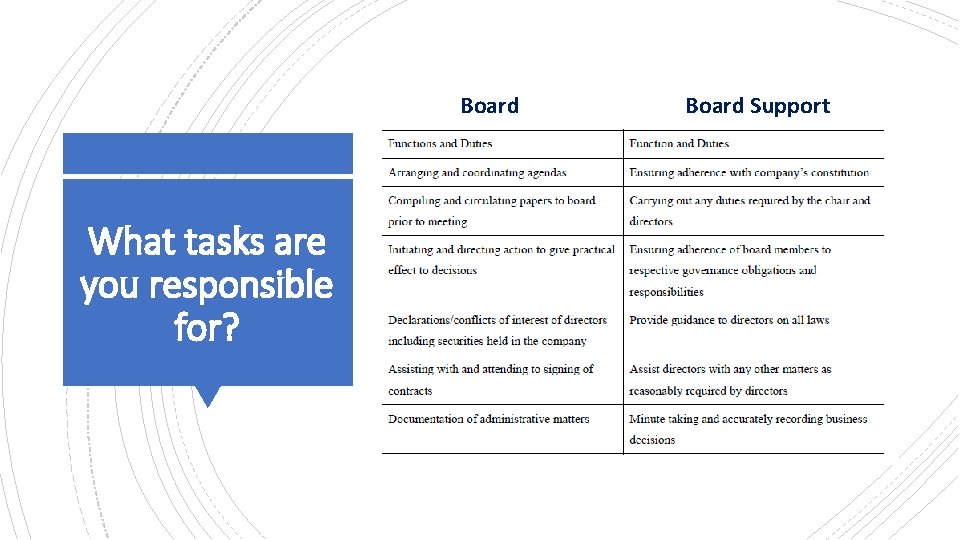
Board What tasks are you responsible for? Board Support
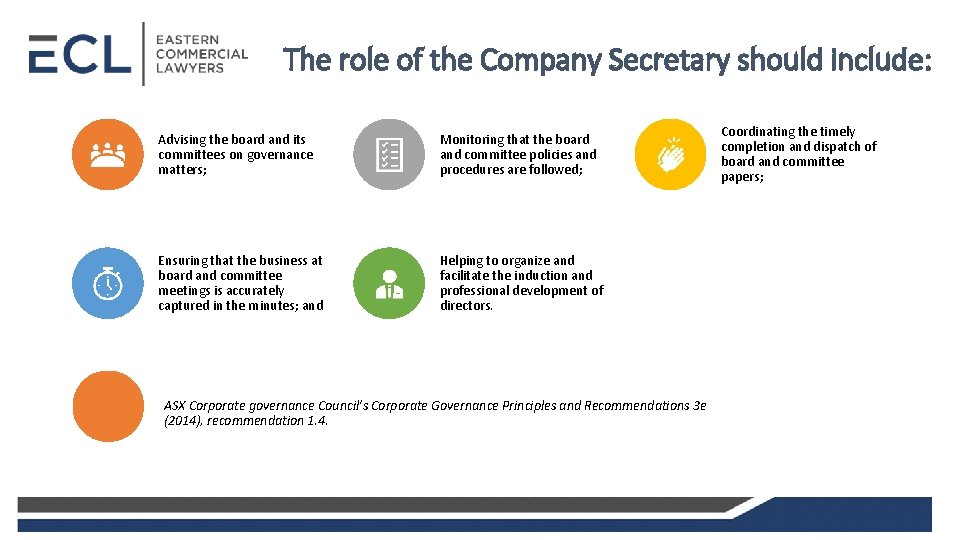
The role of the Company Secretary should include: Advising the board and its committees on governance matters; Monitoring that the board and committee policies and procedures are followed; Ensuring that the business at board and committee meetings is accurately captured in the minutes; and Helping to organize and facilitate the induction and professional development of directors. ASX Corporate governance Council’s Corporate Governance Principles and Recommendations 3 e (2014), recommendation 1. 4. Coordinating the timely completion and dispatch of board and committee papers;

- Slides: 30