
YORKSHIRE DIALECT AND ACCENT Prepared by Edina Homoki
YORKSHIRE DIALECT AND ACCENT Prepared by Edina Homoki
The Yorkshire dialect and accent refers to the varieties of English used in the northern English county of Yorkshire. In many films we can hear examples of the Yorkshire dialect. These films are: • • Kes (drama film, 1969) Last of the Summer Wine (sitcom, 1973 -2010) Emmerdale (soap opera, 1972 -present) Little Voice (musical film, 1998)
Some features of Yorkshire accents are general features of Northern English accent. Other features of pronunciation include: Southern half of Yorkshire • the phoneme /aʊ/ (as in mouth) pronounced as a monophthong [a: ], often represented with “ah” down = “dahn”, south = sahth • some words with igh in spelling, like night, right, can be pronounced with /i: / instead of /aɪ/ • the word right can also be pronounced with the same /eɪ/ as weight
• words with ake at the end may be pronounced with /e/ (as in dress) take = tek, make = mek, ska = sek • the vowel /u: /, as in goose, can be realised as a diphthong [ʊu] • plurals and past participle endings which are pronounced /iz/ and /id/ may be pronounced as /ə/. For example, badge plural barger, boxer
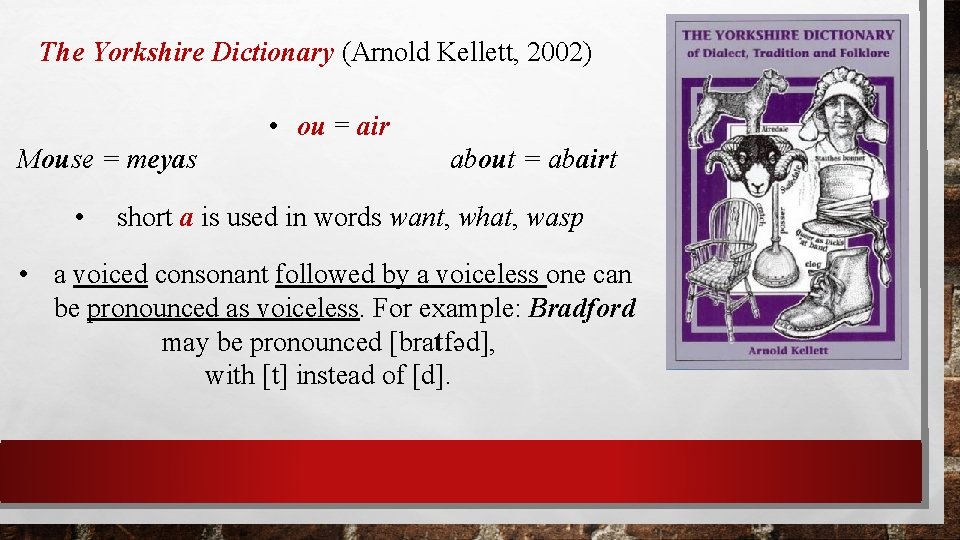
The Yorkshire Dictionary (Arnold Kellett, 2002) • ou = air Mouse = meyas • about = abairt short a is used in words want, what, wasp • a voiced consonant followed by a voiceless one can be pronounced as voiceless. For example: Bradford may be pronounced [bratfəd], with [t] instead of [d].
• replacing of /t/ with /r/ e. g. I’m gerring berrer for I’m getting better, Gerrof for Get off!, Purrit dahn for Put it down • pronunciation of th = d (in some words), the second person pronouns thee and thou = dee, dou (used in southern parts of Yorkshire) • Yorkshire dialect shares many features with other English dialects used in Northern England or in Scotland, e. g. aye = yes
Examples of vocabulary and grammar more specific to Yorkshire dialects include: • Definite article reduction: shortening of the to a form without a vowel, often written t’. “Down the pub” is pronounced “down t’ pub”, where the t’ represents a sound more like a glottal stop than a true t sound. • anything = owt, nothing = nowt • the word us is often used in place of me or our (e. g. We should put us names on us property. )
• the past tense of to be is were: I were wearing t’red coat, but he were wearing t’gree one. • while is often used in the sense of until, e. g. Unless we go at a fair lick, we’ll not be home while sever. • Love is a term used by anyone, said to anyone in any situation, at the end of almost every sentence, e. g. That will be three pounds please love. • the word daft = unintelligent in Yorkshire, but in Britain means silly
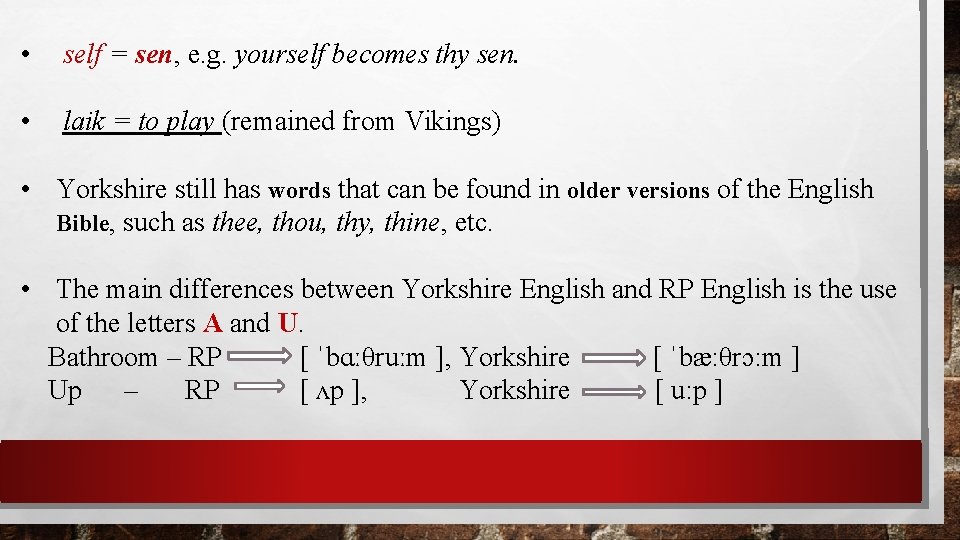
• self = sen, e. g. yourself becomes thy sen. • laik = to play (remained from Vikings) • Yorkshire still has words that can be found in older versions of the English Bible, such as thee, thou, thy, thine, etc. • The main differences between Yorkshire English and RP English is the use of the letters A and U. Bathroom – RP [ ˈbɑːθruːm ], Yorkshire [ ˈbæ: θrɔ: m ] Up – RP [ ʌp ], Yorkshire [ u: p ]
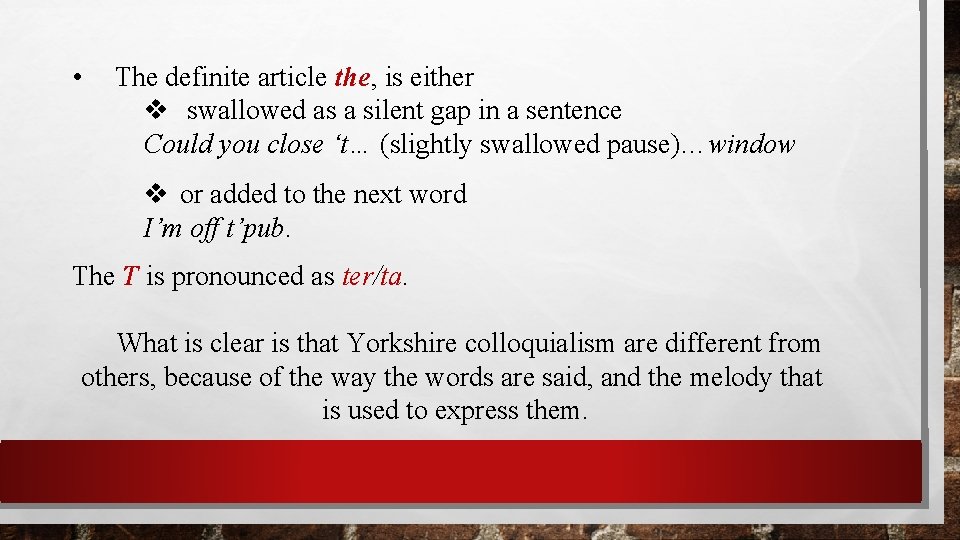
• The definite article the, is either v swallowed as a silent gap in a sentence Could you close ‘t… (slightly swallowed pause)…window v or added to the next word I’m off t’pub. The T is pronounced as ter/ta. What is clear is that Yorkshire colloquialism are different from others, because of the way the words are said, and the melody that is used to express them.
- Slides: 10