
Yolu Region Local Decision Making Partnership Commitment What
- Slides: 26
Yolŋu Region Local Decision Making Partnership Commitment
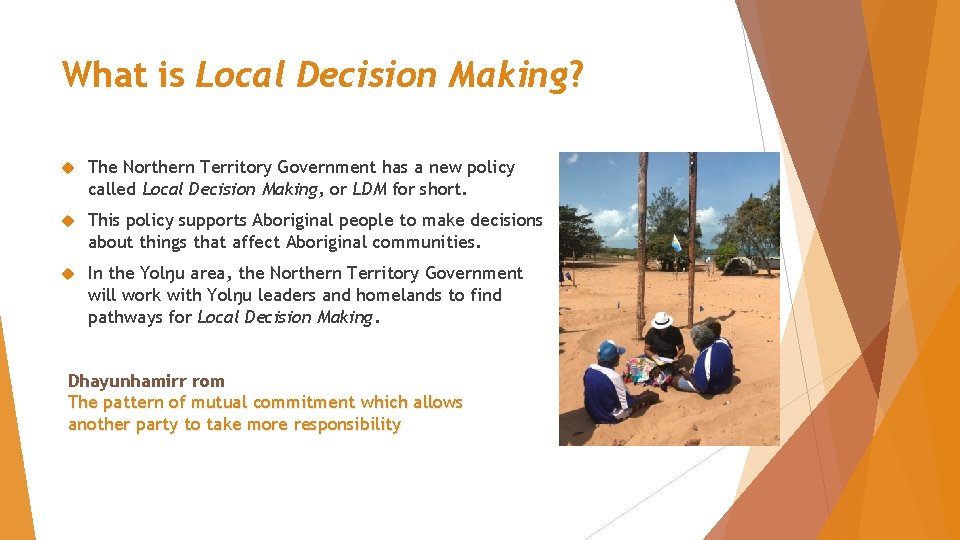
What is Local Decision Making? The Northern Territory Government has a new policy called Local Decision Making, or LDM for short. This policy supports Aboriginal people to make decisions about things that affect Aboriginal communities. In the Yolŋu area, the Northern Territory Government will work with Yolŋu leaders and homelands to find pathways for Local Decision Making. Dhayunhamirr rom The pattern of mutual commitment which allows another party to take more responsibility
Some Guiding Principles. . . Here are some of the main ideas behind Local Decision Making, from the Aboriginal Peak Organisations Northern Territory (APONT): Community Control and Self-determination: Yolŋu people and organisations need to be in the ‘driver’s seat’ and have control over services and programs delivered in their communities. Flexible, place-based approaches: This means that Local Decision Making will bring out different agreements and plans in different places. This is because groups around the Yolŋu Region are all different. Co-design: this means that governments and groups in this Partnership Commitment are drawing or designing the pathway to Local Decision Making together.
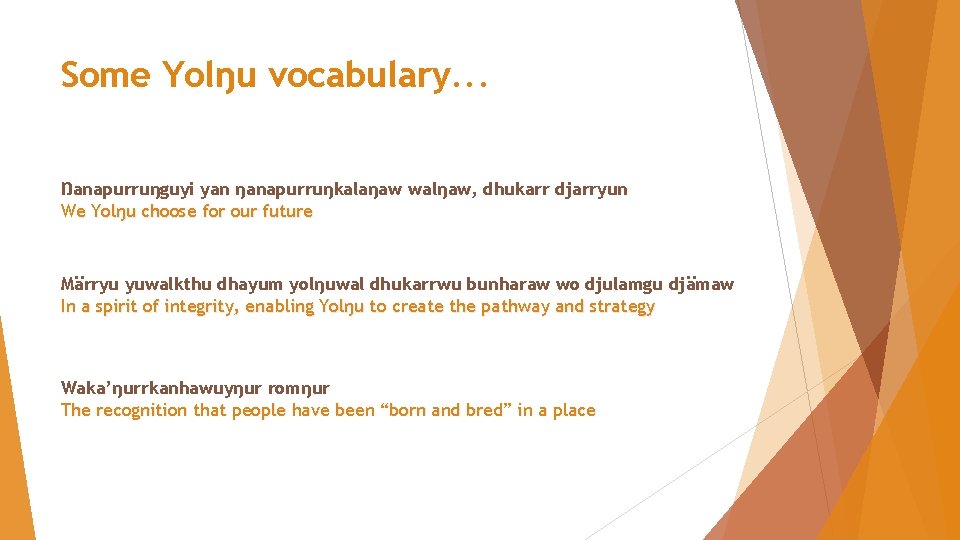
Some Yolŋu vocabulary. . . Ŋanapurruŋguyi yan ŋanapurruŋkalaŋaw walŋaw, dhukarr djarryun We Yolŋu choose for our future Märryu yuwalkthu dhayum yolŋuwal dhukarrwu bunharaw wo djulamgu djämaw In a spirit of integrity, enabling Yolŋu to create the pathway and strategy Waka’ŋurrkanhawuyŋur romŋur The recognition that people have been “born and bred” in a place
Where did the Local Decision Making policy come from? In 2017 and 2018, the Northern Territory Government heard Yolŋu say: Many policies have changed in East Arnhem Land over the last 10 -15 years There are many different governance groups and committees It is difficult for Yolŋu leaders to show unity and authority Governments and other Balanda have decided what work is most important in Yolŋu communities Governments and other Balanda have decided how that work will be done Yolŋu clans and leaders have little power over what happens in their home communities.
Where did the Local Decision Making policy come from? The Northern Territory Government says: The old ways that the Government have made decisions do not work The power to make decisions for Yolŋu communities belongs with Yolŋu people The Northern Territory Government will not move too quickly or too slowly, but at the right pace with Yolŋu people “The old way is finished. At the pace communities are comfortable, the (Northern Territory) Government is ceding decision-making power back to where it belongs, the communities. ” Michael Gunner, Barunga Festival, 2018
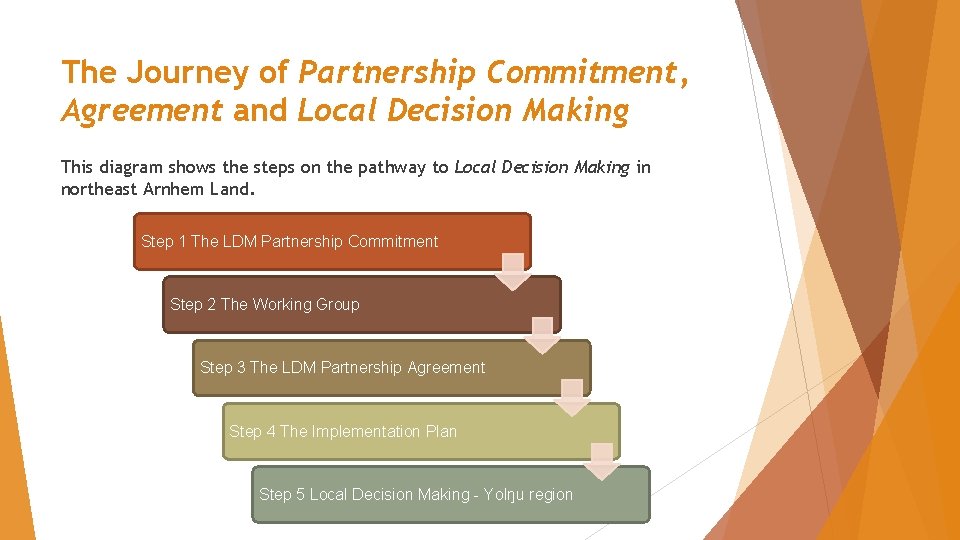
The Journey of Partnership Commitment, Agreement and Local Decision Making This diagram shows the steps on the pathway to Local Decision Making in northeast Arnhem Land. Step 1 The LDM Partnership Commitment Step 2 The Working Group Step 3 The LDM Partnership Agreement Step 4 The Implementation Plan Step 5 Local Decision Making - Yolŋu region
Step 1: The Yolŋu Region Partnership Commitment The Yolŋu Region Local Decision Making Partnership was signed in May 2019 by the Miwatj Health, ALPA, ARDS, Laynhapuy Homelands, the Northern Territory Government, East Arnhem Regional Council and the National Indigenous Australians Agency at the Yolngu Radio Studios in Nhulunbuy. The Northern Land Council is also supporting this Partnership. The Partnership is a way of Balanda and Yolŋu organisations sharing stories to better understand the way decisions are made in the Balanda system and Yolngu system, including their strengths and weaknesses To think about ways of changing the Balanda system to include the Yolŋu way of making decisions An if agreed, to think about how we can make those changes together as Yolŋu
Step 1: The Yolŋu Region Partnership Commitment All of the Governments and groups who are signing this Partnership Commitment agree about many important ideas and principles: Yolŋu people still hold their language, customs and laws, their land sea ownership and custodianship, their culture, songlines and societies Local Decision Making policy will only work if Yolŋu leaders are sharing knowledge and ideas and worries openly Balanda and Yolŋu will learn from each other about ways of sharing information, leading, and making decisions Balanda and Yolŋu will talk respectfully and honestly together, so that strong relationships and trust can grow
Step 1: The Partnership Commitment Goŋbuy giṯiḏaw’yunawuy wo yoranhawuy written or formal agreement Yoranhawuy rom consensual, verbal agreement
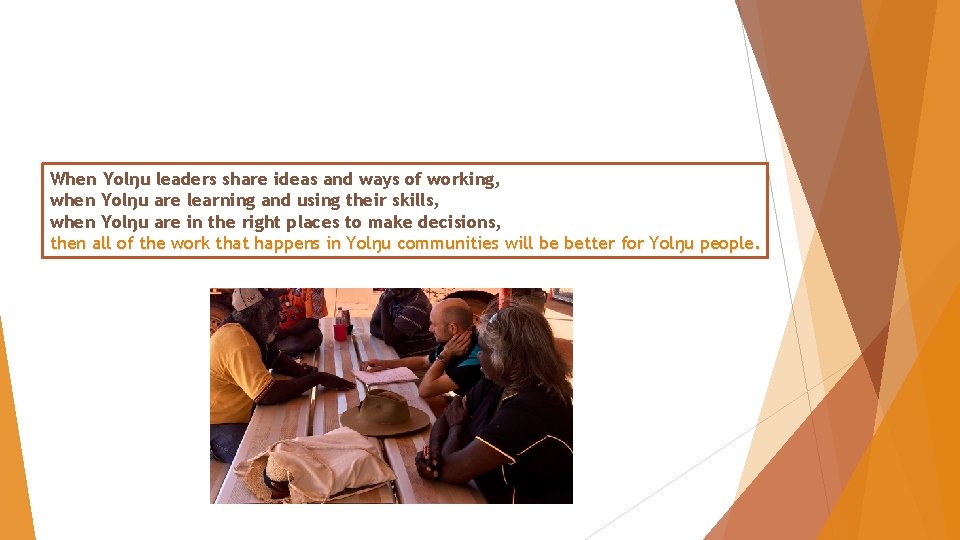
When Yolŋu leaders share ideas and ways of working, when Yolŋu are learning and using their skills, when Yolŋu are in the right places to make decisions, then all of the work that happens in Yolŋu communities will be better for Yolŋu people.
Step 2: The Working Group The Partnership Commitment says that a Working Group will start to meet and talk about how to move down the Local Decision Making pathway. The Partnership Commitment paper explains what the Working Group will do and how it will work. Yolŋu Action Words Märr-yuwalkthirr Djalkiri-burrpurryun Djingaryun Galŋa-rrarrayun English Action Words to believe, to accept, to acknowledge to stand ready to stand to prepare, to organise
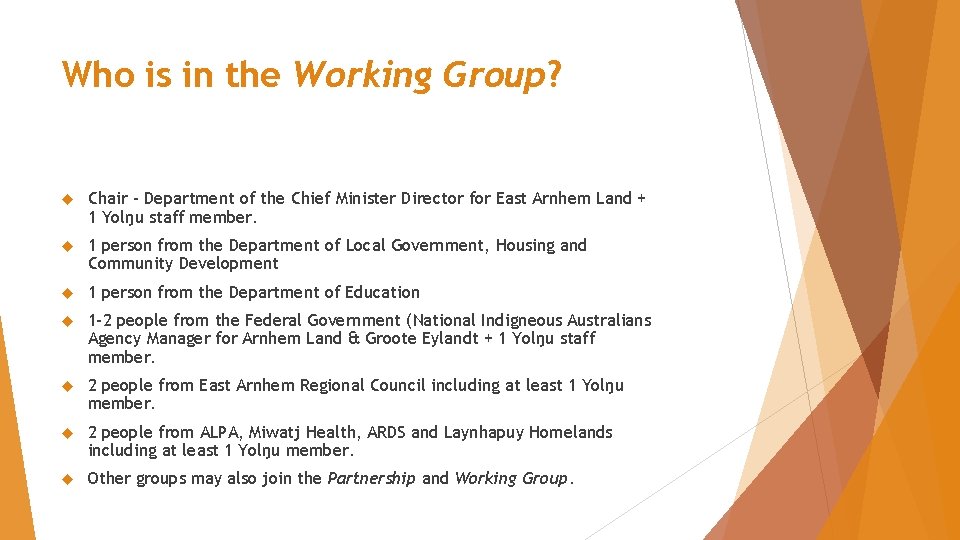
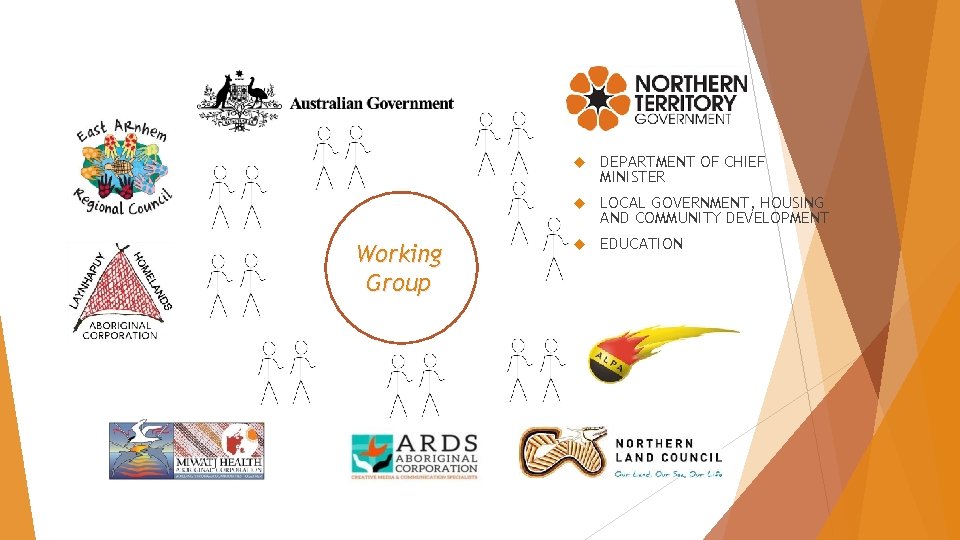
Who is in the Working Group? Chair - Department of the Chief Minister Director for East Arnhem Land + 1 Yolŋu staff member. 1 person from the Department of Local Government, Housing and Community Development 1 person from the Department of Education 1 -2 people from the Federal Government (National Indigneous Australians Agency Manager for Arnhem Land & Groote Eylandt + 1 Yolŋu staff member. 2 people from East Arnhem Regional Council including at least 1 Yolŋu member. 2 people from ALPA, Miwatj Health, ARDS and Laynhapuy Homelands including at least 1 Yolŋu member. Other groups may also join the Partnership and Working Group.
Working Group DEPARTMENT OF CHIEF MINISTER LOCAL GOVERNMENT, HOUSING AND COMMUNITY DEVELOPMENT EDUCATION
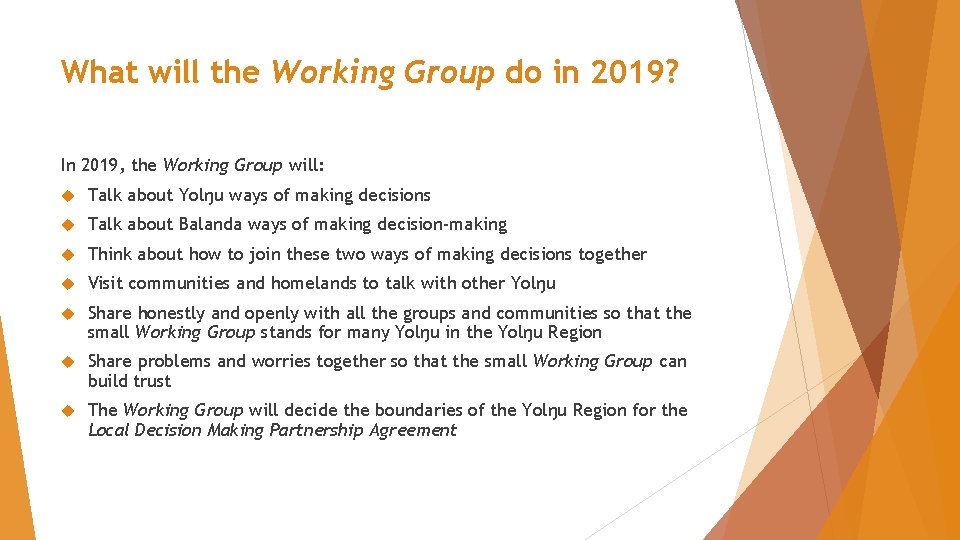
What will the Working Group do in 2019? In 2019, the Working Group will: Talk about Yolŋu ways of making decisions Talk about Balanda ways of making decision-making Think about how to join these two ways of making decisions together Visit communities and homelands to talk with other Yolŋu Share honestly and openly with all the groups and communities so that the small Working Group stands for many Yolŋu in the Yolŋu Region Share problems and worries together so that the small Working Group can build trust The Working Group will decide the boundaries of the Yolŋu Region for the Local Decision Making Partnership Agreement
The Working Group will ask, “What are the special strengths of Yolŋu systems and Balanda systems? ” “In which areas are Yolŋu systems and Balanda systems weak or struggling? ” “How are Yolŋu and Balanda choosing leaders to represent their people and their places? ” “How can we make it easier for Yolŋu leaders to show cultural and decisionmaking authority? ” “How can we make it easier for Yolŋu leaders to make strong decisions for their own people and places? ” “How can Governments and groups help each other to learn and grow skills for Local Decision Making? ”
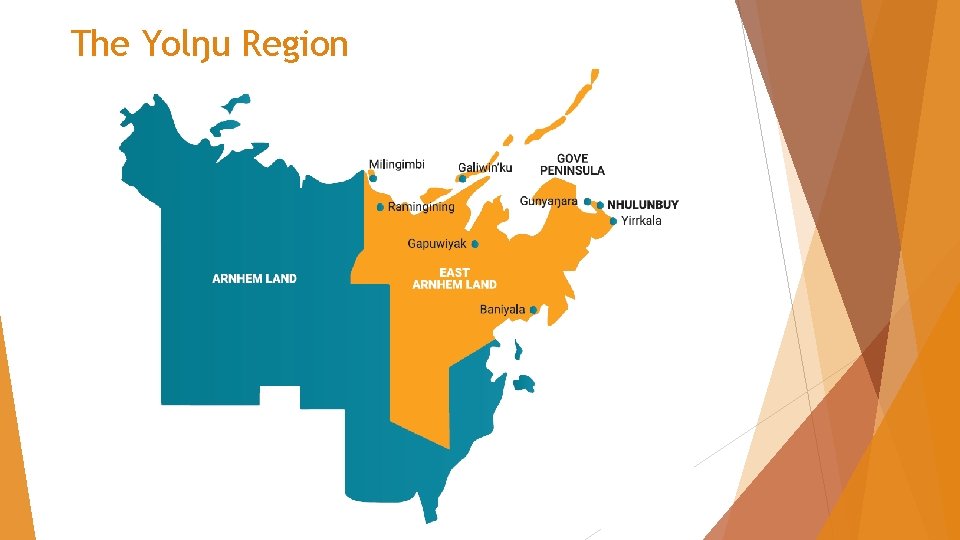
The Yolŋu Region
What will the Working Group do in 2020? In 2020, the Working Group will: List all of the services working in the communities and homelands around the Yolŋu Region Think about how Yolŋu leaders can make more and more decisions about healthcare, education, police and courts, housing, welfare and family support, and other work in the Yolŋu communities Plan how Yolŋu can gradually join in and steer the work
How will people work together in partnership? In the Working Group: Everyone will share ideas openly When people see a way to strengthen the Local Decision Making Partnership, they will share those ideas with the Working Group When people see that something might go wrong in the Local Decision Making Partnership, they will share these worries with the Working Group If there any problems in the Partnership, then the senior leaders in the Working Group will try and solve the problems, or bring the problem to the Regional Strategic Coordination Committee
How will people work together in partnership? Buku-djulkmaram dharŋgurr Trading information in dialogue Dhapinyay romthu djäma Working in good faith, spirit of generosity
When will the Working Group meet? June 2019 - the first meeting of the new Working Group Then the Working Group will meet every month or two
Where will the Working Group meet? The Working Group will mostly meet in Nhulunbuy The Working Group may plan other meetings in different communities
Step 3: Partnership Agreement All of the thinking, talking and planning in the Working Group will be written into a new agreement called the Local Decision Making Partnership Agreement. The Governments and groups hope to finish a Partnership Agreement for Local Decision Making by June 2020. The Partnership Agreement will map the pathway for everyone to walk down to make Local Decision Making real. Dhanara nhirrpan yalalaŋumirriw Setting a future time for a particular cause Yolŋu Action Words Buku-ŋayatham English Action Words to reach an agreement or a milestone
Step 4: Implementation Plans The Implementation Plans will explain: How Governments and groups will make changes to hand more control to Yolŋu leaders; When these changes will happen, over the next ten years; Dhayunhawuy gatjaḻ ŋayi dhu dhä-yuwalkthirri yan, marr ga ŋayi yaka dhu dhä-bäythirr The handover process will be realised, so that (this opportunity) will not be missed
Step 5: Yolŋu Region Local Decision Making hopes to stop dividing Yolŋu leaders across many different boards and groups and help them come back together to look after their clans and country. Everyone looks forward to the future when local Yolŋu in communities will make more decisions, lead decisions and own decisions. The Yolŋu Region Local Decision Making policy will put Yolŋu culture and Yolŋu leaders at the heart of decisions to benefit Yolŋu in East Arnhem Land. Ŋanapurr Yolŋu ŋayaŋu-waŋgany We Yolŋu are united in spirit