
Yogurt bacteria at 400 x magnification Bacteria chain
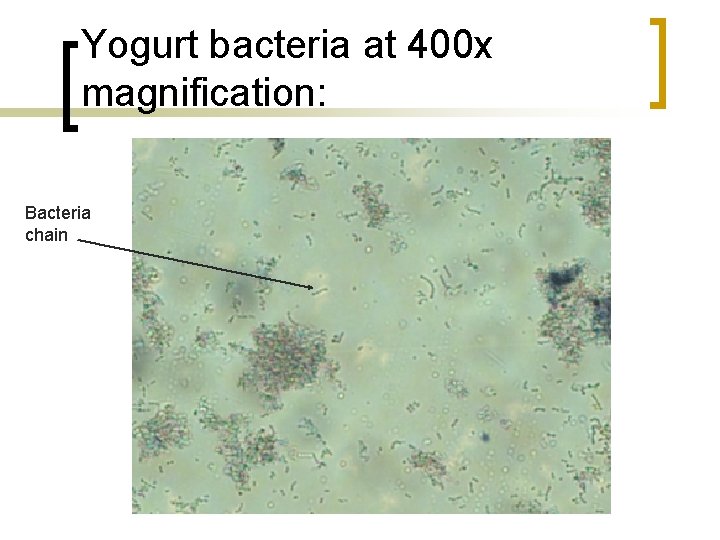
Yogurt bacteria at 400 x magnification: Bacteria chain
Lab Objectives n n n RST 3 – Follow precisely a complex multistep procedure when carrying out experiments, taking measurements, or performing technical tasks, attending to special cases or exceptions in defined in the text. RST 7 – Translate quantitative or technical information expressed in words in a text into visual form and translate information expressed visually or mathematically. WST 2. a – Introduce a topic and organize ideas, concepts and info to make important connections and distinctions; include formatting and graphics.
Comparing Cells Lab (pages 94 -95) n Pre-lab questions: complete in your notebook. 1. List the common features of all cells. 2. What are the defining features of Eukaryotic cells? 3. Identify three unique features of plant cells. 4. How do you calculate the power of magnification on a microscope? 5. List the possible dangers associated with the lab and how we will protect ourselves.
Comparing Cells Lab - Part 1 n Observing animal cells – procedure 1. Watch Mr. Connolly prepare the cheek cell slide – record the step by step procedure. Carefully prepare your own cheek cell slide. (One per group) Follow steps 3 and 4 from part A on Page 94. Complete all work in your team’s lab report! CLEAN UP AND RETURN YOUR SLIDE AND THE COVERSLIP 2. 3. 4. 5.
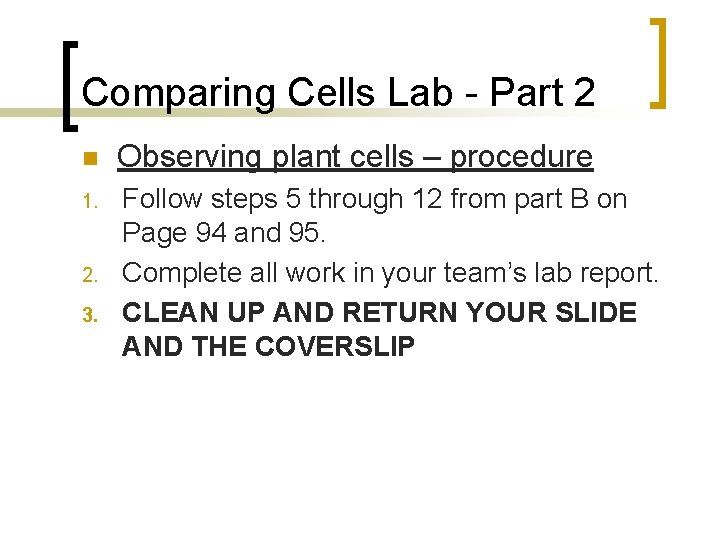
Comparing Cells Lab - Part 2 n Observing plant cells – procedure 1. Follow steps 5 through 12 from part B on Page 94 and 95. Complete all work in your team’s lab report. CLEAN UP AND RETURN YOUR SLIDE AND THE COVERSLIP 2. 3.
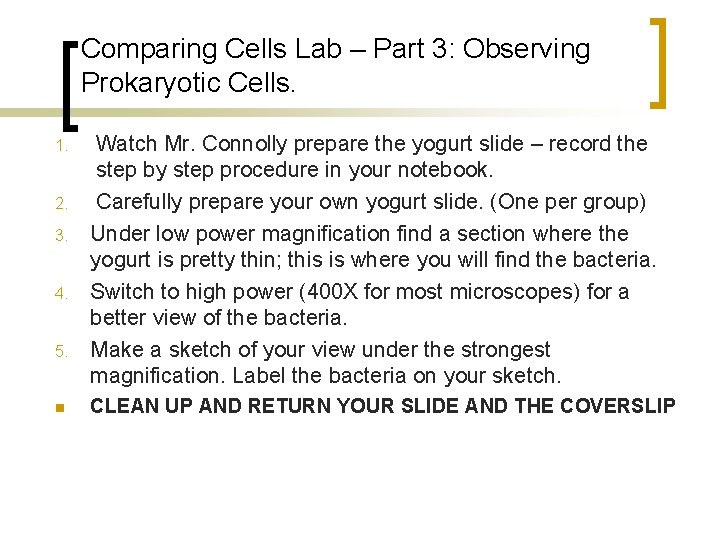
Comparing Cells Lab – Part 3: Observing Prokaryotic Cells. 1. 2. 3. 4. 5. n Watch Mr. Connolly prepare the yogurt slide – record the step by step procedure in your notebook. Carefully prepare your own yogurt slide. (One per group) Under low power magnification find a section where the yogurt is pretty thin; this is where you will find the bacteria. Switch to high power (400 X for most microscopes) for a better view of the bacteria. Make a sketch of your view under the strongest magnification. Label the bacteria on your sketch. CLEAN UP AND RETURN YOUR SLIDE AND THE COVERSLIP
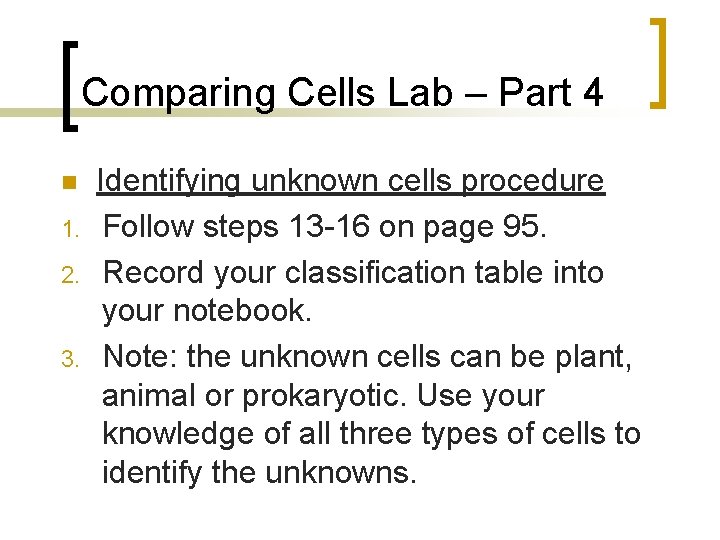
Comparing Cells Lab – Part 4 n 1. 2. 3. Identifying unknown cells procedure Follow steps 13 -16 on page 95. Record your classification table into your notebook. Note: the unknown cells can be plant, animal or prokaryotic. Use your knowledge of all three types of cells to identify the unknowns.
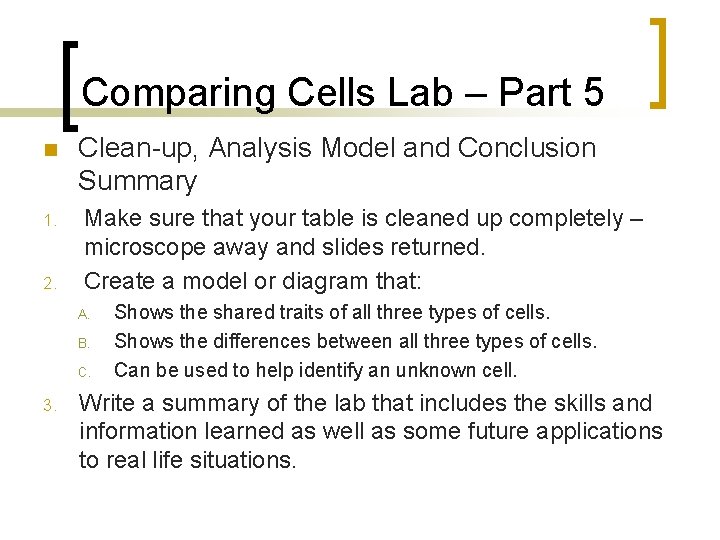
Comparing Cells Lab – Part 5 n 1. 2. Clean-up, Analysis Model and Conclusion Summary Make sure that your table is cleaned up completely – microscope away and slides returned. Create a model or diagram that: A. B. C. 3. Shows the shared traits of all three types of cells. Shows the differences between all three types of cells. Can be used to help identify an unknown cell. Write a summary of the lab that includes the skills and information learned as well as some future applications to real life situations.
- Slides: 8