
YOGHURT TECHNOLGY Res Asst DVM Bahar ONARAN Ankara

YOGHURT TECHNOLGY Res. Asst, DVM Bahar ONARAN Ankara University, Faculty of Veterinary Medicine Department of Food Hygiene and Technology
Yoghurt • A fermented dairy product whereby milk is inoculated with bacteria cultures. • Fermentation a slow decomposition process of organic substances induced by microorganisms or enzymes. • To produce yogurt, lactose, a compound sugar found in milk, is fermented by two different species of bacteria; Streptococcus thermophilus Lactobacillus delbrueckii subsp. bulgaricus
v. Streptococcus thermophilus v. Lactobacillus bulgaricus Thermophilic bacteria Heat-loving grows better at 40 -45 C
• Yogurt is commercially produced by adding to milk a 2 -4 % STARTER CULTURES that has been inoculated with a 2 -5 % combination of S. thermophilus, L. bulgaricus (1: 1 ratio). • The milk mixture is then incubated at 40 -45 C for 3 -6 hours. • The product must be cooled immediately.
• Milk SNF (solids-non-fat) content of yogurt varies from 9 -16 %. • SNF can be increased by adding milk powder, and by other means. • Increased SNF levels are needed to increase protein content, which helps to increase product viscosity to desired levels.
• The major flavor components of yogurt are carbonil compounds; among these, acetaldehyde is the most important and gives the yogurt its acidic flavor. • Other flavor compenents are; Ødiacetyl, lactic acid, acetoin, ethanol • Yogurt quality is based on color, apperance, body, texture and flavor.
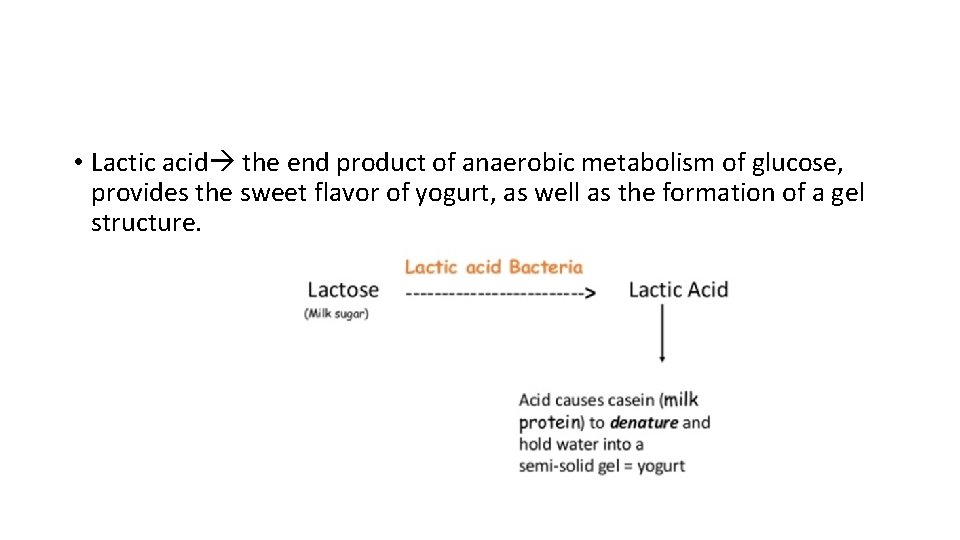
• Lactic acid the end product of anaerobic metabolism of glucose, provides the sweet flavor of yogurt, as well as the formation of a gel structure.
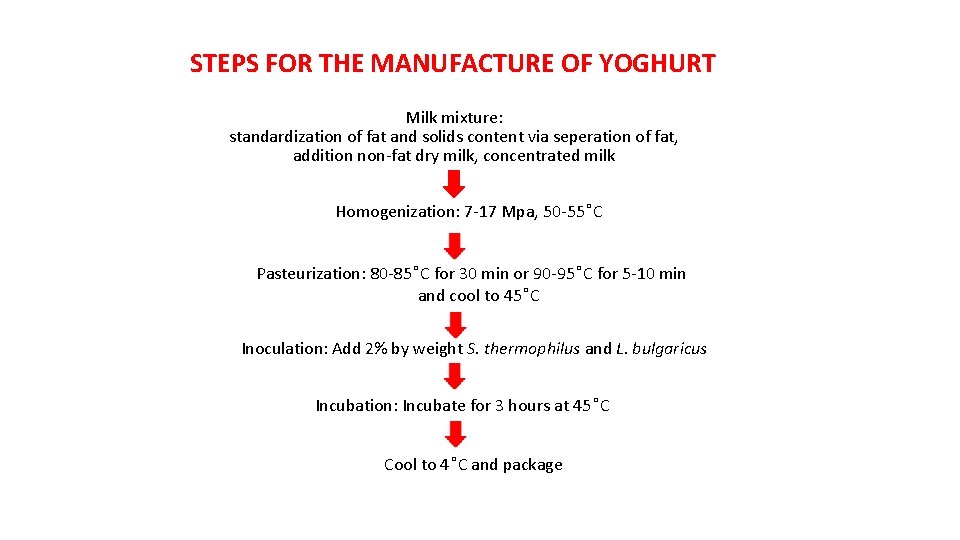
STEPS FOR THE MANUFACTURE OF YOGHURT Milk mixture: standardization of fat and solids content via seperation of fat, addition non-fat dry milk, concentrated milk Homogenization: 7 -17 Mpa, 50 -55 C Pasteurization: 80 -85 C for 30 min or 90 -95 C for 5 -10 min and cool to 45 C Inoculation: Add 2% by weight S. thermophilus and L. bulgaricus Incubation: Incubate for 3 hours at 45 C Cool to 4 C and package
ü Why heating milk at higher temperatures? • Destroying pathogen microoorganisms • Opaque white color Lactalbumin and lactoglobulin denaturation (they are yellow) Consistence is higher • Condition the proteins: begins the denaturing process A whey protein molecule binds to a casein molecule which disrupts the casein bundles allowing them to make short branched micelle chains • Appears formic acid, H 2 S molecules starters grow better
Homogenization • Prevent creaming • More tasty due to the homogen dispertion of fatty acids • More digestable due to the little particules of fatty acids • Good effect on the consistance
Incubation temperature • 40 -45 C takes 3 hours Produces coarse protein network with thick trands give firmness but easily leak whey (a process called syneresis – the seperation of liquid from the gel) • 30 C takes 18 hours Produces a finer more branched delicate network that holds the liquid whey.
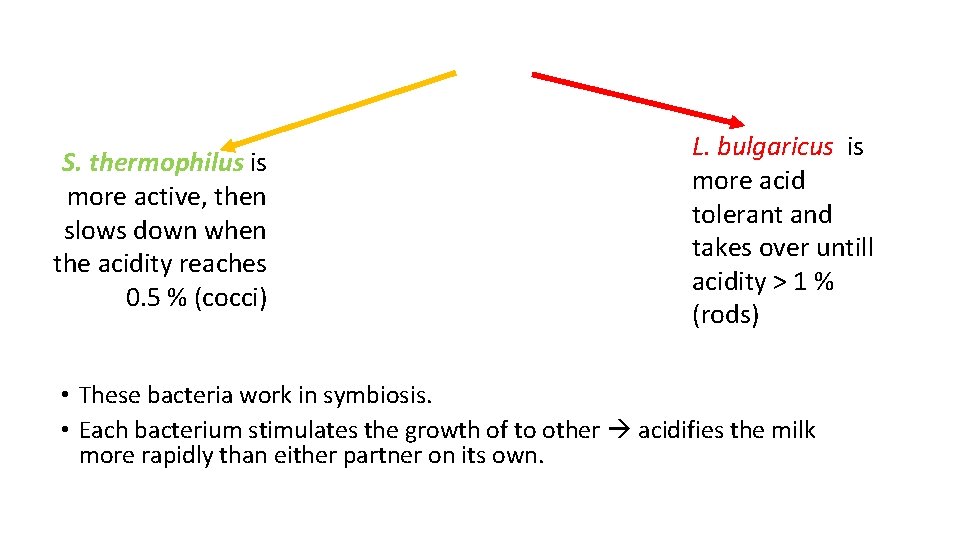
S. thermophilus is more active, then slows down when the acidity reaches 0. 5 % (cocci) L. bulgaricus is more acid tolerant and takes over untill acidity > 1 % (rods) • These bacteria work in symbiosis. • Each bacterium stimulates the growth of to other acidifies the milk more rapidly than either partner on its own.
Simbiosis • Initially S. thermophilus grows rapidly in the presence of oxygen and produce formic acid and CO 2. • The anaerobic condition, formic acid and CO 2 stimulate the growth of L. bulgaricus which has good exoproteinase and peptidase systems and produce amino acids and peptides from milk proteins. • L. bulgaricus produce amino acids such as glycine, valine, histidine, leucine and methionine. (sulfurous amino acids)
Simbiosis • These amino acids are necessary for the growth of S. thermophilus which lacks proteinase enzymes. • S. thermophilus grows rapidly until p. H drops to 5. 2 -5. 3 at the time of 2 nd hour.
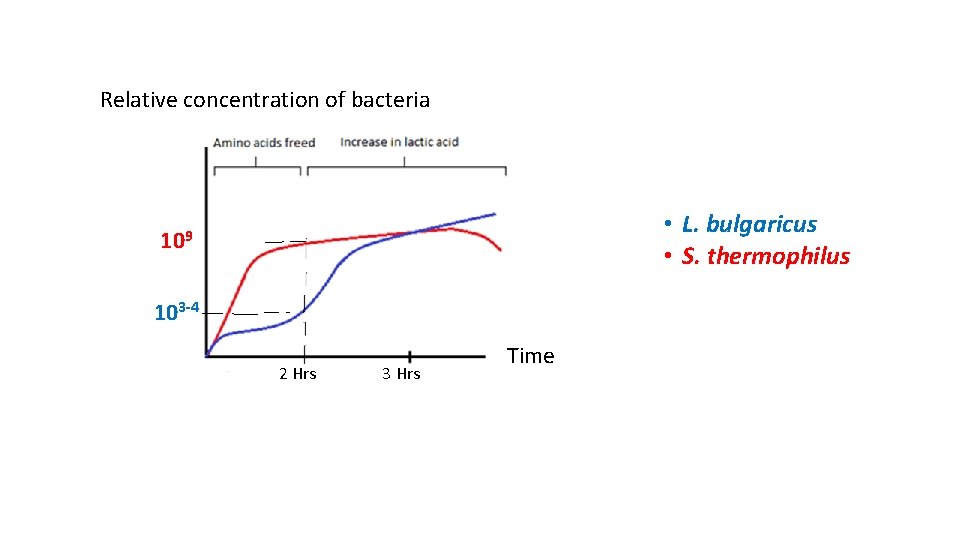
Relative concentration of bacteria • L. bulgaricus • S. thermophilus 109 103 -4 2 Hrs 3 Hrs Time
In p. H 5. 2 -5. 3 (at the end of the 2 nd hour) • Stability of the caseinat particules break down. ØCa and phospates seperates from the casein complex (Ca. Caseinate-Phosphate Complex) and they ionized. ØCasein become precipitated. ØFirst curd appears it’s sweet and loose v. Streptococcus thermophilus: 109 v. Lactobacillus bulgaricus: 103 -4
• After 2 nd hour; • The growth of S. thermophilus slows down. • However, growth of L. bulgaricus continues fairly rapidly. • After 3 hours; we have to take it from the incubator. (we have to cool it immediately) • At the time p. H drops in to 4. 6 -4. 8. • At that time both of the bacteria count: 109 (and they are equal) • If we don’t take of it from the incubator, L. bulgaricus continues to grow and the taste of the yogurt become sour (acidic). • Because L. bulgaricus is proteolitic one.
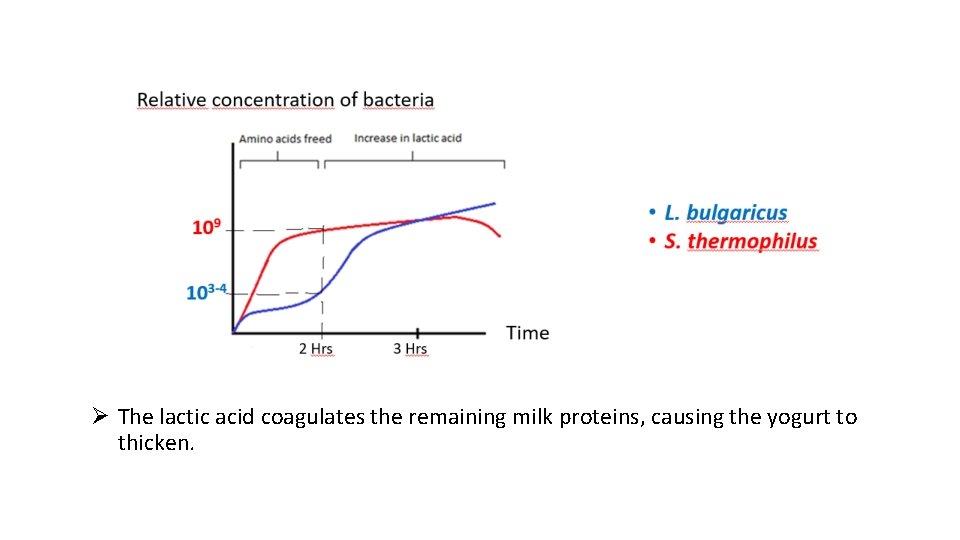
Ø The lactic acid coagulates the remaining milk proteins, causing the yogurt to thicken.
Fat contents of yogurt • The fat content of yogurt varies from 0 -3. 5 %, • Low fat yogurt 1 -1. 5 % fat
- Slides: 19