
YEAST CELL STRUCTURE Stefan Hohmann 2000 2004 w

- Slides: 15
YEAST CELL STRUCTURE © Stefan Hohmann 2000 -2004 w w w Yeast taxonomy Yeast is a eukaryote: the yeast cell Yeast has a sexual cycle Yeast cell duplication: budding vs fission Yeast has a cell wall (functions) Yeast genetics
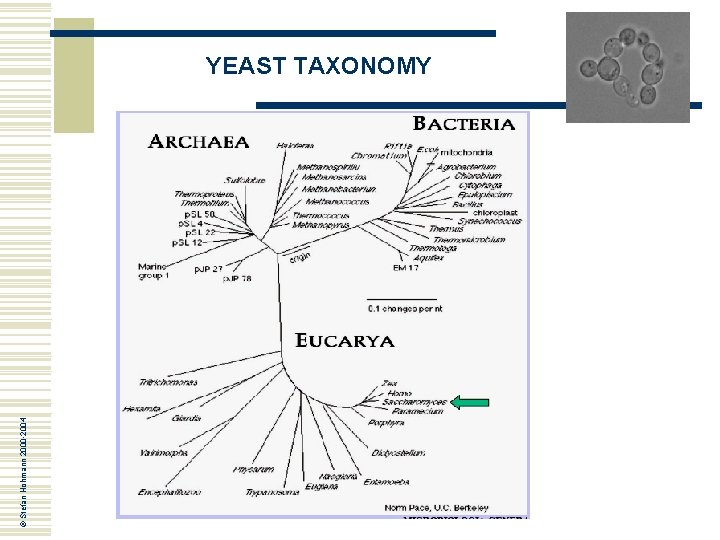
© Stefan Hohmann 2000 -2004 YEAST TAXONOMY
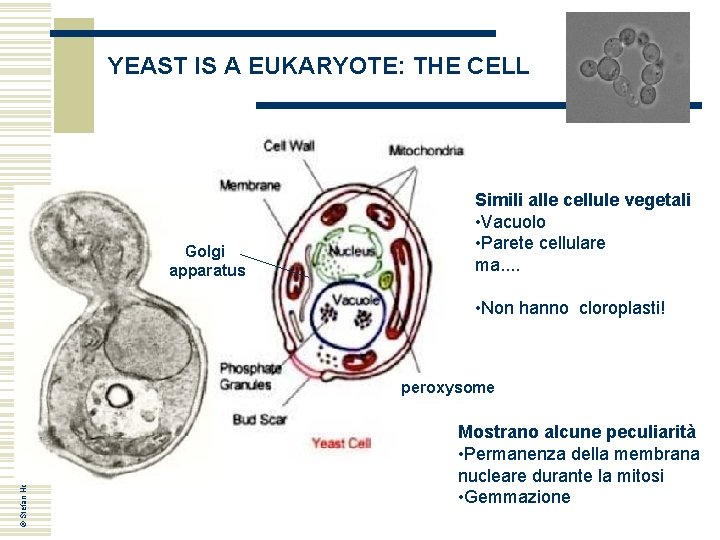
YEAST IS A EUKARYOTE: THE CELL Golgi apparatus Simili alle cellule vegetali • Vacuolo • Parete cellulare ma. . • Non hanno cloroplasti! © Stefan Hohmann 2000 -2004 peroxysome Mostrano alcune peculiarità • Permanenza della membrana nucleare durante la mitosi • Gemmazione
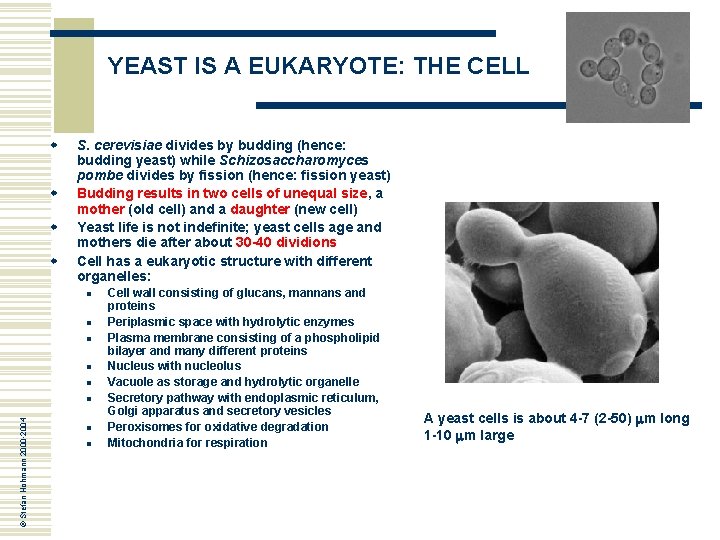
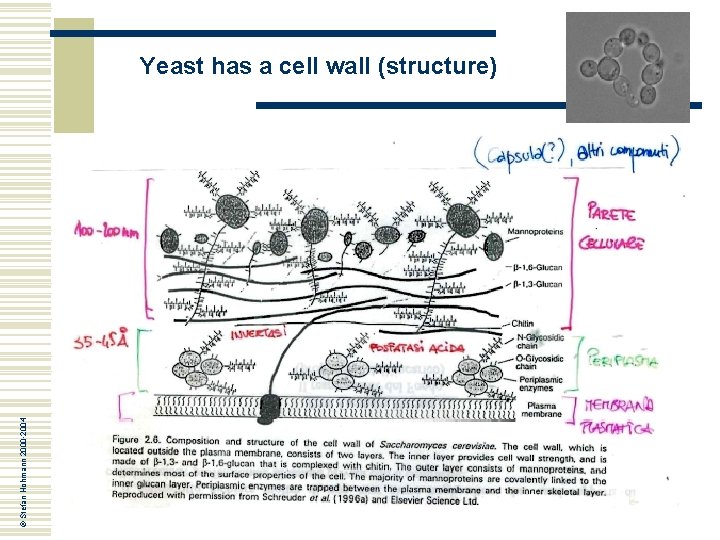
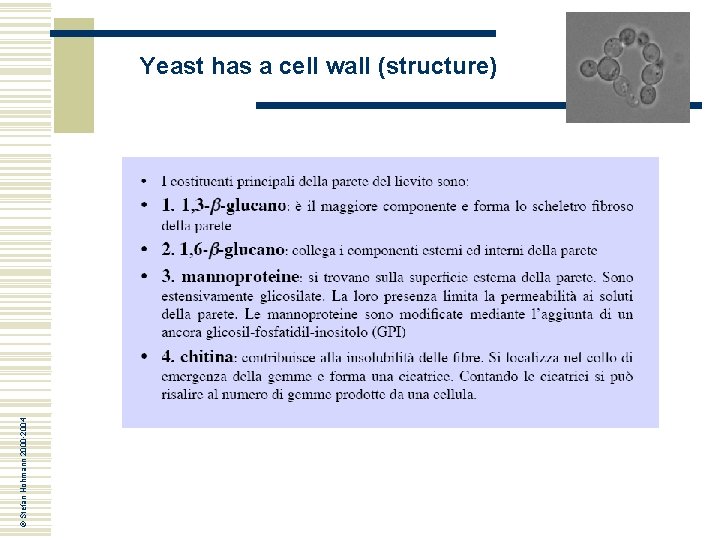
YEAST IS A EUKARYOTE: THE CELL w w S. cerevisiae divides by budding (hence: budding yeast) while Schizosaccharomyces pombe divides by fission (hence: fission yeast) Budding results in two cells of unequal size, a mother (old cell) and a daughter (new cell) Yeast life is not indefinite; yeast cells age and mothers die after about 30 -40 dividions Cell has a eukaryotic structure with different organelles: n n n © Stefan Hohmann 2000 -2004 n n n Cell wall consisting of glucans, mannans and proteins Periplasmic space with hydrolytic enzymes Plasma membrane consisting of a phospholipid bilayer and many different proteins Nucleus with nucleolus Vacuole as storage and hydrolytic organelle Secretory pathway with endoplasmic reticulum, Golgi apparatus and secretory vesicles Peroxisomes for oxidative degradation Mitochondria for respiration A yeast cells is about 4 -7 (2 -50) mm long 1 -10 mm large
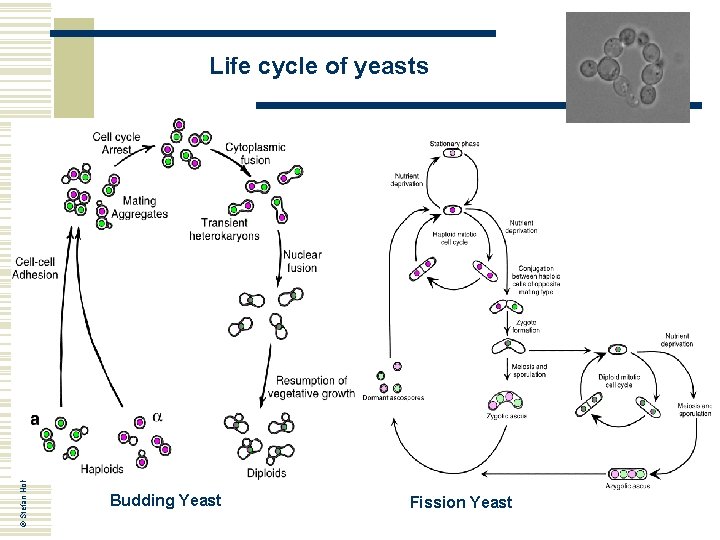
© Stefan Hohmann 2000 -2004 Life cycle of yeasts Budding Yeast Fission Yeast
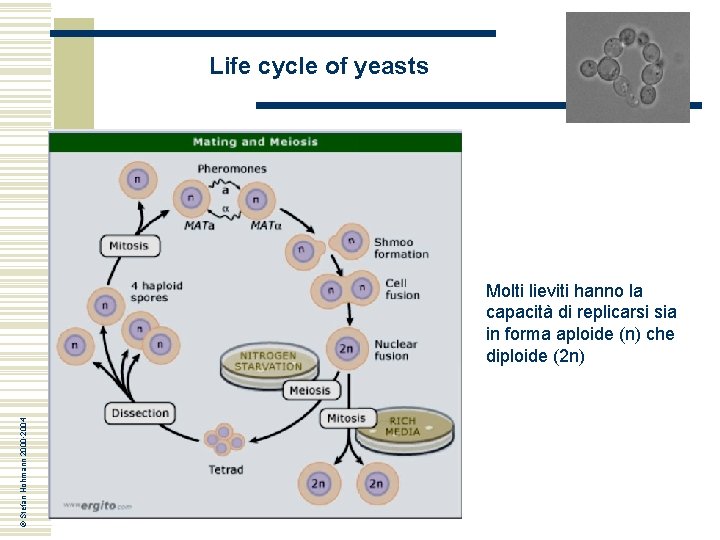
Life cycle of yeasts © Stefan Hohmann 2000 -2004 Molti lieviti hanno la capacità di replicarsi sia in forma aploide (n) che diploide (2 n)
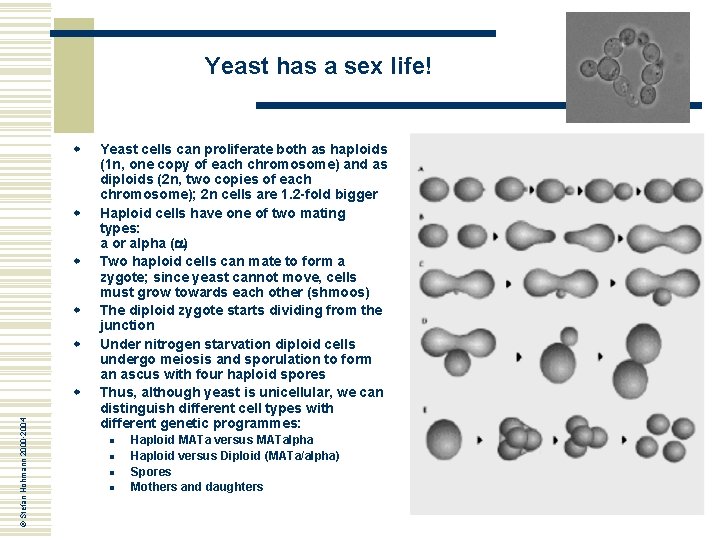
Yeast has a sex life! w w w © Stefan Hohmann 2000 -2004 w Yeast cells can proliferate both as haploids (1 n, one copy of each chromosome) and as diploids (2 n, two copies of each chromosome); 2 n cells are 1. 2 -fold bigger Haploid cells have one of two mating types: a or alpha (a) Two haploid cells can mate to form a zygote; since yeast cannot move, cells must grow towards each other (shmoos) The diploid zygote starts dividing from the junction Under nitrogen starvation diploid cells undergo meiosis and sporulation to form an ascus with four haploid spores Thus, although yeast is unicellular, we can distinguish different cell types with different genetic programmes: n n Haploid MATa versus MATalpha Haploid versus Diploid (MATa/alpha) Spores Mothers and daughters
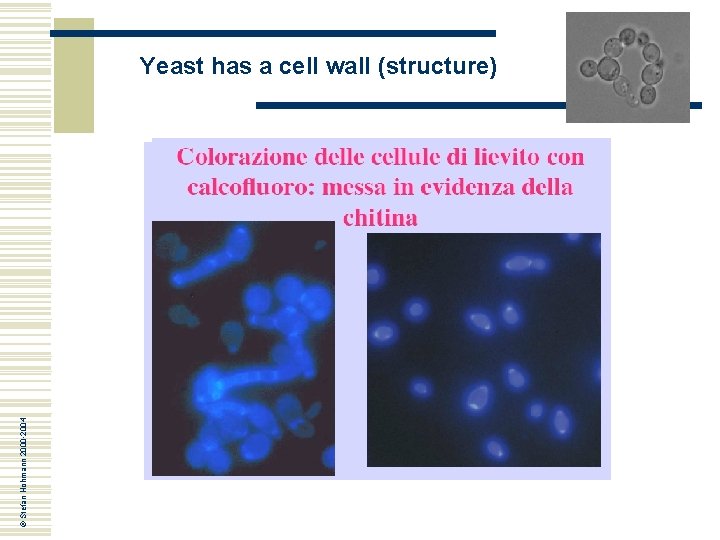
© Stefan Hohmann 2000 -2004 Yeast has a cell wall (structure)
© Stefan Hohmann 2000 -2004 Yeast has a cell wall (structure)
© Stefan Hohmann 2000 -2004 Yeast has a cell wall (structure)
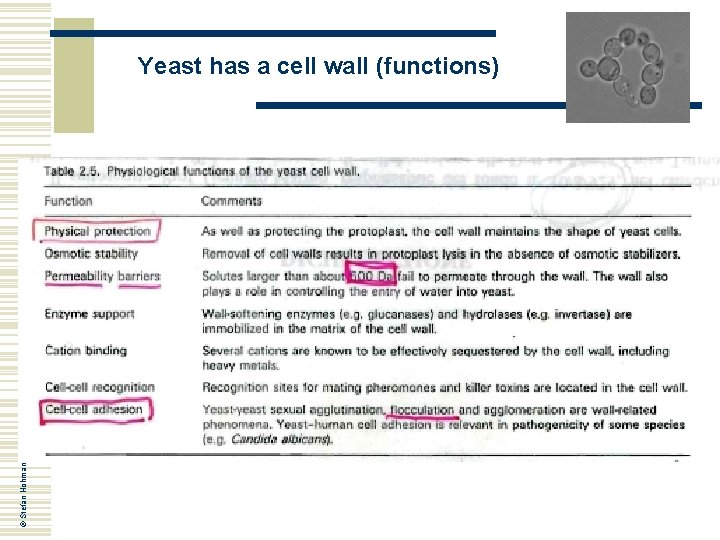
© Stefan Hohmann 2000 -2004 Yeast has a cell wall (functions)
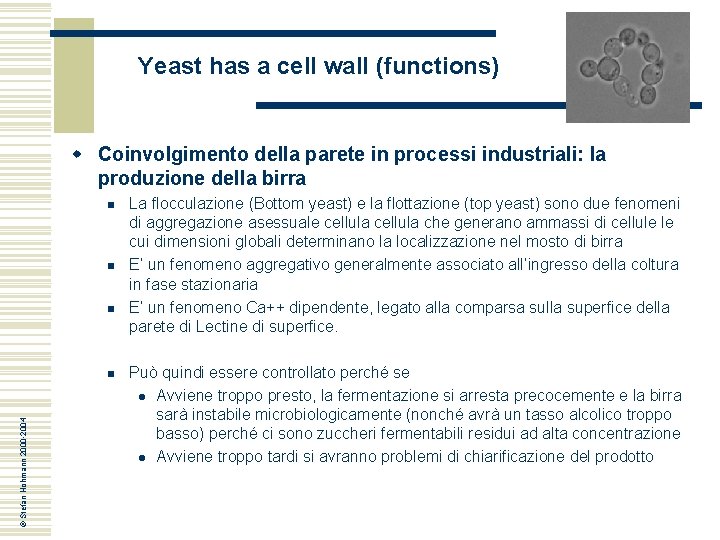
Yeast has a cell wall (functions) w Coinvolgimento della parete in processi industriali: la produzione della birra n n n © Stefan Hohmann 2000 -2004 n La flocculazione (Bottom yeast) e la flottazione (top yeast) sono due fenomeni di aggregazione asessuale cellula che generano ammassi di cellule le cui dimensioni globali determinano la localizzazione nel mosto di birra E’ un fenomeno aggregativo generalmente associato all’ingresso della coltura in fase stazionaria E’ un fenomeno Ca++ dipendente, legato alla comparsa sulla superfice della parete di Lectine di superfice. Può quindi essere controllato perché se l Avviene troppo presto, la fermentazione si arresta precocemente e la birra sarà instabile microbiologicamente (nonché avrà un tasso alcolico troppo basso) perché ci sono zuccheri fermentabili residui ad alta concentrazione l Avviene troppo tardi si avranno problemi di chiarificazione del prodotto
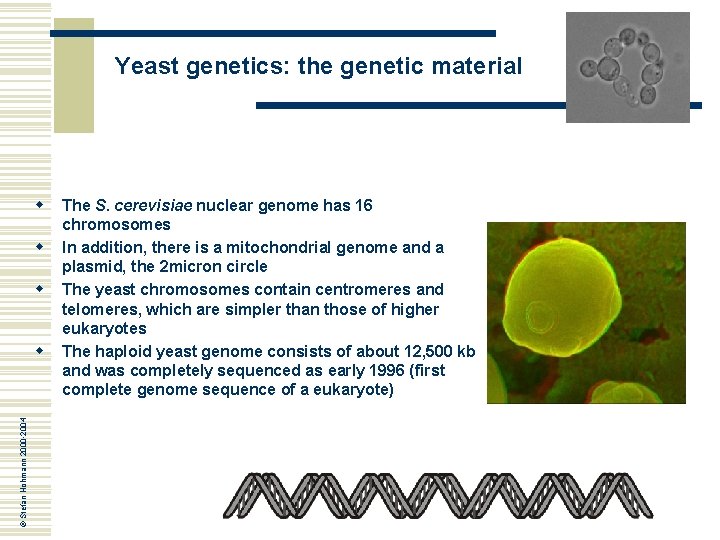
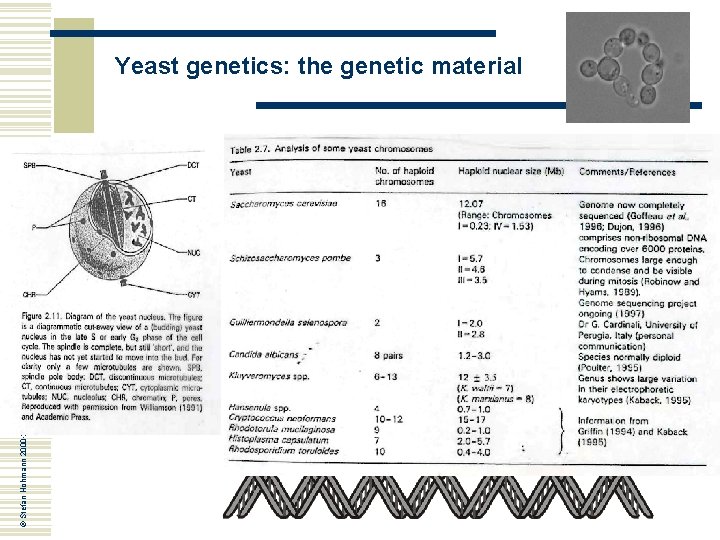
Yeast genetics: the genetic material w w w © Stefan Hohmann 2000 -2004 w The S. cerevisiae nuclear genome has 16 chromosomes In addition, there is a mitochondrial genome and a plasmid, the 2 micron circle The yeast chromosomes contain centromeres and telomeres, which are simpler than those of higher eukaryotes The haploid yeast genome consists of about 12, 500 kb and was completely sequenced as early 1996 (first complete genome sequence of a eukaryote)
© Stefan Hohmann 2000 -2004 Yeast genetics: the genetic material
Yeast genetics: the genetic material w w w © Stefan Hohmann 2000 -2004 w w The yeast genome is predicted to contain about 6, 200 genes, annotation is, however, still ongoing There is substantial ”gene redundancy”, which originates from an ancient genome duplication This means that there are many genes for which closely related homologue exist, which often are differentially regulated The most extreme example are sugar transporter genes; there are more than twenty Roughly 1/3 of the genes has been characterised by genetic analysis, 1/3 shows homology hinting at their biochemical function and 1/3 is not homologous to other genes or only to other uncharacterised genes Only a small percentage of yeast genes has introns, very few have more than one; mapping of introns is not complete The intergenic space between genes is only between 200 and 1, 000 bp The largest known regulatory sequences are spread over about 2, 800 bp (MUC 1/FLO 11)