
Yeast as a Model Organism Raghav Ramachandran Ambhi
Yeast as a Model Organism Raghav Ramachandran Ambhi Ganesan September 9, 2008
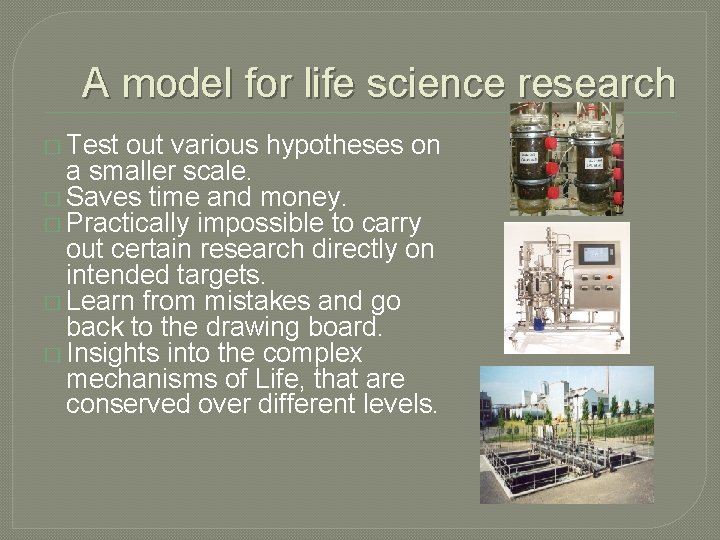
A model for life science research � Test out various hypotheses on a smaller scale. � Saves time and money. � Practically impossible to carry out certain research directly on intended targets. � Learn from mistakes and go back to the drawing board. � Insights into the complex mechanisms of Life, that are conserved over different levels.
Yeast based models in basic Science and applied research � Neurodegenerative disorders: • Ease of expt’al manipulation, high conservation of mechanisms, well defined genome • Studying mechanisms in yeast provide insights into human system. • Designing therapeutics/drugs against homologous protein aggregates in yeast. � Aging: • Calorie restriction affects life span in worms, flies, and rodents, apart from yeast (reducing glucose or amino acid concns can increase life spans) • Life span extension from Sir 2 -overexpression, TOR-inhibition, Sch 9/Akt or DR has been observed in yeast, worms, and flies • Nutrient responsive protein TOR speculated to play conserved role.
Why use yeast? �The S. cerevisiae yeast has one of the smallest genomes of eukaryotes, being unicellular. �Its genome contains 12, 495, 682 base pairs and 5770 genes as opposed to 3. 3 *109 base pairs and ~20500 genes in humans. �Also, S. cerevisiae (baker’s yeast) is viable with numerous markers and available in large quantities making it cheap to study.
Why use yeast? �Perhaps, the most striking feature of S. cerevisiae is its existence in both haploid and diploid forms. �This makes it easy to isolate recessive mutations in haploids. �Also, DNA transformed in S. cerevisiae can undergo homologous recombination readily, into the S. cerevisiae genome.
Why use yeast? �By analyzing the S. cerevisiae mutants observed from homologous recombination of foreign DNA, the functions of several proteins in vivo can be discerned. �The entire genome of S. cerevisiae was sequenced in 1996 and since then, it has been used as a eukaryotic model for the study of protein interactions and infectious diseases.
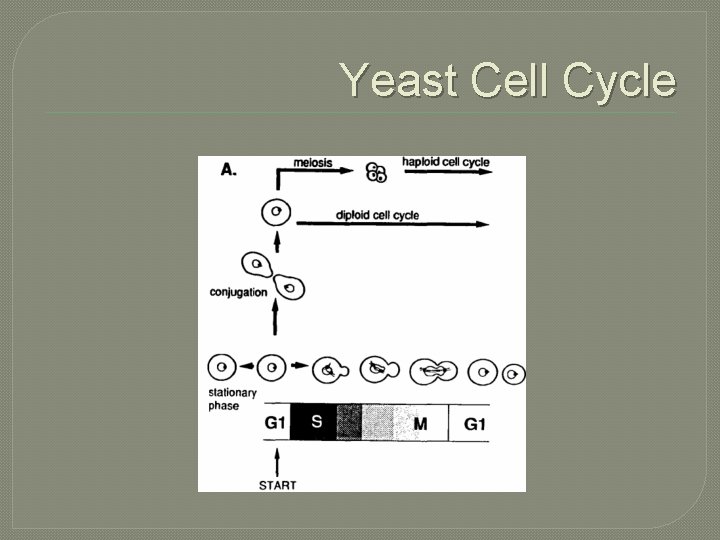
Yeast Cell Cycle �Each Yeast Cell undergoes four phases in its life cycle: G 1, S, G 2, M (growth, synthesis, mitosis) �In S. cerevisiae, arrangement of microtubules and duplication of spindle pole bodies takes place early in the life cycle to allow for bud formation. �Thus, budding S. cerevisiae lacks clear distinction between S, G 2 and M phases.
Yeast Cell Cycle
Regulation of cell cycle �In the G 1 phase of the cycle, the yeast cell has three options • It can complete the cycle and divide • It can leave the cycle, if nutritionally starved, where it is resistant to heat and chemical treatment • It can mate with a cell of opposite sex, if haploid, after a transient arrest in G 1. • It can undergo meiosis to produce four haploid cells under nutritional starvation, if diploid
Regulatory genes in yeast �A gene is a cell cycle regulator if its mutant causes inappropriate progression through the cycle. �CDC 28 -p 34 protein kinase in G 1/S and G 2/M �CLN 1, CLN 2, WHI 1 -G 1 cyclins in G 1/S �MIH 1 - inducer of mitosis in G 2/M �CKS 1, CDC 37, CDC 36 (haploids), CDC 39 (haploids)
G 1/S phase of yeast life cycle �The START phase occurs during G 1 and after this phase, the cell is committed to DNA replication and cell division. �Before passing START, cells must obtain a critical mass. �CDC 28 is a critical START p 34 protein kinase whose mutants can block cells at G 1/S or G 2 phases.
G 2/M phase of yeast life cycle �While START commits the cell to its life cycle, mitosis can only take place after the S phase thus requiring a second checkpoint in the life cycle, namely the G 2/M phase. �The MIH 1 gene speeds up the entry of cells into mitosis. The role of other genes in regulating G 2/M in S. cerevisiae is unclear.
Relationship between M and S phases �Initiation of M phase depends upon successful completion of DNA replication in S phase. The RAD 9 gene performs this function in S. cerevisiae. If DNA replication is delayed, cells undergo mitosis with lethal effects. �The p 34 kinase increases in activity on the onset of mitosis and its activity can be regulated by tyrosine dephosphorylation at the G 2/M stage.
yeast life cycle-Meiosis § START-specific genes, like CDC 28, act after DNA replication in G 1/S meiosis, whereas they have an indirect affect on DNA replication in meiosis. § However, CDC 28 is required for the second G 2/M meiosis, where the M and S phases are uncoupled from each other.
Exit from life cycle �Under nutritional starvation, yeast cells stop growing and exit the life cycle (G 0 phase). �Unlike in mammalian cells, growth factors may not play a role in growth control in yeast cells and such cells in the stationary (G 0 phase) are metabolically dormant.
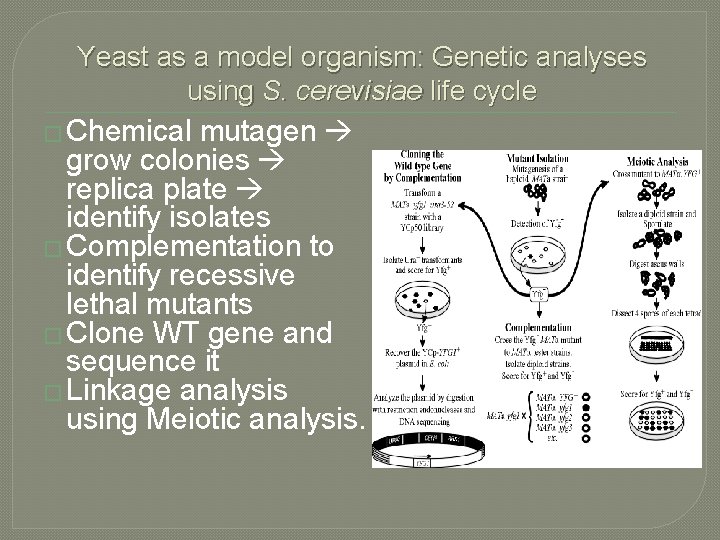
Yeast as a model organism: Genetic analyses using S. cerevisiae life cycle � Chemical mutagen grow colonies replica plate identify isolates � Complementation to identify recessive lethal mutants � Clone WT gene and sequence it � Linkage analysis using Meiotic analysis.
Functional characterization of the S. cerevisae Genome by Gene Deletion and Parallel Analysis �The usual methods: • Random mutagenesis – rapid but matching phenotypes is slower • Genetic footprinting – simultaneous testing but mutant strains can not be recovered �The new method: • Delete entire ORFs using PCRs and homologous recombination • Direct and simultaneous analysis • Rapid and increased sensitivity
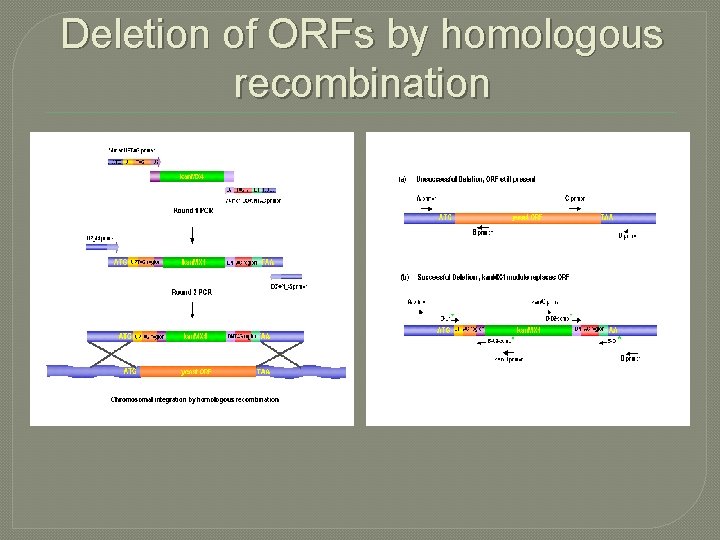
Deletion of ORFs by homologous recombination
Essential Genes � Deletions of ‘essential’ genes: • Essential for viability and lacking human homologues => targets for antifungal drugs • 356 ORFs identified as essential – failed to grow (YEPD, 30 o. C) as haploid deletants. • Only 56 % of these previously shown to be essential for viability. � 1620 non-essential genes identified. � Additional homozygous and 2 haploid deletants constructed.
Non-essential genes � Non-essential genes: • Relatively more complicated to analyze than essential genes; may require complicated growth conditions to observe the effects for some. • 558 homozygous deletion mutants pooled and grown in Rich (R) and Minimal (M) media. • Aliquots from both pools Amplify tags Hybridize to complements on array Hybrid. Data, measure of growth rate. • Correlation of UPTAG and DOWNTAG growth rates (<0. 6 of WT for the growth-impaired strains)
Results �New findings: • Genes whose inactivation affects growth are not necessarily the ones induced during growth under the same particular conditions. �Caveats: • Neomycin phosphatase (product of Kan. MX 4) may affect fitness • Composition of pool, culture conditions • Complementation (? )
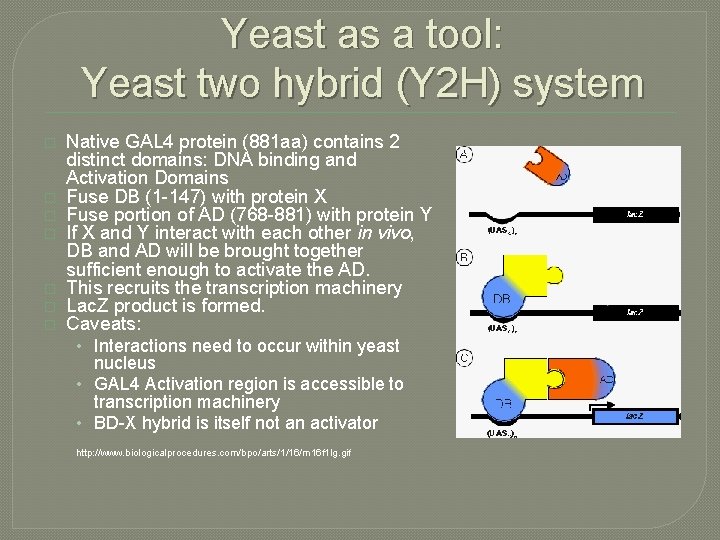
Yeast as a tool: Yeast two hybrid (Y 2 H) system � � � � Native GAL 4 protein (881 aa) contains 2 distinct domains: DNA binding and Activation Domains Fuse DB (1 -147) with protein X Fuse portion of AD (768 -881) with protein Y If X and Y interact with each other in vivo, DB and AD will be brought together sufficient enough to activate the AD. This recruits the transcription machinery Lac. Z product is formed. Caveats: • Interactions need to occur within yeast nucleus • GAL 4 Activation region is accessible to transcription machinery • BD-X hybrid is itself not an activator http: //www. biologicalprocedures. com/bpo/arts/1/16/m 16 f 1 lg. gif
- Slides: 22