
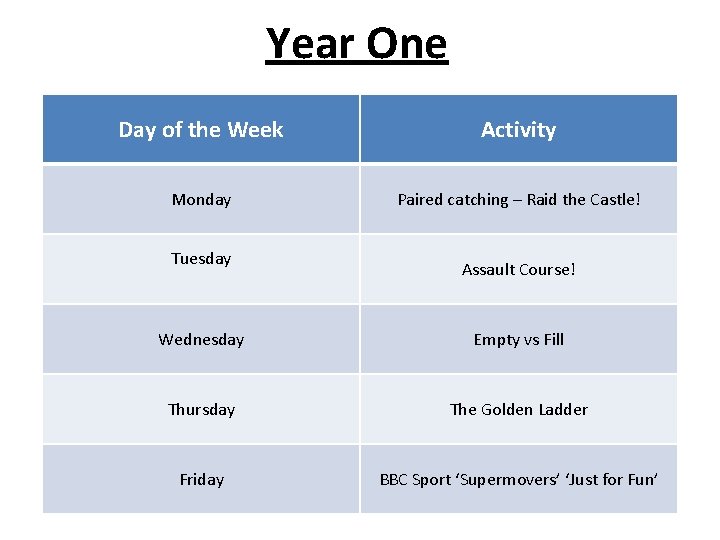
Year One Day of the Week Activity Monday
- Slides: 15
Year One Day of the Week Activity Monday Paired catching – Raid the Castle! Tuesday Assault Course! Wednesday Empty vs Fill Thursday The Golden Ladder Friday BBC Sport ‘Supermovers’ ‘Just for Fun’
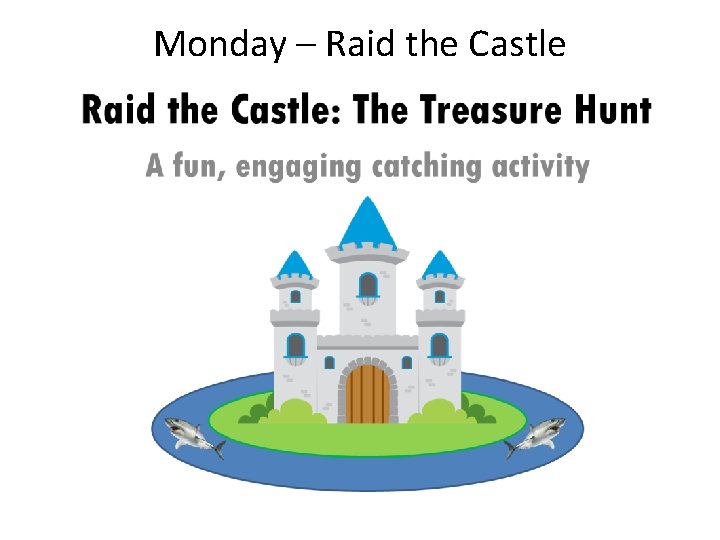
Monday – Raid the Castle
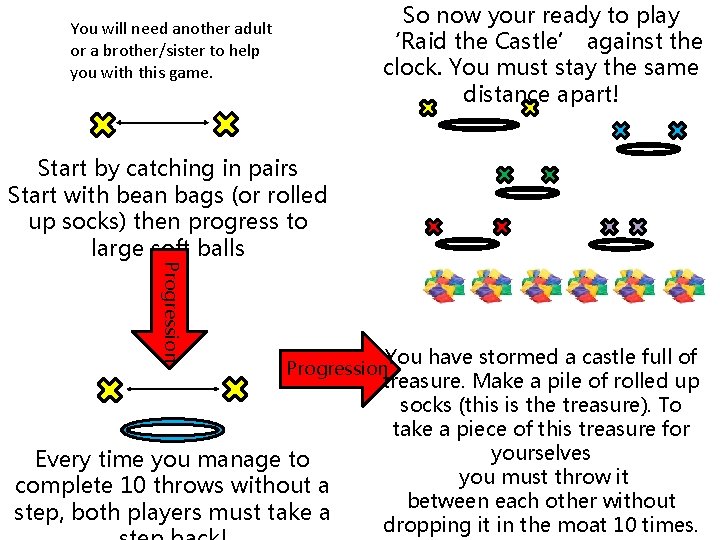
So now your ready to play ‘Raid the Castle’ against the clock. You must stay the same distance apart! You will need another adult or a brother/sister to help you with this game. Progression Start by catching in pairs Start with bean bags (or rolled up socks) then progress to large soft balls You have stormed a castle full of treasure. Make a pile of rolled up socks (this is the treasure). To take a piece of this treasure for yourselves you must throw it between each other without dropping it in the moat 10 times. Progression Every time you manage to complete 10 throws without a step, both players must take a
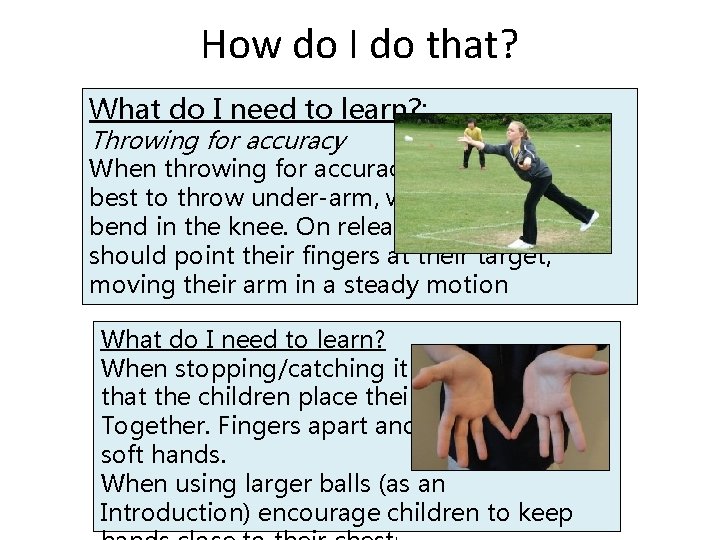
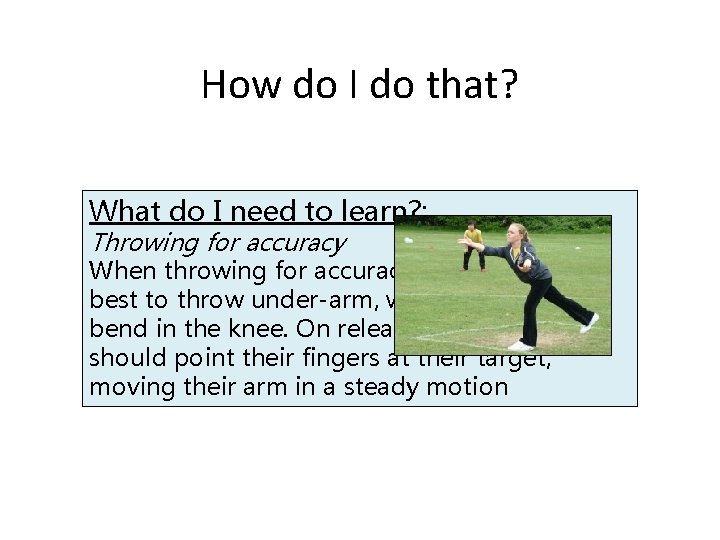
How do I do that? What do I need to learn? : Throwing for accuracy When throwing for accuracy it is best to throw under-arm, with a slight bend in the knee. On release the children should point their fingers at their target, moving their arm in a steady motion What do I need to learn? When stopping/catching it is important that the children place their hands close Together. Fingers apart and outstretched, soft hands. When using larger balls (as an Introduction) encourage children to keep
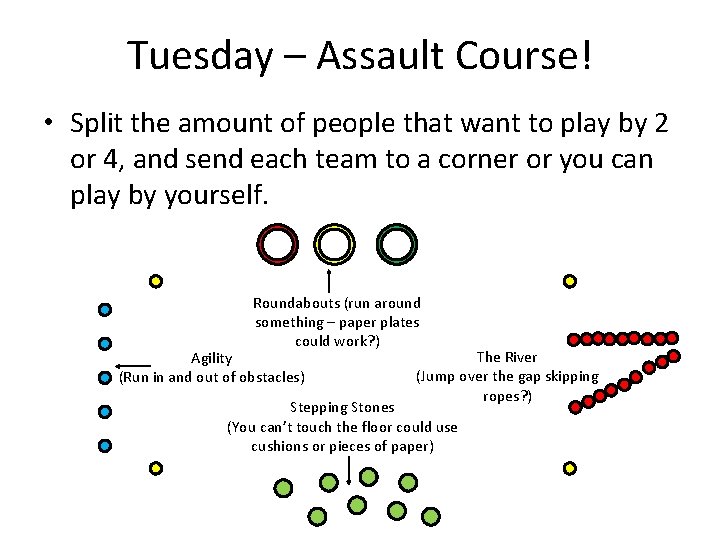
Tuesday – Assault Course! • Split the amount of people that want to play by 2 or 4, and send each team to a corner or you can play by yourself. Roundabouts (run around something – paper plates could work? ) Agility (Run in and out of obstacles) The River (Jump over the gap skipping ropes? ) Stepping Stones (You can’t touch the floor could use cushions or pieces of paper)
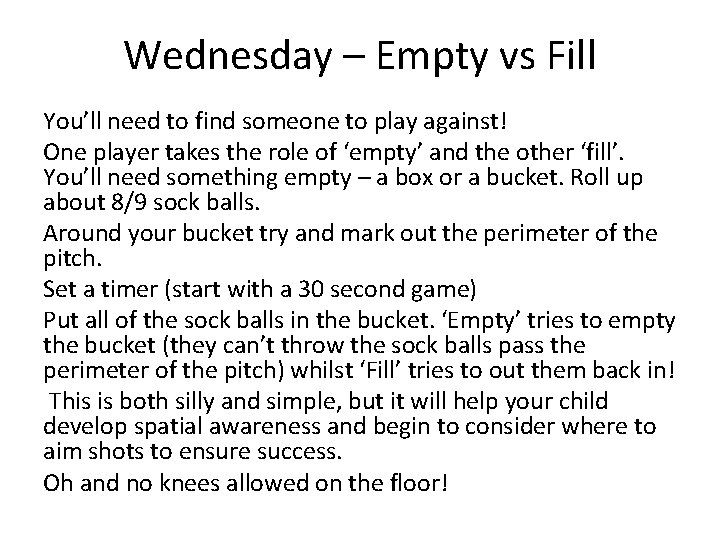
Wednesday – Empty vs Fill You’ll need to find someone to play against! One player takes the role of ‘empty’ and the other ‘fill’. You’ll need something empty – a box or a bucket. Roll up about 8/9 sock balls. Around your bucket try and mark out the perimeter of the pitch. Set a timer (start with a 30 second game) Put all of the sock balls in the bucket. ‘Empty’ tries to empty the bucket (they can’t throw the sock balls pass the perimeter of the pitch) whilst ‘Fill’ tries to out them back in! This is both silly and simple, but it will help your child develop spatial awareness and begin to consider where to aim shots to ensure success. Oh and no knees allowed on the floor!
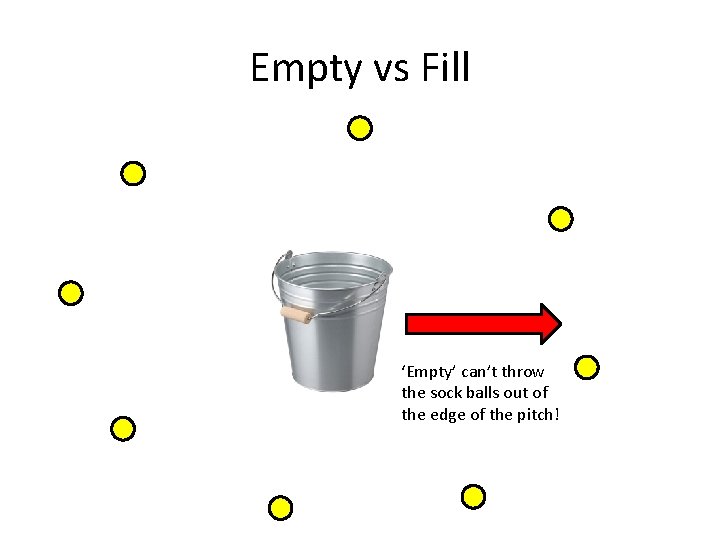
Empty vs Fill ‘Empty’ can’t throw the sock balls out of the edge of the pitch!
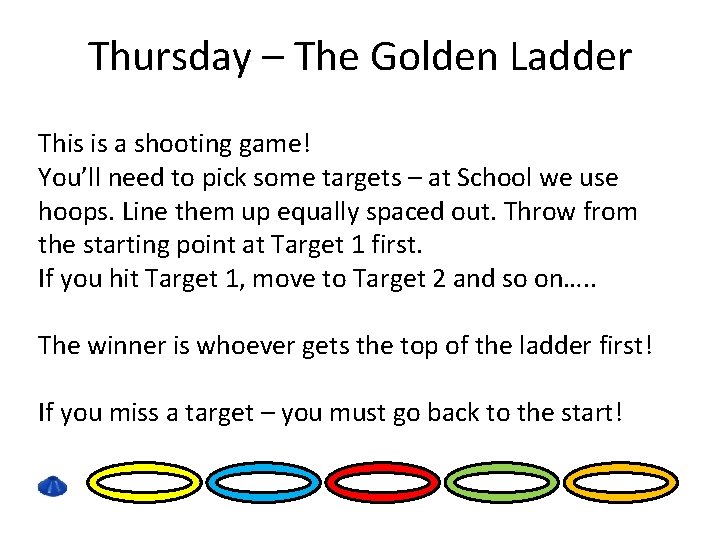
Thursday – The Golden Ladder This is a shooting game! You’ll need to pick some targets – at School we use hoops. Line them up equally spaced out. Throw from the starting point at Target 1 first. If you hit Target 1, move to Target 2 and so on…. . The winner is whoever gets the top of the ladder first! If you miss a target – you must go back to the start!
How do I do that? What do I need to learn? : Throwing for accuracy When throwing for accuracy it is best to throw under-arm, with a slight bend in the knee. On release the children should point their fingers at their target, moving their arm in a steady motion
Friday – BBC Sport ‘Supermovers’ Just for Fun • Happy Friday! • Visit https: //www. bbc. co. uk/teach/supermovers/justfor-fun-collection/z 7 tymfr • Pick a video that interests you and have fun! • My favourite is the Match of the Day one or Dangermouse!
“I can do that…. What’s next? ”
Progressions: Balance Increas e in Compl • Children can maintain balance when performing a task on one leg (this applies when static or when moving) (Develop through setting challenges where children must perform tasks on one leg. I. e – Throw and catch bean bag with alternate hands on one leg – Individual or as pairs) • Children can maintain their balance whilst standing on one foot (Set time challenges, use apparatus to focus children. Encourage the children to look at something that is level with their eyes – ears govern our balance! Some children will initially find it easier balancing with a bend in their knee, allowing the Quadriceps to contract slightly and control their body) • Children maintain their balance whilst standing in a stationary position and performing a task (2 feet) (Develop by asking children to balance a bean bag on their shoulder>back of As children develop their balance, ask them to hold their limbs further away from their core!
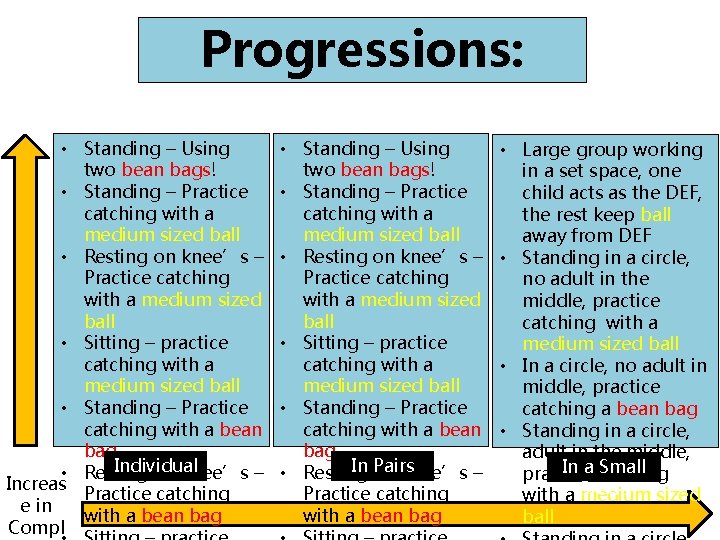
Progressions: Catching • Standing – Using two bean bags! • Standing – Practice catching with a medium sized ball • Resting on knee’s – Practice catching with a medium sized ball • Sitting – practice catching with a medium sized ball • Standing – Practice catching with a bean bag Individual • Resting on knee’s – Increas Practice catching e in with a bean bag Compl • Standing – Using two bean bags! • Standing – Practice catching with a medium sized ball • Resting on knee’s – Practice catching with a medium sized ball • Sitting – practice catching with a medium sized ball • Standing – Practice catching with a bean bag In on Pairs • Resting knee’s – Practice catching with a bean bag • Large group working in a set space, one child acts as the DEF, the rest keep ball away from DEF • Standing in a circle, no adult in the middle, practice catching with a medium sized ball • In a circle, no adult in middle, practice catching a bean bag • Standing in a circle, adult in the middle, In a catching Small practice with a Group medium sized ball
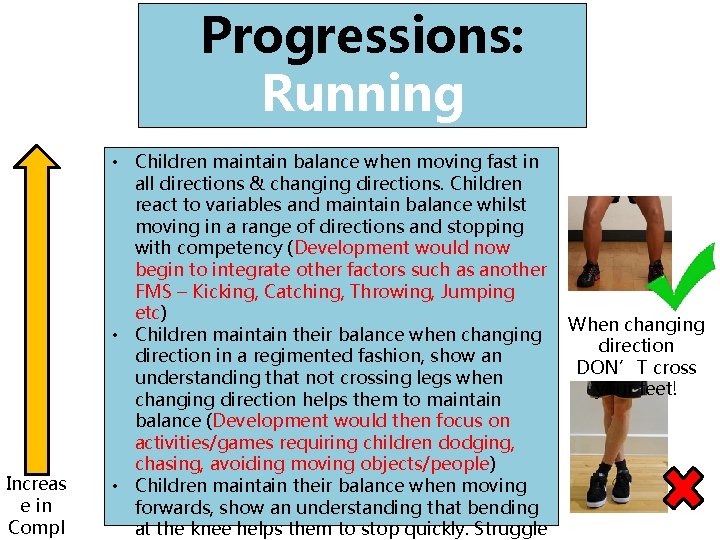
Progressions: Running & Stopping Increas e in Compl • Children maintain balance when moving fast in all directions & changing directions. Children react to variables and maintain balance whilst moving in a range of directions and stopping with competency (Development would now begin to integrate other factors such as another FMS – Kicking, Catching, Throwing, Jumping etc) • Children maintain their balance when changing direction in a regimented fashion, show an understanding that not crossing legs when changing direction helps them to maintain balance (Development would then focus on activities/games requiring children dodging, chasing, avoiding moving objects/people) • Children maintain their balance when moving forwards, show an understanding that bending at the knee helps them to stop quickly. Struggle When changing direction DON’T cross your feet!
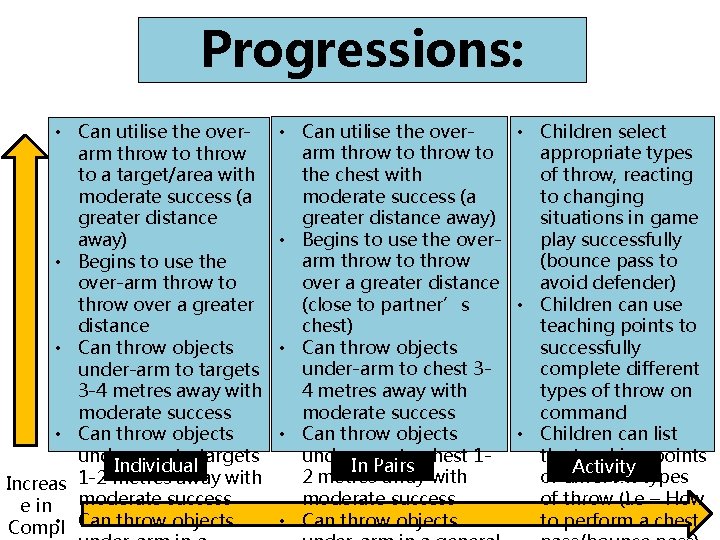
Progressions: Throwing • Can utilise the overarm throw to a target/area with moderate success (a greater distance away) • Begins to use the over-arm throw to throw over a greater distance • Can throw objects under-arm to targets 3 -4 metres away with moderate success • Can throw objects under-arm to targets Individual 1 -2 metres away with Increas e in moderate success • Can throw objects Compl • Children select • Can utilise the overappropriate types arm throw to of throw, reacting the chest with to changing moderate success (a situations in game greater distance away) play successfully • Begins to use the over(bounce pass to arm throw to throw avoid defender) over a greater distance • Children can use (close to partner’s teaching points to chest) successfully • Can throw objects complete different under-arm to chest 3 types of throw on 4 metres away with command moderate success • Children can list • Can throw objects the teaching points under-arm to chest 1 In Pairs Activity of different types 2 metres away with specific of throw (I. e – How moderate success to perform a chest • Can throw objects