
Year in Review Chronic Lymphocytic Leukemia BTK Inhibitors
Year in Review Chronic Lymphocytic Leukemia BTK Inhibitors Matthew S. Davids, MD, MMSc Associate Professor of Medicine | Harvard Medical School Director of Clinical Research | Division of Lymphoma |Dana-Farber Cancer Institute January 2021
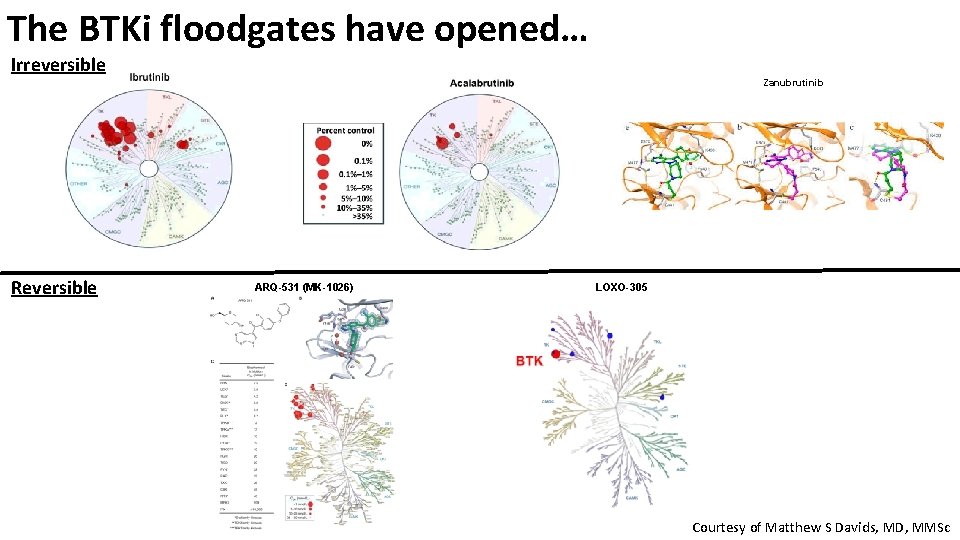
The BTKi floodgates have opened… Irreversible Zanubrutinib Reversible ARQ-531 (MK-1026) LOXO-305 Courtesy of Matthew S Davids, MD, MMSc
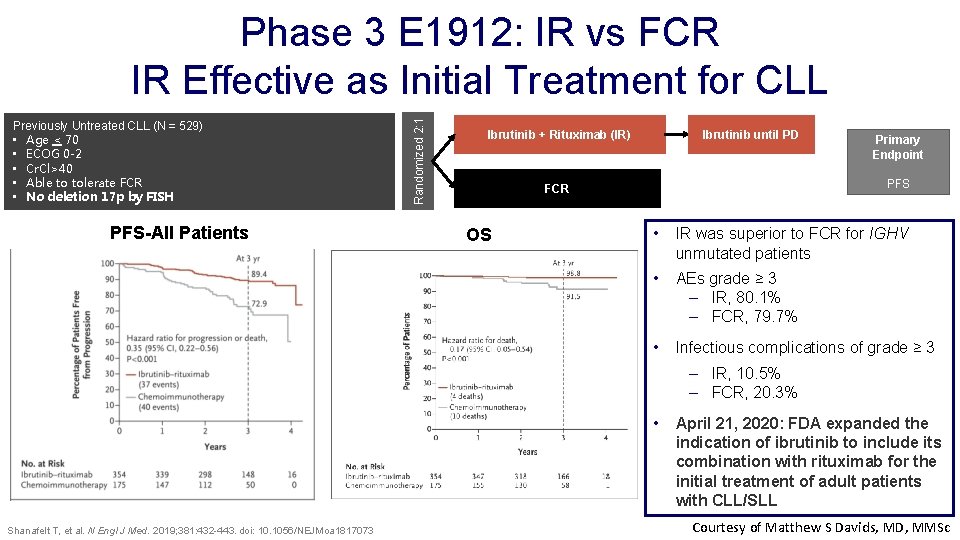
Previously Untreated CLL (N = 529) • Age < 70 • ECOG 0 -2 • Cr. Cl>40 • Able to tolerate FCR • No deletion 17 p by FISH PFS-All Patients Randomized 2: 1 Phase 3 E 1912: IR vs FCR IR Effective as Initial Treatment for CLL Ibrutinib + Rituximab (IR) Ibrutinib until PD PFS FCR OS Primary Endpoint • IR was superior to FCR for IGHV unmutated patients • AEs grade ≥ 3 – IR, 80. 1% – FCR, 79. 7% • Infectious complications of grade ≥ 3 – IR, 10. 5% – FCR, 20. 3% • Shanafelt T, et al. N Engl J Med. 2019; 381: 432 -443. doi: 10. 1056/NEJMoa 1817073 April 21, 2020: FDA expanded the indication of ibrutinib to include its combination with rituximab for the initial treatment of adult patients with CLL/SLL Courtesy of Matthew S Davids, MD, MMSc

Phase 3 RESONATE-2 Trial: 5 -Year Update Ibrutinib Provides Durable Response as Initial Therapy in Frail Pts Efficacy • Ibrutinib benefit was also consistent in patients with high prognostic risk (TP 53 mutation, 11 q deletion, and/or unmutated IGHV) Ibrutinib Chlorambucil Safety • Discontinuation due to AEs decreased over time, with 58% of ibrutinib pts continuing daily treatment Burger JA, et al. Leukemia. 2020; 34(3): 787 -798. doi: 10. 1038/s 41375 -019 -0602 -x. Ibrutinib Chlorambucil Median PFS, mo NE 15. 0 HR (95% CI) 0. 146 (0. 098 -0. 218) Courtesy of Matthew S Davids, MD, MMSc
Conclusions Impact on Patient Care and Treatment Algorithm • Ibrutinib-based therapy is superior to FCR for young, fit patients with unmutated IGHV • Ibrutinib provides long term benefit with reasonable tolerability for older patients • Discontinuations due to toxicity do continue over time, esp. in older patients Implications for Future Research • Longer term follow-up needed to understand how to approach mutated-IGHV patients • Ongoing studies are looking at ibrutinib + CIT (i. FCR, i. FCG, etc. ) • Ibrutinib will be a key comparator in the CLL 17 study (I vs IV vs VO) and in combination with obin in the US cooperative group studies (vs IVO) Courtesy of Matthew S Davids, MD, MMSc
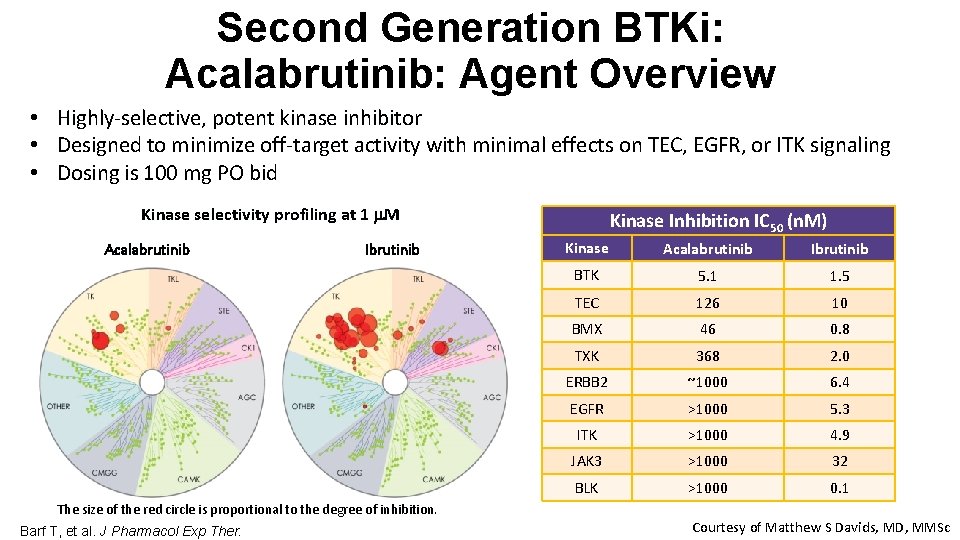
Second Generation BTKi: Acalabrutinib: Agent Overview • Highly-selective, potent kinase inhibitor • Designed to minimize off-target activity with minimal effects on TEC, EGFR, or ITK signaling • Dosing is 100 mg PO bid Kinase selectivity profiling at 1 M Acalabrutinib Ibrutinib The size of the red circle is proportional to the degree of inhibition. Barf T, et al. J Pharmacol Exp Ther. Kinase Inhibition IC 50 (n. M) Kinase Acalabrutinib Ibrutinib BTK 5. 1 1. 5 TEC 126 10 BMX 46 0. 8 TXK 368 2. 0 ERBB 2 ~1000 6. 4 EGFR >1000 5. 3 ITK >1000 4. 9 JAK 3 >1000 32 BLK >1000 0. 1 Courtesy of Matthew S Davids, MD, MMSc

Acalabrutinib is Highly Effective in Front-Line CLL Phase 1/2 ACE-CL-001 Study in patients with previously untreated CLL requiring tx (N = 99) Acalabrutinib 200 mg once daily or 100 mg twice daily ASCO/EHA 2020 Update: Acalabrutinib monotherapy demonstrated durable remissions and long-term tolerability (median follow-up of 53 months) • ORR 97% (7% CR, 90% PR) • Median time to response 3. 7 mo • 86% of patients remain on treatment • Median DOR was not reached 48 -month DOR rate: 97% (95% CI, 90%– 99%) • Median EFS was not reached 48 -month EFS rate: 90% (95% CI, 82%– 94%) Courtesy of Matthew S Davids, MD, MMSc Byrd, et al. Blood. 2018; 132 (Supplement 1): 692. doi. org/10. 1182/blood-2018 -99 -110451. Byrd, et al. J Clin Oncol. 2020; 38, no. 15_suppl: 8024 -8024. . doi. org/10. 1200/JCO. 2020. 38. 15_suppl. 8024.
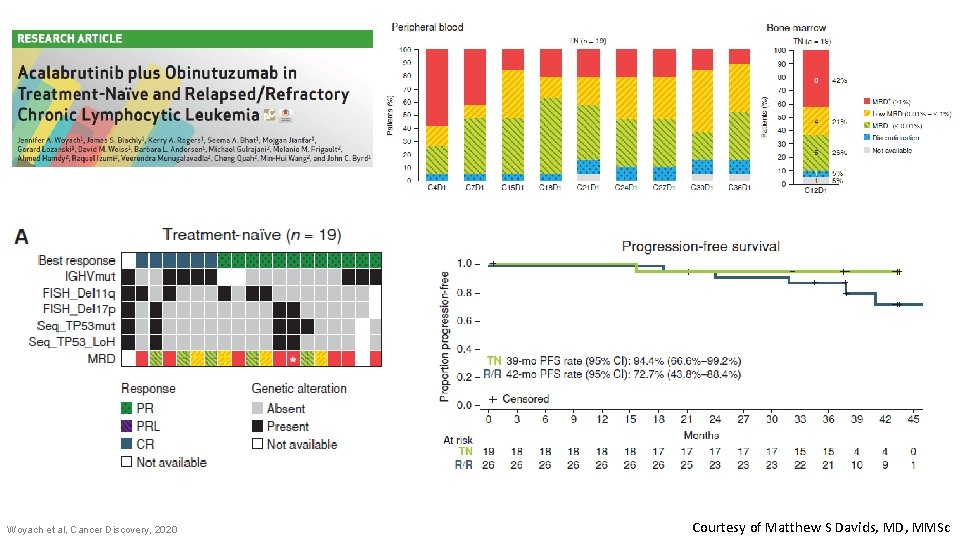
Woyach et al, Cancer Discovery, 2020 Courtesy of Matthew S Davids, MD, MMSc
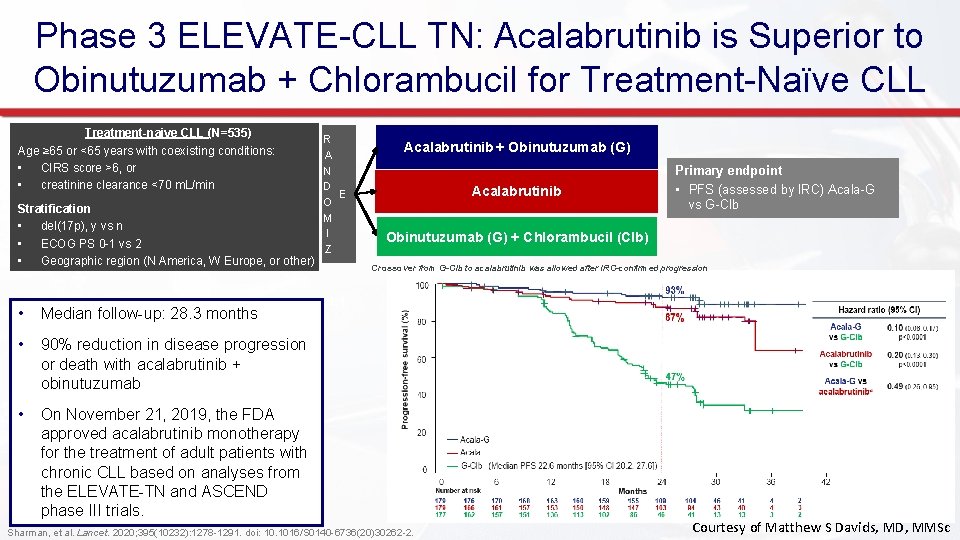
Phase 3 ELEVATE-CLL TN: Acalabrutinib is Superior to Obinutuzumab + Chlorambucil for Treatment-Naïve CLL Treatment-naive CLL (N=535) Age ≥ 65 or <65 years with coexisting conditions: • CIRS score >6, or • creatinine clearance <70 m. L/min Stratification • del(17 p), y vs n • ECOG PS 0 -1 vs 2 • Geographic region (N America, W Europe, or other) • Median follow-up: 28. 3 months • 90% reduction in disease progression or death with acalabrutinib + obinutuzumab • On November 21, 2019, the FDA approved acalabrutinib monotherapy for the treatment of adult patients with chronic CLL based on analyses from the ELEVATE-TN and ASCEND phase III trials. R A N D E O M I Z Acalabrutinib + Obinutuzumab (G) Acalabrutinib Primary endpoint • PFS (assessed by IRC) Acala-G vs G-Clb Obinutuzumab (G) + Chlorambucil (Clb) Crossover from G-Clb to acalabrutinib was allowed after IRC-confirmed progression 1: 1: 1 Sharman, et al. Lancet. 2020; 395(10232): 1278 -1291. doi: 10. 1016/S 0140 -6736(20)30262 -2. Courtesy of Matthew S Davids, MD, MMSc
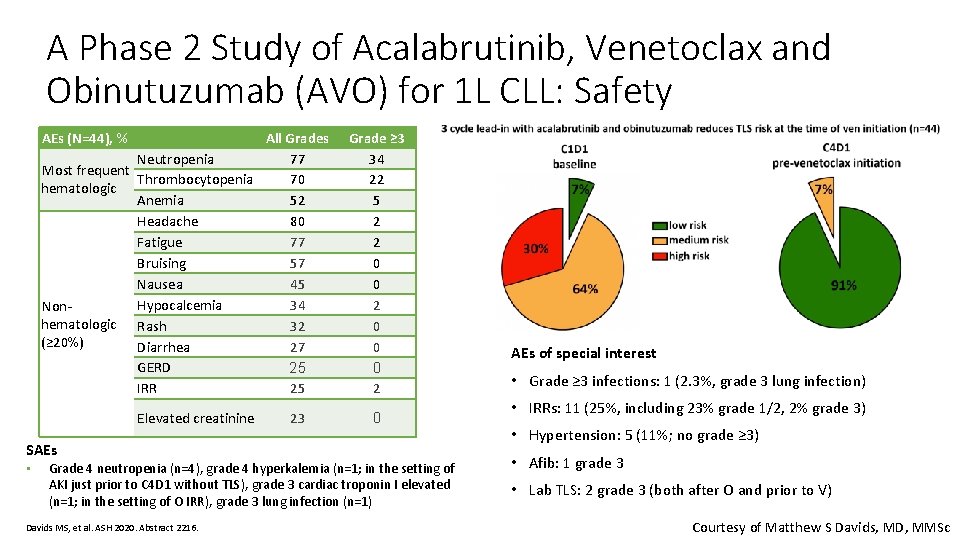
A Phase 2 Study of Acalabrutinib, Venetoclax and Obinutuzumab (AVO) for 1 L CLL: Safety AEs (N=44), % All Grades Neutropenia 77 Most frequent Thrombocytopenia 70 hematologic Anemia 52 Headache 80 Fatigue 77 Bruising 57 Nausea 45 Hypocalcemia 34 Nonhematologic Rash 32 (≥ 20%) Diarrhea 27 GERD 25 IRR 25 Elevated creatinine SAEs • 23 Grade ≥ 3 34 22 5 2 2 0 0 0 2 0 Grade 4 neutropenia (n=4), grade 4 hyperkalemia (n=1; in the setting of AKI just prior to C 4 D 1 without TLS), grade 3 cardiac troponin I elevated (n=1; in the setting of O IRR), grade 3 lung infection (n=1) Davids MS, et al. ASH 2020. Abstract 2216. AEs of special interest • Grade ≥ 3 infections: 1 (2. 3%, grade 3 lung infection) • IRRs: 11 (25%, including 23% grade 1/2, 2% grade 3) • Hypertension: 5 (11%; no grade ≥ 3) • Afib: 1 grade 3 • Lab TLS: 2 grade 3 (both after O and prior to V) Courtesy of Matthew S Davids, MD, MMSc
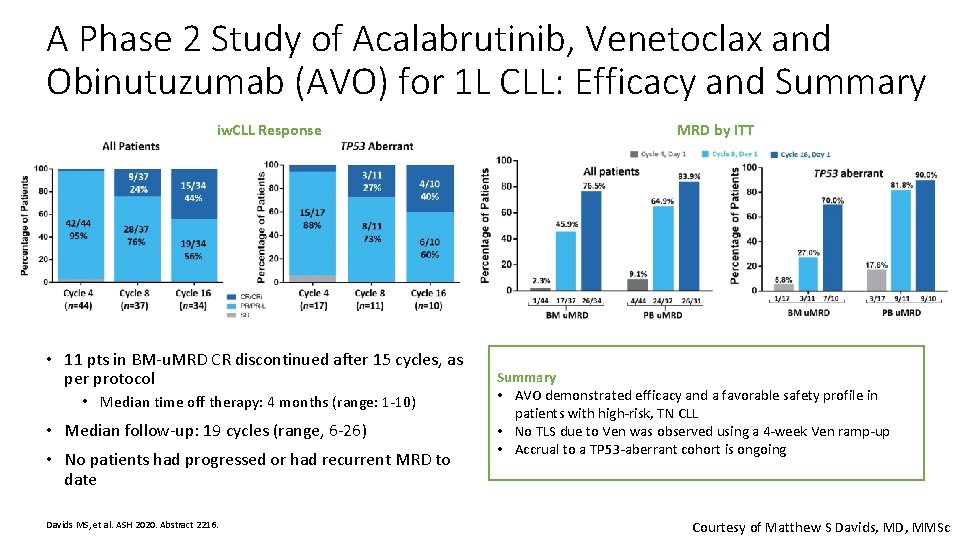
A Phase 2 Study of Acalabrutinib, Venetoclax and Obinutuzumab (AVO) for 1 L CLL: Efficacy and Summary iw. CLL Response • 11 pts in BM-u. MRD CR discontinued after 15 cycles, as per protocol • Median time off therapy: 4 months (range: 1 -10) • Median follow-up: 19 cycles (range, 6 -26) • No patients had progressed or had recurrent MRD to date Davids MS, et al. ASH 2020. Abstract 2216. MRD by ITT Summary • AVO demonstrated efficacy and a favorable safety profile in patients with high-risk, TN CLL • No TLS due to Ven was observed using a 4 -week Ven ramp-up • Accrual to a TP 53 -aberrant cohort is ongoing Courtesy of Matthew S Davids, MD, MMSc
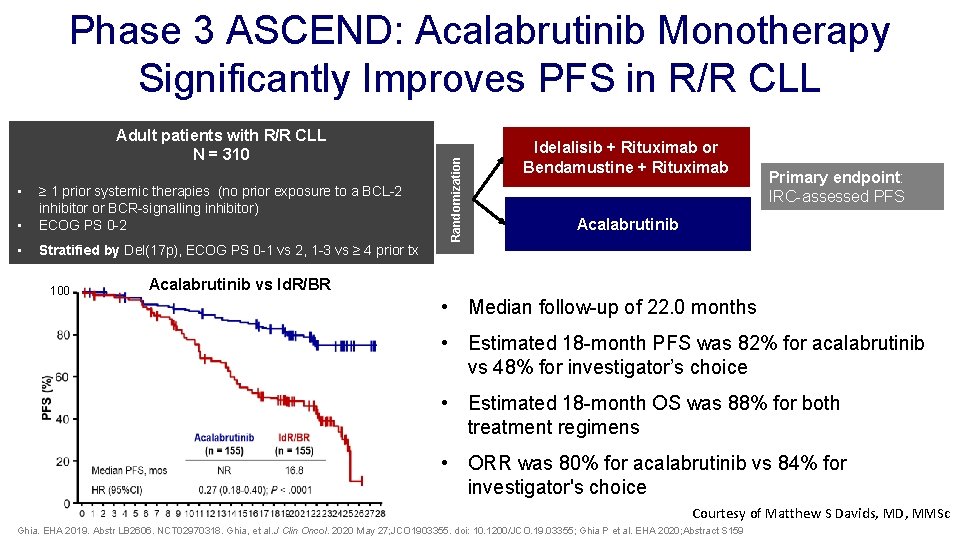
Adult patients with R/R CLL N = 310 • • ≥ 1 prior systemic therapies (no prior exposure to a BCL-2 inhibitor or BCR-signalling inhibitor) ECOG PS 0 -2 • Stratified by Del(17 p), ECOG PS 0 -1 vs 2, 1 -3 vs ≥ 4 prior tx 100 Randomization Phase 3 ASCEND: Acalabrutinib Monotherapy Significantly Improves PFS in R/R CLL Idelalisib + Rituximab or Bendamustine + Rituximab Primary endpoint: IRC-assessed PFS Acalabrutinib vs Id. R/BR • Median follow-up of 22. 0 months • Estimated 18 -month PFS was 82% for acalabrutinib vs 48% for investigator’s choice • Estimated 18 -month OS was 88% for both treatment regimens • ORR was 80% for acalabrutinib vs 84% for investigator's choice Courtesy of Matthew S Davids, MD, MMSc Ghia. EHA 2019. Abstr LB 2606. NCT 02970318. Ghia, et al. J Clin Oncol. 2020 May 27; JCO 1903355. doi: 10. 1200/JCO. 19. 03355; Ghia P et al. EHA 2020; Abstract S 159
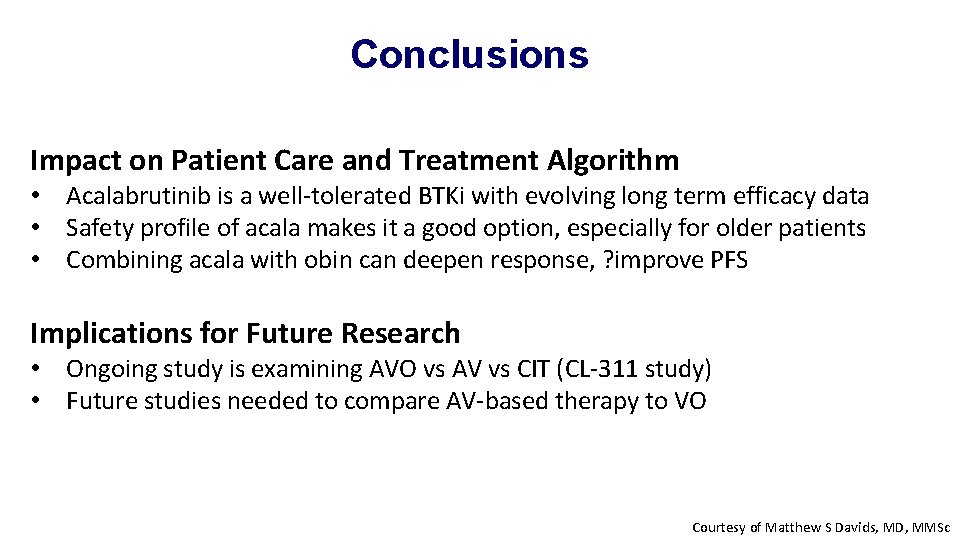
Conclusions Impact on Patient Care and Treatment Algorithm • Acalabrutinib is a well-tolerated BTKi with evolving long term efficacy data • Safety profile of acala makes it a good option, especially for older patients • Combining acala with obin can deepen response, ? improve PFS Implications for Future Research • Ongoing study is examining AVO vs AV vs CIT (CL-311 study) • Future studies needed to compare AV-based therapy to VO Courtesy of Matthew S Davids, MD, MMSc
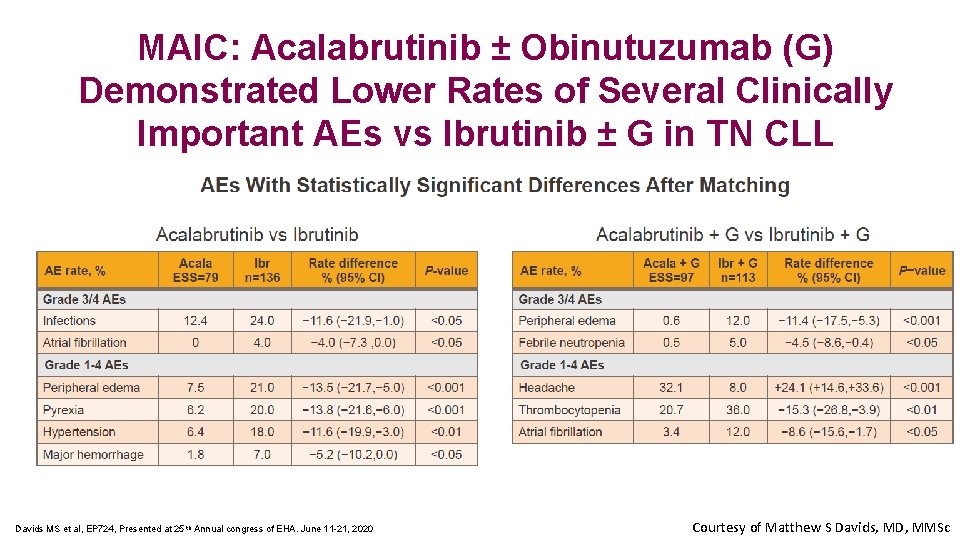
MAIC: Acalabrutinib ± Obinutuzumab (G) Demonstrated Lower Rates of Several Clinically Important AEs vs Ibrutinib ± G in TN CLL Davids MS et al, EP 724, Presented at 25 th Annual congress of EHA. June 11 -21, 2020 Courtesy of Matthew S Davids, MD, MMSc
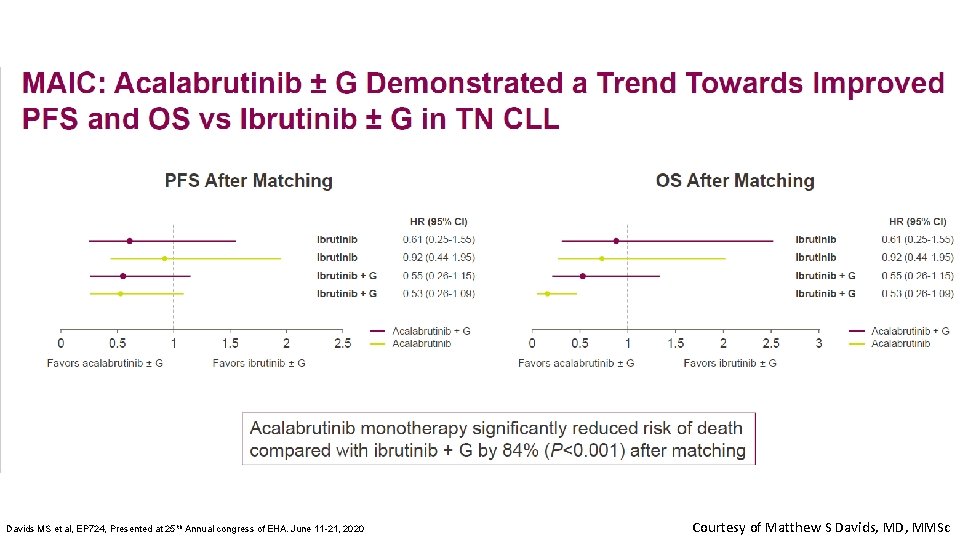
Davids MS et al, EP 724, Presented at 25 th Annual congress of EHA. June 11 -21, 2020 Courtesy of Matthew S Davids, MD, MMSc
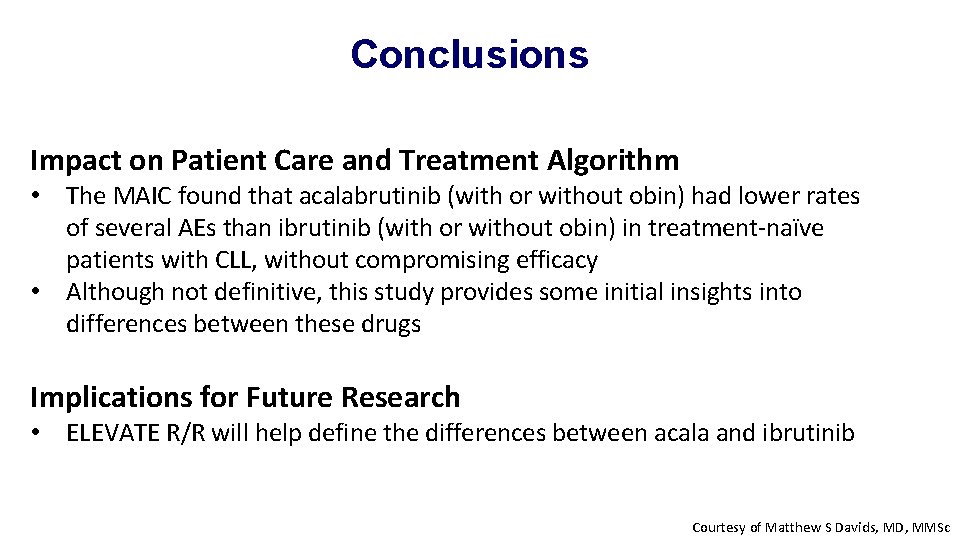
Conclusions Impact on Patient Care and Treatment Algorithm • The MAIC found that acalabrutinib (with or without obin) had lower rates of several AEs than ibrutinib (with or without obin) in treatment-naïve patients with CLL, without compromising efficacy • Although not definitive, this study provides some initial insights into differences between these drugs Implications for Future Research • ELEVATE R/R will help define the differences between acala and ibrutinib Courtesy of Matthew S Davids, MD, MMSc
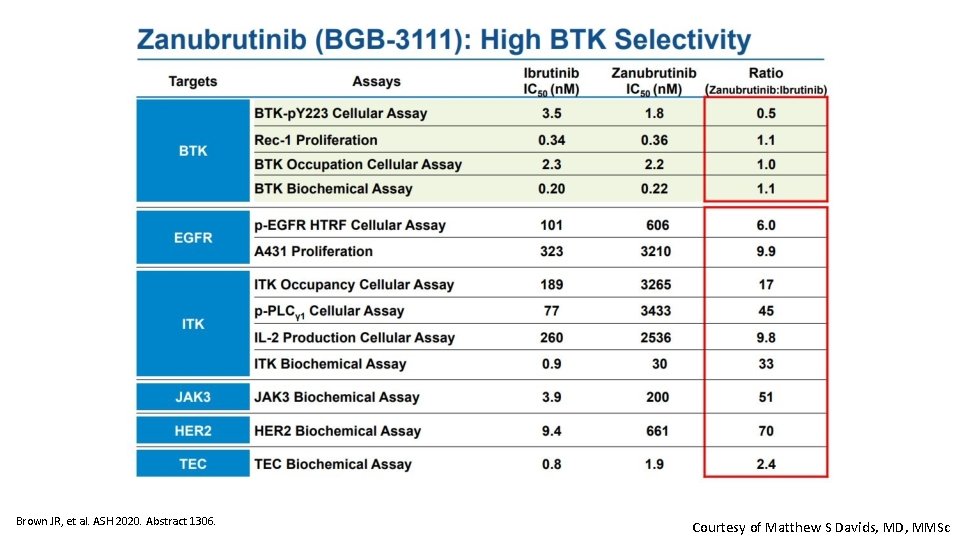
Brown JR, et al. ASH 2020. Abstract 1306. Courtesy of Matthew S Davids, MD, MMSc
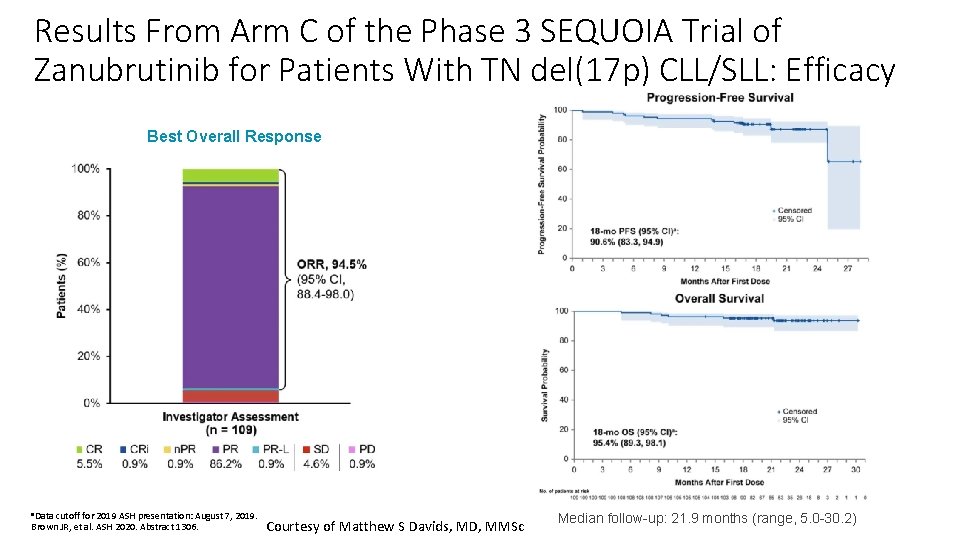
Results From Arm C of the Phase 3 SEQUOIA Trial of Zanubrutinib for Patients With TN del(17 p) CLL/SLL: Efficacy Best Overall Response a. Data cutoff for 2019 ASH presentation: August 7, 2019. Brown JR, et al. ASH 2020. Abstract 1306. Courtesy of Matthew S Davids, MD, MMSc Median follow-up: 21. 9 months (range, 5. 0 -30. 2)
Conclusions Impact on Patient Care and Treatment Algorithm • Zanubrutinib is efficacious in patients with high risk TN CLL • The toxicity profile looks more similar to acala than to ibrutinib • Possible advantages of zanubrutinib include potential for daily dosing and no drug-drug interaction with PPIs Implications for Future Research • Awaiting registrational arm of the SEQUOIA study for zanubrutinib approval in CLL • Other promising combinations with zanu under evaluation (e. g. BOVen) Courtesy of Matthew S Davids, MD, MMSc
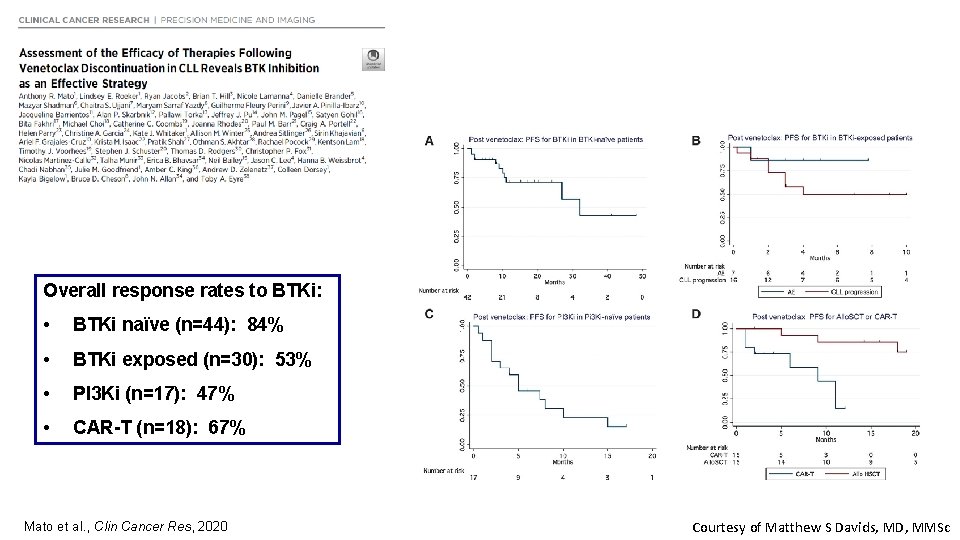
Overall response rates to BTKi: • BTKi naïve (n=44): 84% • BTKi exposed (n=30): 53% • PI 3 Ki (n=17): 47% • CAR-T (n=18): 67% Mato et al. , Clin Cancer Res, 2020 Courtesy of Matthew S Davids, MD, MMSc
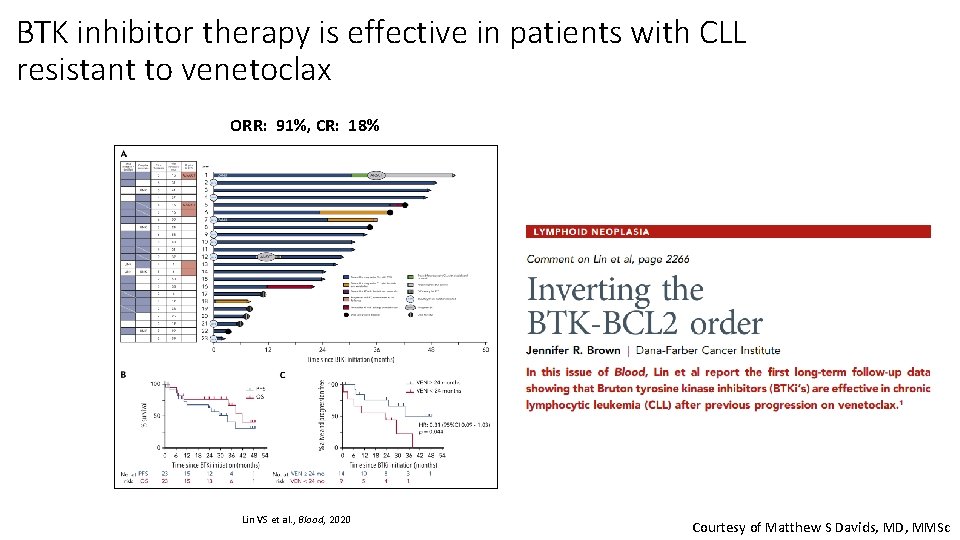
BTK inhibitor therapy is effective in patients with CLL resistant to venetoclax ORR: 91%, CR: 18% Lin VS et al. , Blood, 2020 Courtesy of Matthew S Davids, MD, MMSc
Conclusions Impact on Patient Care and Treatment Algorithm • • • Several retrospective datasets have emerged suggesting that BTKis are active postvenetoclax For patients with prior BTKi progression, re-treatment with a BTKi is unlikely to be helpful PI 3 Kis are an option for patients who progress on both BTKi and BCL-2 i, but initial data suggest responses are unlikely to be durable Implications for Future Research • • • Awaiting prospective data on this sequence (MURANO will provide some) Sequencing questions are important but it is challenging to incorporate the next line of therapy into a clinical trial Prospective registry-based studies are one way to capture this information Courtesy of Matthew S Davids, MD, MMSc
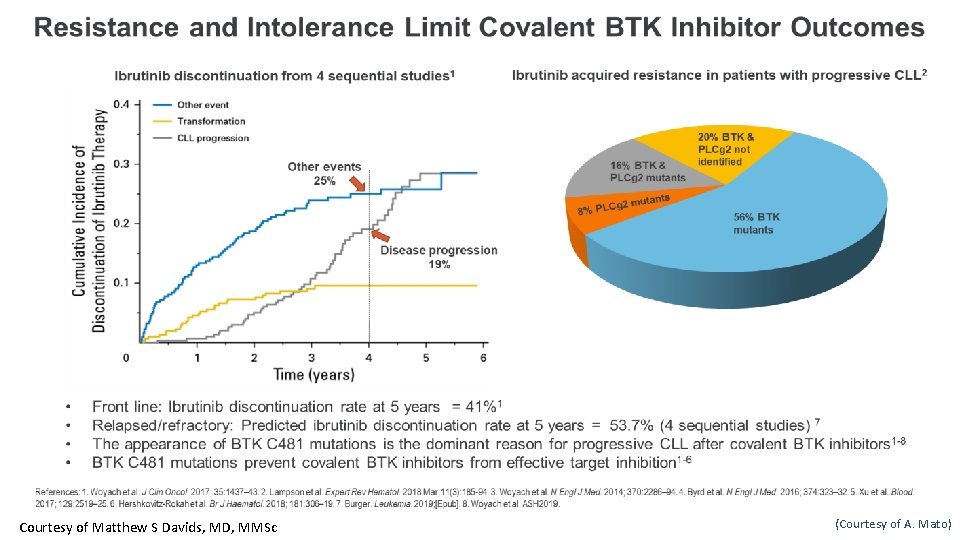
Courtesy of Matthew S Davids, MD, MMSc (Courtesy of A. Mato)
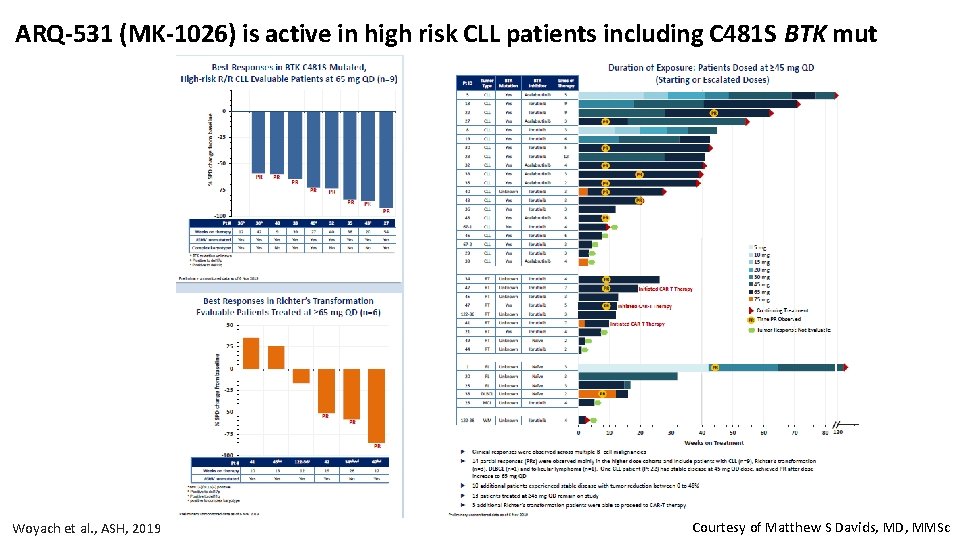
ARQ-531 (MK-1026) is active in high risk CLL patients including C 481 S BTK mut Woyach et al. , ASH, 2019 Courtesy of Matthew S Davids, MD, MMSc
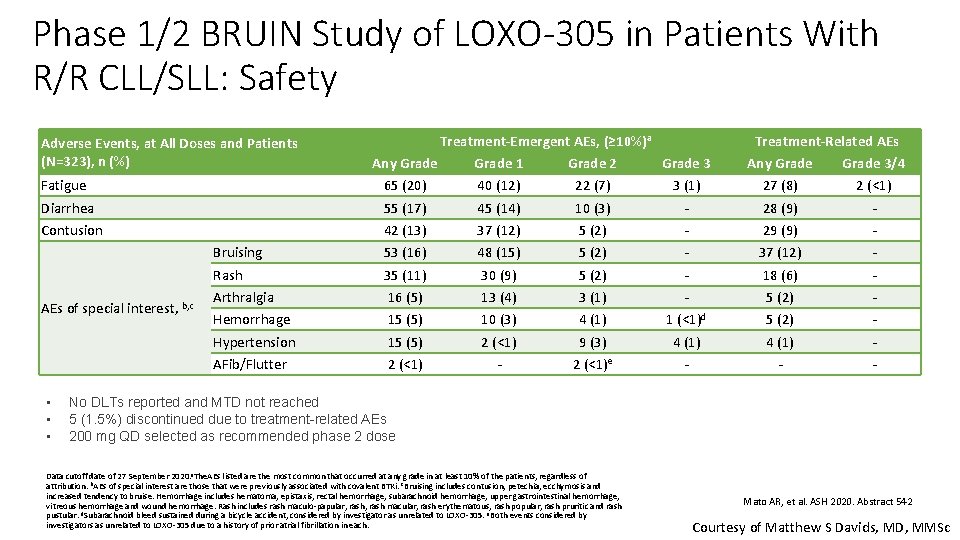
Phase 1/2 BRUIN Study of LOXO-305 in Patients With R/R CLL/SLL: Safety Adverse Events, at All Doses and Patients (N=323), n (%) Fatigue Diarrhea Contusion AEs of special interest, b, c • • • Bruising Rash Arthralgia Hemorrhage Hypertension AFib/Flutter Treatment-Emergent AEs, (≥ 10%)a Any Grade 1 Grade 2 Grade 3 65 (20) 40 (12) 22 (7) 3 (1) 55 (17) 45 (14) 10 (3) 42 (13) 37 (12) 5 (2) 53 (16) 48 (15) 5 (2) 35 (11) 30 (9) 5 (2) 16 (5) 13 (4) 3 (1) 15 (5) 10 (3) 4 (1) 1 (<1)d 15 (5) 2 (<1) 9 (3) 4 (1) 2 (<1)e - Treatment-Related AEs Any Grade 3/4 27 (8) 2 (<1) 28 (9) 29 (9) 37 (12) 18 (6) 5 (2) 4 (1) - No DLTs reported and MTD not reached 5 (1. 5%) discontinued due to treatment-related AEs 200 mg QD selected as recommended phase 2 dose Data cutoff date of 27 September 2020. a. The. AEs listed are the most common that occurred at any grade in at least 10% of the patients, regardless of attribution. b. AEs of special interest are those that were previously associated with covalent BTKi. c. Bruising includes contusion, petechia, ecchymosis and increased tendency to bruise. Hemorrhage includes hematoma, epistaxis, rectal hemorrhage, subarachnoid hemorrhage, upper gastrointestinal hemorrhage, vitreous hemorrhage and wound hemorrhage. Rash includes rash maculo-papular, rash macular, rash erythematous, rash popular, rash pruritic and rash pustular. d. Subarachnoid bleed sustained during a bicycle accident, considered by investigator as unrelated to LOXO-305. e. Both events considered by investigators as unrelated to LOXO-305 due to a history of prior atrial fibrillation in each. Mato AR, et al. ASH 2020. Abstract 542 Courtesy of Matthew S Davids, MD, MMSc
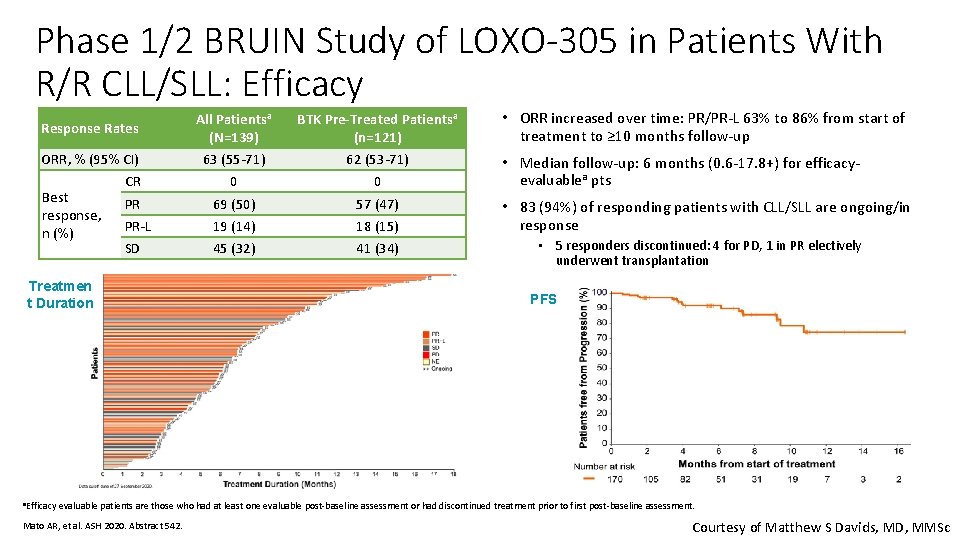
Phase 1/2 BRUIN Study of LOXO-305 in Patients With R/R CLL/SLL: Efficacy Response Rates ORR, % (95% CI) CR Best PR response, PR-L n (%) SD Treatmen t Duration a. Efficacy All Patientsa (N=139) 63 (55 -71) 0 69 (50) 19 (14) 45 (32) BTK Pre-Treated Patientsa (n=121) 62 (53 -71) 0 57 (47) 18 (15) 41 (34) • ORR increased over time: PR/PR-L 63% to 86% from start of treatment to ≥ 10 months follow-up • Median follow-up: 6 months (0. 6 -17. 8+) for efficacyevaluablea pts • 83 (94%) of responding patients with CLL/SLL are ongoing/in response • 5 responders discontinued: 4 for PD, 1 in PR electively underwent transplantation PFS evaluable patients are those who had at least one evaluable post-baseline assessment or had discontinued treatment prior to first post-baseline assessment. Mato AR, et al. ASH 2020. Abstract 542. Courtesy of Matthew S Davids, MD, MMSc
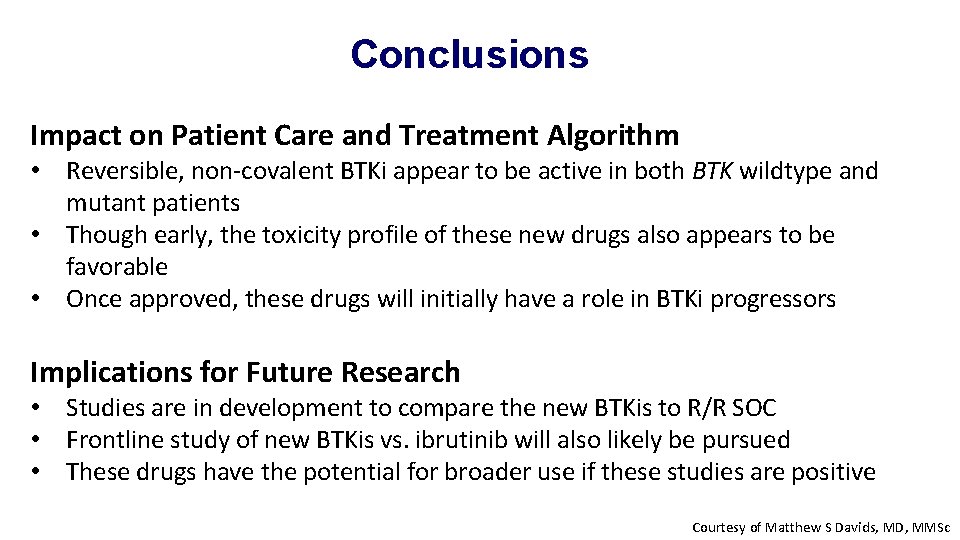
Conclusions Impact on Patient Care and Treatment Algorithm • Reversible, non-covalent BTKi appear to be active in both BTK wildtype and mutant patients • Though early, the toxicity profile of these new drugs also appears to be favorable • Once approved, these drugs will initially have a role in BTKi progressors Implications for Future Research • Studies are in development to compare the new BTKis to R/R SOC • Frontline study of new BTKis vs. ibrutinib will also likely be pursued • These drugs have the potential for broader use if these studies are positive Courtesy of Matthew S Davids, MD, MMSc
- Slides: 27