
Year 9 Pathways Vocational pathway What will Y
- Slides: 14
Year 9 Pathways Vocational pathway
What will Y 10 and Y 11 look like for your daughter? • All students study: – English (and most will also study English Literature) GCSE – Maths GCSE (Foundation or Higher) – GCSE Combined Science (Foundation) – worth 2 GCSEs. – RE GCSE – PE and PHSE (non-exam) – Students who follow this route will also study IT (Certificate in Digital Applications which is equivalent to 1 GCSE) so therefore don’t need to select it in the option blocks
The core curriculum • These compulsory subjects take up about 80% of the timetable • We believe students should study these subjects because they provide vital skills to help them access the sixth form and university courses • It is also the case that some of them are statutory
Changes to GCSE assessment • All GCSE subjects will be graded 9 -1 in 2020 • This process started with the current Y 11 who are sitting most of their exams in this format this summer • This is happening nationally and will affect all students sitting GCSE examinations in 2020 • BTEC and other GCSE equivalent subjects will continue to have their own grading system • Preparations to respond to these changes are well advanced in school
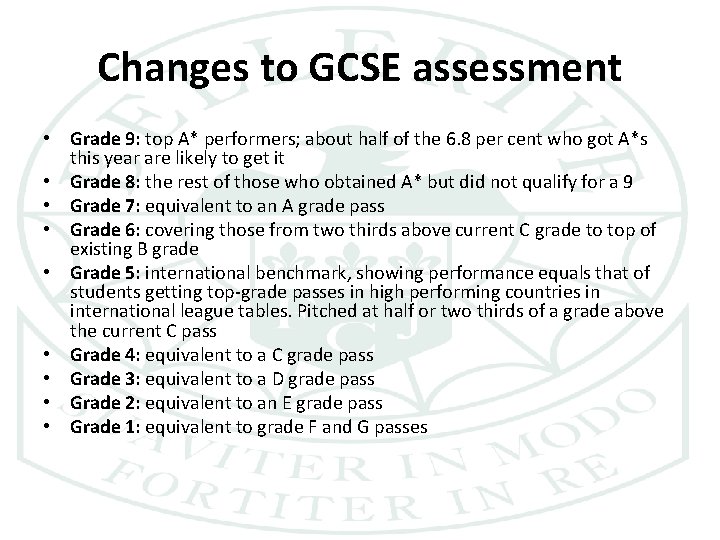
Changes to GCSE assessment • Grade 9: top A* performers; about half of the 6. 8 per cent who got A*s this year are likely to get it • Grade 8: the rest of those who obtained A* but did not qualify for a 9 • Grade 7: equivalent to an A grade pass • Grade 6: covering those from two thirds above current C grade to top of existing B grade • Grade 5: international benchmark, showing performance equals that of students getting top-grade passes in high performing countries in international league tables. Pitched at half or two thirds of a grade above the current C pass • Grade 4: equivalent to a C grade pass • Grade 3: equivalent to a D grade pass • Grade 2: equivalent to an E grade pass • Grade 1: equivalent to grade F and G passes
Sciences at Key Stage 4 • • • Science is a Core subject in the National Curriculum and is a compulsory subject at Key Stage 4 (Years 10 and 11). All girls study aspects of all 3 Sciences: Biology, Chemistry and Physics during years 10 and 11. It is important that girls think carefully about their possible career path beyond KS 4 as the choice of Science course in year 10 and 11 will affect the courses that can be taken in the future.
Sciences at Key Stage 4 • • • We believe GCSE in Combined Science (Foundation) will be best for your daughter Pupils will study all the GCSE Biology, Chemistry and Physics in a topic based manner. Pupils will have one teacher for all their sciences. This course is worth 2 GCSEs. Highest grades possible are 5/5.
GCSE Combined Science (Foundation) • Girls suitable for this course are: (i) Those who find Science challenging. (ii) Prefer working in Science on a project based course. (iii) Prefer the continuity of ONE teacher for all Science subjects.
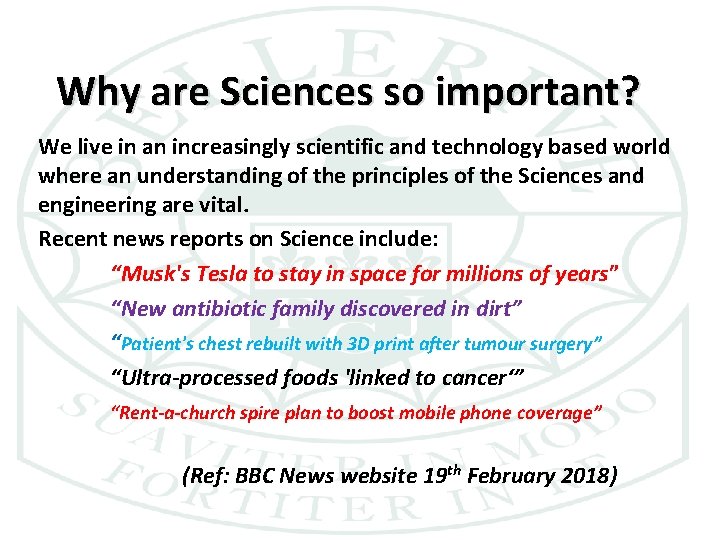
Why are Sciences so important? We live in an increasingly scientific and technology based world where an understanding of the principles of the Sciences and engineering are vital. Recent news reports on Science include: “Musk's Tesla to stay in space for millions of years” “New antibiotic family discovered in dirt” “Patient's chest rebuilt with 3 D print after tumour surgery” “Ultra-processed foods 'linked to cancer‘” “Rent-a-church spire plan to boost mobile phone coverage” (Ref: BBC News website 19 th February 2018)
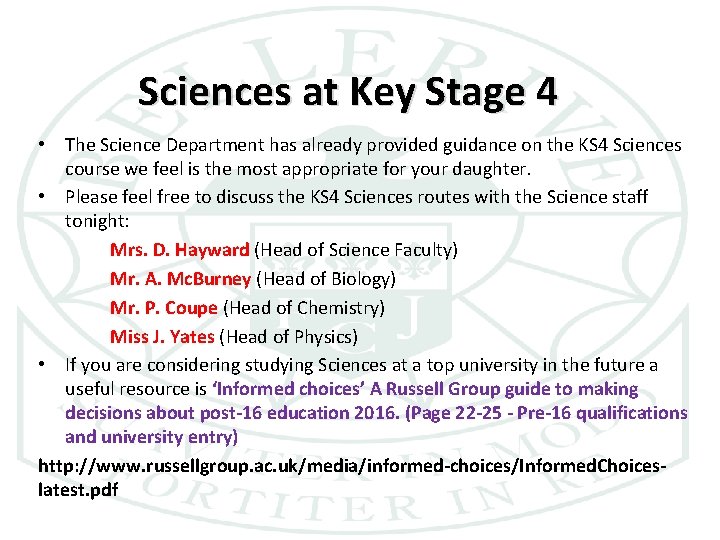
Sciences at Key Stage 4 • The Science Department has already provided guidance on the KS 4 Sciences course we feel is the most appropriate for your daughter. • Please feel free to discuss the KS 4 Sciences routes with the Science staff tonight: Mrs. D. Hayward (Head of Science Faculty) Mr. A. Mc. Burney (Head of Biology) Mr. P. Coupe (Head of Chemistry) Miss J. Yates (Head of Physics) • If you are considering studying Sciences at a top university in the future a useful resource is ‘Informed choices’ A Russell Group guide to making decisions about post-16 education 2016. (Page 22 -25 - Pre-16 qualifications and university entry) http: //www. russellgroup. ac. uk/media/informed-choices/Informed. Choiceslatest. pdf
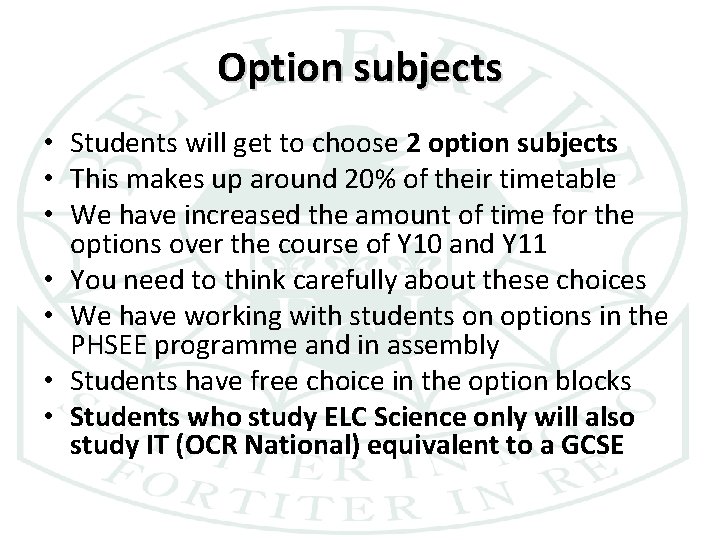
Option subjects • Students will get to choose 2 option subjects • This makes up around 20% of their timetable • We have increased the amount of time for the options over the course of Y 10 and Y 11 • You need to think carefully about these choices • We have working with students on options in the PHSEE programme and in assembly • Students have free choice in the option blocks • Students who study ELC Science only will also study IT (OCR National) equivalent to a GCSE
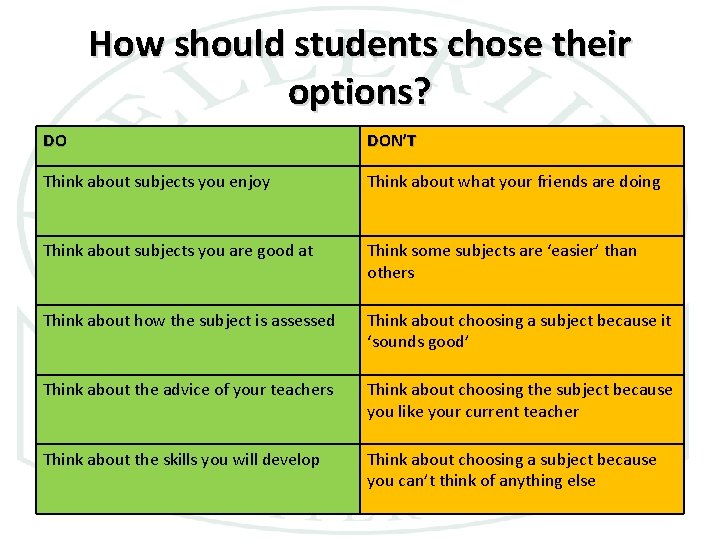
How should students chose their options? DO DON’T Think about subjects you enjoy Think about what your friends are doing Think about subjects you are good at Think some subjects are ‘easier’ than others Think about how the subject is assessed Think about choosing a subject because it ‘sounds good’ Think about the advice of your teachers Think about choosing the subject because you like your current teacher Think about the skills you will develop Think about choosing a subject because you can’t think of anything else
What happens next? • We would like students to complete the option form by Friday 16 th March • Write 1 for the first choice and 2 for the second choice in each column • When deciding if an option subject will run , we will factor in the number of students opting for the subject • Where more students opt for a subject than we can accommodate, we will take factors such as behaviour, attendance and progress in the subject into account • Please make sure you are comfortable with both subjects in both option columns • PLEASE NOTE THE ADDITIONAL GCSE SUBJECTS WE HOPE TO RUN AS AFTER SCHOOL CLASSES • Students will be informed of their final option choices in the summer term
What happens next? • Subject staff from all option subjects are available in the Sports Hall • options@bellerivefcj. org • Miss Power is also available to advise on careers as is our Connexions adviser