
Year 9 Options 2021 2023 We will be
Year 9 Options 2021 - 2023 We will be starting shortly
Year 9 Options 2021 - 2023
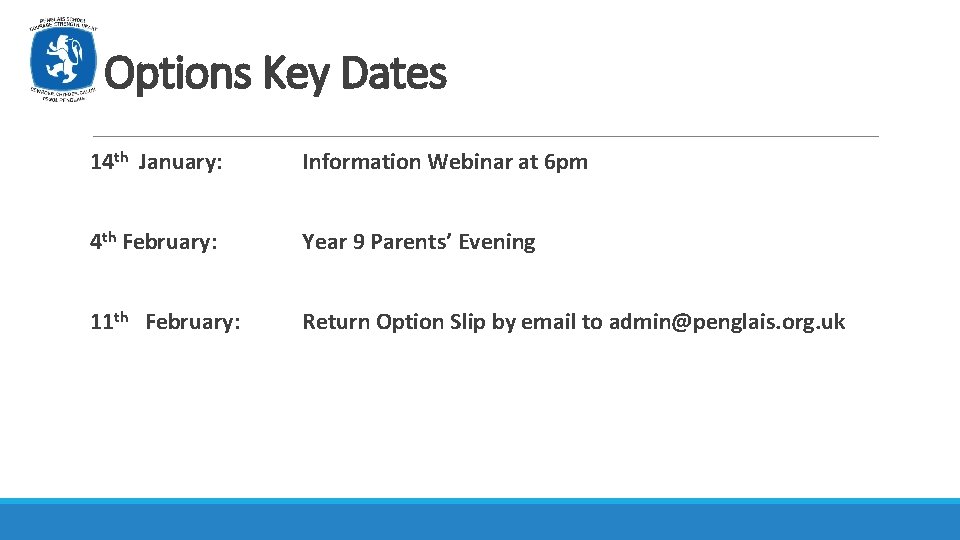
Options Key Dates 14 th January: Information Webinar at 6 pm 4 th February: Year 9 Parents’ Evening 11 th February: Return Option Slip by email to admin@penglais. org. uk
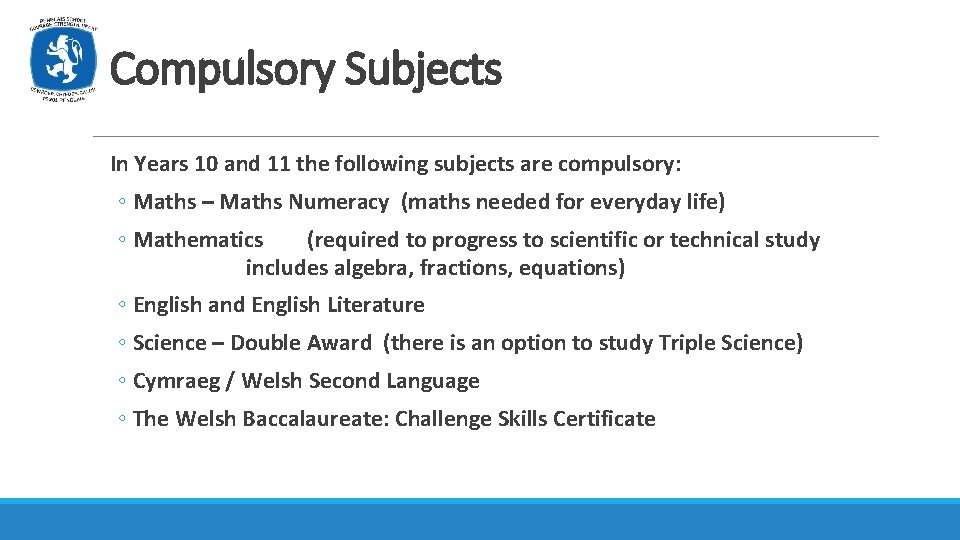
Compulsory Subjects In Years 10 and 11 the following subjects are compulsory: ◦ Maths – Maths Numeracy (maths needed for everyday life) ◦ Mathematics (required to progress to scientific or technical study includes algebra, fractions, equations) ◦ English and English Literature ◦ Science – Double Award (there is an option to study Triple Science) ◦ Cymraeg / Welsh Second Language ◦ The Welsh Baccalaureate: Challenge Skills Certificate
In addition… Students will also have one non-examined subject: PE – One lesson per week The compulsory subjects add up to 20 lessons per fortnight. The three option choices account for the remaining 9 lessons per fortnight. This is the first chance you have to select some of the subjects you wish to study.

Most option subjects are at GCSE, but there are some exceptions – 1. Engineering – this is an NVQ course, delivered in school and counts as two options. 2. Anela – A GCSE equivalent qualification looking at preparing students for work and exploring topics which are relevant to life after school. 3. Enterprise and Marketing (National Certificate) which is equivalent to a GCSE and is very practical 4. Skills which supports students in all of their other GCSEs. Class Sizes Some subjects, particularly practical subjects, are more limited in class size. Where numbers opting for a course are greater than the available places some of the factors considered in allocating places will be • The level of work produced in key stage 3 and ability to cope with the subject content
What you need to consider: What do these subjects involve? Read the guide in the options booklet, speak to subject teachers, look at the specifications for these subjects. Find out about: - What topics will be studied? Some of the subjects are new to pupils in Year 10. The topics covered at GCSE may be very different from what has been studied in Key Stage 3. - How is the subject examined? At GCSE there is controlled assessment, practical exams, oral exams, written exams. Some subjects may be 100% controlled assessment, some are 100% exams, some have a combination. Since the review of qualifications in 2014 many subjects now have a higher percentage of written examination. - What type of course is it? Is it a linear course – with all exams at the end of Year 11, or is it modular with some exams before the summer of Year 11? Since the review of qualifications in 2014 there has been a move back towards linear assessment i. e. assessment at the end of Year 11, and fewer exams in Year 10 and January of Year 11. - Do you have to have studied the subject at GCSE if you are to be able to study it to A Level?
Looking further ahead - If you have a good idea of what career you might like to go into what combination and level of GCSEs is advisable? Careers Wales website and staff will be able to provide you with more information on this. - If you are thinking you may want to go to University remember GCSE results are the only completed course grades they will have. - If you have a good idea of what course you might like to study at University or College then you need to be looking at the entry requirements for these courses. What combination and level of GCSEs do they require?
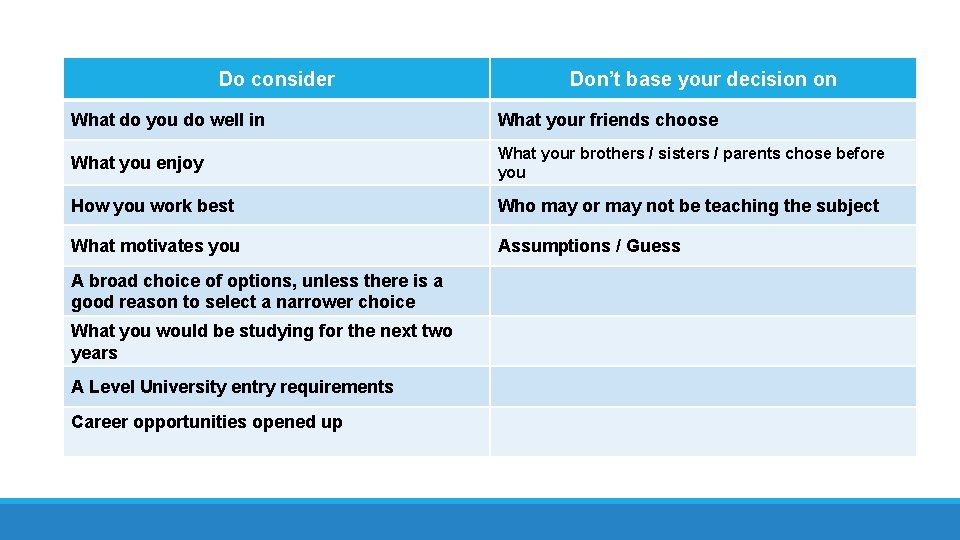
Do consider Don’t base your decision on What do you do well in What your friends choose What you enjoy What your brothers / sisters / parents chose before you How you work best Who may or may not be teaching the subject What motivates you Assumptions / Guess A broad choice of options, unless there is a good reason to select a narrower choice What you would be studying for the next two years A Level University entry requirements Career opportunities opened up
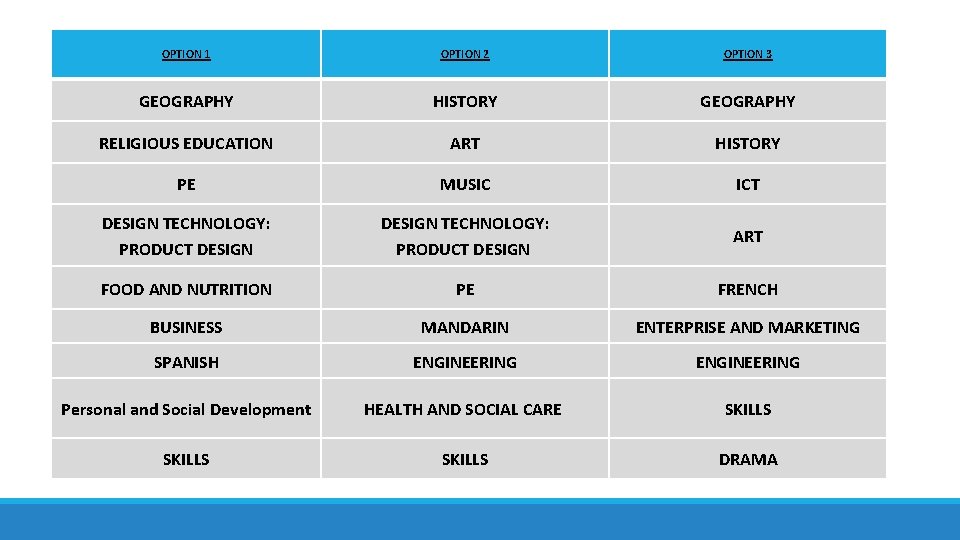
OPTION 1 OPTION 2 OPTION 3 GEOGRAPHY HISTORY GEOGRAPHY RELIGIOUS EDUCATION ART HISTORY PE MUSIC ICT DESIGN TECHNOLOGY: PRODUCT DESIGN ART FOOD AND NUTRITION PE FRENCH BUSINESS MANDARIN ENTERPRISE AND MARKETING SPANISH ENGINEERING Personal and Social Development HEALTH AND SOCIAL CARE SKILLS DRAMA
5 pieces of advice: 1) GCSE’s are the foundations of your future, don’t waste this opportunity. 2) Take ownership. 3) Cope With Failure and Learn From Mistakes. 4) Be organised. 5) Never stop doing the things you enjoy, find the right balance.
Questions and queries If you have any questions please contact the following staff: Mererid Thomas: Matthew Hughes: Hayley Leighton: Wyn Davies: nmt@penglais. org. uk mdh@penglais. org. uk hgg@penglais. org. uk wyn. davies@careerswales. gov. wales
- Slides: 12