
Year 9 knowledge organiser 1 Choose the Perfect
- Slides: 2
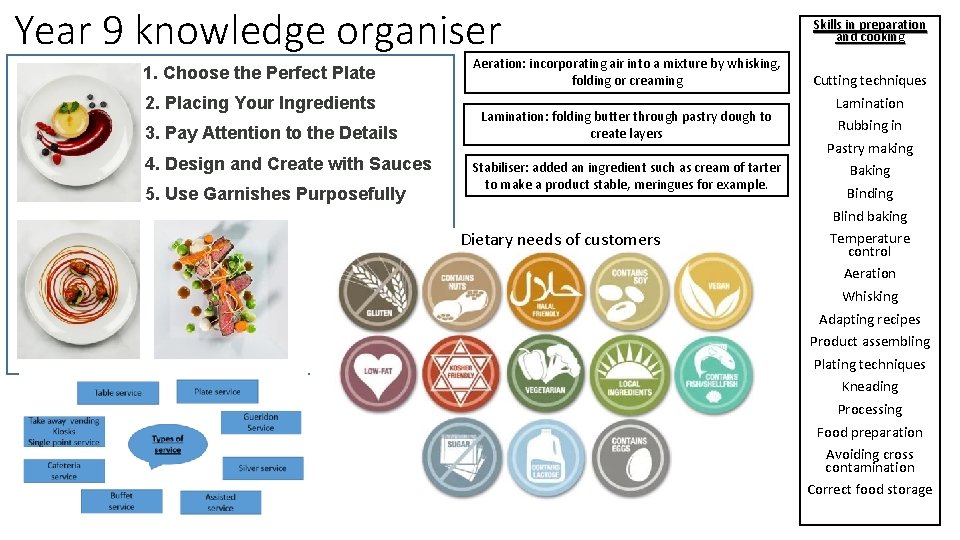
Year 9 knowledge organiser 1. Choose the Perfect Plate 2. Placing Your Ingredients 3. Pay Attention to the Details 4. Design and Create with Sauces 5. Use Garnishes Purposefully Aeration: incorporating air into a mixture by whisking, folding or creaming Lamination: folding butter through pastry dough to create layers Stabiliser: added an ingredient such as cream of tarter to make a product stable, meringues for example. Skills in preparation and cooking Cutting techniques Lamination Rubbing in Pastry making Binding Blind baking Dietary needs of customers Temperature control Aeration Whisking Adapting recipes Product assembling Plating techniques Kneading Processing Food preparation Avoiding cross contamination Correct food storage
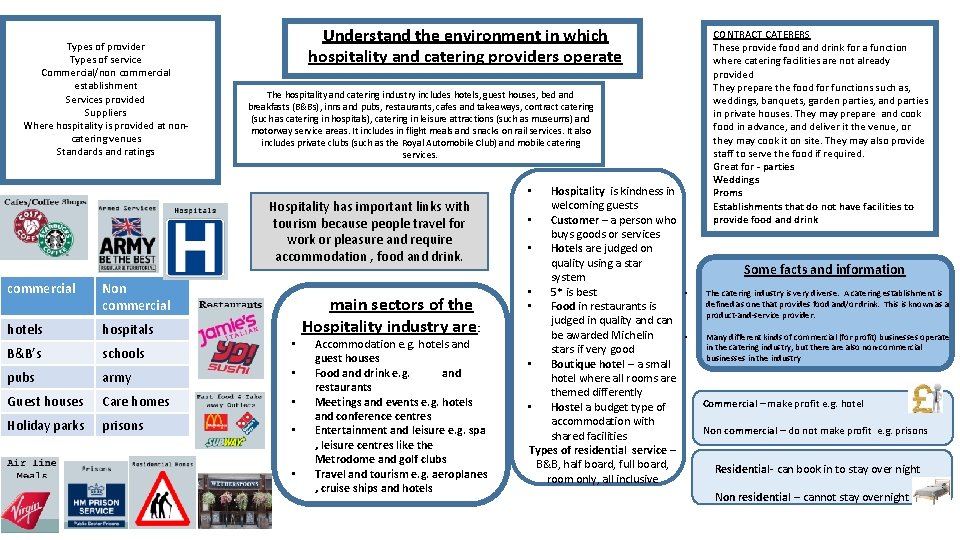
Types of provider Types of service Commercial/non commercial establishment Services provided Suppliers Where hospitality is provided at noncatering venues Standards and ratings Understand the environment in which hospitality and catering providers operate CONTRACT CATERERS These provide food and drink for a function where catering facilities are not already provided They prepare the food for functions such as, weddings, banquets, garden parties, and parties in private houses. They may prepare and cook food in advance, and deliver it the venue, or they may cook it on site. They may also provide staff to serve the food if required. Great for - parties Weddings Proms Establishments that do not have facilities to provide food and drink The hospitality and catering industry includes hotels, guest houses, bed and breakfasts (B&Bs), inns and pubs, restaurants, cafes and takeaways, contract catering (such as catering in hospitals), catering in leisure attractions (such as museums) and motorway service areas. It includes in flight meals and snacks on rail services. It also includes private clubs (such as the Royal Automobile Club) and mobile catering services. Hospitality is kindness in welcoming guests • Customer – a person who buys goods or services • Hotels are judged on quality using a star system • 5* is best • Food in restaurants is judged in quality and can be awarded Michelin stars if very good • Boutique hotel – a small hotel where all rooms are themed differently • Hostel a budget type of accommodation with shared facilities Types of residential service – B&B, half board, full board, room only, all inclusive • Hospitality has important links with tourism because people travel for work or pleasure and require accommodation , food and drink. commercial Non commercial hotels hospitals B&B’s schools pubs army • Guest houses Care homes • Holiday parks prisons • The main • • sectors of the Hospitality industry are: Accommodation e. g. hotels and guest houses Food and drink e. g. cafes and restaurants Meetings and events e. g. hotels and conference centres Entertainment and leisure e. g. spa , leisure centres like the Metrodome and golf clubs Travel and tourism e. g. aeroplanes , cruise ships and hotels Some facts and information • The catering industry is very diverse. A catering establishment is defined as one that provides food and/or drink. This is known as a product-and-service provider. • Many different kinds of commercial (for profit) businesses operate in the catering industry, but there also non-commercial businesses in the industry Commercial – make profit e. g. hotel Non commercial – do not make profit e. g. prisons Residential- can book in to stay over night Non residential – cannot stay overnight