
Year 9 into Yr 10 Geography Summer reading

- Slides: 4
Year 9 (into Yr 10) Geography Summer reading COASTS
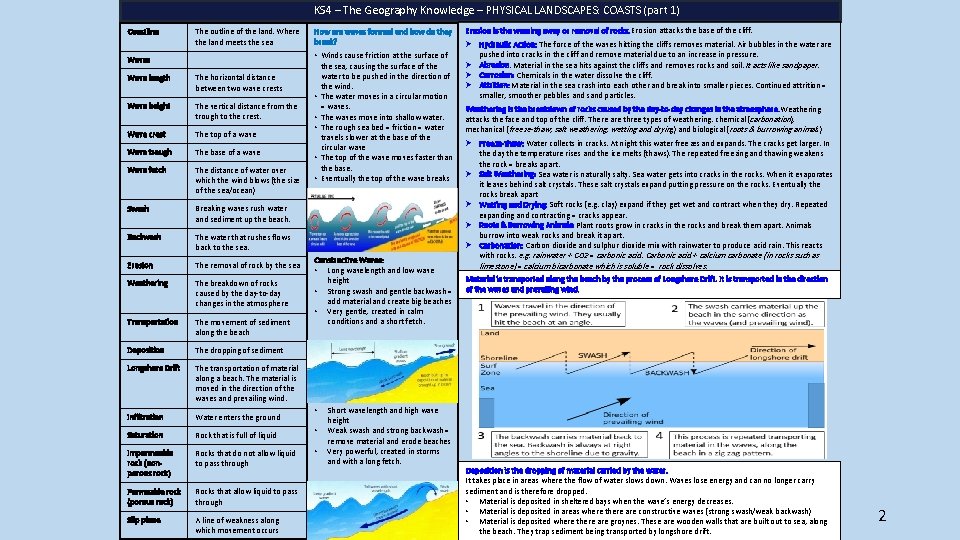
KS 4 – The Geography Knowledge – PHYSICAL LANDSCAPES: COASTS (part 1) Coastline The outline of the land. Where the land meets the sea • Winds cause friction at the surface of Waves Wave length The horizontal distance between two wave crests Wave height The vertical distance from the trough to the crest. Wave crest The top of a wave Wave trough The base of a wave Wave fetch The distance of water over which the wind blows (the size of the sea/ocean) Swash Breaking waves rush water and sediment up the beach. Backwash The water that rushes flows back to the sea. Erosion How are waves formed and how do they break? The removal of rock by the sea Weathering The breakdown of rocks caused by the day-to-day changes in the atmosphere Transportation The movement of sediment along the beach Deposition The dropping of sediment Longshore Drift The transportation of material along a beach. The material is moved in the direction of the waves and prevailing wind. Infiltration Water enters the ground Saturation Rock that is full of liquid Impermeable rock (nonporous rock) Rocks that do not allow liquid to pass through Permeable rock (porous rock) Rocks that allow liquid to pass through Slip plane A line of weakness along which movement occurs • • • the sea, causing the surface of the water to be pushed in the direction of the wind. The water moves in a circular motion = waves. The waves move into shallow water. The rough sea bed = friction = water travels slower at the base of the circular wave The top of the wave moves faster than the base. Eventually the top of the wave breaks Erosion is the wearing away or removal of rocks. Erosion attacks the base of the cliff. Ø Hydraulic Action: The force of the waves hitting the cliffs removes material. Air bubbles in the water are pushed into cracks in the cliff and remove material due to an increase in pressure. Ø Abrasion: Material in the sea hits against the cliffs and removes rocks and soil. It acts like sandpaper. Ø Corrosion: Chemicals in the water dissolve the cliff. Ø Attrition: Material in the sea crash into each other and break into smaller pieces. Continued attrition = smaller, smoother pebbles and sand particles. Weathering is the breakdown of rocks caused by the day-to-day changes in the atmosphere. Weathering attacks the face and top of the cliff. There are three types of weathering: chemical (carbonation), mechanical (freeze-thaw, salt weathering, wetting and drying) and biological (roots & burrowing animals) Ø Freeze-thaw: Water collects in cracks. At night this water freezes and expands. The cracks get larger. In Ø Ø Constructive Waves: • Long wavelength and low wave height • Strong swash and gentle backwash = add material and create big beaches • Very gentle, created in calm conditions and a short fetch. Destructive Waves • Short wavelength and high wave height • Weak swash and strong backwash = remove material and erode beaches • Very powerful, created in storms and with a long fetch. the day the temperature rises and the ice melts (thaws). The repeated freezing and thawing weakens the rock = breaks apart. Salt Weathering: Sea water is naturally salty. Sea water gets into cracks in the rocks. When it evaporates it leaves behind salt crystals. These salt crystals expand putting pressure on the rocks. Eventually the rocks break apart Wetting and Drying: Soft rocks (e. g. clay) expand if they get wet and contract when they dry. Repeated expanding and contracting = cracks appear. Roots & Burrowing Animals: Plant roots grow in cracks in the rocks and break them apart. Animals burrow into weak rocks and break it apart. Carbonation: Carbon dioxide and sulphur dioxide mix with rainwater to produce acid rain. This reacts with rocks. e. g. rainwater + CO 2 = carbonic acid. Carbonic acid + calcium carbonate (in rocks such as limestone) = calcium bicarbonate which is soluble = rock dissolves. Material is transported along the beach by the process of Longshore Drift. It is transported in the direction of the waves and prevailing wind. Deposition is the dropping of material carried by the water. It takes place in areas where the flow of water slows down. Waves lose energy and can no longer carry sediment and is therefore dropped. • Material is deposited in sheltered bays when the wave’s energy decreases. • Material is deposited in areas where there are constructive waves (strong swash/weak backwash) • Material is deposited where there are groynes. These are wooden walls that are built out to sea, along the beach. They trap sediment being transported by longshore drift. 2
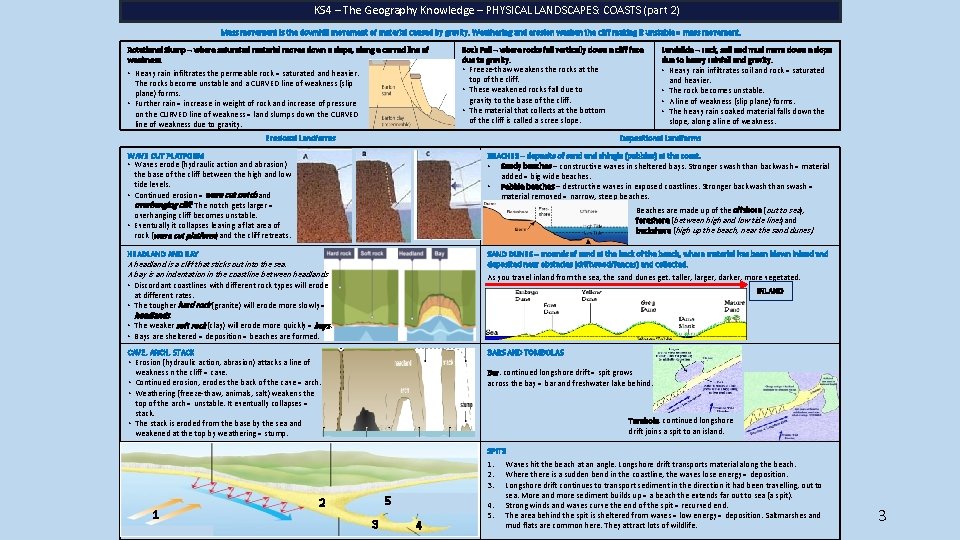
KS 4 – The Geography Knowledge – PHYSICAL LANDSCAPES: COASTS (part 2) Mass movement is the downhill movement of material caused by gravity. Weathering and erosion weaken the cliff making it unstable = mass movement. Rotational Slump – where saturated material moves down a slope, along a curved line of weakness. • Heavy rain infiltrates the permeable rock = saturated and heavier. The rocks become unstable and a CURVED line of weakness (slip plane) forms. • Further rain = increase in weight of rock and increase of pressure on the CURVED line of weakness = land slumps down the CURVED line of weakness due to gravity. Rock Fall – where rocks fall vertically down a cliff face due to gravity. • Freeze-thaw weakens the rocks at the top of the cliff. • These weakened rocks fall due to gravity to the base of the cliff. • The material that collects at the bottom of the cliff is called a scree slope. Erosional Landforms Landslide – rock, soil and mud move down a slope due to heavy rainfall and gravity. • Heavy rain infiltrates soil and rock = saturated and heavier. • The rock becomes unstable. • A line of weakness (slip plane) forms. • The heavy rain soaked material falls down the slope, along a line of weakness. Depositional Landforms WAVE CUT PLATFORM BEACHES – deposits of sand shingle (pebbles) at the coast. • Sandy beaches – constructive waves in sheltered bays. Stronger swash than backwash = material added = big wide beaches. • Pebble beaches – destructive waves in exposed coastlines. Stronger backwash than swash = material removed = narrow, steep beaches. • Waves erode (hydraulic action and abrasion) the base of the cliff between the high and low tide levels. • Continued erosion = wave cut notch and overhanging cliff. The notch gets larger = overhanging cliff becomes unstable. • Eventually it collapses leaving a flat area of rock (wave cut platform) and the cliff retreats. Beaches are made up of the offshore (out to sea), foreshore (between high and low tide lines) and backshore (high up the beach, near the sand dunes). HEADLAND BAY SAND DUNES – mounds of sand at the back of the beach, where material has been blown inland deposited near obstacles (driftwood/fences) and collected. As you travel inland from the sea, the sand dunes get: taller, larger, darker, more vegetated. A headland is a cliff that sticks out into the sea. A bay is an indentation in the coastline between headlands • Discordant coastlines with different rock types will erode INLAND at different rates. • The tougher hard rock (granite) will erode more slowly = headlands. • The weaker soft rock (clay) will erode more quickly = bays. • Bays are sheltered = deposition = beaches are formed. CAVE, ARCH, STACK • Erosion (hydraulic action, abrasion) attacks a line of weakness n the cliff = cave. • Continued erosion, erodes the back of the cave = arch. • Weathering (freeze-thaw, animals, salt) weakens the top of the arch = unstable. It eventually collapses = stack. • The stack is eroded from the base by the sea and weakened at the top by weathering = stump. BARS AND TOMBOLAS Bar: continued longshore drift = spit grows across the bay = bar and freshwater lake behind. Tombola: continued longshore drift joins a spit to an island. SPITS 1. 2. 3. 1 5 2 3 4 4. 5. Waves hit the beach at an angle. Longshore drift transports material along the beach. Where there is a sudden bend in the coastline, the waves lose energy = deposition. Longshore drift continues to transport sediment in the direction it had been travelling, out to sea. More and more sediment builds up = a beach the extends far out to sea (a spit). Strong winds and waves curve the end of the spit = recurved end. The area behind the spit is sheltered from waves = low energy = deposition. Saltmarshes and mud flats are common here. They attract lots of wildlife. 3
KS 4 – The Geography Knowledge – PHYSICAL LANDSCAPES: COASTS (part 3) Our coastline is at risk of erosion due to destructive waves, soft rock and longshoredrift. We must protect our coastline, however we cannot protect all of it. For a section of coastline to be protected, the cost of the scheme must be less than the value of the land, property and infrastructure (e. g. roads) saved, and the scheme must have no negative ‘knock-on’ environmental effects, for example making erosion worse somewhere else. The British Government creates shoreline management plans (SMPs) that outline how our coastline will be protected. There are four strategies. • Advance the line: build new coastal defence structures in front of existing defence structures. It is expensive and used to protect very high value land. • Hold the line: maintain or improve existing coastal defences to continue protecting the coastline from erosion. It is expensive and used to protect high value land. • Management realignment: move the line of coastal defences inland allow the sea to naturally move inland until it comes to a natural barrier of higher land. Leads to loss of land infrastructure and so used in areas where there is low land value. • Do nothing: no change, no investment, no existing or new defences. Natural processes are allowed to shape the coastline. Used in areas where there is very low land value. Hard engineering – using manmade, artificial structures to prevent erosion and flooding. . More effective, long lasting and need less maintaining than soft engineering, however more expensive and less natural/environmentally friendly. Beach Nourishment Adds sediment to the beach to make it wider = acts as a barrier from the waves = reduces erosion and flooding. • Cheap and easy to maintain, natural looking, bigger beaches = more tourism • Short lifespan, constant maintenance, beach is closed due it is being done. Beach Reprofiling Material removed by longshore drift or destructive waves is returned to the beach = prevents the beach getting smaller. • Cheap and easy to maintain, natural appearance, bigger beach = more tourists • Short lifespan, constant maintenance, beach is closed due it is being done. Dune Regeneration Sand dunes are repaired and made larger using fences or marram grass = barrier from the waves. • Cheap, very natural, popular with wildlife (creates habitats). • While being repaired, dunes are closed = less tourists, constant maintenance as dunes are constantly changing. Wood or rock fences built out into the sea. They trap sediment transported by longshore drift and make the beach larger. • Groynes - Beach becomes wider = waves lose energy as they rush up the beach = less erosion. Big beaches boosts tourism. • They prevent sediment reaching beaches further along the coastline = problem is shifted and not solved. More expensive than soft engineering. Dune Fencing Fences are built on sandy beaches to collect sand create new sand dunes = act as a barrier from the waves • Cheap, natural, help make dunes larger, minimal impact on wildlife. • Can be dangerous if the fences break, need regular maintenance after storms Stone walls built up in the ocean parallel to the coastline. They reduce the energy of the waves and help deposition to occur = beach gets larger (e. g. Sea Palling), however they can also be very expensive and can interfere with boats. People are evacuated, buildings demolished any existing sea defences removed. The sea floods the land salt marshes develop which absorb the energy of future waves. New flood defences can be built in high-value land behind the salt marshes. Sea Wall A strong concrete wall built in front of the cliff/settlement that absorbs the wave’s energy. • Effective, long lifespan, tourists like to walk along it. • Expensive to build and maintain, looks unnatural. Rock Amour Large rocks placed in front of the cliff or settlement, that absorb the wave’s energy. • Effective, long lifespan, more natural than sea wall and easier to build/maintain. • Expensive, access to the beach can be difficult, can become slippery and dangerous. Gabions A wire cage filled with rocks that are placed in front of the cliff or seaside settlement, that absorb the wave’s energy. • Effective, long lifespan, cheaper than rock armour/sea walls, if covered in vegetation can look natural. • Wire cages have short lifespan (5 -10 years). Sea water corrodes metal cages = broken gabions which can be dangerous to tourists. More expensive than soft engineering. Groynes Off-shore Breakwater Soft engineering – using natural, environmentally friendly methods to prevent erosion and flooding. Often cheaper than hard engineering however need more maintaining and have a shorter lifespan. Example: North Norfolk is located on the east coast of England. Historic records show that between 1600 and 1850, >250 m of land was eroded by the sea. This is due to soft rock (clay), large wave fetch (4000 miles from Arctic) and strong weather. Along the coastline they have a number of Shoreline Management Plans (SMPs). • Happisburgh – very low land value. SMP: do nothing. Old sea defences are not repaired the cliff is left to erode. Owners were given 40% of their homes full value (non-risk value) • Sea Palling – mid land value (homes, few shops, pub). SMP: hold the line. They have a concrete sea wall and offshore breakwaters. • Sheringham – high land value (lots of homes and businesses). SMP: hold the line. They have a sea wall, wooden groynes, rock armour and beach nourishment. Managed retreat – a deliberate decision to allow the sea to flood an area of low-value land. Medmerry Managed Retreat, Chichester, South England: largest managed retreat project in Europe The flat, low-lying land had a low value (used for farming and caravan parks). The sea wall that protected the area needed repairing, but the decision was to not repair it and allow the land to flood as it was cheaper than repairing the sea wall. The managed retreat took place in November 2013. ADVANTAGES DISADVANTAGES Created large saltmarsh that protected the most expensive inland areas from flooding. Created wildlife habitats Cheaper than repairing sea wall People and businesses were flooded and relocated. It cost the government £ 28 million. Large areas of agricultural land was lost. 4