
Year 9 Geography Knowledge Organizer A Fieldwork Skills
- Slides: 9
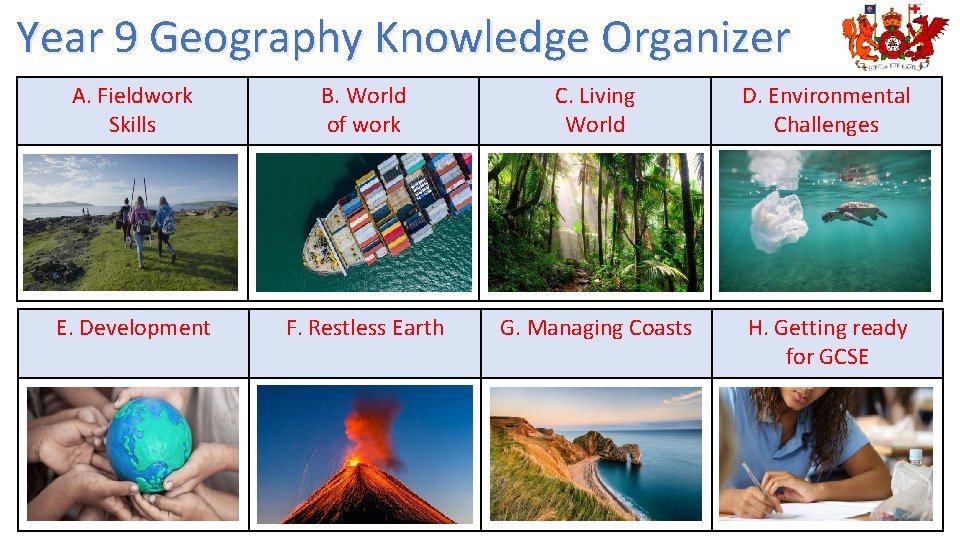
Year 9 Geography Knowledge Organizer A. Fieldwork Skills B. World of work C. Living World D. Environmental Challenges E. Development F. Restless Earth G. Managing Coasts H. Getting ready for GCSE
10 different ways you can use your Knowledge organizer: 1. Prepare for a spelling test of key words e. g. environment. Your teacher might misspell them on purpose, so be ready to correct their mistakes! 6. Make your own quiz or challenge for a classmate or your teacher. You could design a crossword using the key terms and use definitions for the clues. 2. Prepare for a quiz at the start of the lessons – the answers are all the key words… Or you have to think of the questions instead! 7. Organise the key words in different ways – try making a spider diagram or a mind map. 3. Sort the key words somehow (into categories such as physical geography or human geography) 8. Your teacher could ask you which words in the knowledge organiser are most relevant to the topic you are studying. 4. Use the key words by including them in an answer to a question you’ve been set by your teacher. 9. Make connections between the key words – you could draw a flow diagram to show different words and ideas are linked. 5. Check you know what the key words mean – talk about what they mean at home, take notes, or make a glossary containing definitions for them. 10. Put a next to key words if you are confident that you know what they mean. Work on the others, and ask your teacher for some help if you need it.
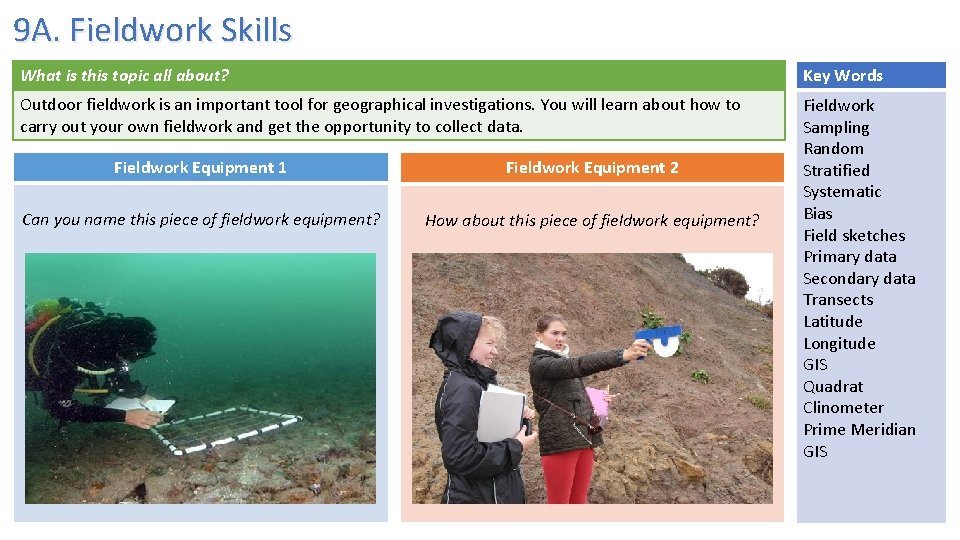
9 A. Fieldwork Skills What is this topic all about? Key Words Outdoor fieldwork is an important tool for geographical investigations. You will learn about how to carry out your own fieldwork and get the opportunity to collect data. Fieldwork Sampling Random Stratified Systematic Bias Field sketches Primary data Secondary data Transects Latitude Longitude GIS Quadrat Clinometer Prime Meridian GIS Fieldwork Equipment 1 Fieldwork Equipment 2 Can you name this piece of fieldwork equipment? How about this piece of fieldwork equipment?
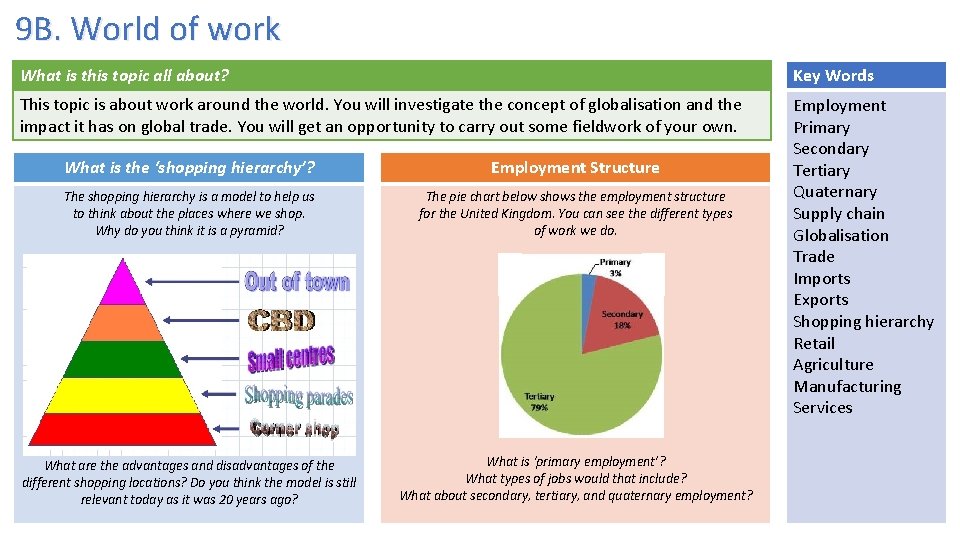
9 B. World of work What is this topic all about? Key Words This topic is about work around the world. You will investigate the concept of globalisation and the impact it has on global trade. You will get an opportunity to carry out some fieldwork of your own. Employment Primary Secondary Tertiary Quaternary Supply chain Globalisation Trade Imports Exports Shopping hierarchy Retail Agriculture Manufacturing Services What is the ‘shopping hierarchy’? Employment Structure The shopping hierarchy is a model to help us to think about the places where we shop. Why do you think it is a pyramid? The pie chart below shows the employment structure for the United Kingdom. You can see the different types of work we do. What are the advantages and disadvantages of the different shopping locations? Do you think the model is still relevant today as it was 20 years ago? What is ‘primary employment’? What types of jobs would that include? What about secondary, tertiary, and quaternary employment?
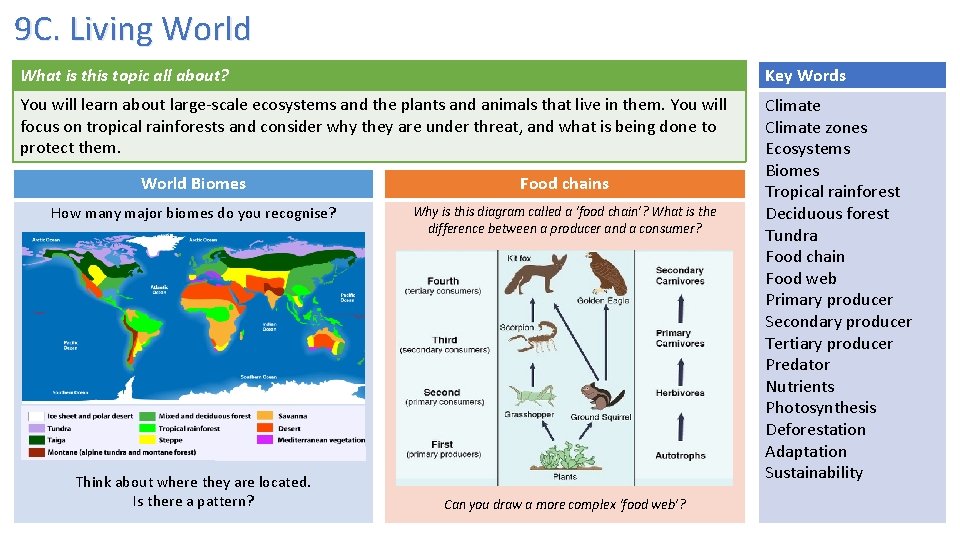
9 C. Living World What is this topic all about? Key Words You will learn about large-scale ecosystems and the plants and animals that live in them. You will focus on tropical rainforests and consider why they are under threat, and what is being done to protect them. Climate zones Ecosystems Biomes Tropical rainforest Deciduous forest Tundra Food chain Food web Primary producer Secondary producer Tertiary producer Predator Nutrients Photosynthesis Deforestation Adaptation Sustainability World Biomes Food chains How many major biomes do you recognise? Why is this diagram called a ‘food chain’? What is the difference between a producer and a consumer? Think about where they are located. Is there a pattern? Can you draw a more complex ‘food web’?
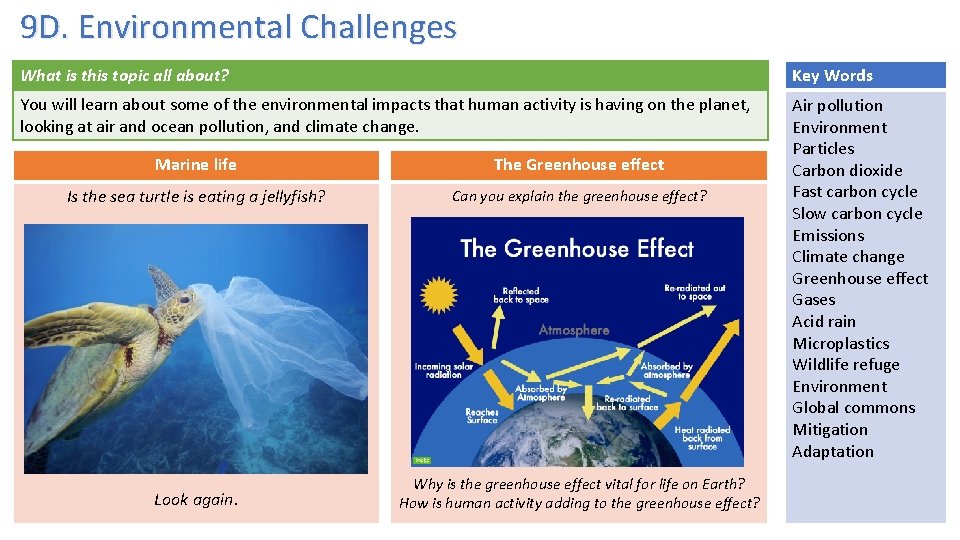
9 D. Environmental Challenges What is this topic all about? Key Words You will learn about some of the environmental impacts that human activity is having on the planet, looking at air and ocean pollution, and climate change. Air pollution Environment Particles Carbon dioxide Fast carbon cycle Slow carbon cycle Emissions Climate change Greenhouse effect Gases Acid rain Microplastics Wildlife refuge Environment Global commons Mitigation Adaptation Marine life The Greenhouse effect Is the sea turtle is eating a jellyfish? Can you explain the greenhouse effect? Look again. Why is the greenhouse effect vital for life on Earth? How is human activity adding to the greenhouse effect?
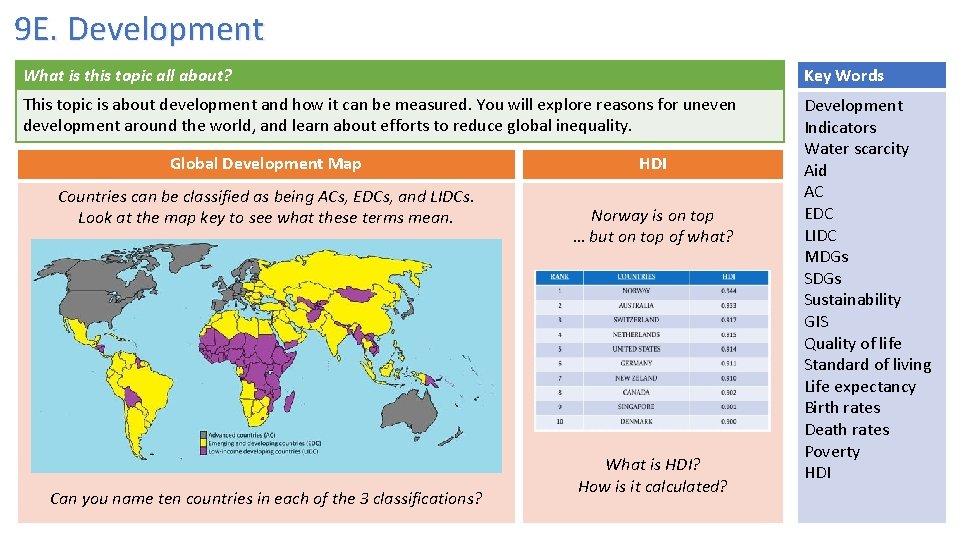
9 E. Development What is this topic all about? Key Words This topic is about development and how it can be measured. You will explore reasons for uneven development around the world, and learn about efforts to reduce global inequality. Development Indicators Water scarcity Aid AC EDC LIDC MDGs Sustainability GIS Quality of life Standard of living Life expectancy Birth rates Death rates Poverty HDI Global Development Map Countries can be classified as being ACs, EDCs, and LIDCs. Look at the map key to see what these terms mean. Can you name ten countries in each of the 3 classifications? HDI Norway is on top … but on top of what? What is HDI? How is it calculated?
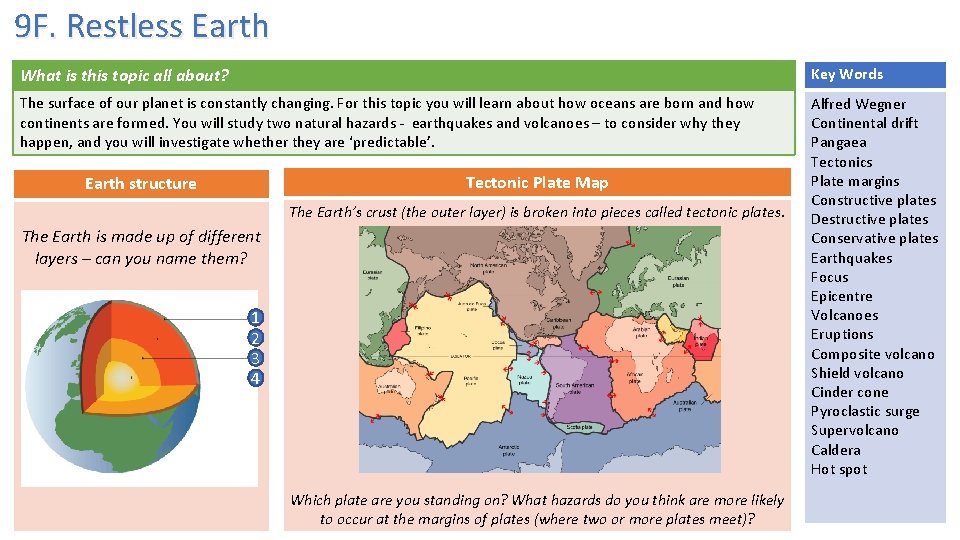
9 F. Restless Earth What is this topic all about? Key Words The surface of our planet is constantly changing. For this topic you will learn about how oceans are born and how continents are formed. You will study two natural hazards - earthquakes and volcanoes – to consider why they happen, and you will investigate whether they are ‘predictable’. Alfred Wegner Continental drift Pangaea Tectonics Plate margins Constructive plates Destructive plates Conservative plates Earthquakes Focus Epicentre Volcanoes Eruptions Composite volcano Shield volcano Cinder cone Pyroclastic surge Supervolcano Caldera Hot spot Tectonic Plate Map Earth structure The Earth’s crust (the outer layer) is broken into pieces called tectonic plates. The Earth is made up of different layers – can you name them? 1 2 3 4 Which plate are you standing on? What hazards do you think are more likely to occur at the margins of plates (where two or more plates meet)?
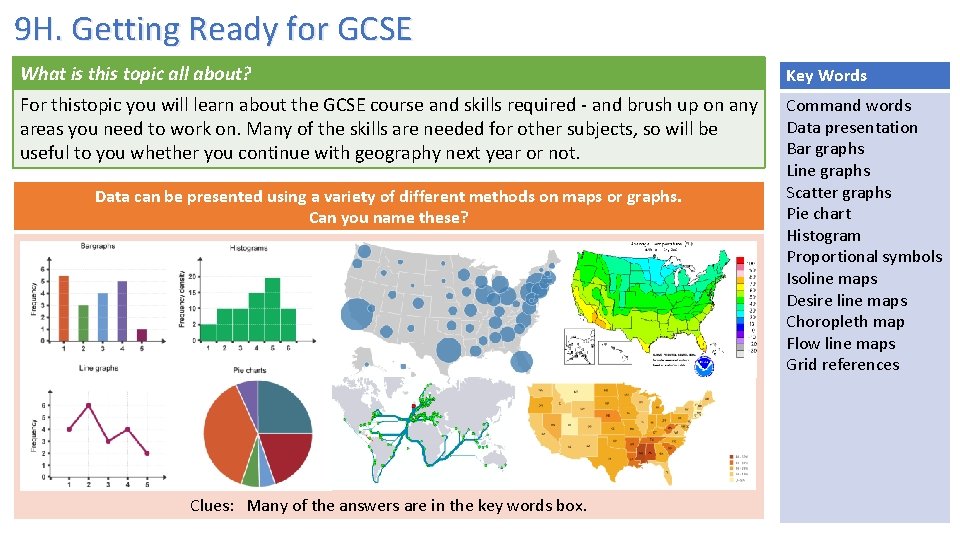
9 H. Getting Ready for GCSE What is this topic all about? Key Words For thistopic you will learn about the GCSE course and skills required - and brush up on any areas you need to work on. Many of the skills are needed for other subjects, so will be useful to you whether you continue with geography next year or not. Command words Data presentation Bar graphs Line graphs Scatter graphs Pie chart Histogram Proportional symbols Isoline maps Desire line maps Choropleth map Flow line maps Grid references Data can be presented using a variety of different methods on maps or graphs. Can you name these? Clues: Many of the answers are in the key words box.