
Year 9 Geography EBE KS 4 The Geography
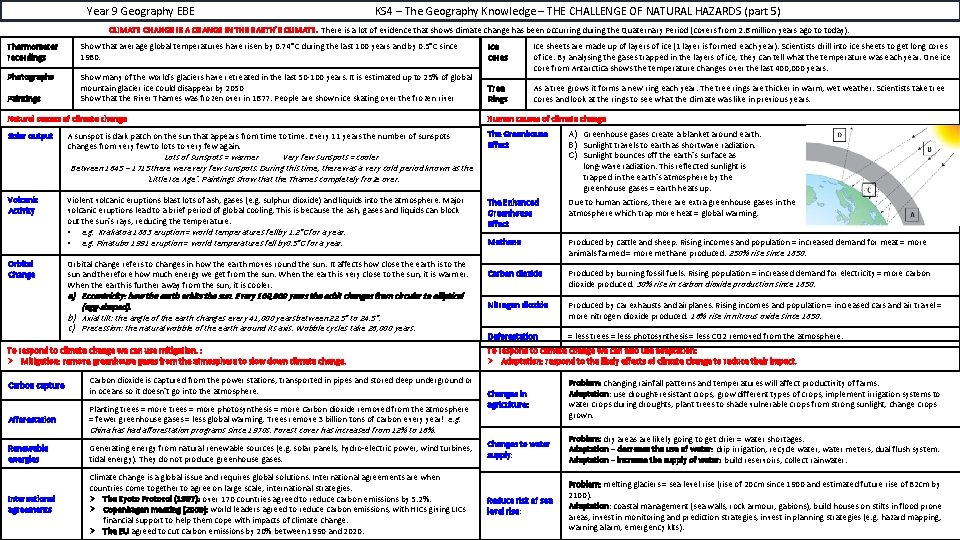
Year 9 Geography EBE KS 4 – The Geography Knowledge – THE CHALLENGE OF NATURAL HAZARDS (part 5) 5 CLIMATE CHANGE IS A CHANGE IN THE EARTH’S CLIMATE. There is a lot of evidence that shows climate change has been occurring during the Quaternary Period (covers from 2. 6 million years ago to today). Thermometer recordings Show that average global temperatures have risen by 0. 74°C during the last 100 years and by 0. 5°C since 1980. Ice cores Photographs Show many of the world’s glaciers have retreated in the last 50 -100 years. It is estimated up to 25% of global mountain glacier ice could disappear by 2050 Show that the River Thames was frozen over in 1677. People are shown ice skating over the frozen river Ice sheets are made up of layers of ice (1 layer is formed each year). Scientists drill into ice sheets to get long cores of ice. By analysing the gases trapped in the layers of ice, they can tell what the temperature was each year. One ice core from Antarctica shows the temperature changes over the last 400, 000 years. Tree Rings As a tree grows it forms a new ring each year. The tree rings are thicker in warm, wet weather. Scientists take tree cores and look at the rings to see what the climate was like in previous years. Paintings Natural causes of climate change Human causes of climate change Solar output The Greenhouse Effect A sunspot is dark patch on the sun that appears from time to time. Every 11 years the number of sunspots changes from very few to lots to very few again. Lots of sunspots = warmer Very few sunspots = cooler Between 1645 – 1715 there were very few sunspots. During this time, there was a very cold period known as the ‘Little Ice Age’. Paintings show that the Thames completely froze over. Volcanic Activity Violent volcanic eruptions blast lots of ash, gases (e. g. sulphur dioxide) and liquids into the atmosphere. Major volcanic eruptions lead to a brief period of global cooling. This is because the ash, gases and liquids can block out the sun’s rays, reducing the temperature. • • Orbital Change e. g. Krakatoa 1883 eruption = world temperatures fell by 1. 2°C for a year. e. g. Pinatubo 1991 eruption = world temperatures fell by 0. 5°C for a year. Orbital change refers to changes in how the earth moves round the sun. It affects how close the earth is to the sun and therefore how much energy we get from the sun. When the earth is very close to the sun, it is warmer. When the earth is further away from the sun, it is cooler. a) Eccentricity: how the earth orbits the sun. Every 100, 000 years the orbit changes from circular to elliptical (egg-shaped). b) Axial tilt: the angle of the earth changes every 41, 000 years between 22. 5° to 24. 5°. c) Precession: the natural wobble of the earth around its axis. Wobble cycles take 26, 000 years. To respond to climate change we can use mitigation. : Ø Mitigation: remove greenhouse gases from the atmosphere to slow down climate change. Carbon capture Carbon dioxide is captured from the power stations, transported in pipes and stored deep underground or in oceans so it doesn’t go into the atmosphere. Afforestation Planting trees = more photosynthesis = more carbon dioxide removed from the atmosphere = fewer greenhouse gases = less global warming. Trees remove 3 billion tons of carbon every year! e. g. Renewable energies Generating energy from natural renewable sources (e. g. solar panels, hydro-electric power, wind turbines, tidal energy). They do not produce greenhouse gases. International agreements Climate change is a global issue and requires global solutions. International agreements are when countries come together to agree on large scale, international strategies. Ø The Kyoto Protocol (1997): over 170 countries agreed to reduce carbon emissions by 5. 2%. Ø Copenhagen meeting (2009): world leaders agreed to reduce carbon emissions, with HICs giving LICs financial support to help them cope with impacts of climate change. Ø The EU agreed to cut carbon emissions by 20% between 1990 and 2020. A) Greenhouse gases create a blanket around earth. B) Sunlight travels to earth as shortwave radiation. C) Sunlight bounces off the earth’s surface as long-wave radiation. This reflected sunlight is trapped in the earth’s atmosphere by the greenhouse gases = earth heats up. The Enhanced Greenhouse Effect Due to human actions, there are extra greenhouse gases in the atmosphere which trap more heat = global warming. Methane Produced by cattle and sheep. Rising incomes and population = increased demand for meat = more animals farmed = more methane produced. 250% rise since 1850. Carbon dioxide Produced by burning fossil fuels. Rising population = increased demand for electricity = more carbon dioxide produced. 30% rise in carbon dioxide production since 1850. Nitrogen dioxide Produced by car exhausts and airplanes. Rising incomes and population = increased cars and air travel = more nitrogen dioxide produced. 16% rise in nitrous oxide since 1850. Deforestation = less trees = less photosynthesis = less CO 2 removed from the atmosphere. To respond to climate change we can also use adaptation: Ø Adaptation: respond to the likely effects of climate change to reduce their impact. Changes in agriculture: Problem: changing rainfall patterns and temperatures will affect productivity of farms. Adaptation: use drought-resistant crops, grow different types of crops, implement irrigation systems to water crops during droughts, plant trees to shade vulnerable crops from strong sunlight, change crops grown. Changes to water supply: Problem: dry areas are likely going to get drier = water shortages. Adaptation – decrease the use of water: drip irrigation, recycle water, water meters, dual flush system. Adaptation – increase the supply of water: build reservoirs, collect rainwater. Reduce risk of sea level rise: Problem: melting glaciers = sea level rise (rise of 20 cm since 1900 and estimated future rise of 82 cm by 2100). Adaptation: coastal management (sea walls, rock armour, gabions), build houses on stilts in flood prone areas, invest in monitoring and prediction strategies, invest in planning strategies (e. g. hazard mapping, warning alarm, emergency kits). China has had afforestation programs since 1970 s. Forest cover has increased from 12% to 16%.
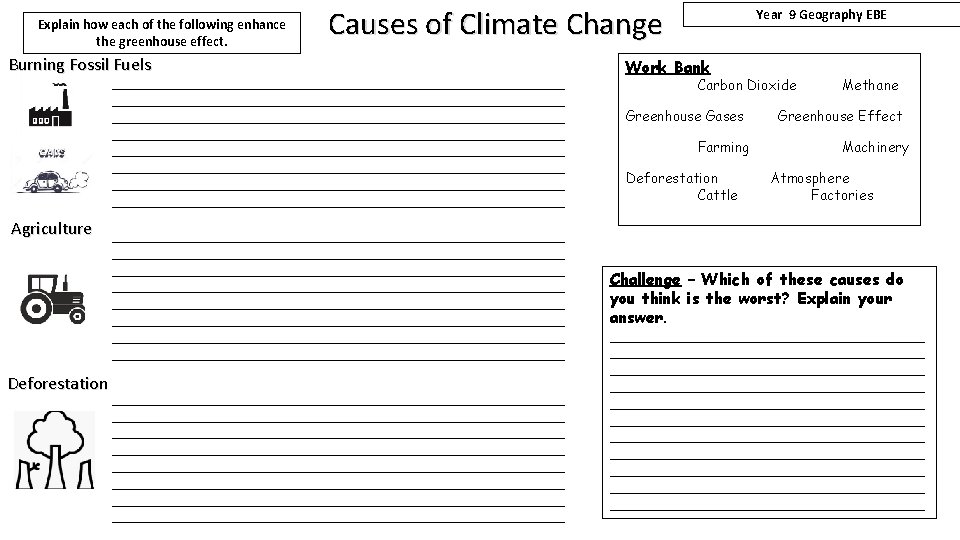
Explain how each of the following enhance the greenhouse effect. Causes of Climate Change Burning Fossil Fuels _________________________________________________________________ _________________________________________________________________ Agriculture Deforestation _________________________________________________________________ _________________________________________________________________ _________________________________________________________________ _________________________________________________________________ Year 9 Geography EBE Work Bank Carbon Dioxide Greenhouse Gases Farming Deforestation Cattle Methane Greenhouse Effect Machinery Atmosphere Factories Challenge – Which of these causes do you think is the worst? Explain your answer. ____________________________________ ____________________________________ ____________________________________
- Slides: 3