
Year 9 Food Knowledge Organiser Function of ingredients
- Slides: 1
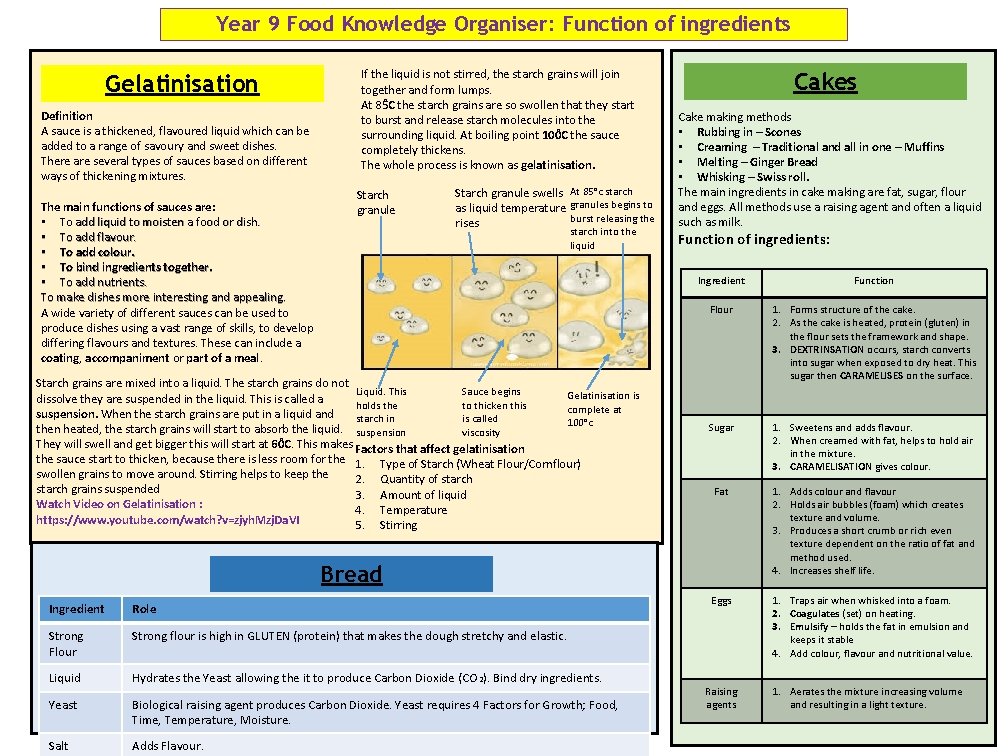
Year 9 Food Knowledge Organiser: Function of ingredients Gelatinisation Definition A sauce is a thickened, flavoured liquid which can be added to a range of savoury and sweet dishes. There are several types of sauces based on different ways of thickening mixtures. The main functions of sauces are: • To add liquid to moisten a food or dish. • To add flavour. • To add colour. • To bind ingredients together. • To add nutrients. To make dishes more interesting and appealing. A wide variety of different sauces can be used to produce dishes using a vast range of skills, to develop differing flavours and textures. These can include a coating, accompaniment or part of a meal. If the liquid is not stirred, the starch grains will join together and form lumps. At 85 C the starch grains are so swollen that they start to burst and release starch molecules into the surrounding liquid. At boiling point 100 C the sauce completely thickens. The whole process is known as gelatinisation. Starch granule swells At 85°c starch as liquid temperature granules begins to burst releasing the rises starch into the liquid Starch grains are mixed into a liquid. The starch grains do not Liquid. This Sauce begins Gelatinisation is dissolve they are suspended in the liquid. This is called a holds the to thicken this complete at suspension. When the starch grains are put in a liquid and starch in is called 100°c then heated, the starch grains will start to absorb the liquid. suspension viscosity They will swell and get bigger this will start at 60 C. This makes Factors that affect gelatinisation the sauce start to thicken, because there is less room for the 1. Type of Starch (Wheat Flour/Cornflour) swollen grains to move around. Stirring helps to keep the 2. Quantity of starch grains suspended 3. Amount of liquid Watch Video on Gelatinisation : 4. Temperature https: //www. youtube. com/watch? v=zjyh. Mzj. Da. VI 5. Stirring Cakes Cake making methods • Rubbing in – Scones • Creaming – Traditional and all in one – Muffins • Melting – Ginger Bread • Whisking – Swiss roll. The main ingredients in cake making are fat, sugar, flour and eggs. All methods use a raising agent and often a liquid such as milk. Function of ingredients: Ingredient Function Flour 1. Forms structure of the cake. 2. As the cake is heated, protein (gluten) in the flour sets the framework and shape. 3. DEXTRINSATION occurs, starch converts into sugar when exposed to dry heat. This sugar then CARAMELISES on the surface. Sugar 1. Sweetens and adds flavour. 2. When creamed with fat, helps to hold air in the mixture. 3. CARAMELISATION gives colour. Fat 1. Adds colour and flavour 2. Holds air bubbles (foam) which creates texture and volume. 3. Produces a short crumb or rich even texture dependent on the ratio of fat and method used. 4. Increases shelf life. Eggs 1. Traps air when whisked into a foam. 2. Coagulates (set) on heating. 3. Emulsify – holds the fat in emulsion and keeps it stable 4. Add colour, flavour and nutritional value. Bread Ingredient Role Strong Flour Strong flour is high in GLUTEN (protein) that makes the dough stretchy and elastic. Liquid Hydrates the Yeast allowing the it to produce Carbon Dioxide (CO 2). Bind dry ingredients. Yeast Biological raising agent produces Carbon Dioxide. Yeast requires 4 Factors for Growth; Food, Time, Temperature, Moisture. Salt Adds Flavour. Raising agents 1. Aerates the mixture increasing volume and resulting in a light texture.