
Year 9 Factorising Quadratics Dr J Frost jfrosttiffin


- Slides: 27
Year 9: Factorising Quadratics Dr J Frost (jfrost@tiffin. kingston. sch. uk) www. drfrostmaths. com Last modified: 30 th September 2015
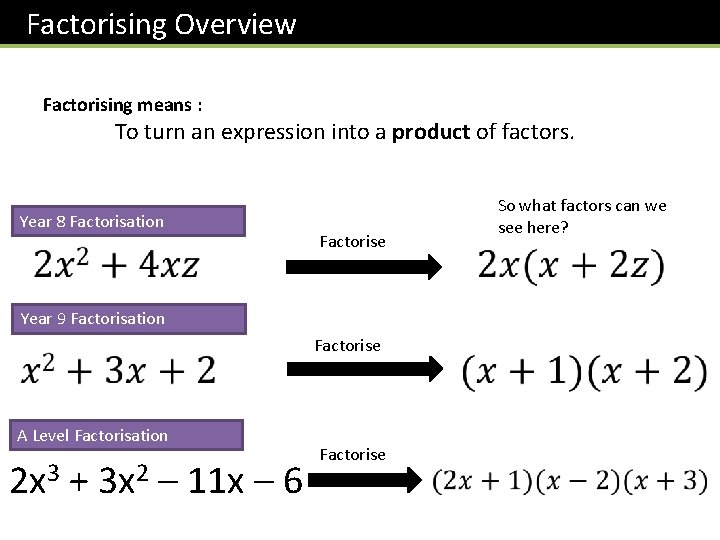
Factorising Overview Factorising means : To turn an expression into a product of factors. Year 8 Factorisation Factorise Year 9 Factorisation Factorise A Level Factorisation 2 x 3 + 3 x 2 – 11 x – 6 Factorise So what factors can we see here?
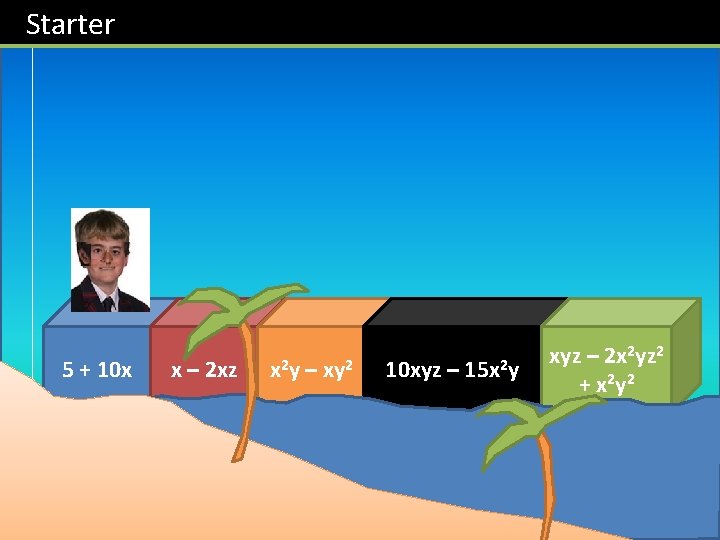
Starter 5 + 10 x x – 2 xz x 2 y – xy 2 10 xyz – 15 x 2 y xyz – 2 x 2 yz 2 + x 2 y 2
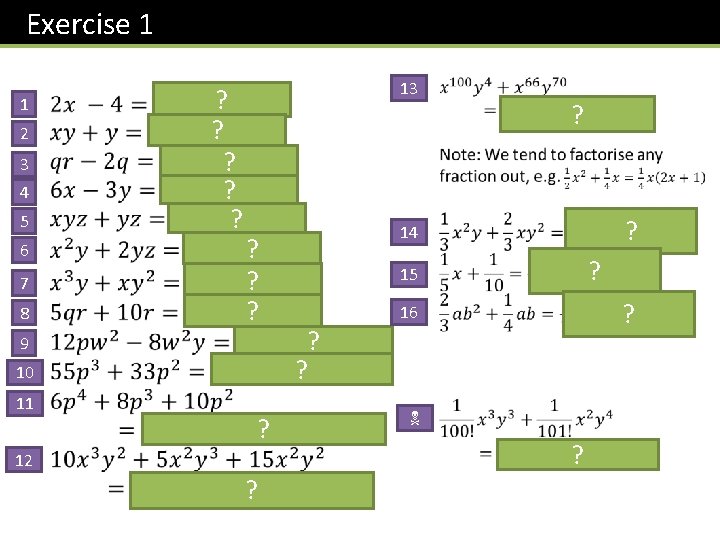
Exercise 1 1 2 3 4 5 6 7 8 ? ? ? 13 ? ? ? 9 10 11 ? 12 ? ? ? 14 ? 15 ? 16 ? ? N ?
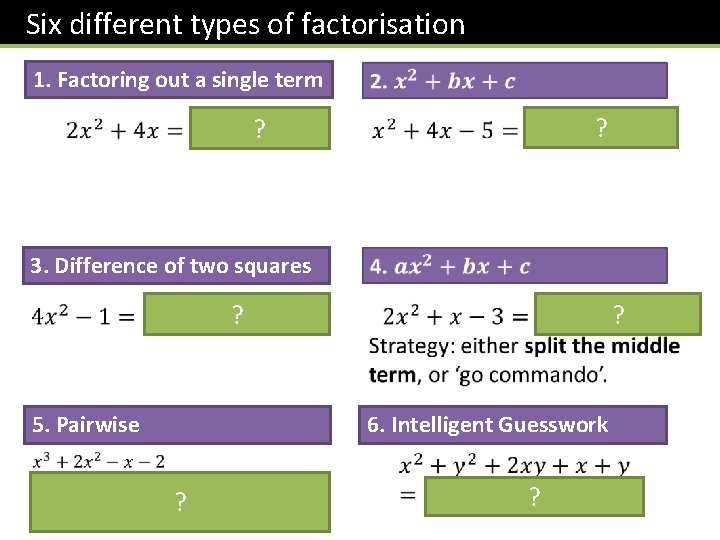
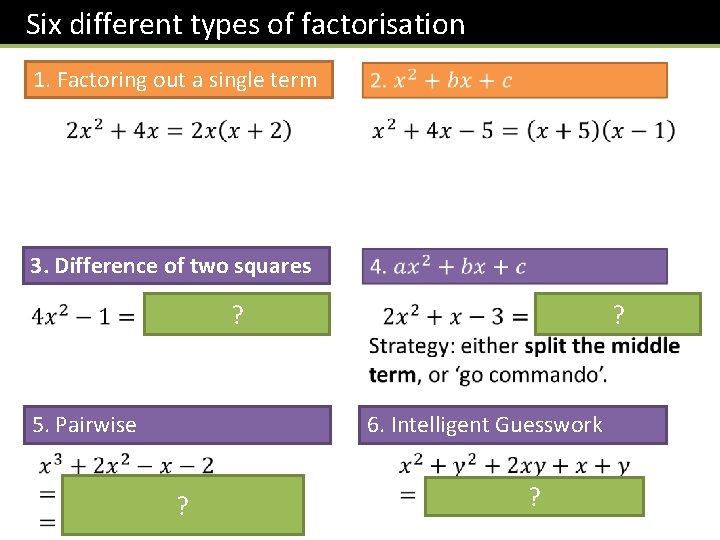
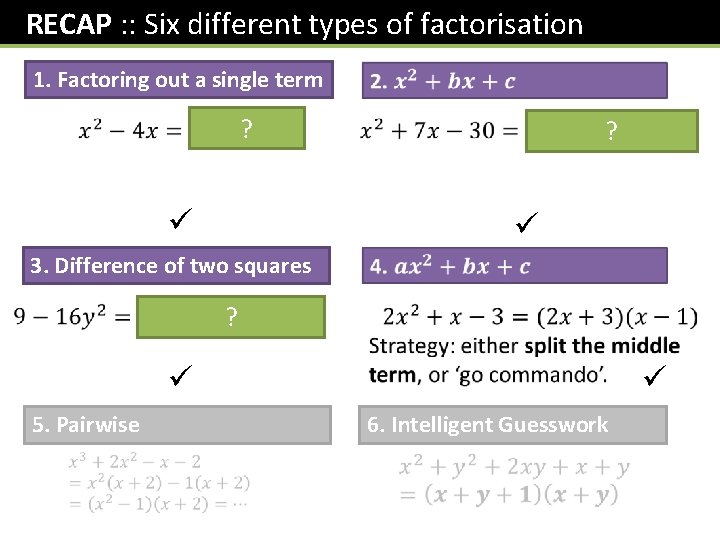
Six different types of factorisation 1. Factoring out a single term ? ? 3. Difference of two squares ? ? 5. Pairwise 6. Intelligent Guesswork ? ?
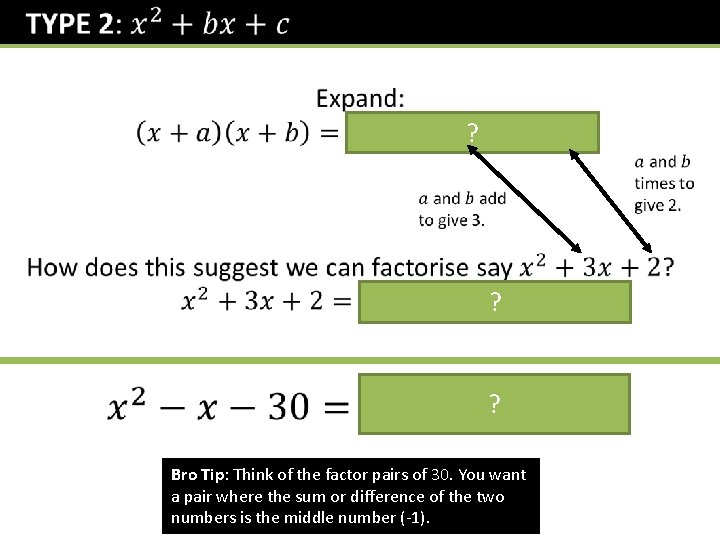
? ? ? Bro Tip: Think of the factor pairs of 30. You want a pair where the sum or difference of the two numbers is the middle number (-1).
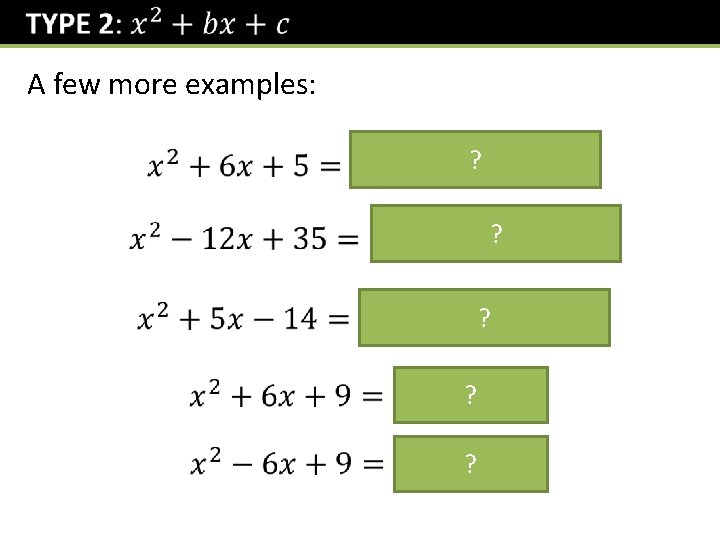
A few more examples: ? ? ?
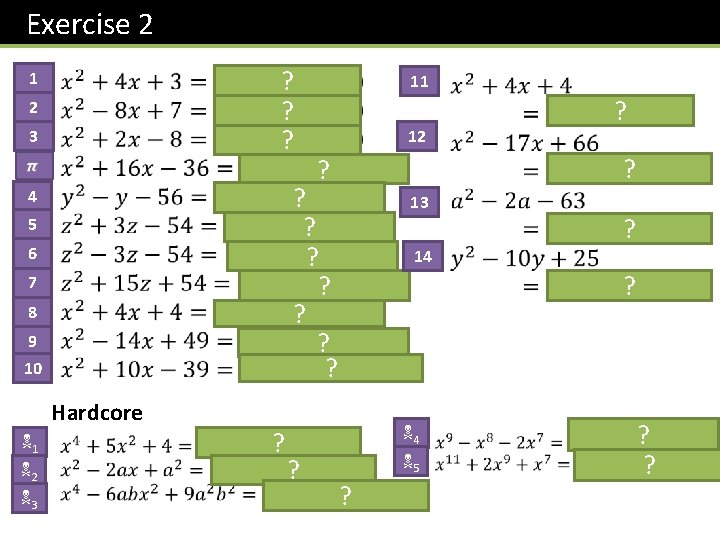
Exercise 2 ? ? ? 1 2 3 5 6 7 8 9 10 Hardcore N 2 N 3 12 ? 13 14 ? ? N 4 ? ? ? ? ? ? 4 N 1 11 N 5 ? ? ?
Six different types of factorisation 1. Factoring out a single term 3. Difference of two squares ? ? 5. Pairwise 6. Intelligent Guesswork ? ?
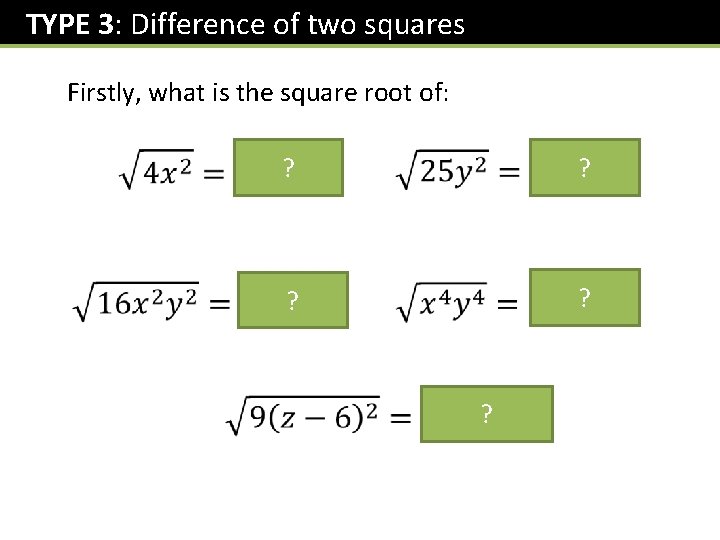
TYPE 3: Difference of two squares Firstly, what is the square root of: ? ? ?
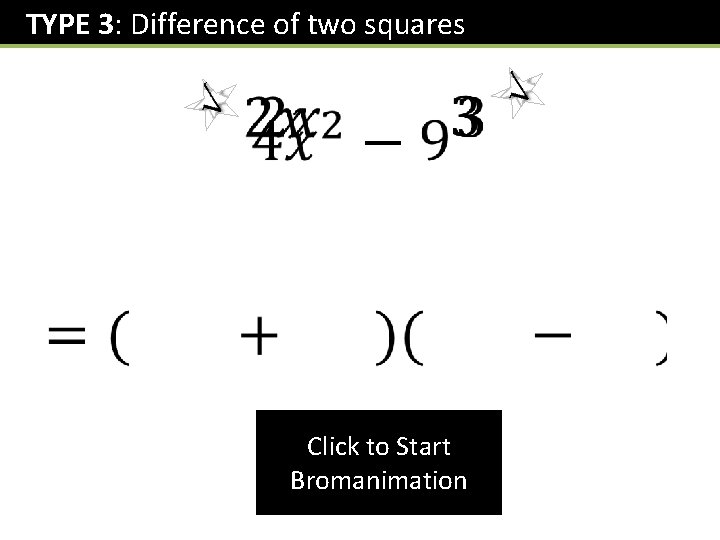
TYPE 3: Difference of two squares Click to Start Bromanimation
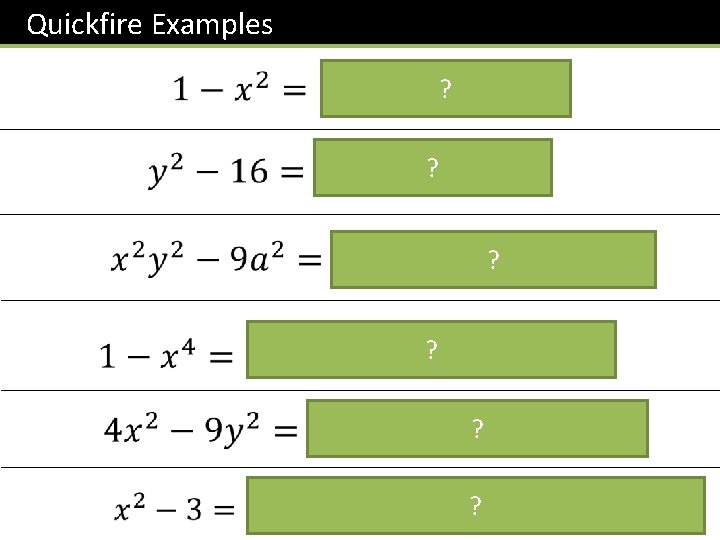
Quickfire Examples ? ? ? (Strictly speaking, this is not a valid factorisation)
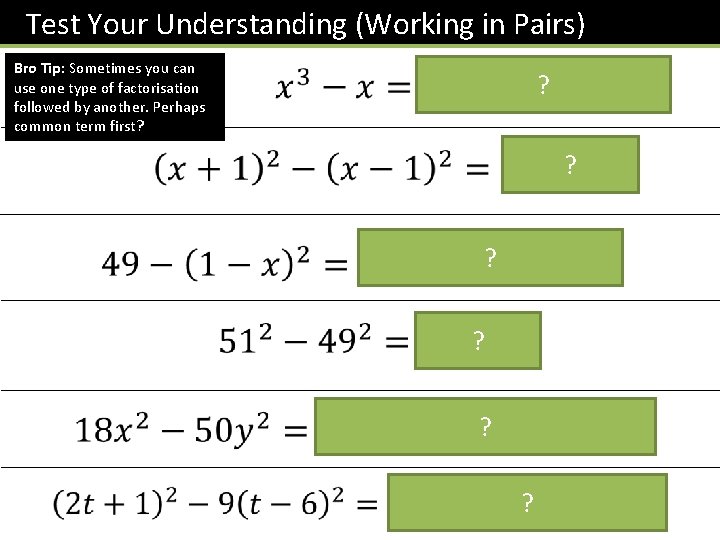
Test Your Understanding (Working in Pairs) Bro Tip: Sometimes you can use one type of factorisation followed by another. Perhaps common term first? ? ? ?
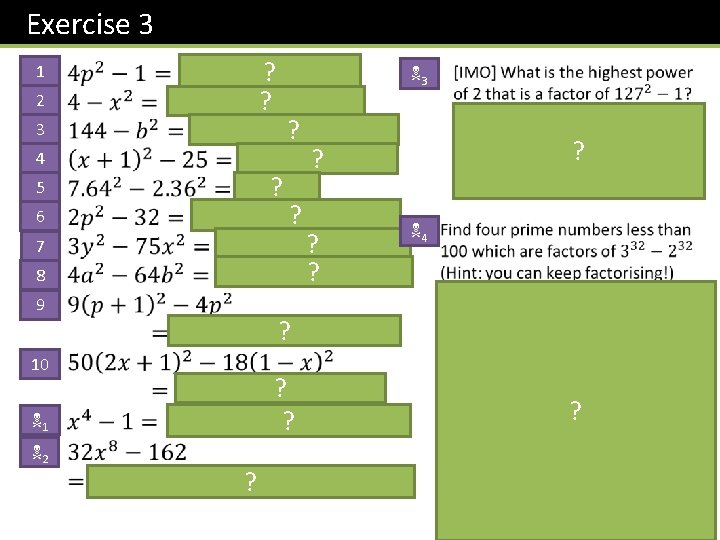
Exercise 3 ? ? 1 2 N 3 ? 3 4 ? 5 6 ? 7 8 9 ? ? N 4 ? 10 ? ? N 1 N 2 ? ?
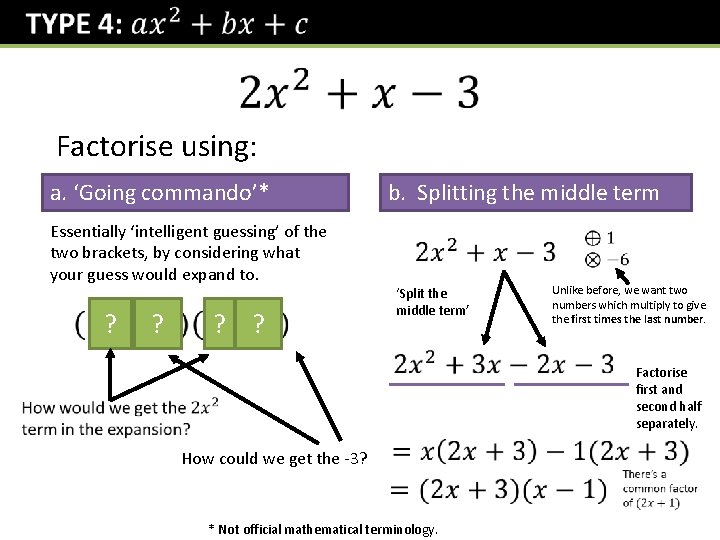
Factorise using: a. ‘Going commando’* b. Splitting the middle term Essentially ‘intelligent guessing’ of the two brackets, by considering what your guess would expand to. ? ? ? ? ‘Split the middle term’ Unlike before, we want two numbers which multiply to give the first times the last number. Factorise first and second half separately. How could we get the -3? * Not official mathematical terminology.
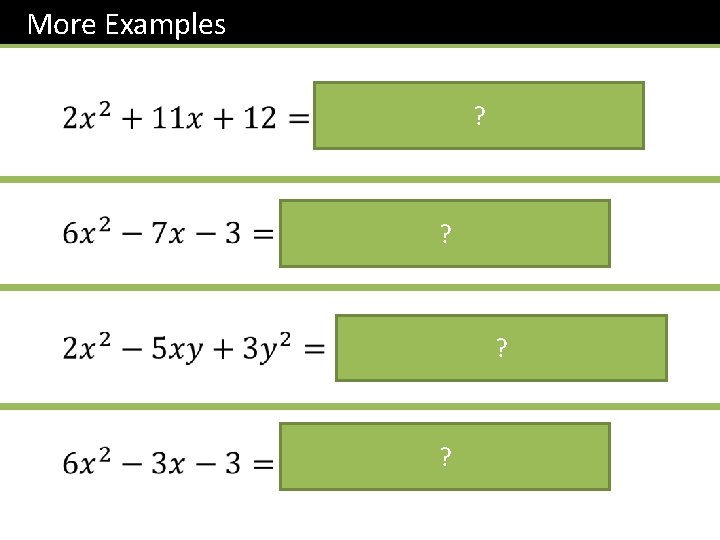
More Examples ? ?
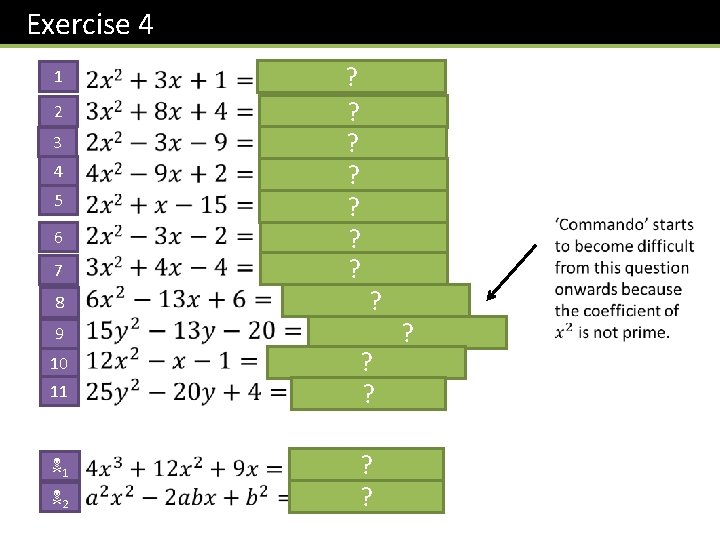
Exercise 4 1 2 3 4 5 6 7 8 ? ? ? ? ? 9 10 11 N 2 ? ? ?
RECAP : : Six different types of factorisation 1. Factoring out a single term ? ? 3. Difference of two squares ? 5. Pairwise 6. Intelligent Guesswork
Method A: Guessing the brackets Method B: Splitting the middle term ? ? Both of these methods can be extended to more general expressions. This method of ‘intelligent guessing’ can be extended to non-quadratics. After we split the middle term, we looked at the expression in two pairs and factorised. I call more general usage of this ‘pairwise factorisation’.
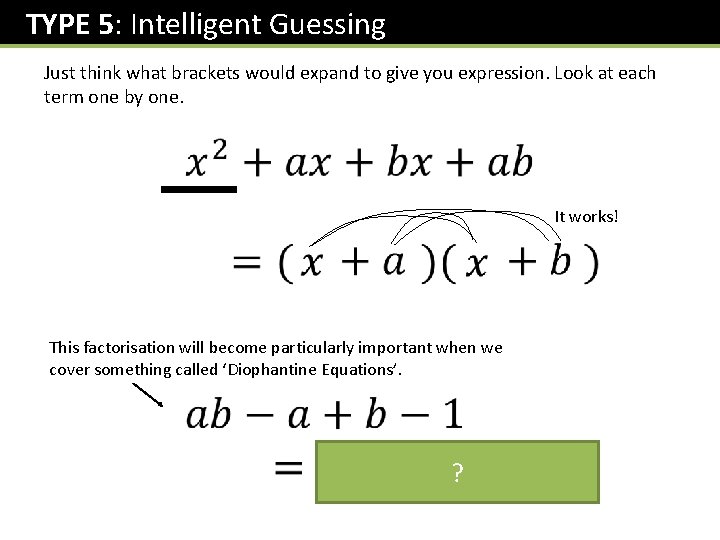
TYPE 5: Intelligent Guessing Just think what brackets would expand to give you expression. Look at each term one by one. It works! This factorisation will become particularly important when we cover something called ‘Diophantine Equations’. ?
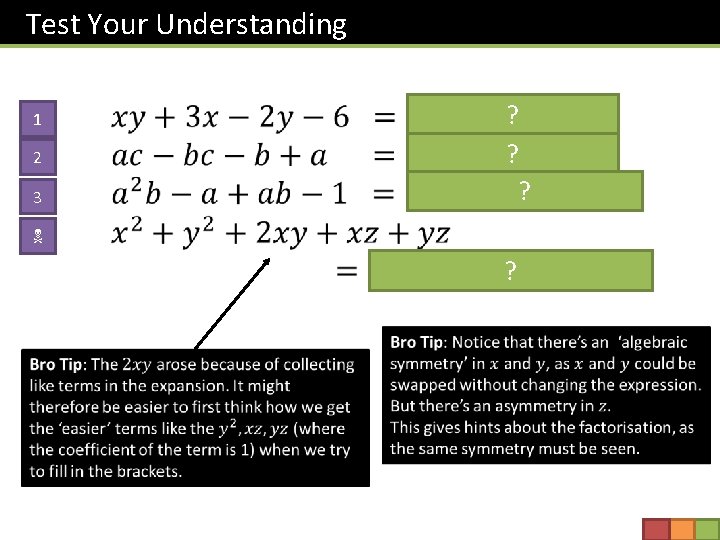
Test Your Understanding 1 2 3 ? ? ? N ?
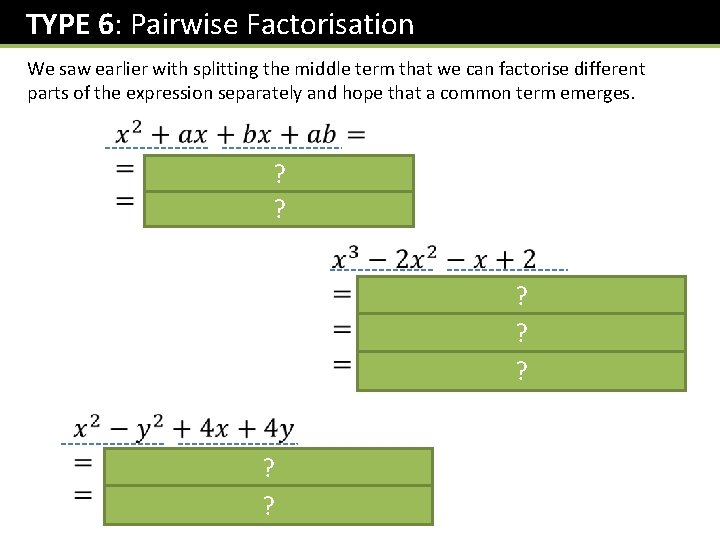
TYPE 6: Pairwise Factorisation We saw earlier with splitting the middle term that we can factorise different parts of the expression separately and hope that a common term emerges. ? ? ? ?
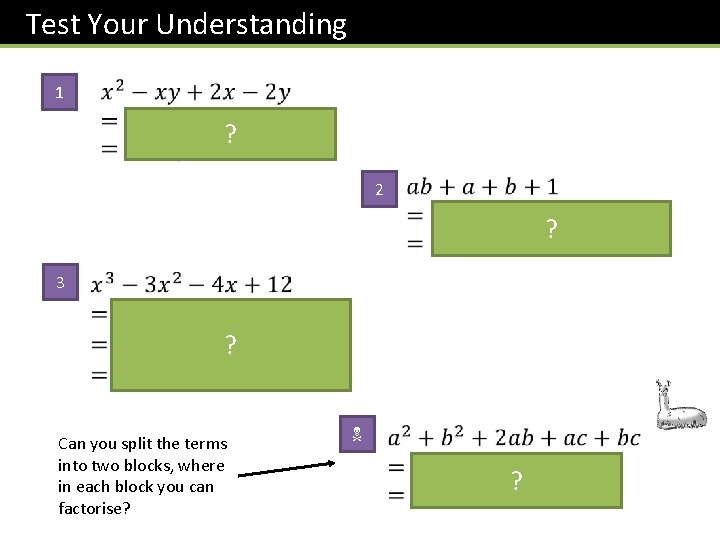
Test Your Understanding 1 ? 2 ? 3 ? Can you split the terms into two blocks, where in each block you can factorise? N ?
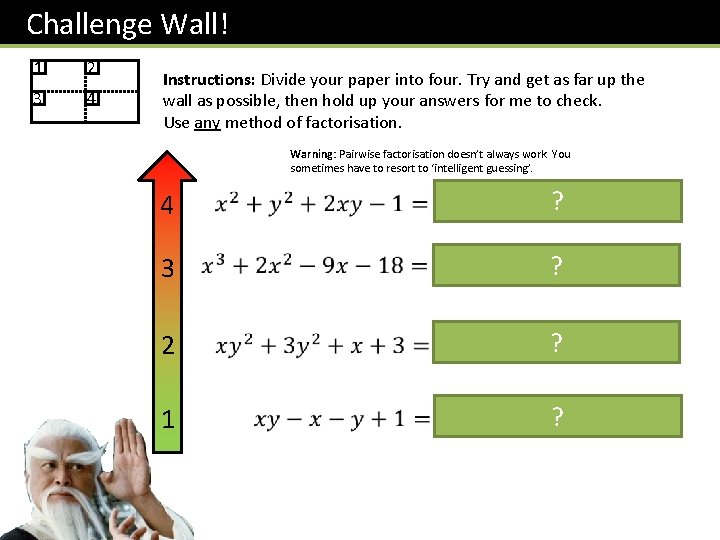
Challenge Wall! 1 2 3 4 Instructions: Divide your paper into four. Try and get as far up the wall as possible, then hold up your answers for me to check. Use any method of factorisation. Warning: Pairwise factorisation doesn’t always work. You sometimes have to resort to ‘intelligent guessing’. 4 ? 3 ? 2 ? 1 ?
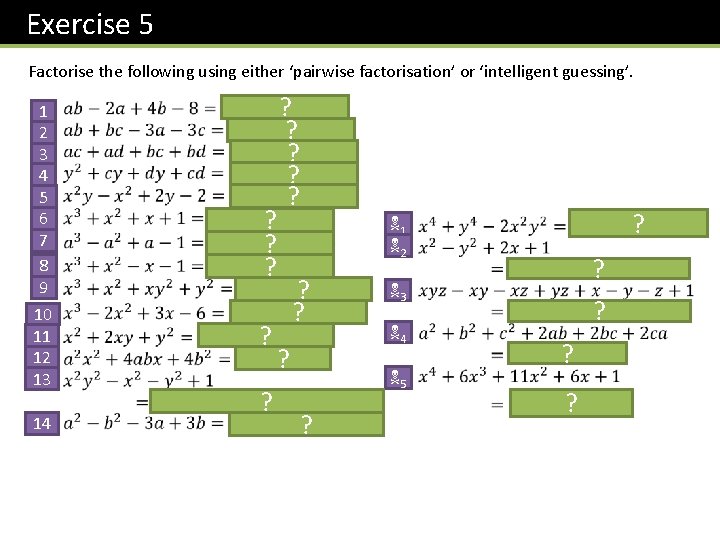
Exercise 5 Factorise the following using either ‘pairwise factorisation’ or ‘intelligent guessing’. 1 2 3 4 5 6 7 8 9 10 11 12 13 14 ? ? ? ? ? ? N 1 N 2 ? ? ? N 3 N 4 N 5 ? ? ?
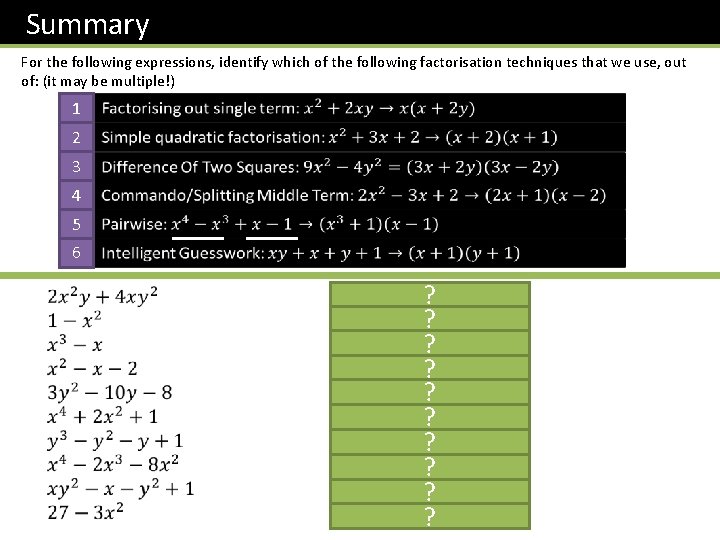
Summary For the following expressions, identify which of the following factorisation techniques that we use, out of: (it may be multiple!) 1 2 3 4 5 6 ? ? ? ? ?
Factorising out an expression It’s fine to factorise out an entire expression: ? ?