
Year 9 Cell structure Knowledge Organiser All living
- Slides: 2
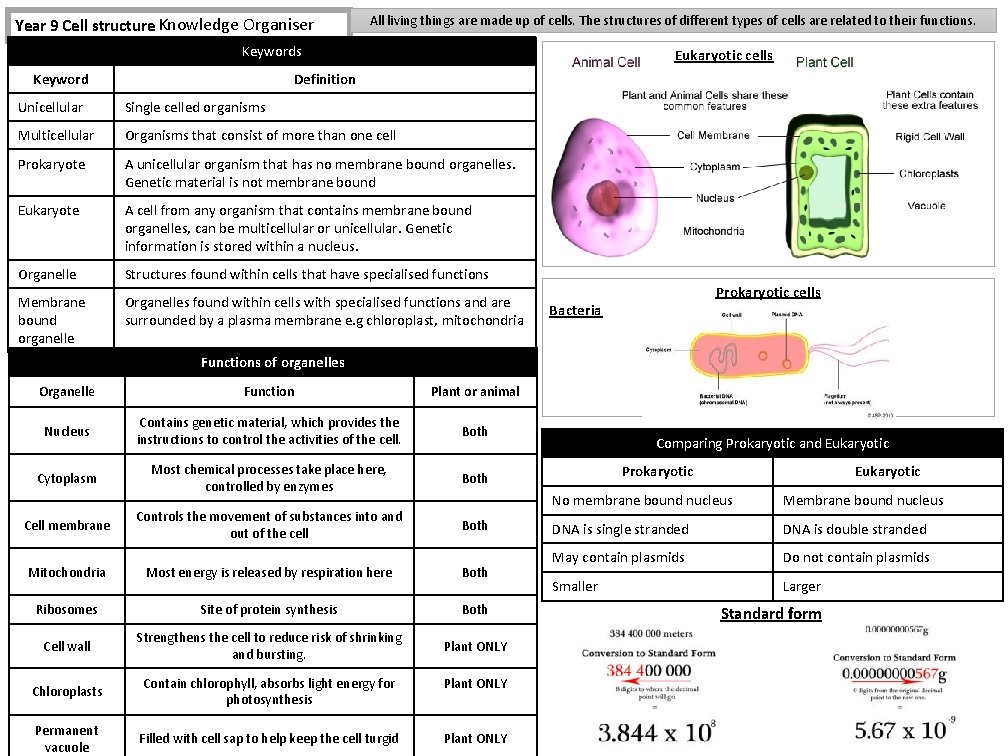
Year 9 Cell structure Knowledge Organiser All living things are made up of cells. The structures of different types of cells are related to their functions. Keywords Keyword Eukaryotic cells Definition Unicellular Single celled organisms Multicellular Organisms that consist of more than one cell Prokaryote A unicellular organism that has no membrane bound organelles. Genetic material is not membrane bound Eukaryote A cell from any organism that contains membrane bound organelles, can be multicellular or unicellular. Genetic information is stored within a nucleus. Organelle Structures found within cells that have specialised functions Membrane bound organelle Organelles found within cells with specialised functions and are surrounded by a plasma membrane e. g chloroplast, mitochondria Prokaryotic cells Bacteria Functions of organelles Organelle Function Plant or animal Nucleus Contains genetic material, which provides the instructions to control the activities of the cell. Both Cytoplasm Most chemical processes take place here, controlled by enzymes Both Controls the movement of substances into and out of the cell Both Cell membrane Mitochondria Most energy is released by respiration here Both Ribosomes Site of protein synthesis Both Cell wall Strengthens the cell to reduce risk of shrinking and bursting. Plant ONLY Chloroplasts Contain chlorophyll, absorbs light energy for photosynthesis Plant ONLY Permanent vacuole Filled with cell sap to help keep the cell turgid Plant ONLY Comparing Prokaryotic and Eukaryotic Prokaryotic Eukaryotic No membrane bound nucleus Membrane bound nucleus DNA is single stranded DNA is double stranded May contain plasmids Do not contain plasmids Smaller Larger Standard form
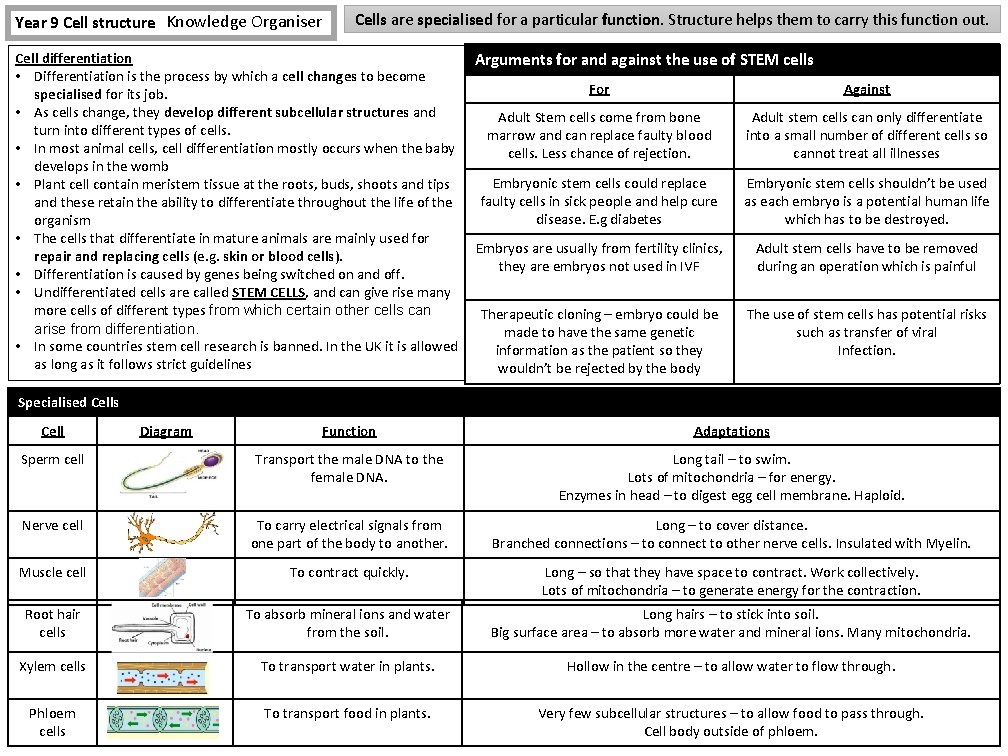
Year 9 Cell structure Knowledge Organiser Cells are specialised for a particular function. Structure helps them to carry this function out. Cell differentiation • Differentiation is the process by which a cell changes to become specialised for its job. • As cells change, they develop different subcellular structures and turn into different types of cells. • In most animal cells, cell differentiation mostly occurs when the baby develops in the womb • Plant cell contain meristem tissue at the roots, buds, shoots and tips and these retain the ability to differentiate throughout the life of the organism • The cells that differentiate in mature animals are mainly used for repair and replacing cells (e. g. skin or blood cells). • Differentiation is caused by genes being switched on and off. • Undifferentiated cells are called STEM CELLS, and can give rise many more cells of different types from which certain other cells can arise from differentiation. • In some countries stem cell research is banned. In the UK it is allowed as long as it follows strict guidelines Arguments for and against the use of STEM cells For Against Adult Stem cells come from bone marrow and can replace faulty blood cells. Less chance of rejection. Adult stem cells can only differentiate into a small number of different cells so cannot treat all illnesses Embryonic stem cells could replace faulty cells in sick people and help cure disease. E. g diabetes Embryonic stem cells shouldn’t be used as each embryo is a potential human life which has to be destroyed. Embryos are usually from fertility clinics, they are embryos not used in IVF Adult stem cells have to be removed during an operation which is painful Therapeutic cloning – embryo could be made to have the same genetic information as the patient so they wouldn’t be rejected by the body The use of stem cells has potential risks such as transfer of viral Infection. Specialised Cells Cell Diagram Function Adaptations Sperm cell Transport the male DNA to the female DNA. Long tail – to swim. Lots of mitochondria – for energy. Enzymes in head – to digest egg cell membrane. Haploid. Nerve cell To carry electrical signals from one part of the body to another. Long – to cover distance. Branched connections – to connect to other nerve cells. Insulated with Myelin. Muscle cell To contract quickly. Long – so that they have space to contract. Work collectively. Lots of mitochondria – to generate energy for the contraction. Root hair cells To absorb mineral ions and water from the soil. Long hairs – to stick into soil. Big surface area – to absorb more water and mineral ions. Many mitochondria. Xylem cells To transport water in plants. Hollow in the centre – to allow water to flow through. Phloem cells To transport food in plants. Very few subcellular structures – to allow food to pass through. Cell body outside of phloem.