
YEAR 8 Victorian Voices Project YEAR 8 Victorian
- Slides: 21
YEAR 8: Victorian Voices Project
YEAR 8: Victorian Voices • There will be 12 activities, which should take an hour each. You should aim to do 2 of these a week, in chronological order. • You may already have some knowledge of Victorian literature from English lessons. This project should allow you to develop on that knowledge.
TASK ONE: Victorians and the Industrial Revolution Activity A: Victorians and the Industrial Revolution Using your own knowledge and internet research find five facts each about: • The Victorian era • The Industrial Revolution • Class in the Victorian era Then, using what you found, summarise how the Industrial Revolution changed the way people lived and worked in Britain in three sentences. Activity B: Victorian Literature Then, watch this clip: https: //www. youtube. com/watch? v=nll. Dcnfo. H 5 A And answer the following questions: 1. Why were so many more books printed during this time? 2. Which famous writers wrote during this period? 3. What different types of literature were published and popular during this time? 4. How did the Industrial Revolution transform the printing of books? 5. Which writer did Queen Victoria admire the work of?
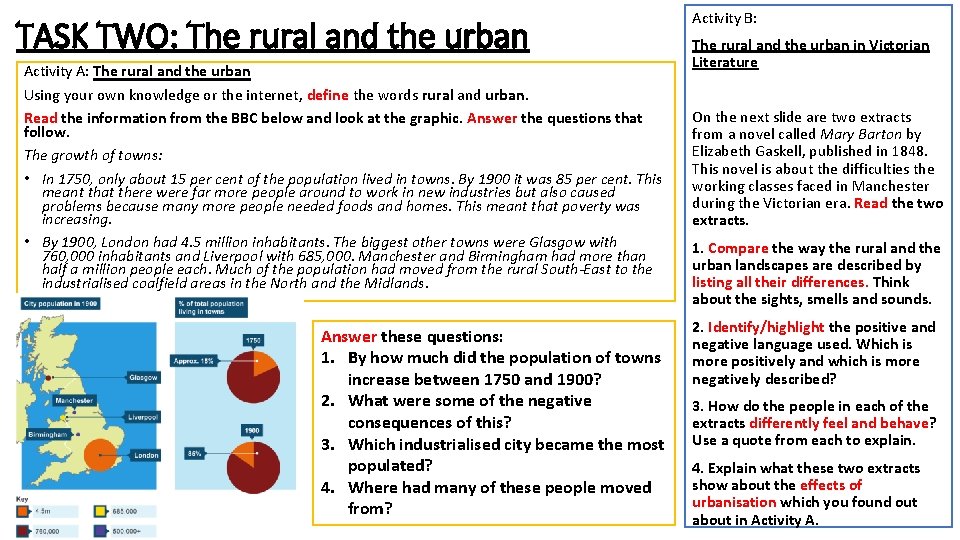
TASK TWO: The rural and the urban Activity A: The rural and the urban Using your own knowledge or the internet, define the words rural and urban. Read the information from the BBC below and look at the graphic. Answer the questions that follow. The growth of towns: • In 1750, only about 15 per cent of the population lived in towns. By 1900 it was 85 per cent. This meant that there were far more people around to work in new industries but also caused problems because many more people needed foods and homes. This meant that poverty was increasing. • By 1900, London had 4. 5 million inhabitants. The biggest other towns were Glasgow with 760, 000 inhabitants and Liverpool with 685, 000. Manchester and Birmingham had more than half a million people each. Much of the population had moved from the rural South-East to the industrialised coalfield areas in the North and the Midlands. Answer these questions: 1. By how much did the population of towns increase between 1750 and 1900? 2. What were some of the negative consequences of this? 3. Which industrialised city became the most populated? 4. Where had many of these people moved from? Activity B: The rural and the urban in Victorian Literature On the next slide are two extracts from a novel called Mary Barton by Elizabeth Gaskell, published in 1848. This novel is about the difficulties the working classes faced in Manchester during the Victorian era. Read the two extracts. 1. Compare the way the rural and the urban landscapes are described by listing all their differences. Think about the sights, smells and sounds. 2. Identify/highlight the positive and negative language used. Which is more positively and which is more negatively described? 3. How do the people in each of the extracts differently feel and behave? Use a quote from each to explain. 4. Explain what these two extracts show about the effects of urbanisation which you found out about in Activity A.
TASK TWO: The rural and the urban (continued) Extract one (rural): Extract two (urban): There are some fields near Manchester, well known to the inhabitants as “Green Heys Fields, ” through which runs a public footpath to a little village about two miles distant. In spite of these fields being flat and low, nay, in spite of the want of wood (the great and usual recommendation of level tracts of land), there is a charm about them which strikes even the inhabitant of a mountainous district, who sees and feels the effect of contrast in these common-place but thoroughly rural fields, with the busy, bustling manufacturing town he left but half-an-hour ago. Here and there an old black and white farm-house, with its rambling outbuildings, speaks of other times and other occupations than those which now absorb the population of the neighbourhood. Here in their seasons may be seen the country business of hay-making, ploughing, etc. , which are such pleasant mysteries for townspeople to watch; and here the artisan, deafened with noise of tongues and engines, may come to listen awhile to the delicious sounds of rural life: the lowing of cattle, the milk-maids’ call, the clatter and cackle of poultry in the old farm-yards. You cannot wonder, then, that these fields are popular places of resort at every holiday time; and you would not wonder, if you could see, or I properly describe, the charm of one particular stile, that it should be, on such occasions, a crowded halting-place. On the way Wilson said Davenport was a good fellow, though too much of the Methodee; that his children were too young to work, but not too young to be cold and hungry; that they had sunk lower and lower, and pawned thing after thing, and that now they lived in a cellar in Berry Street, off Store Street. Barton growled inarticulate words of no benevolent import to a large class of mankind, and so they went along till they arrived in Berry Street. It was unpaved; and down the middle a gutter forced its way, every now and then forming pools in the holes with which the street abounded. I do not know whether it was on a holiday granted by the masters, or a holiday seized in right of Nature and her beautiful spring time by the workmen, but one afternoon (now ten or a dozen years ago) these fields were much thronged. It was an early May evening—the April of the poets; for heavy showers had fallen all the morning, and the round, soft, white clouds which were blown by a west wind over the dark blue sky, were sometimes varied by one blacker and more threatening. The softness of the day tempted forth the young green leaves, which almost visibly fluttered into life; and the willows, which that morning had only a brown reflection in the water below, were now of that tender graygreen which blends so delicately with the spring harmony of colours. Groups of merry and somewhat loudtalking girls, whose ages might range from twelve to twenty, came by with a buoyant step. They were most of them factory girls… As they passed, women from their doors tossed household slops of every description into the gutter; they ran into the next pool, which overflowed and stagnated. Heaps of ashes were the stepping-stones, on which the passer-by, who cared in the least for cleanliness, took care not to put his foot. Our friends were not dainty, but even they picked their way till they got to some steps leading down into a small area, where a person standing would have his head about one foot below the level of the street, and might at the same time, without the least motion of his body, touch the window of the cellar and the damp muddy wall right opposite. You went down one step even from the foul area into the cellar in which a family of human beings lived. It was very dark inside. The window-panes were, many of them, broken and stuffed with rags, which was reason enough for the dusky light that pervaded the place even at mid-day. After the account I have given of the state of the street, no one can be surprised that on going into the cellar inhabited by Davenport, the smell was so foetid as almost to knock the two men down. Quickly recovering themselves, as those inured to such things do, they began to penetrate thick darkness of the place, and to see three or four little children rolling on the damp, nay wet, brick floor, through which the stagnant, filthy moisture of the street oozed up; the fire-place was empty and black; the wife sat on her husband’s lair, and cried in the dank loneliness. Hint: look at the words in bold. Look up any you don’t understand.
TASK THREE: Dickens and industrialisation Activity A: Dickens and industrialisation Using your own knowledge and internet research explain: • Who was Charles Dickens? • What does ‘industrialisation’ mean? • How did Dickens feel about industrialisation? Activity B: The Old Curiosity Shop Dickens wrote about his travels to the Black Country and this extract from his 1840 novel The Old Curiosity Shop was influenced by what he saw. The Black Country is an area of the West Midlands in England, north and west of Birmingham. In the Industrial Revolution, it became one of the most industrialised parts of Britain with coal mines, coking, iron foundries and steel mills producing a high level of air pollution. Read the extract and complete the following tasks: 1. Identify any interesting adjectives, verbs and adverbs and note down their connotations. The first paragraph has been started for you. 2. Identify the use of sensory language and personification (especially of the factory engines). Which sense has been used the most? 3. Write at least one paragraph to explain how Dickens shows the negative outcomes of industrialisation. You should make a clear point, include a quote, zoom in on the language and analyse the effect on the reader. cheerless: unhappy place and people - no laughter A long suburb of red brick houses, --- some with patches of garden-ground, where coal-dust and factory smoke darkened the shrinking leaves, and coarse rank flowers; and where the struggling vegetation sickened and sank under the hot breath of kiln and furnace, making them by its presence seem yet more blighting and unwholesome than in the town itself, --- a long, flat, straggling suburb passed, they came by slow degrees upon a cheerless region, where not a blade of grass was seen to grow; where not a but put forth its promise in the spring; where nothing green could live but on the surface of the stagnant pools, which here and there lay idly sweltering by the black roadside. Advancing more and more into the shadow of this mournful place, its dark depressing influence stole upon their spirits, and filled them with a dismal gloom. On every side, and as far as the eye could see into the heavy distance, tall chimneys, crowding on each other and presenting that endless repetition of the same dull, ugly form, which is the horror of oppressive dreams, poured out their plague of smoke, obscured the light, and made foul the melancholy air. On mounds of ashes by the wayside, sheltered only by a few rough boards, or rotten pent-house roofs, strange engines spun and writhed like tortured creatures; clanking their iron chains, shrinking in their rapid whirl from time to time as though in torment unendurable, and making the ground tremble with their agonies. Dismantled houses here and there appeared, tottering to the earth, propped up by fragments of others that had fallen down, unroofed, windowless, blackened, desolate, but yet inhabited. Men, women, children, wan in their looks and ragged attire, tended the engines, fed their tributary fires, begged upon the road, or scowled half-naked from the doorless houses. Then came more of the wrathful monsters, whose like they almost seemed to be in their wildness and their untamed air, screeching and turning round and round again; and still, before, behind, and to the right and left, was the same interminable perspective of brick towers, never ceasing in their black vomit, blasting all things living or inanimate, shutting out the face of day, and closing in on all these horrors with a dense dark cloud. But night-time in this dreadful spot! --- night, when the smoke was changed to fire; when every chimney spurted up its red flame; and places that had been dark vaults all day, now shone red-hot, with figures moving to and fro within their blazing jaws, and calling to one another with hoarse cries of night, when the noise of every strange machine was aggravated by the darkness; when the people near them looked wilder and more savage; when bands of unemployed labourers paraded in the roads, or clustered by torchlight round their leaders, who told them in stern language of their wrongs, and urged them on to frightful cries and threats; when maddened men, armed with sword and firebrand, spurning the tears and prayers of women who would restrain them, rushed forth on errands of terror and destruction, to work no ruin half so surely as their own --- night, when carts came rumbling by, filled with rude coffins (for contagious disease and death had been busy with the living crops); when orphans cried, and distracted women shrieked and followed in their wake --- night, when some called for bread, and some for drink to drown their cares; and some with tears, and some with staggering feet, and some with bloodshot eyes, went brooding home --- night, which unlike the night that Heaven sends on earth, brought with it not peace, nor quiet, nor signs of blessed sleep --- who shall tell the terrors of the night to that young wandering child!
TASK FOUR: Describing changing landscapes Activity A: Changing landscapes Activity B: Describing changing landscapes Read the article The new ruralism: how the pastoral idyll is taking over our cities from The Guardian (on the next slide or follow this link https: //www. theguardian. com/artan ddesign/2012/nov/18/new-ruralismtakes-over-cities ) You are going to write your own description of the changing landscape of an industrialised Victorian city, using these images and what you have read so far to help. Answer these questions from your reading: 1. What is increasing in urbanised cities such as London? 2. What does the article suggest are some of the reasons for this change? 3. How does this contrast with what happened during the Industrial Revolution? Start by mind-mapping what you might: • See (chimneys, rows of factories) • Smell (smoke, fire, burning, sewage) • Hear (machinery, crying) • Feel (afraid, tired) Then think about techniques you could use: • Similes • Metaphors • Personification Don’t forget to look back at Dickens’ and Gaskell’s descriptions for inspiration. Aim to write two to three paragraphs of detailed description. You may wish to do this in first person, as though you are a worker, or third person, as Dickens does.
TASK FOUR: Describing changing landscapes (continued) The new ruralism: how the pastoral idyll is taking over our cities Meadows nestling beside tower blocks, children cavorting in rustic playgrounds, not to mention all those farmers' markets – these days, our cities can't seem to get enough of the countryside. Children are scrabbling over fallen tree trunks, wobbling across a wooden bridge, chasing pigeons through the long grass, necks bobbing as they scatter. Shouts go up. Folk look fondly on. On this patch of green, two powerful fantasies are converging: the idyllic childhood played out in a countryside idyll. Except this is not the countryside but an inner-city playground: London Fields in east London, also home to a wildflower meadow or two and a woodland section where the rangers have built enormous, rustic furniture out of fallen branches. Head through the park and you are at Broadway Market, where the rural theme continues with two weekly farmers' markets. A few miles further east lies the Olympic Park, where Danny Boyle's opening ceremony offered up another pastoral scene, of sheep, geese and rolling green. There is nothing special about this playground. Like many in the Olympic borough of Hackney it has been spruced up, paint-chipped metal climbing frames replaced with wooden chalets, wooden forts, wooden and rope swings, giant boulders and, to hammer home the point, tree stumps. This ruralisation of play is happening all over Britain, from Kinross to Bristol. "We've gone past the tipping point, with more wooden things going in than not, " says Mark Hughes, who runs a playground furnishing company in Bath, called Big Wood Play. No one wants metal these days, he says. Not even the children. At one school, he was painting the wood blue, at the head's request, when the kids started protesting, "asking us what on earth we were doing. They thought it looked nicer natural. " In parallel, a rural children's literature is flourishing, sometimes with bizarrely niche titles such as The Stick Book: Loads of Things You Can Make or do With a Stick. More things, possibly, than you can shake a stick at. Children's play is only the start of it. Everywhere you look, the countryside has crept into cities and towns – the way we shop, eat, read, dress, decorate our homes, spend our time. Street food is sold out of revamped agricultural trucks, or from village-delivery style bicycles. City-dwellers are booking into a growing number of courses on rural life; urban bees and chickens are commonplace (though do keep up: ducks are where it's at now). And when Rebekah Brooks wanted to get the prime minister's attention? "Let's discuss over country supper soon. ” In Liverpool, according to Grant Luscombe, founder of environmental education charity Landlife, wildflower meadows have been sown across the city from a derelict site next to Anfield football stadium to an estate of tower blocks in nearby Kirkby, where schoolchildren bring their easels. "It's like Monet, " he says. It might seem a leap from the meadows of Liverpool – you could take a train to Euston in central London and be met by another wildflower meadow outside the station – to the beautiful artificial bird nests and dandelions that earlier this year decorated the famous windows of London department store Liberty, but there is something of the same impulse behind them all. We can't get enough nature in our lives. It is a trend whose tendrils are wrapping around the walls of our homes with flora and fauna-themed wallpaper, rustic furniture and apparently endless bird ornaments, so you can celebrate the pastoral while stuck in front of the box – that's the box that's overrun with nature programming, of course. Or perhaps with your feet up and a copy of Robert Mc. Farlane's bestselling The Old Ways, a paean to the delights of rambling. Every other month Elle Decoration proclaims "the wonders of wood". Used apple crates are hailed as a stylish storage solution. The humble milking stool is exalted as a furniture shape of prototypical purity by hip designers such as Another Country, its proportions seeming to convey some sort of Platonic ideal. "A stool boiled down to a minimum", is how the man behind Another Country, Paul de Zwart, puts it, as if the chisel has scraped away the layers to release an essential simpleness lurking within. It is a beautiful stool, and a clever one. Appearing at once simple by nature and simple by design, it begs appreciation of all the complex calculations that have produced it, and promises to take its owner one step nearer to an uncomplicated life. As De Zwart well knows, his stool demonstrates the most fashionable way to join a leg to a seat - with "a loose tongue", a traditional rustic device. If you don't know what that looks like, check your chairs. Where the top of the leg pokes through the seat, you will see a little wooden strip dissecting the circular top of the leg, like the line through a pill. (If your chair legs don't poke through the seat, there's no helping you. ) Not surprisingly, the most exalted woods in current design are not the exotics but humble pine and oak. Earthenware, with its coarser texture, is preferred to porcelain. Rushwork, basketwork, anything woven, raffia and wool, the sorts of tufty stuff your fingers bump and stumble over. It is a supremely clean way of getting a bit of rural life under your fingernails. This summer, you could even buy a Burberry basketweave hat for the basketcase price of $225 (£ 140). So why is this happening now? Marcus Fairs, who founded online magazine Dezeen, thinks the recession has brought "a maturing of the urban attitude, and it doesn't feel right to have things that are too shiny and polished". Fairs, who grew up in the village of Thuxton, Hampshire, in the 1970 s, also thinks "people got bored by the debate of countryside v city, and realised that the best part of the country could be brought into the city. The whole hipster look, " he says, with its jeans that fall short, checked shirts, dungarees, belt-back trousers or waistcoats and homespun jumpers, "is quite Amish. Dalston [in Hackney] is full of people who look like farmers. " In architecture, he adds, the big move is "the return of windows that open" – which sounds worryingly as if someone has found a way to sell us fresh air. When elements of rural life feel this fashionable, does that make our interest in all things country less valid, and more a kind of trendy role play?
TASK FIVE: Life in the workhouses Activity A: The workhouses Using your own knowledge and internet research find answers to each of these questions: 1. What did the Poor Law Amendment Act of 1834 change about the way the poor were treated? 2. What is a workhouse? 3. Who was sent there? 4. What did a workhouse provide for people? 5. What types of staff were employed in a workhouse? 6. Why were the workhouses feared by the poor and old? Activity B: Life in the workhouses – a fictional account One of Dickens’ most famous texts is Oliver Twist. In this, Oliver faces many terrible circumstances, including spending time at a workhouse. Firstly, watch these clips and make notes on: A. The conditions of the workhouse B. The conditions of the children C. The attitudes of the people employed by the workhouse D. How you think Oliver and the other children felt https: //www. youtube. com/watch? v=9 l. EDDs. BKSx. U (Polanski) https: //www. youtube. com/watch? v=nl. Jugdk 4 OGc (musical) Secondly, read the extract from the novel on the next slide and answer these questions. 1. Were the boys given enough to eat? What quotation shows this? 2. What effect did this have on the Oliver and the other boys? What quotation shows this? 3. How did Oliver feel about asking for ‘some more’? 4. How does the appearance of the master contrast with that of the boys? 5. What happened to Oliver as a consequence of him asking for ‘some more’?
TASK FIVE: Life in the workhouses (continued) Extract from Oliver Twist by Charles Dickens The room in which the boys were fed, was a large stone hall, with a copper at one end: out of which the master, dressed in an apron for the purpose, and assisted by one or two women, ladled the gruel at mealtimes. Of this festive composition each boy had one porringer, and no more—except on occasions of great public rejoicing, when he had two ounces and a quarter of bread besides. The bowls never wanted washing. The boys polished them with their spoons till they shone again; and when they had performed this operation (which never took very long, the spoons being nearly as large as the bowls), they would sit staring at the copper, with such eager eyes, as if they could have devoured the very bricks of which it was composed; employing themselves, meanwhile, in sucking their fingers most assiduously, with the view of catching up any stray splashes of gruel that might have been cast thereon. Boys have generally excellent appetites. Oliver Twist and his companions suffered the tortures of slow starvation for three months: at last they got so voracious and wild with hunger, that one boy, who was tall for his age, and hadn't been used to that sort of thing (for his father had kept a small cook-shop), hinted darkly to his companions, that unless he had another basin of gruel per diem, he was afraid he might some night happen to eat the boy who slept next him, who happened to be a weakly youth of tender age. He had a wild, hungry eye; and they implicitly believed him. A council was held; lots were cast who should walk up to the master after supper that evening, and ask for more; and it fell to Oliver Twist. The evening arrived; the boys took their places. The master, in his cook’s uniform, stationed himself at the copper; his pauper assistants ranged themselves behind him; the gruel was served out; and a long grace was said over the short commons. The gruel disappeared; the boys whispered each other, and winked at Oliver; while his next neighbours nudged him. Child as he was, he was desperate with hunger, and reckless with misery. He rose from the table; and advancing to the master, basin and spoon in hand, said: somewhat alarmed at his own temerity: ‘Please, sir, I want some more. ’ The master was a fat, healthy man; but he turned very pale. He gazed in stupefied astonishment on the small rebel for some seconds, and then clung for support to the copper. The assistants were paralysed with wonder; the boys with fear. 'What!' said the master at length, in a faint voice. 'Please, sir, ' replied Oliver, 'I want some more. ' The master aimed a blow at Oliver's head with the ladle; pinioned him in his arm; and shrieked aloud for the beadle. The board were sitting in solemn conclave, when Mr. Bumble rushed into the room in great excitement, and addressing the gentleman in the high chair, said, 'Mr. Limbkins, I beg your pardon, sir! Oliver Twist has asked for more!' There was a general start. Horror was depicted on every countenance. 'For more!' said Mr. Limbkins. 'Compose yourself, Bumble, and answer me distinctly. Do I understand that he asked for more, after he had eaten the supper allotted by the dietary? ' 'He did, sir, ' replied Bumble. 'That boy will be hung, ' said the gentleman in the white waistcoat. 'I know that boy will be hung. ' Nobody controverted the prophetic gentleman's opinion. An animated discussion took place. Oliver was ordered into instant confinement; and a bill was next morning pasted on the outside of the gate, offering a reward of five pounds to anybody who would take Oliver Twist off the hands of the parish. In other words, five pounds and Oliver Twist were offered to any man or woman who wanted an apprentice to any trade, business, or calling.
TASK SIX: Children in the workhouses Activity A: Autobiography Using your own knowledge and internet research find answers to each of these questions: 1. What is an autobiography? 2. How is a biography different? 3. What type of people write autobiographies? 4. What do people usually write about in autobiographies? Activity B: Walter Richardson’s autobiography Read the extract from Walter Richardson’s autobiography, describing his experiences in the workhouse. Then find these details: • How was Walter burnt while in the workhouse? • Why did Mr Darley hit Walter with the cane? • What did Walter say ‘lasted with me for years’? • What did Walter do each night? Activity C: Continuing Walter Richardson’s autobiography From everything you have read, can you continue Walter’s autobiography by a paragraph, explaining how you think it felt to live there. Write at least one paragraph. Walter Richardson’s story. Walter was a child when he was sent to the workhouse. He later recorded his experiences in an autobiography. After dinner an old woman came and took all my clothes and then showed me into the bathroom, with 3 other boys, telling me to get in and not be afraid. I was in the bath in a moment with a jump, but the next moment my screams and yells could be heard far and wide. The fact was, the water was hot, to me it appeared scalding hot. Mr. Willis the master came and several more, but could not get me in again. They lifted me, smacked me, coaxed, and at last used sheer force. I never was so afraid. in all my life; I thought they were going to kill me: Never before had I had such a thing as a hot bath; and never shall I forget it. They thought I was afraid of the water; it was the heat. I was a marked boy from that time; the scars of the burns I carry with me to this day. Luckily, I bathed only once a month in the workhouse. When at last I got dressed in the uniform, Mr. Willis himself marched me off to the school, and, with a full and facetious account of my bath, left me in the custody of Mr. Darley the workhouse schoolmaster. It was Saturday afternoon, and the boys were 'kept in' for previous bad behaviour. They were all standing stock still round the school, and as quiet as could be. I looked at them and wondered at seeing so many and so still. Mr. D. asked me my name. I wouldn't answer. He asked me two or three times, but no answer. At last he got off the stool at the desk, and took hold of my shoulder, and said, 'What is your name. ' I was out of his reach in a moment. There was a titter all round the school, and one of the monitors caught me by the collar, and got a punch in the head for his pains, which did not seem to hurt him in the least. He was a big boy, and had me up to the desk in no time. Mr. D. opened the desk and brought out a cane, and told me to look at it. I looked at the cane, but paid far more attention to the monitor who had hold of me. Mr. D. again wanted my name, and I wanted the monitor to leave go his hold and then I would tell. The monitor was ordered to leave go, and I sulked out in answer to the repeated query, Walter. At last he got my name, and I got the cane. When we got into the dining-hall, the thought struck me I might possibly see my sister; but no. I found out after, that she was on the infants list, and they did not attend the hall. My dinner was a bowl of water mixed with grain. It took two spoonful's to swallow it all and my pains of hunger began. They lasted with me for years. All this time I had been very sulky, and when at last I had my bed pointed out, and when Mr. Waters the shoemaker had undressed me and put me into bed I felt so relieved. The boys soon began to make a noise in the bed-room, but not so myself. I remember putting my head right under the bed-clothes, and having such a quiet cry. Night after night I did the same, and used to long for the night to come so that I might cry, without being noticed.
TASK SEVEN: Chimney sweepers Activity A: Chimney sweepers in popular culture Watch the following clips from the Disney film, Mary Poppins. https: //www. youtube. com/watch? v=k. G 6 O 4 N 3 wxf 8 https: //www. youtube. com/watch? v=YSCd. FVc 6 Do. Y Answer these questions: 1. How does it present the life and role of a chimney sweep? 2. Do you think that was the reality of life as a chimney sweep? Activity B: History of chimney sweeps (blog) Read the blog entry on the History of Chimney Sweeps (follow this link or read the next slide https: //www. chimneyspecialistsinc. com/blog/historyof-chimney-sweeps/ ) Find out: • The origins of chimney-sweeping • The impact of the hearth tax • How children were used in this industry • The impact this had on the health of the children • How and when children chimney sweepers were abolished Activity C: Describing the experience From everything you have read and watched, imagine how a small would experience sweeping a chimney for the first time. Use the prompts to the right and write at least one paragraph describing this. It could be in first person… “I felt as if…” It could include sensory language… “The smell and taste of…” It could include a simile… “It was as dark as a…” It could include a metaphor… “The darkness was a…”
TASK SEVEN: Chimney sweepers (continued) A Brief Look at the History of Chimney Sweeps Chimney Sweep History In the history of chimney sweeping, there isn’t a chapter that honestly resembles the depiction of the joyful sweep played by Dick Van Dyke in the classic movie Mary Poppins. Sadly, for centuries chimney sweeping was not an enviable or safe profession, though it was always very much needed. Honorable chimney sweeps of today are respected professionals. Present-day experiences are very different from those of chimney sweeps down through history. The earliest signs of chimneys go as far back as the 13 th century in Italy, though it still took centuries for chimneys to really catch on. The professional of chimney sweeping got its start in the 16 th century in England. Originally, only the ruling class in England had chimneys, and chimney sweeps had the filthy job of keeping them clean. It wasn’t long, however, before the working class began requesting that fireplaces and chimneys be built in every room of their homes. Chimney sweeps had plenty of work to do and would sometimes simply move from roof to roof cleaning the creosote and soot from chimneys. England began charging a hefty hearth tax in the 17 th century, and it was based on how many chimneys a home had. Builders began connecting flues with existing chimneys, to avoid the tax. As a result, chimneys became narrow, pitch black, complex mazes which chimney sweeps had to clean. The importance of chimney sweeps became even more important when most people began using coal instead of firewood. If the sticky soot deposits were not regularly cleaned, toxic fumes would fill the homes. With the increased use of coal, chimney sweeps became a symbol not only of a good hearth but also of good health, since they restored clean air in homes. Chimney Sweep Children Tragically, the way chimney sweeps accomplished getting the maze-like chimneys cleaned was by using small boys to do the work. The children were either orphan boys chosen to be chimney sweeps or were sold by destitute parents to a chimney master. The small boys would work from dawn to dusk and were forced to climb through the chimneys in exchange for a place to sleep, food, and water. They would scrape the coal deposits from the flue linings. If a child was hesitant to climb, oftentimes the chimney master would light a small fire in the fireplace as motivation; this is where the phrase “to light a fire under someone” originated. The young sweeps, who were usually between the ages of 5 and 11 years old, suffered many perils. Their bones often became deformed because of the positions their bodies were constantly in as they scooted up chimneys. Sometimes they became trapped and died in the chimneys. The children suffered from soot inhalation, which many believe is why child chimney sweeps rarely lived past middle age. Adolescent chimney sweeps suffered from the first recorded industrial cancer. The deadly cancer was also very painful. Many people recognized the cruel treatment suffered by the young children used to clean chimneys, and efforts were made over the years to put an end to it. Several pieces of literature helped with the effort, including a poem by William Blake entitled “The Chimney Sweeper. ” The “Act for the Regulation of Chimney Sweepers” was finally passed by the English Parliament in 1864, and it put an end to child chimney sweeps in that country. Necessity being the mother of invention, another method was required to clean chimneys. Joseph Glass invented brushes and canes for cleaning chimneys in the 18 th century, and his basic designs are still in use today.
TASK EIGHT: Blake and The Chimney Sweeper Activity A: William Blake Activity B: The Chimney Sweeper poem Using your own knowledge and internet research find out: Read the poem on the next slide and look at Blake’s accompanying engraving. Answer these questions: • Who was William Blake? 2. How do they feel? • What was he famous for writing? • What did he write about? • What were the differences between his Songs of Innocence and Experience? 1. Who is the poem about? 3. Why did the child have their head shaved? 4. What does the child in the poem dream about? 5. Why is the child happy at the end of the poem? There is a lot of imagery used in the poem. For each of these images, draw, annotate or list the connotations of each of them and why you think Blake has used them in the poem. • “curled like a lamb’s back” • “coffins of black” • “an Angel who had a bright key” • “rise upon clouds” Now, choose what you think is the most effective line or image in the poem that creates sympathy for the chimney sweepers. Write a paragraph with a clear point, evidence, zoom in to analyse key words or images and explain the effect on the reader. There is an example on the next slide to help you.
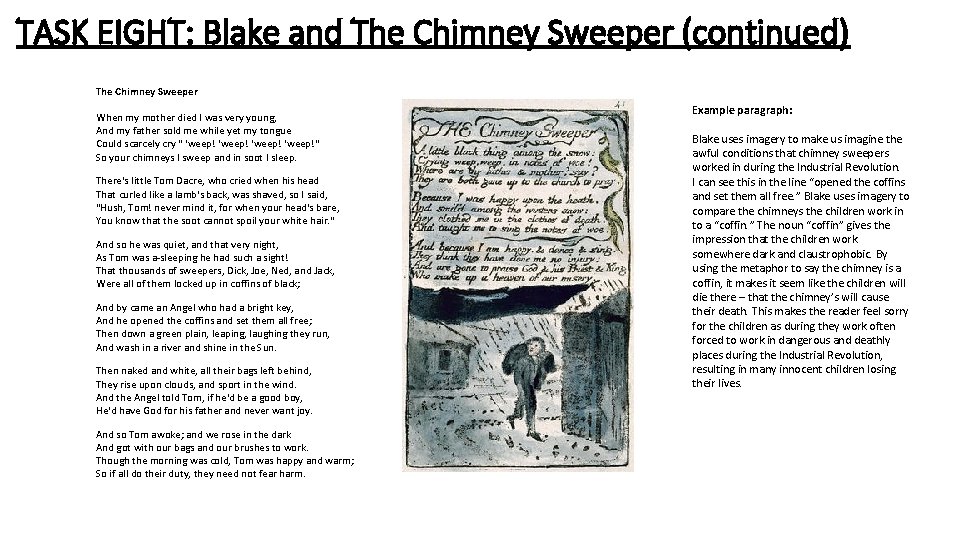
TASK EIGHT: Blake and The Chimney Sweeper (continued) The Chimney Sweeper When my mother died I was very young, And my father sold me while yet my tongue Could scarcely cry " 'weep!" So your chimneys I sweep and in soot I sleep. There's little Tom Dacre, who cried when his head That curled like a lamb's back, was shaved, so I said, "Hush, Tom! never mind it, for when your head's bare, You know that the soot cannot spoil your white hair. " And so he was quiet, and that very night, As Tom was a-sleeping he had such a sight! That thousands of sweepers, Dick, Joe, Ned, and Jack, Were all of them locked up in coffins of black; And by came an Angel who had a bright key, And he opened the coffins and set them all free; Then down a green plain, leaping, laughing they run, And wash in a river and shine in the Sun. Then naked and white, all their bags left behind, They rise upon clouds, and sport in the wind. And the Angel told Tom, if he'd be a good boy, He'd have God for his father and never want joy. And so Tom awoke; and we rose in the dark And got with our bags and our brushes to work. Though the morning was cold, Tom was happy and warm; So if all do their duty, they need not fear harm. Example paragraph: Blake uses imagery to make us imagine the awful conditions that chimney sweepers worked in during the Industrial Revolution. I can see this in the line “opened the coffins and set them all free. ” Blake uses imagery to compare the chimneys the children work in to a “coffin. ” The noun “coffin” gives the impression that the children work somewhere dark and claustrophobic. By using the metaphor to say the chimney is a coffin, it makes it seem like the children will die there – that the chimney’s will cause their death. This makes the reader feel sorry for the children as during they work often forced to work in dangerous and deathly places during the Industrial Revolution, resulting in many innocent children losing their lives.
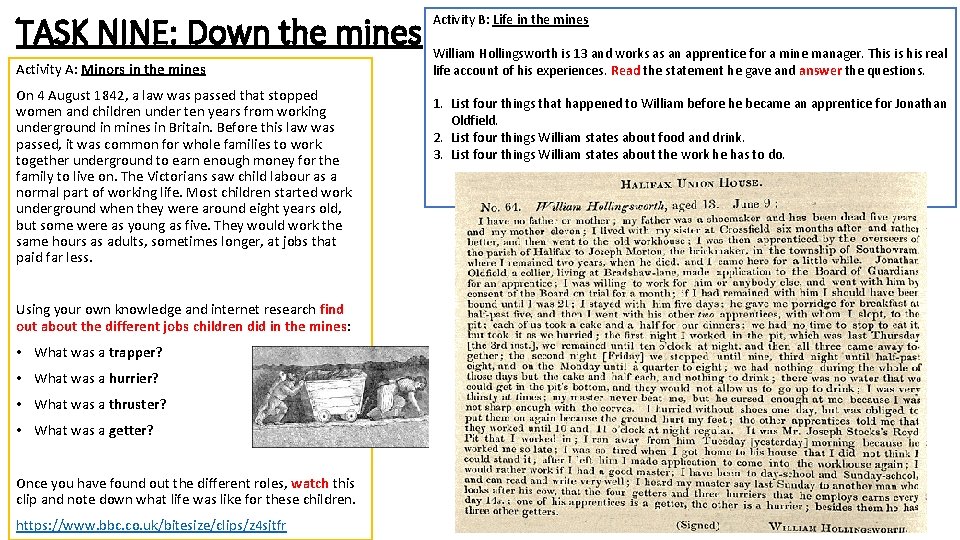
TASK NINE: Down the mines Activity A: Minors in the mines On 4 August 1842, a law was passed that stopped women and children under ten years from working underground in mines in Britain. Before this law was passed, it was common for whole families to work together underground to earn enough money for the family to live on. The Victorians saw child labour as a normal part of working life. Most children started work underground when they were around eight years old, but some were as young as five. They would work the same hours as adults, sometimes longer, at jobs that paid far less. Using your own knowledge and internet research find out about the different jobs children did in the mines: • What was a trapper? • What was a hurrier? • What was a thruster? • What was a getter? Once you have found out the different roles, watch this clip and note down what life was like for these children. https: //www. bbc. co. uk/bitesize/clips/z 4 sjtfr Activity B: Life in the mines William Hollingsworth is 13 and works as an apprentice for a mine manager. This is his real life account of his experiences. Read the statement he gave and answer the questions. 1. List four things that happened to William before he became an apprentice for Jonathan Oldfield. 2. List four things William states about food and drink. 3. List four things William states about the work he has to do.
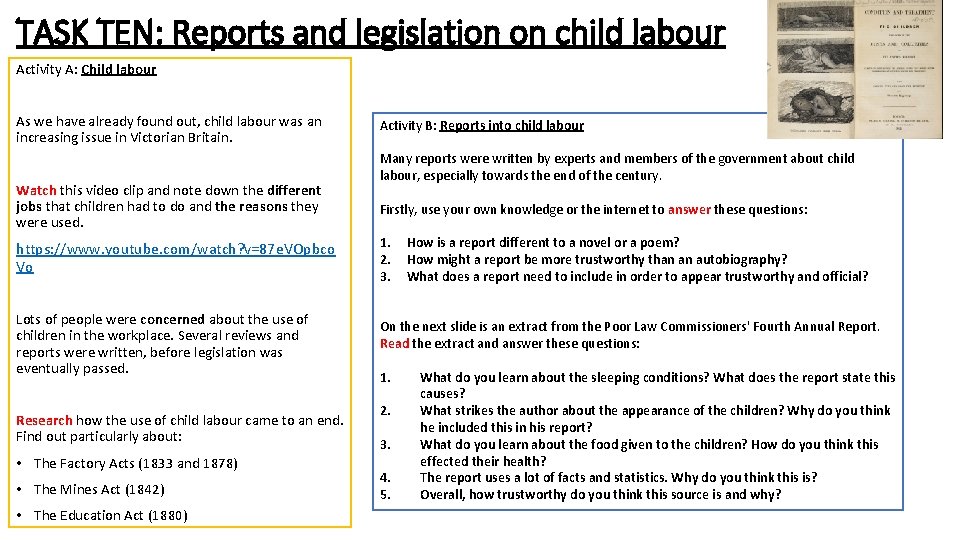
TASK TEN: Reports and legislation on child labour Activity A: Child labour As we have already found out, child labour was an increasing issue in Victorian Britain. Watch this video clip and note down the different jobs that children had to do and the reasons they were used. https: //www. youtube. com/watch? v=87 e. VOpbco Vo Lots of people were concerned about the use of children in the workplace. Several reviews and reports were written, before legislation was eventually passed. Research how the use of child labour came to an end. Find out particularly about: • The Factory Acts (1833 and 1878) • The Mines Act (1842) • The Education Act (1880) Activity B: Reports into child labour Many reports were written by experts and members of the government about child labour, especially towards the end of the century. Firstly, use your own knowledge or the internet to answer these questions: 1. 2. 3. How is a report different to a novel or a poem? How might a report be more trustworthy than an autobiography? What does a report need to include in order to appear trustworthy and official? On the next slide is an extract from the Poor Law Commissioners' Fourth Annual Report. Read the extract and answer these questions: 1. 2. 3. 4. 5. What do you learn about the sleeping conditions? What does the report state this causes? What strikes the author about the appearance of the children? Why do you think he included this in his report? What do you learn about the food given to the children? How do you think this effected their health? The report uses a lot of facts and statistics. Why do you think this is? Overall, how trustworthy do you think this source is and why?
TASK TEN: Reports and legislation on child labour (continued) The Poor Law Commissioners' Fourth Annual Report in 1838 recorded a visit by Dr Lawson to the Whitechapel workhouse who witnessed: In going over the Whitechapel workhouse I was struck with the statement of the fact, that, out of 104 children (girls) resident in thy house, 89 have recently been attacked with fever. On examining the dormitory in which these children sleep, my wonder ceased. In a room 88 feet long, 16½ feet wide, and 7 feet high, with a sloping root rising to 10 feet, all these 104 children, together with four women who have the charge of them, sleep. The beds are close to each other ; in the beds there are never less than four children, in many, five ; ventilation of the room is most imperfect. Under such circumstances in the breaking out of fever is inevitable. . I was likewise struck with the pale and unhealthy appearance of a number of children in the Whitechapel workhouse, in a room called the Infant Nursery. These children appear to be from two to three years of age ; they are 23 in number ; they all sleep in one room, and they seldom or never go out of this room, either for air or exercise. Several attempts have been made to send these infants into the country, but a majority of the Board of Guardians has hitherto succeeded in resisting the proposition. In the Whitechapel workhouse there are two fever-wards; in the lower ward the beds are much too close ; two fever patients are placed in each bed ; the ventilation is most imperfect ; and the room is so close as to be dangerous to all who enter it, as well as most injurious to the sick. In the upper fever-ward the beds are also much too close, but here the beds are single, and the ventilation is better. The privies in this workhouse are in a filthy state, and the place altogether is very imperfectly drained : there is not a single bath in the house. It is perhaps even worse to describe the practise of eating. Those who I observed were brought tubs of scraps. These were heaped high on a huge platter in an indescribable mess—pieces of bread, chunks of grease and fat pork, the burnt skin from the outside of roasted joints, bones, in short, all the leavings from the fingers and mouths of the sick ones suffering from all manner of diseases. Into this mess the men plunged their hands, digging, pawing, turning over, examining, rejecting, and scrambling for. It wasn't pretty. Pigs couldn't have done worse. But the poor devils were hungry, and they ate ravenously of the swill, and when they could eat no more they bundled what was left into their handkerchiefs and thrust it inside their shirts.
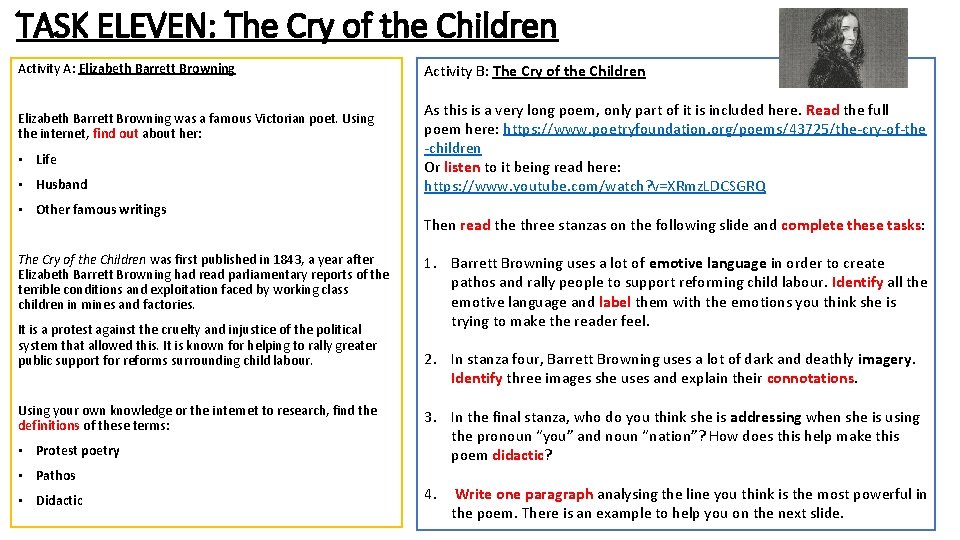
TASK ELEVEN: The Cry of the Children Activity A: Elizabeth Barrett Browning was a famous Victorian poet. Using the internet, find out about her: • Life • Husband • Other famous writings The Cry of the Children was first published in 1843, a year after Elizabeth Barrett Browning had read parliamentary reports of the terrible conditions and exploitation faced by working class children in mines and factories. It is a protest against the cruelty and injustice of the political system that allowed this. It is known for helping to rally greater public support for reforms surrounding child labour. Using your own knowledge or the internet to research, find the definitions of these terms: • Protest poetry • Pathos • Didactic Activity B: The Cry of the Children As this is a very long poem, only part of it is included here. Read the full poem here: https: //www. poetryfoundation. org/poems/43725/the-cry-of-the -children Or listen to it being read here: https: //www. youtube. com/watch? v=XRmz. LDCSGRQ Then read the three stanzas on the following slide and complete these tasks: 1. Barrett Browning uses a lot of emotive language in order to create pathos and rally people to support reforming child labour. Identify all the emotive language and label them with the emotions you think she is trying to make the reader feel. 2. In stanza four, Barrett Browning uses a lot of dark and deathly imagery. Identify three images she uses and explain their connotations. 3. In the final stanza, who do you think she is addressing when she is using the pronoun “you” and noun “nation”? How does this help make this poem didactic? 4. Write one paragraph analysing the line you think is the most powerful in the poem. There is an example to help you on the next slide.
TASK ELEVEN: The Cry of the Children (continued) Stanza one: Do ye hear the children weeping, O my brothers, Ere the sorrow comes with years? They are leaning their young heads against their mothers, And that cannot stop their tears. The young lambs are bleating in the meadows, The young birds are chirping in the nest, The young fawns are playing with the shadows, The young flowers are blowing toward the west - But the young, young children, O my brothers, They are weeping bitterly! They are weeping in the playtime of the others, In the country of the free. Final stanza: They look up, with their pale and sunken faces, And their look is dread to see, For they think you see their angels in their places, With eyes meant for Deity ; — "How long, " they say, "how long, O cruel nation, Will you stand, to move the world, on a child's heart, — Stifle down with a mailed heel its palpitation, And tread onward to your throne amid the mart ? Our blood splashes upward, O our tyrants, And your purple shews your path ; But the child's sob curseth deeper in the silence Than the strong man in his wrath !" Stanza four: "True, " say the children, "it may happen That we die before our time. Little Alice died last year -her grave is shapen Like a snowball, in the rime. We looked into the pit prepared to take her: Was no room for any work in the close clay! From the sleep wherein she lieth none will wake her, Crying `Get up, little Alice! it is day. ' If you listen by that grave, in sun and shower, With your ear down, little Alice never cries; Could we see her face, be sure we should not know her, For the smile has time for growing in her eyes: And merry go her moments, lulled and stilled in The shroud by the kirk-chime. It is good when it happens, " say the children, "That we die before our time. " Example paragraph: Barrett Browning’s poem gives a very strong message about the cruelty of child labour. I think the most powerful line stating this is “Do ye hear the children weeping, O my brothers, Ere the sorrow comes with years? ” The use of the rhetorical question makes the reader, especially those in government or positions of power, take note and feel guilty. She also uses the emotive sound of the children “weeping” to create pathos and make us pity the children.
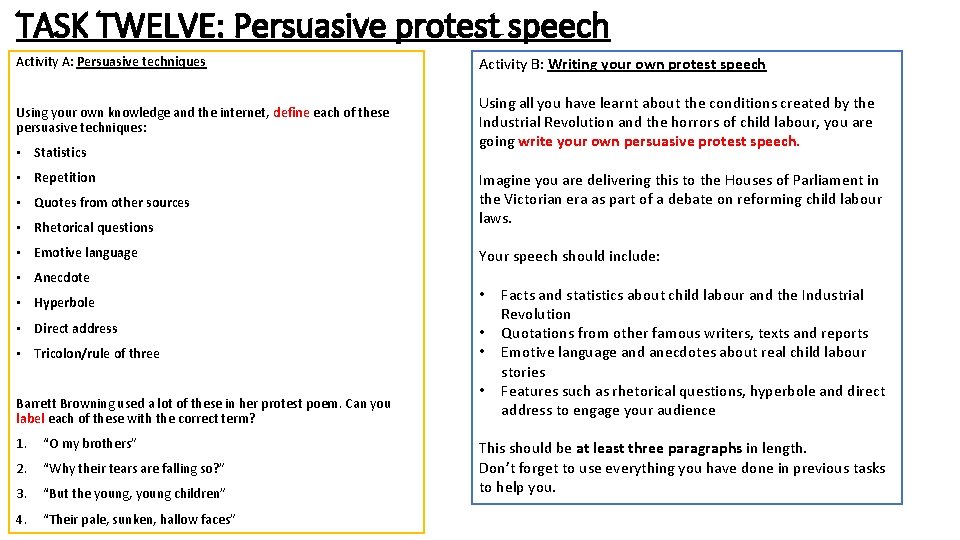
TASK TWELVE: Persuasive protest speech Activity A: Persuasive techniques Activity B: Writing your own protest speech Using your own knowledge and the internet, define each of these persuasive techniques: Using all you have learnt about the conditions created by the Industrial Revolution and the horrors of child labour, you are going write your own persuasive protest speech. • Statistics • Repetition • Quotes from other sources • Rhetorical questions • Emotive language • Anecdote • Hyperbole • Direct address • Tricolon/rule of three Barrett Browning used a lot of these in her protest poem. Can you label each of these with the correct term? 1. “O my brothers” 2. “Why their tears are falling so? ” 3. “But the young, young children” 4. “Their pale, sunken, hallow faces” Imagine you are delivering this to the Houses of Parliament in the Victorian era as part of a debate on reforming child labour laws. Your speech should include: • • Facts and statistics about child labour and the Industrial Revolution Quotations from other famous writers, texts and reports Emotive language and anecdotes about real child labour stories Features such as rhetorical questions, hyperbole and direct address to engage your audience This should be at least three paragraphs in length. Don’t forget to use everything you have done in previous tasks to help you.