
Year 8 Geography Knowledge Organisers Year 8 2019

- Slides: 4
Year 8 Geography Knowledge Organisers Year 8 – 2019 Summer Exam • Development • Natural Hazards • Coasts
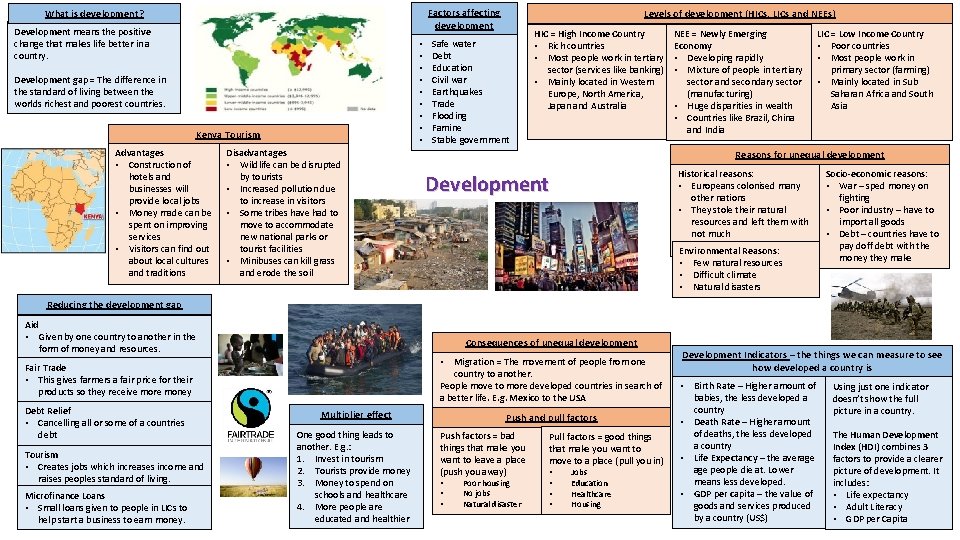
Factors affecting development What is development? Development means the positive change that makes life better in a country. • • • Development gap = The difference in the standard of living between the worlds richest and poorest countries. Kenya Tourism Advantages • Construction of hotels and businesses will provide local jobs • Money made can be spent on improving services • Visitors can find out about local cultures and traditions Disadvantages • Wildlife can be disrupted by tourists • Increased pollution due to increase in visitors • Some tribes have had to move to accommodate new national parks or tourist facilities • Minibuses can kill grass and erode the soil Levels of development (HICs, LICs and NEEs) Safe water Debt Education Civil war Earthquakes Trade Flooding Famine Stable government HIC = High Income Country • Rich countries • Most people work in tertiary sector (services like banking) • Mainly located in Western Europe, North America, Japan and Australia NEE = Newly Emerging Economy • Developing rapidly • Mixture of people in tertiary sector and secondary sector (manufacturing) • Huge disparities in wealth • Countries like Brazil, China and India LIC = Low Income Country • Poor countries • Most people work in primary sector (farming) • Mainly located in Sub Saharan Africa and South Asia Reasons for unequal development Historical reasons: • Europeans colonised many other nations • They stole their natural resources and left them with not much Development Environmental Reasons: • Few natural resources • Difficult climate • Natural disasters Socio-economic reasons: • War – sped money on fighting • Poor industry – have to import all goods • Debt – countries have to pay doff debt with the money they make Reducing the development gap Aid • Given by one country to another in the form of money and resources. Consequences of unequal development • Migration = The movement of people from one country to another. People move to more developed countries in search of a better life. E. g. Mexico to the USA Fair Trade • This gives farmers a fair price for their products so they receive more money Debt Relief • Cancelling all or some of a countries debt Tourism • Creates jobs which increases income and raises peoples standard of living. Microfinance Loans • Small loans given to people in LICs to help start a business to earn money. Multiplier effect One good thing leads to another. E. g. : 1. Invest in tourism 2. Tourists provide money 3. Money to spend on schools and healthcare 4. More people are educated and healthier Push and pull factors Push factors = bad things that make you want to leave a place (push you away) • • • Poor housing No jobs Natural disaster Pull factors = good things that make you want to move to a place (pull you in) • • Jobs Education Healthcare Housing Development Indicators – the things we can measure to see how developed a country is • Birth Rate – Higher amount of babies, the less developed a country • Death Rate – Higher amount of deaths, the less developed a country • Life Expectancy – the average people die at. Lower means less developed. • GDP per capita – the value of goods and services produced by a country (US$) Using just one indicator doesn’t show the full picture in a country. The Human Development Index (HDI) combines 3 factors to provide a clearer picture of development. It includes: • Life expectancy • Adult Literacy • GDP per Capita
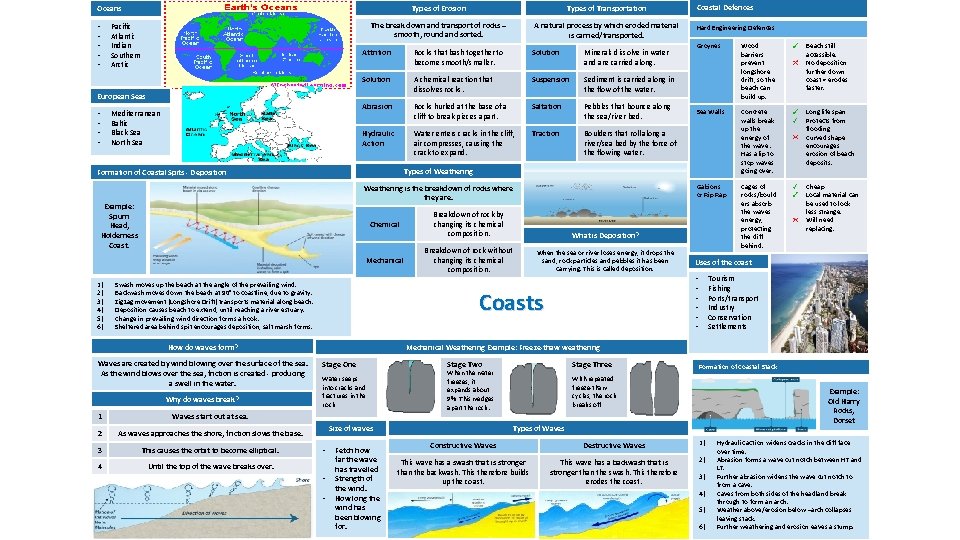
Types of Erosion Types of Transportation The break down and transport of rocks – smooth, round and sorted. A natural process by which eroded material is carried/transported. Oceans • • • Pacific Atlantic Indian Southern Arctic Attrition Rocks that bash together to become smooth/smaller. Solution Minerals dissolve in water and are carried along. Solution A chemical reaction that dissolves rocks. Suspension Sediment is carried along in the flow of the water. Abrasion Rocks hurled at the base of a cliff to break pieces apart. Saltation Pebbles that bounce along the sea/river bed. Hydraulic Action Water enters cracks in the cliff, air compresses, causing the crack to expand. Traction Boulders that roll along a river/sea bed by the force of the flowing water. European Seas • • Mediterranean Baltic Black Sea North Sea Weathering is the breakdown of rocks where they are. Example: Spurn Head, Holderness Coast. Chemical Mechanical Swash moves up the beach at the angle of the prevailing wind. Backwash moves down the beach at 90° to coastline, due to gravity. Zigzag movement (Longshore Drift) transports material along beach. Deposition causes beach to extend, until reaching a river estuary. Change in prevailing wind direction forms a hook. Sheltered area behind spit encourages deposition, salt marsh forms. Why do waves break? 1 Waves start out at sea. 2 As waves approaches the shore, friction slows the base. 3 This causes the orbit to become elliptical. 4 Until the top of the wave breaks over. Breakdown of rock by changing its chemical composition. What is Deposition? Breakdown of rock without changing its chemical composition. When the sea or river loses energy, it drops the sand, rock particles and pebbles it has been carrying. This is called deposition. Groynes Wood barriers prevent longshore drift, so the beach can build up. Beach still accessible. No deposition further down coast = erodes faster. Sea Walls Concrete walls break up the energy of the wave. Has a lip to stop waves going over. Long life span Protects from flooding Curved shape encourages erosion of beach deposits. Gabions or Rip Rap Cages of rocks/bould ers absorb the waves energy, protecting the cliff behind. Cheap Local material can be used to look less strange. Will need replacing. Uses of the coast • • • Coasts How do waves form? Waves are created by wind blowing over the surface of the sea. As the wind blows over the sea, friction is created - producing a swell in the water. Hard Engineering Defences Types of Weathering Formation of Coastal Spits - Deposition 1) 2) 3) 4) 5) 6) Coastal Defences Tourism Fishing Ports/transport Industry Conservation Settlements Mechanical Weathering Example: Freeze-thaw weathering Stage One Water seeps into cracks and fractures in the rock. Stage Two Size of waves • • • Fetch how far the wave has travelled Strength of the wind. How long the wind has been blowing for. Stage Three When the water freezes, it expands about 9%. This wedges apart the rock. Formation of Coastal Stack With repeated freeze-thaw cycles, the rock breaks off. Example: Old Harry Rocks, Dorset Types of Waves Constructive Waves Destructive Waves 1) This wave has a swash that is stronger than the backwash. This therefore builds up the coast. This wave has a backwash that is stronger than the swash. This therefore erodes the coast. 2) 3) 4) 5) 6) Hydraulic action widens cracks in the cliff face over time. Abrasion forms a wave cut notch between HT and LT. Further abrasion widens the wave cut notch to from a cave. Caves from both sides of the headland break through to form an arch. Weather above/erosion below –arch collapses leaving stack. Further weathering and erosion eaves a stump.
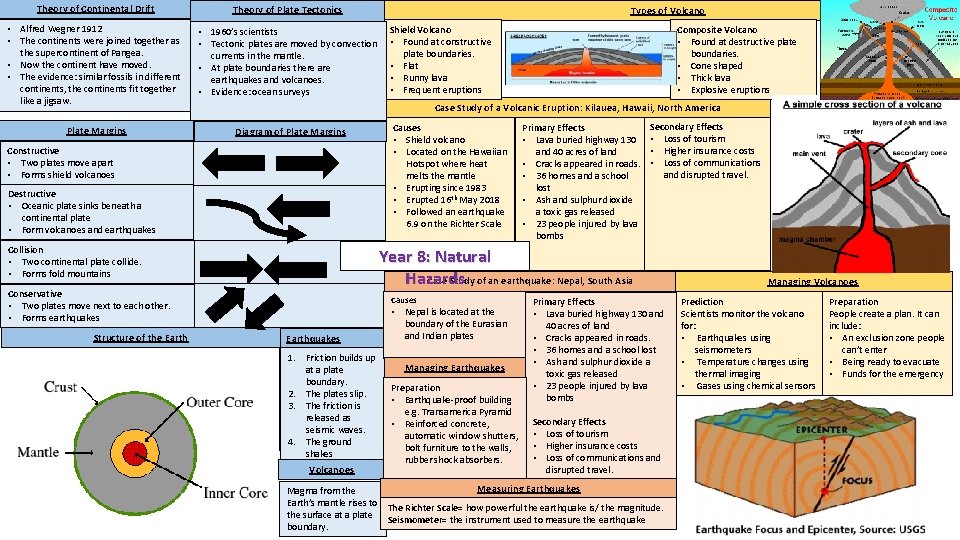
Theory of Continental Drift Theory of Plate Tectonics • Alfred Wegner 1912 • The continents were joined together as the supercontinent of Pangea. • Now the continent have moved. • The evidence: similar fossils in different continents, the continents fit together like a jigsaw. • 1960’s scientists • Tectonic plates are moved by convection currents in the mantle. • At plate boundaries there are earthquakes and volcanoes. • Evidence: ocean surveys Plate Margins Composite Volcano • Found at destructive plate boundaries. • Cone shaped • Thick lava • Explosive eruptions Shield Volcano • Found at constructive plate boundaries. • Flat • Runny lava • Frequent eruptions Case Study of a Volcanic Eruption: Kilauea, Hawaii, North America Diagram of Plate Margins Constructive • Two plates move apart • Forms shield volcanoes Destructive • Oceanic plate sinks beneath a continental plate • Form volcanoes and earthquakes Collision • Two continental plate collide. • Forms fold mountains Causes • Shield volcano • Located on the Hawaiian Hotspot where heat melts the mantle • Erupting since 1983 • Erupted 16 th May 2018 • Followed an earthquake 6. 9 on the Richter Scale Primary Effects • Lava buried highway 130 and 40 acres of land • Cracks appeared in roads. • 36 homes and a school lost • Ash and sulphur dioxide a toxic gas released • 23 people injured by lava bombs Secondary Effects • Loss of tourism • Higher insurance costs • Loss of communications and disrupted travel. Year 8: Natural Hazards Case Study of an earthquake: Nepal, South Asia Conservative • Two plates move next to each other. • Forms earthquakes Structure of the Earth Types of Volcano Causes Earthquakes • Loss of tourism 1. Friction builds up • Higher insurance at a plate costs boundary. • 2. Loss Theof plates slip. communications 3. The friction is and disrupted released as travel. seismic waves. 4. The ground shakes Volcanoes • Nepal is located at the boundary of the Eurasian and Indian plates Managing Earthquakes Preparation • Earthquake-proof building e. g. Transamerica Pyramid • Reinforced concrete, automatic window shutters, bolt furniture to the walls, rubber shock absorbers. Primary Effects • Lava buried highway 130 and 40 acres of land • Cracks appeared in roads. • 36 homes and a school lost • Ash and sulphur dioxide a toxic gas released • 23 people injured by lava bombs Secondary Effects • Loss of tourism • Higher insurance costs • Loss of communications and disrupted travel. Measuring Earthquakes Magma from the Earth’s mantle rises to The Richter Scale= how powerful the earthquake is/ the magnitude. the surface at a plate Seismometer= the instrument used to measure the earthquake boundary. Managing Volcanoes Prediction Scientists monitor the volcano for: • Earthquakes using seismometers • Temperature changes using thermal imaging • Gases using chemical sensors Preparation People create a plan. It can include: • An exclusion zone people can’t enter • Being ready to evacuate • Funds for the emergency